


As airport commercial ecosystems grow more complex, food & beverage has quietly become one of the most powerful forces shaping passenger experience, non-aeronautical revenue and terminal identity.
Yet it remains one of the most under-strategised disciplines in the industry, contends Michiel Reuvers, Associate Partner – Business Development at Conceptional*, who shares his perspective here on what is driving the transformation of airport F&B, and why intuition alone is no longer enough.
What makes airport F&B fundamentally different from any other hospitality environment?
Airports are unique and vibrant marketplaces, offering a rare opportunity to reach very large volumes of potential customers. But that opportunity comes with a context unlike anything in commercial hospitality.
Passengers are not primarily there to eat; they are there to travel. Their emotional state shifts constantly – from the stress of check-in to the relief of clearing security to the anticipation or fatigue of the gate. Airport F&B operates entirely within that emotional landscape.
The captive audience dynamic changes everything. Once passengers pass through security, they cannot simply leave and choose another option. This shifts range and variety expectations, price perception, and how decisions are made. But it also raises the stakes on quality and experience: in a captive environment, a poor offer is inescapable. Travellers remember it.

They also travel as very different personalities – business versus leisure, solo versus family – each with distinct needs. The best operators design for these moments, prioritising clarity over choice and speed over spectacle.
Operationally, airports are among the most demanding environments in the world for F&B. Space is scarce. Infrastructure – power, extraction, back-of-house – is often limited. Staffing, logistics, long opening hours and complex regulatory frameworks all add layers of difficulty that the high street simply does not face.
Concession agreements typically involve variable rents underpinned by minimum guarantees: a model that works well when volumes are strong but becomes a structural burden the moment they fall.

How has the role of F&B evolved – and where are the most significant shifts happening today?
Over the past decade, F&B has shifted from functional necessity to a core pillar of the airport experience. Traditional retail and duty free have come under sustained pressure; food & beverage continues to grow as both a revenue driver and an emotional anchor.
Three forces are driving this evolution. First, changing consumer values: health, sustainability, provenance and transparency now actively shape purchasing decisions.
Second, technology: digital ordering, delivery models and increasingly AI are redefining convenience and the pace of service expectations.

Third, experience-led formats are blurring traditional categories entirely.
The formats themselves are changing just as fast. The traditional sit-down restaurant – long the default anchor for airport F&B – is giving way to more agile, hybrid models better suited to how people actually move through terminals.
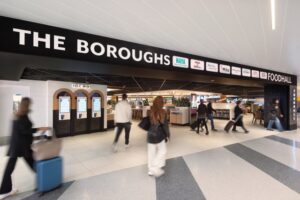
Food halls and multi-operator market concepts are gaining significant ground, offering variety under one roof while creating a far stronger sense of place. Grab-and-go has matured well beyond the sandwich in plastic packaging: it now encompasses chef-driven, freshly prepared ranges that rival high street delis in quality and presentation.
We are also seeing the rise of what I would call purposeful formats – concepts built around a specific traveller moment rather than a cuisine category. A concept designed for the 25-minute pre-gate window operates very differently from one anchored in a long-haul lounge environment or a landside family zone. Format must serve the moment, not the other way around.

On the food trend side, the direction is clear: health, provenance and cultural authenticity are no longer niche demands – they are mainstream expectations. Plant-forward menus, locally sourced ingredients and transparent supply chains are increasingly table stakes.
Equally significant is the rise of global comfort food: passengers are drawn to familiar flavours from unfamiliar places – Korean fried chicken, Japanese convenience-store-inspired concepts, Middle Eastern mezze formats – offered with the speed and accessibility of fast casual. The airports that recognise these shifts early and translate them into their concept mix will be significantly better positioned, both experientially and commercially.
How are passenger profiles changing, and what does that mean for F&B planning?
The most important shift is not within any single generation – it is the growing irrelevance of the single passenger profile altogether. The same person behaves very differently on a Monday business trip compared to a Friday holiday flight, or when travelling alone versus with a family.
Younger travellers – Millennials and Gen Z – arrive with expectations that are fundamentally different from those of previous generations. They seek speed and convenience, healthier and more diverse options, strong design and brand identity, and seamless digital experiences. For them, airport F&B is not purely functional; it is part of the journey, and often a form of self-expression.

Business travellers continue to value efficiency and predictability, but the bar has risen sharply: barista-quality coffee, fresh food and calm, well-considered spaces are now baseline expectations, not differentiators. Families and leisure travellers are more experience-driven – they value clarity, flexibility and offers that work across age groups.
Designing F&B through this dual lens – who people are and why they are travelling – is becoming essential to deliver relevance, satisfaction and long-term value. Airports that continue to plan against a single generalised passenger profile will consistently miss the mark.
What are the most common mistakes airports still make in F&B planning?
F&B is still too often planned as an afterthought. Space is frequently allocated as a fixed percentage of total GLA rather than being shaped by real passenger behaviour, volumes and dwell times. The result is predictable: over- or under-capacity, queues in the wrong places, and underperforming units that fail on both operational and experiential grounds.
A second persistent assumption is that more brands or more locations automatically lead to better performance. In reality, a strong F&B portfolio is not about quantity – it is about coherence and diversity. Copy-pasting concepts without a clear logic or a defined role within the passenger journey rarely delivers sustainable results.

Finally, visibility and infrastructure remain critical unresolved challenges. F&B is sometimes still placed in low-footfall locations lacking proper utilities, extraction or back-of-house capacity. These constraints make efficient operations and high-quality execution extremely difficult, regardless of brand strength.
These are often rooted in legacy layouts and operational realities – but they also represent a significant opportunity. Addressed early, with the right strategic expertise, they become drivers of performance rather than permanent limitations.
F&B does not exist in isolation in a terminal. How should airports think about its alignment with retail and lounges?
This is one of the most important – and most under-appreciated – questions in airport commercial strategy. F&B, retail and lounges are too often planned in silos: managed by different teams, governed by separate agreements and optimised individually rather than as a connected commercial ecosystem. That fragmentation is increasingly at odds with how passengers actually experience a terminal.
From a commercial standpoint, the relationship between F&B and retail is genuinely symbiotic. Well-placed dining and coffee concepts slow passengers down, extend dwell time and create the conditions for retail conversion.

A strong retail environment, in turn, draws footfall that benefits adjacent F&B operators. When leasing strategies are developed in alignment – considering adjacencies, anchor concepts and the overall commercial rhythm of the terminal – the portfolio performs better as a whole than the sum of its individual parts. This has direct implications for non-aeronautical revenue, which remains under significant pressure across the industry.

From an experience standpoint, the alignment between F&B, retail and lounges is what gives a terminal its sense of coherence and identity. Lounges – whether operated by airlines or as pay-in concepts – set a quality benchmark that influences passenger expectations across the entire commercial offer.
When lounge standards rise, the bar rises for the wider concession mix. Equally, a well-curated food hall or a distinctive local F&B concept can anchor a terminal’s sense of place in a way that generic retail rarely achieves.
The practical implication is clear: F&B strategy must never be developed in isolation. It needs to be co-created alongside retail and lounge planning, with a shared understanding of passenger flows, dwell patterns, and the overall commercial and experiential ambition of the terminal. The airports that plan holistically are the ones that create destinations – not just departure halls.
Why is a formal F&B strategy and masterplan so critical – and what does that look like in practice?
Without strategy, every decision becomes tactical. And tactical decisions rarely create long-term value. A solid F&B strategy and masterplan creates a clear sense of place and experience, turns terminals into meaningful destinations, ensures the offer truly reflects passenger needs, optimises capacity and flow, attracts the right operators and brands, and maximises sustainable non-aeronautical revenue. In short, it protects both experience and income.
At Conceptional, we begin with a fundamental shift in mindset: moving from business cases to value cases. Rather than asking ‘Which brands can we fill this space with?’, we first ask ‘Which traveller moments do we want to serve, and what value should this create for passengers, operators and the airport?’
This means starting with people and context – not square metres. We map the existing F&B ecosystem, analyse performance and study passenger flows, dwell times and pinch points across the journey. From there, we define traveller profiles, needs and expectations – both today and in the years ahead – and translate these insights into a clear vision and strategic pillars for F&B.
On this foundation, we develop an integrated masterplan covering spatial planning, capacity and mix, concept logic, leasing strategy, and financial modelling – always aligned with the airport’s broader retail and lounge strategy, not designed alongside it as an afterthought. The result is a coherent portfolio rather than a collection of standalone units.
A key part of our role is connecting stakeholders. We act as a bridge between landlords, operators and brands – aligning interests, supporting brand selection based on genuine fit, and ensuring that infrastructure, operations, and guest experience work together in practice.
The masterplan can then be strengthened through specialised layers: embedding sustainability via our Sustainable Food Route, as at Schiphol Airport; delivering concept development for specific locations and traveller profiles, as at Brussels Airport; or supporting F&B tenders across multiple airports in the EMEA region.
What is your message to airport leaders as they plan the next phase of their commercial offer?
Place the traveller at the heart of every decision – and involve professionals who truly understand food & beverage: not only how to design beautiful spaces, but how to operate them successfully, and how to connect them to the wider commercial ecosystem of the terminal.
Rather than simply planning spaces, airports must plan purpose, content and adaptability. F&B is no longer about filling units or maximising short-term concession revenue. When approached strategically – and in genuine alignment with retail and lounge strategy – it becomes a catalyst for experience, placemaking and long-term commercial performance.
The terminals that will define the next decade are not the ones with the most brands. They are the ones where F&B, retail and lounges work together to make passengers feel that where they are matters – before they even board.
*About Conceptional
Conceptional is an international advisory firm specialising in F&B masterplanning, concept strategy and commercial placemaking across airports, theme parks, hotels and restaurant brands.
With more than 400 projects in 27 countries, the firm partners with airport authorities, operators and developers across EMEA to deliver F&B strategies that are both commercially robust and experientially distinctive.
Conceptional advises airport operators internationally on long-term F&B masterplanning, working with hubs including Amsterdam Schiphol, Aeropuertos Argentina, Brussels Airport, and Eindhoven Airport, among others across EMEA.
For collaborations or F&B strategy enquiries, reach out to: michiel@conceptional.nl