


 INDIA/INTERNATIONAL. While the omnichannel revolution occurring in the airport duty free and specialty retail space grabs most of the headlines, a similar – and potentially more rewarding – revolution is happening in the food & beverage (F&B) space, writes Ivo Favotto, Founder & CEO of The Mercurius Group*.
The mobile food ordering market is a growing element of the overall airport F&B market as more and more food service operators and airports turn to App-based and web-based food ordering solutions to complement their physical outlets.
The trend towards mobile food ordering at airports had its genesis a decade or so ago at airports in North America where independent concessionaire OTG pioneered mobile food ordering by placing iPads connected to F&B outlets in gate lounges and other high dwell areas. The technology has evolved over time and now tends to be centred around App-based or web-based ordering.
The number of service providers offering mobile food ordering has also grown with companies such as Servy, Grab, Uber Eats and Mr Yum increasingly forging additional partnerships with airport F&B operators or indeed with airports themselves.
More recently, a new player has stepped into the market, declaring its intentions to capture its share of the airport mobile food ordering market – Compass Group-owned, Bengaluru, India-based SmartQ.
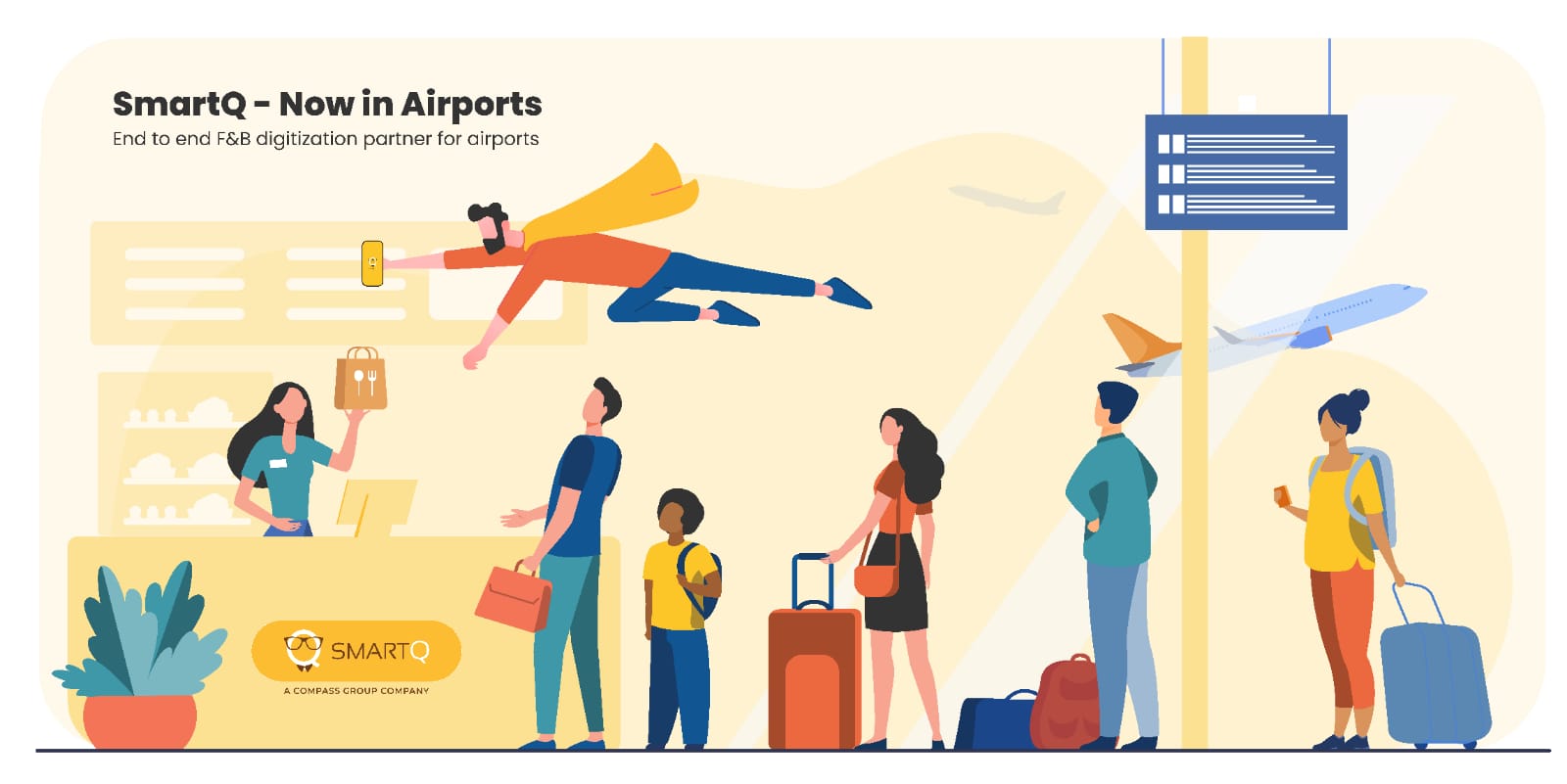
The company claims that mobile food ordering offers multiple benefits, including:
- Better customer convenience – customers can order ahead and from anywhere in the journey through the airport, thus saving time;
- Lower operating costs – the ability to order online reduces staff numbers and the capacity pressure on cash tills;
- Less time spent in queues – F&B customers no longer have to line up to order, freeing up valuable dwell time for other purposes (including more shopping);
- Higher operator sales – mobile food ordering can enhance F&B penetration and increase average transaction values;
- Higher airport rents – more sales typically mean more rent for airports given most airport F&B concessions have a percentage rent structure;
- Greater F&B capacity – the ability to effectively turn every public seat in a terminal into an F&B seat means that F&B turnover is not limited to the spend of people who can sit in an outlet.
Additionally, COVID-19 has added contactless interactions to this list of benefits in an increasingly contact-conscious environment.

These benefits have seen the uptake of mobile food ordering grow despite the added cost of introducing another party in between the F&B operator and the customer.
But the way in which the current participants in the mobile food ordering market operate can differ markedly. In some airports, mobile ordering players have forged partnerships with individual F&B operators, while at other locations, airports have selected a partner that links all outlets.
The next evolution of this market may be the suite of services and benefits being offered by new entrant, SmartQ. Part of the global F&B giant Compass Group, SmartQ is an end-to-end F&B tech provider for airports, which has been forged off-airport in corporate environments (e.g. major banks such as Goldman Sachs), in the event space (e.g. Dubai Formula 1), universities (e.g. Oxford University in the UK) and food courts in Stadiums (Forsyth Barr Stadium in Otago, New Zealand).
SmartQ offers airports a comprehensive product that can seamlessly sit across all F&B operators in a terminal and offer additional benefits such as:
- Integrating with each F&B outlets Point-of-Sale system which allows ordering and paying from multiple outlets and mixing and matching orders;
- Incorporating a customer feedback/product review system into the process;
- Being able to incorporate airport led promotions;
- Being able to bundle F&B offers with other airport functions (e.g., car parking);
- Including a digital wallet to which customers can add money to use inside the airport. This functionality can also be used for airline delay vouchers, significantly improving the efficiency of this process.
The most obvious benefits of the SmartQ approach for airports are visibility of sales through the App and the data analytics capability this brings to airport decision-making on a range of topics including outlet mix planning, outlet offer planning, pricing, operating hours and service times.

According to SmartQ VP of Sales Ashwin N, the SmartQ system’s key benefit is that in addition to selling more F&B with greater efficiency, it also helps airports manage their terminals more efficiently, potentially reducing operating and capital costs.
“Our system with its full POS integration with all F&B operators within a terminal gives airports previously unheard-of visibility into what customers are ordering, when and how much they are paying. This transparency gives them much more operating and planning flexibility,” he notes.
“SmartQ sees a scenario where every seat in a terminal is an F&B seat, whether the offer is a pick-up in-store model or a deliver to seat model. By scanning a QR code into the SmartQ App, they will get to see the menu/offer of every F&B provider, order and pay seamlessly. The marketing benefits of such an App, particularly when teamed with our feedback, loyalty and digital wallet features makes SmartQ an exciting prospect for airports and makes things much simpler for consumers,” Ashwin notes.
According to the Airport Commercial Revenues Study 2019 published jointly by The Moodie Davitt Report and The Mercurius Group, F&B is becoming an increasingly important part of airport commercial revenue programmes, accounting for almost 25% of all airport income from in-terminal retail activities, up from less than 10% 20 years ago.
The continued evolution of the mobile ordering market by SmartQ as well as existing and new players to come, will continue to propel this growth.
Note: The Moodie Davitt Report is about to relaunch FAB, its popular airport & travel related food & beverage e-Newsletter. To subscribe free of charge please email Sinead@MoodieDavittReport.com headed ‘Complimentary FAB Subscription’. For advertising and sponsorship details please email FAB Publisher Sarah Genest at Sarah@MoodieDavittReport.com
*Note (2): The Mercurius Group, in partnership with The Moodie Davitt Report, has released the inaugural edition of the Airport Food & Beverage Study (AFABS).
The AFABS 2021 edition focuses on the Australian and New Zealand airport F&B markets, covering all 27 airports in Australia and New Zealand with annual passenger volumes exceeding 0.5 million.
The AFABS 2021 also features The Mercurius Group’s Top 12 F&B Operators League Table. These particular operators are responsible for 75% of the outlets within the region.
Other key features of AFABS Australia and New Zealand include:
- An estimate of overall airport F&B sales in the Australian and New Zealand market
- F&B PSRs by country, terminal type and airport size;
- F&B PSRs by outlet type, outlet location and operator size;
- The number and type of F&B outlets in the market;
- A ranking of the Top 12 F&B operators by sales and a profile of their outlet portfolio; and
- A profile of the F&B programme for each airport (and for each terminal where applicable)Other special features of the publication include a commentary on:- How airports build an F&B programme; and
– The potential for F&B operator consolidation (mergers and acquisition activity) in the Australian and New Zealand airport F&B market.To purchase a copy please contact The Mercurius Group:Tel: +61 423 564 057;
Email: ifavotto@themercuriusgroup.com;
Website: www.themercuriusgroup.com