



INTERNATIONAL. Airline passenger demand in July (measured in revenue passenger kilometres or RPKs) climbed by +8% year-on-year, according to latest International Air Transport Association (IATA) data.
The global aviation trade body, which represents 330 airlines, noted a marked increase in international passenger during the month, reflecting signs that most markets are resuming their long-term growth trajectories following the post-pandemic recovery.

Capacity in July climbed +10.5% compared to the same month last year, while load factor declined to 85.9% (-0.3ppt).

IATA did not see any significant negative impact on travel demand from the CrowdStrike IT outage on 19 July which disrupted the global aviation sector.
Domestic air passenger traffic saw a year-on-year improvement in July, rising +4.8%. Capacity increased +2.8% and the load factor reached 86.1% percentage points, up +1.7ppt.
IATA Director General Willie Walsh said: “July was another positive month. In fact, passenger demand hit an all-time high for the industry and in all regions except Africa, despite significant disruption caused by the CrowdStrike IT outage.
“The winding down of the peak northern summer season is a reminder of how much people depend on flying. As the mix of travellers shift from leisure to business, aviation’s many roles are evident—reuniting families, enabling exploration and powering commerce.
“People need and want to fly. And they are doing that in great numbers. Load factors are at the practicable maximum. But persistent supply chain bottlenecks have made deploying the capacity to meet the need to travel more challenging.
“As much of the world returns from vacation, there is an urgent call for manufacturers and suppliers to resolve their supply chain issues so that air travel remains accessible and affordable to all those who rely on it.”
International passenger market performance by region
All international passenger markets reported notable year-on-year growth in July, with Asia Pacific outperforming others.
Demand continued to grow strongly in the region, up +19.1%. Capacity rose by +20.3%, and the load factor stood at 83.8%, down by -0.8 percentage points compared to the same month of the previous year. Most Asian routes are still below pre-pandemic 2019 levels, except for those connecting Asia and the Middle East.

Demand for European carriers grew +8.3% year-on-year in July. Capacity increased +8.1%, and the load factor reached 87.5%, up +0.2 percentage points. Among key international routes, Europe-Asia posted the fastest growth, but has yet to surpass 2019 levels.
Middle Eastern airlines saw a +5.8% increase in demand in July compared to the same month last year. Capacity was up +5.5%, and the load factor stood at 84.1%, a +0.3 percentage point year-on-year rise.
In North America, air travel demand in July grew +5.3% year-on-year. Capacity was up +6.3% and the load factor was 89.4% (down -0.8 percentage points from the same month in 2023), the highest across all regions.
Latin American airlines saw a +13.4% year-on-year growth in demand. Capacity jumped +15.7%, and the load factor stood at 87.5%, down -1.7 percentage points year-on-year. Despite the disruptions caused by Hurricane Beryl in the Caribbean, Gulf of Mexico and southern United States, it had minimal impact on regional demand, IATA noted.
African airlines saw a +7.4% increase in demand in July compared to the same month in 2023. Capacity grew +6.7% year-on-year, and the load factor improved to 74.3%, up +0.5 percentage points.
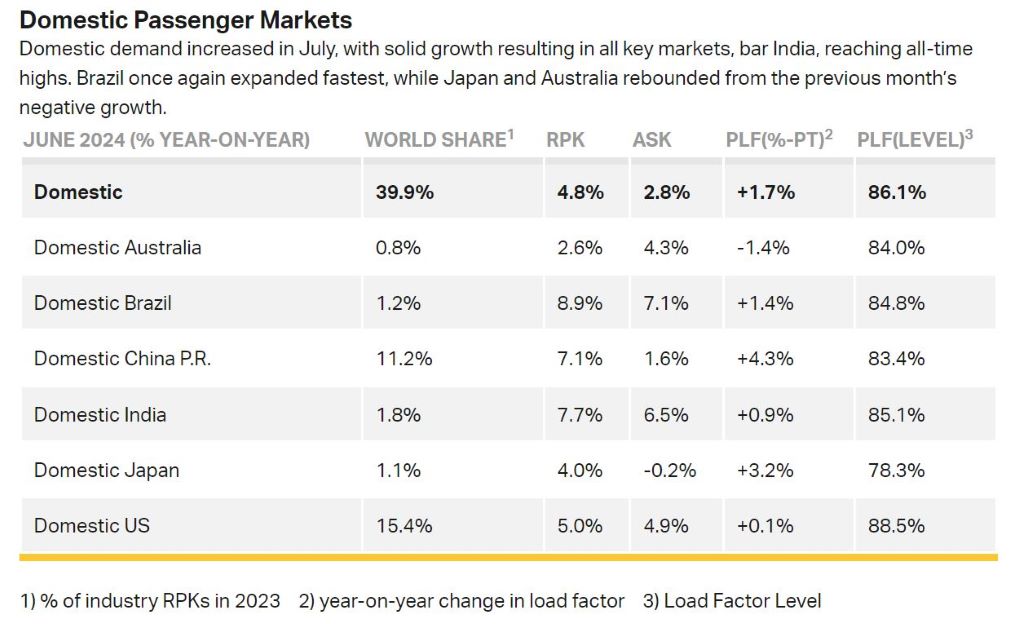
Domestic demand in July rose sharply, driving all key markets, except India, to new record levels. Brazil was the fastest-growing market, while Japan and Australia recovered from the negative growth of the previous month. ✈