The HMRC view “Airside shops in airports can apply a zero VAT rate to goods bought by passengers intending to take them to non-EU destinations. The retailer must retain suitable evidence of the passenger’s destination such as by scanning the boarding card. “HMRC cannot comment on the commercial pricing policies of individual retailers.” Background • Exports are zero rated subject to evidence that the goods have left the EU. By concession, airside retailers are treated as exporters and may zero rate sales of goods to passengers intending to take them to destinations outside of the EU. In such cases a boarding pass for a non EU flight is accepted as evidence that the goods will leave the EU. • Many airside retailers have sophisticated till systems which allow them to scan boarding passes and the till system will identify if a particular flight is to an EU or non-EU destination and thereby record it as either a standard rated domestic sale or a zero rated export. • The original concession was introduced in the early 1990s and, following the withdrawal of duty free sales for intra-EU passengers in 1999, was amended to apply to goods exported by passengers travelling to non-EU destinations only. • Sales in duty-free shops are tightly controlled as they can hold goods where the duty or VAT has been suspended. To ensure sufficient controls are in place, HMRC require duty-free outlets to provide evidence of destination for all goods sold. • There is nothing in VAT law to require the production of a boarding pass to purchase goods in non-duty-free airport shops, but without such evidence the supply cannot be zero-rated as an export. • Catering services at the airport are subject to VAT. |
UK. The UK Chancellor of the Exchequer George Osborne today launched a review into airport sales to ensure that VAT savings are being properly passed on to shoppers.
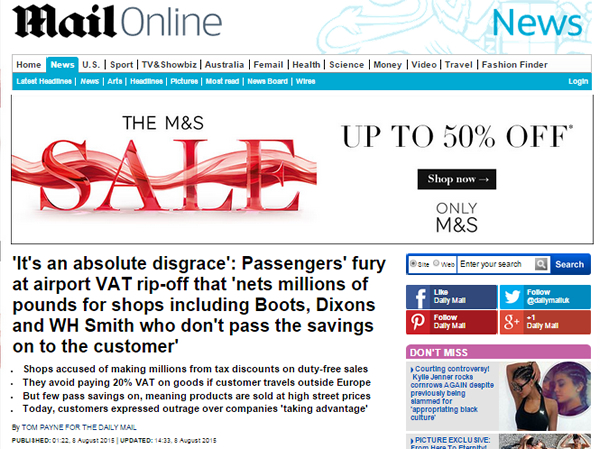
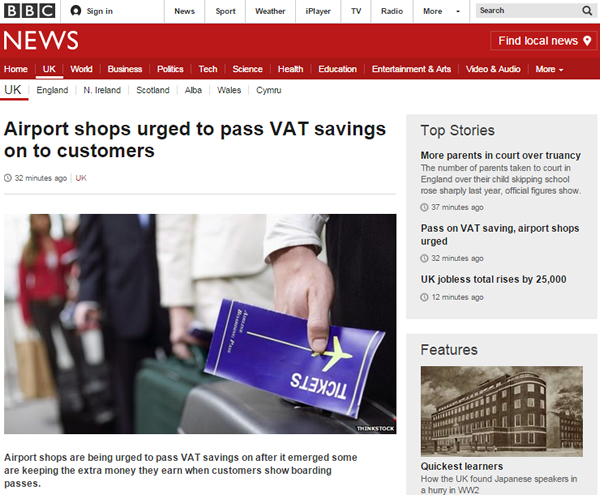
The review follows a media furore in August after UK tabloid newspaper The Sun investigated the retailer practice of demanding passengers’ boarding cards when they made a purchase. The newspaper claimed that the demand was a “profit-boosting ruse”.
The newspaper correctly pointed out that if a traveller is flying to a destination within the European Union, airport retailers must pass on to the British Government the 20% VAT they receive on every item purchased. If that traveller is leaving the EU, however, the 20% remains with the retailer.
What those retailers then do with that saving was at the nub of the controversy – and of the government review.
In a statement the Chancellor confirmed that the “extensive review” will make sure that VAT relief in airports is leading to savings for shoppers, as it is intended to do.
Currently, the statement claimed, some airside retailers are keeping up to an estimated 50p of every £1 of potential VAT savings instead of passing those savings on to shoppers.
The Chancellor has tasked HMRC to review airside VAT-free shopping to ensure that shoppers share more of the benefit in future. The review is expected to be completed by early 2016 and will also cover all other airside shopping taxes.
Osborne said: “For families flying out of the UK for a winter-getaway, airports should be the ideal place to pick-up a bargain.
“VAT relief at airports is intended to cut prices for those travellers – not be a windfall gain for shops. But many people could be paying over the odds for their purchases because the Government’s VAT concession isn’t passed on.
“This is simply unacceptable. I have launched a review to make sure that this VAT relief benefits those it’s intended for – consumers – whatever time of the year they are travelling.”
The review will consider ways to ensure prices reflect VAT savings as well as savings on duty.
The UK Travel Retail Form (UKTRF) today issued a statement in response to the Chancellor’s announcement. It said: “Shopping has become a much-loved part of travelling through UK airports, which lead the world in offering choice and value to passengers.
“We welcome the opportunity to show HMRC the value that we offer to consumers and to demonstrate how airport retail generates vital revenue to underpin and sustain the success of British airports.
“UKTRF welcomes the opportunity to contribute to the review and to clarify with HMRC how the rules on VAT on sales to travellers are applied.”
COMMENT AND BACKGROUND: The UK Travel Retail Form is exactly right to welcome this review rather than fear it. So much of the original reporting on the supposed great airport ‘rip-off’ was erroneous that this official investigation represents an ideal opportunity to clarify legalities, Customs requirements and business practices. The industry is not whiter than white, and its public relations effort at the time of the furore was inadequate, but it is a properly run sector as the following content shows.
Earlier this year The Moodie Report produced a detailed analysis in simple Q&A format of the facts vs the hype over the alleged “˜Airport shopping rip-off’. Where does the truth lie? On the eve of the government’s review, we think it worthwhile to publish it again below [note – the answers relate to retailer practices on boarding cards at the time of original publication].
Q: What is a UK airport retailer’s legal obligation in relation to VAT?
A: Airport retailers must pass on to the Government the 20% VAT they receive on every item bought in store by intra-European Union travellers. If that traveller is leaving the European Union, however, they do not have to.
Q: Then in non-EU travellers’ cases what happens to the 20% VAT saving?
A: In almost all cases, UK airport retailers pass on the saving to the consumer.
Q: “˜Almost all’ – who are the exceptions?
A: Boots, WHSmith and Dixons Travel – the companies at the heart of the current media storm – do not. At Heathrow Airport, luxury goods brands Hermès, Louis Vuitton and Rolex are also only offering the saving to non-EU passengers.
Q: Sounds unfair. How do these retailers justify not passing on the saving they are making?
HMRC specifically requires duty free retailers to check customers’ boarding passes. Passengers must show their boarding passes when buying all products from a duty free retailer… not just liquor and tobacco. |
A: Each of them benchmarks their pricing against the High Street – and in Dixon Travel’s case against competitive online rivals. It guarantees in fact that its airport prices are less than the web prices of Amazon, John Lewis and Argos – and offers to pay double the difference if a shopper finds an item cheaper on those sites. Dixons said it is reviewing its policy and will from now make it clear to customers that the offering of a boarding card is not mandatory.
Boots is also reviewing its policy. It claims to offer all its customers (High Street or airport) “the same great value” and therefore currently has a single pricing structure, including the same promotions and rewards. It’s worth mentioning too that VAT rates vary significantly on items Boots sells from a zero rating to full UK VAT.
WHSmith said: “Any relief obtained is reflected in our single price and extensive promotional offers provided to all of our customers.”
 |
 |
Q: That’s not an entirely convincing defence. Any mitigating factors?
A: Dixons Travel offers a very good price guarantee. And again it’s important to note that a large proportion of sales in WHSmith and Boots actually come from goods that are exempt from VAT – for example, books, magazines, newspapers, certain sandwiches, biscuits, pharmacy /healthcare products etc.
 |
Q: Is it a legal requirement for stores to demand boarding cards at the point of sale?
A: It depends on the store involved. In a UK “˜duty free’ store (see below for definition), it certainly is. Categorically. There have been instances in the past few days of physical abuse of World Duty Free staff by consumers who have been asked for their boarding cards. The staff were, in fact, legitimately applying the law.
Q: So what’s the difference between a duty free retailer – such as World Duty Free – and, say, Boots or WHSmith?
A: Different rules apply. HMRC specifically requires duty free retailers to check customers’ boarding passes. Passengers must show their boarding passes when buying all products from a duty free retailer.
Q: All products? Not just alcohol and tobacco?
A: All products. HMRC confirmed the fact to us last week, saying: “Sales in duty free shops are tightly controlled as they can hold goods where the duty or VAT has been suspended. To ensure sufficient controls are in place, HMRC require duty free outlets to provide evidence of destination for all goods sold.”
To be clear, any “˜duty free retailer’ such as World Duty Free, The Nuance Group and Aelia operating at any UK airport MUST ask for passengers’ boarding cards at the point of sale.
Q: But a lot of the newspaper articles refer to “˜duty free rip-off’ etc. So not all airport shops are “˜duty free’ then?
A: Absolutely not. Duty free is an item sold free of excise duty, customs duty and VAT, such as whisky, vodka and cigarettes. By the way, since 1999 UK airport retailers can only sell duty free goods to passengers headed outside the EU.
“˜Tax Free’ refers to items sold prior to the addition of VAT (Value Added Tax). As mentioned, if the passenger is flying outside the EU no tax is applicable to HM Revenue & Customs (HMRC). If the passenger is flying within the UK or EU the VAT will be accounted to HMRC by the retailer. Because the VAT is fully accounted for, there are no limits to the amount that can be purchased (for personal use) by those passengers flying within the UK or EU.
Typical categories which are sold at tax free prices include: fashion and footwear, fragrance, skincare, cosmetics, sunglasses, watches, jewellery and handbags.
Such retailers bring all their products into their shops “˜duty and tax suspended’, i.e. out of bond. The tax is then accounted for to the HMRC through the reading of the boarding cards. Unlike, say, WHSmith, which is bringing its goods into the airport on a duty/tax paid basis and using the boarding cards to claim back the VAT on non-EU passengers’ purchases.
Q: But not passing it on to the customer?
A: Correct. And there lies the heart of the current furore.
Q: Is World Duty Free passing the saving on?
A: Yes.
Q: So World Duty Free – or for that matter any other UK airport duty free retailer – has done nothing wrong? Either in not passing on the tax and duty saving, or in asking for boarding passes?
A: Correct.
Q: What happens when World Duty Free sells, say a bottle of Scotch or perfume to an EU-bound passenger?
A: World Duty Free benchmarks its prices against the UK High Street. For EU passengers, products are discounted by at least the equivalent of VAT (this is funded by World Duty Free) and any applicable VAT on the purchase is still accounted for to HMRC.
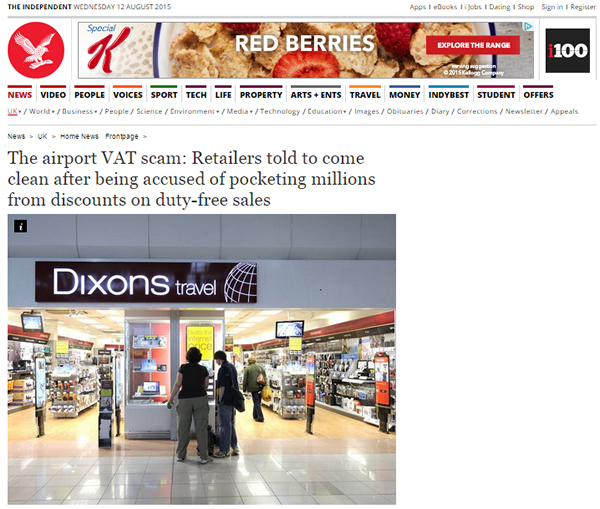 |
The Independent claimed, incorrectly, that “the majority of” airport retailers were using boarding pass scans to reclaim VAT |
Q: Sounds complex.
A: Not really. For non-EU passengers, it’s simple – no excise duty, customs duty or VAT is paid by the shopper. In UK airports almost all dutiable goods are sold at the same price wherever the traveller is headed – EU or non-EU. In the former case, World Duty Free for example, would simply absorb the VAT.
If the retailer is passing on the VAT saving to the intra-EU passenger, yes they are perfectly within their rights to ask for boarding cards |
Q: Ok let’s go back to the demand for boarding cards. You’ve answered the duty free retailing question – what about other non-duty free airport stores?
A: That answer’s complex, sorry. If the retailer is passing on the VAT saving to the intra-EU passenger, yes they are perfectly within their rights to ask for boarding cards. In order to pay the correct VAT in their tax return to HMRC they must be able to demonstrate the correct amount of VAT due – by showing who is going to the EU and who is going outside the EU.
The only way they can do that is through the boarding card. So while no law specifically states that a passenger must show his or her boarding card, if every passenger were to refuse an airport retailer could not provide an accurate tax return to HMRC.
It’s simple really. Retailers must be able to prove that a sale is non-EU (to HMRC). If they can’t prove it, they would theoretically have to charge the EU passenger the High Street price.
Q: What’s the tax-free/VAT-free saving by the way? 20% as reported in the newspapers?
A: No. The VAT rate of 20% is added to the base price (so if the base price is, say, £20, £4 VAT is added), thus making VAT 16.66% of the final price, not 20% as indicated in all the newspaper reports.
Q: So, to repeat, this furore relates to three main retailers – Boots, Dixons Travel and WHSmith?
A: Mainly, yes. Plus the luxury retailers I mentioned at Heathrow.
Q: So what happens with, say, a High Street favourite such as Harrods, at, say, Heathrow or Gatwick Airport?
A: With the vast majority of retailers (and certainly Harrods), the passenger gets charged the High Street price minus the VAT discount, wherever they are headed, EU or non-EU.
VAT is actually paid by those retailers on all the purchases that are made by travellers headed for EU destinations. However it’s not charged on to the passenger, it’s funded by the retailer as a discount instead. If the passenger is headed for a non-EU destination, they don’t pay VAT on it and neither does the retailer.
Q: So let’s be clear – with the majority of retailers, wherever you are travelling, you get the VAT discount?
A: Correct. They’re all offering the VAT saving, even though (like WHSmith, Boots and Dixons) they don’t technically have to.
Q: So could you argue that most airport retailers are actually offering airport shoppers a bonus that they don’t have to?
A: You could – it depends on how you spin the story.
In today’s retail market, any retailer simply has to be competitive. Being in a so-called “˜captive market’ such as airport is no protection. Consumers vote with their feet – and their wallets. |
Q: So is airport retailing a “˜rip-off’ or not?
A: It’s generally fair value and in the majority of cases (particularly if you’re travelling intra-EU) actually good value. But like all things in life it’s complex and often a matter of perception. The state of High Street and internet discounting means that you’ll always be able to find some products cheaper outside duty free or tax free. That doesn’t necessarily make airport shopping a “˜rip-off’.
In today’s retail market, any retailer simply has to be competitive. Being in a so-called “˜captive market’ such as an airport is no protection. Consumers vote with their feet – and their wallets.
Yes airport retailers have significant cost burdens compared with their High Street equivalents – long opening hours, high operating costs and so on – but that doesn’t tend to wash with the consumer and certainly not with the press.
Each and every airport retailer must be mindful of the value they offer and this furore is a welcome reminder of that. It will be interesting to see how Boots, Dixons Travel and WHSmith structure their policies in the future.
Q: Rights or wrongs aside, it still seems like a public relations disaster for the airports and retailers concerned?
A: Well it isn’t good. But the reality, as you can see, is rather more complex. That complexity needs to be understood before becoming over-excited about terms such as “˜rip-off’. It’s pretty important to know what terms such as “˜duty free’ and “˜tax free’ actually mean, for example and some national newspapers don’t know the difference.