

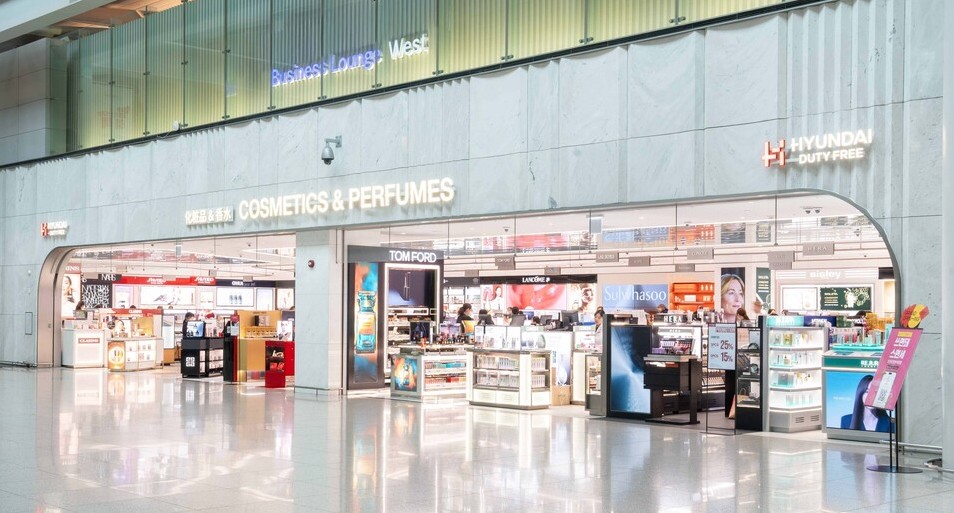
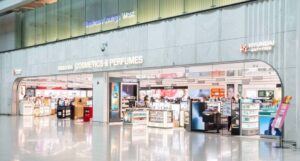
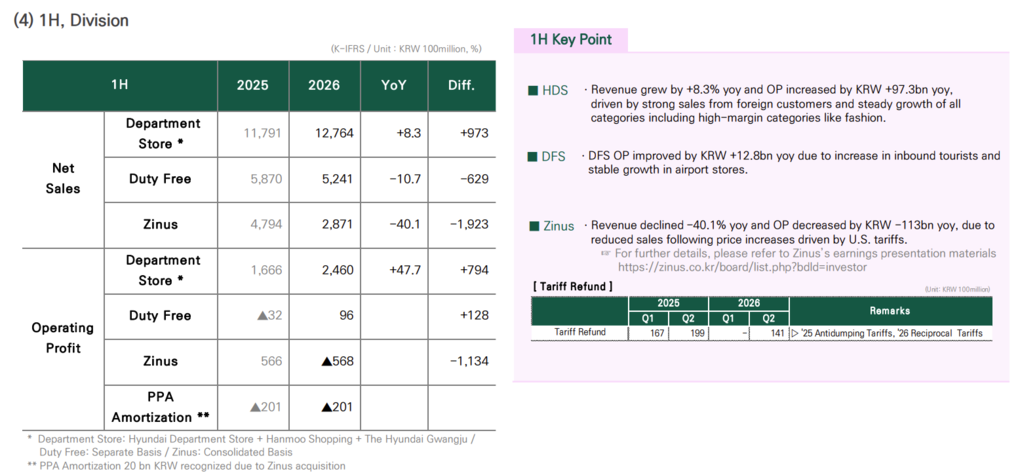
SOUTH KOREA. Hyundai Duty Free’s operating profit improved by KRW12.8 billion (US$9.3 million) year-on-year to KRW9.6 billion (US$6.95 million) in the first half ended 30 June.
The sharp move into positive territory came despite a -10.7% year-on-year decline in sales to KRW521.4 billion (US$379.4 million).
Parent company Hyundai Department Store attributed the operating profit improvement to an increase in inbound tourists and stable growth across the retailer’s airport stores.
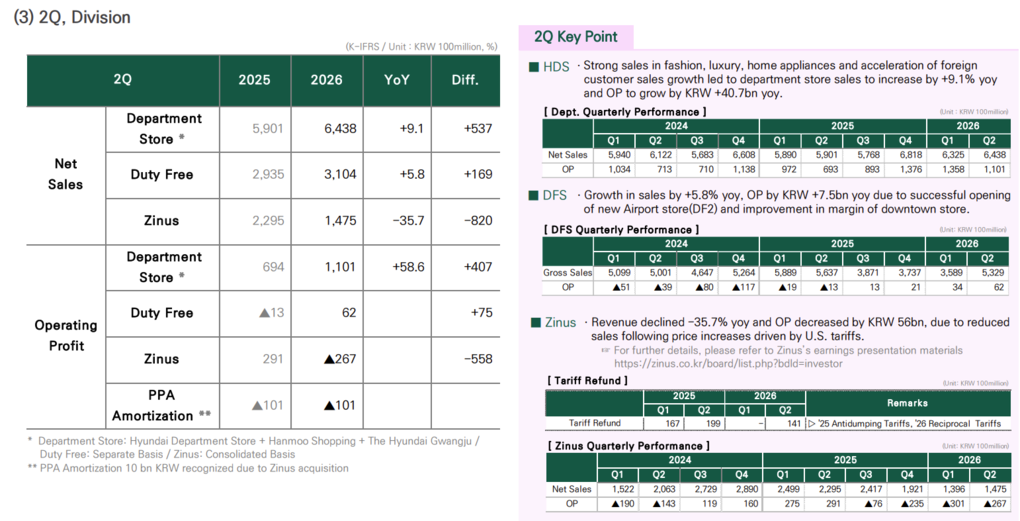
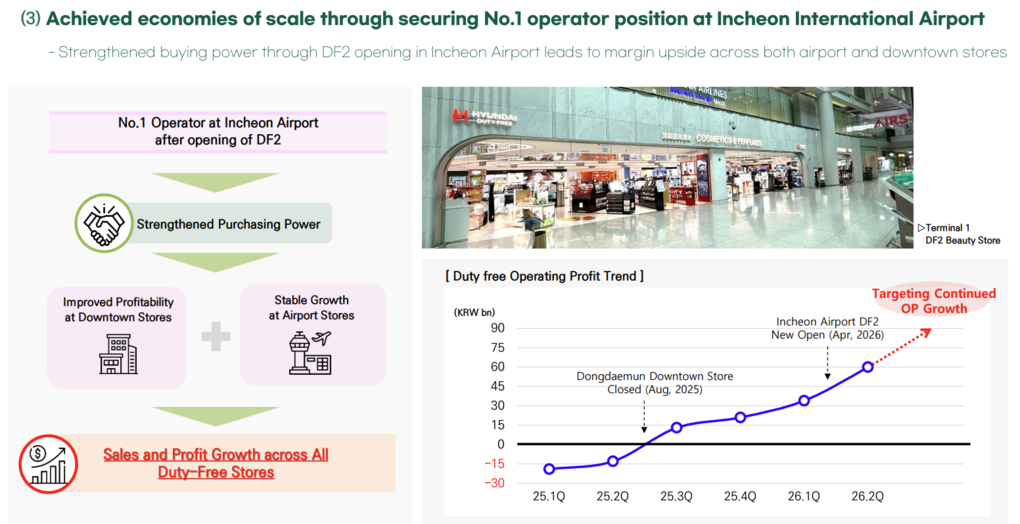
For the second quarter, Hyundai Duty Free posted a +5.8% rise in sales to KRW310.4 billion (US$224.5 million). Operating profit reached KRW6.2 billion (US$4.5 million), an improvement of KRW7.5 billion (US$5.4 million) over last year’s KRW1.3 billion (US$94,000) deficit.
The Q2 result was driven by the opening of Hyundai Duty Free’s new DF2 concession at Incheon International Airport on 28 April and an improvement in the retailer’s downtown duty-free margin.
Department store sales to foreigners boom
Arguably the real talking point of the results came, however, with the department store side of the group’s business. H1 revenue grew +8.3% year-on-year to a record KRW1.28 trillion (US$926.5 million) while operating profit surged +47.7% to KRW246 billion (US$178.1 million).
The results were driven by strong sales from foreign customers – reflecting a sustained domestic market retail trend – and steady growth across all categories, including high-margin sectors such as fashion.
Similar dynamics were at play in Q2 (sales up +9.1% to KRW643.8 billion/US$465.9 million – an all-time high for the quarter – with operating profit ahead by a whopping +58.6% to KRW110.1 billion/US$79.7 million).
This stellar showing was spurred by an acceleration of foreign shopper numbers allied to robust growth in fashion, luxury and home appliances sales.
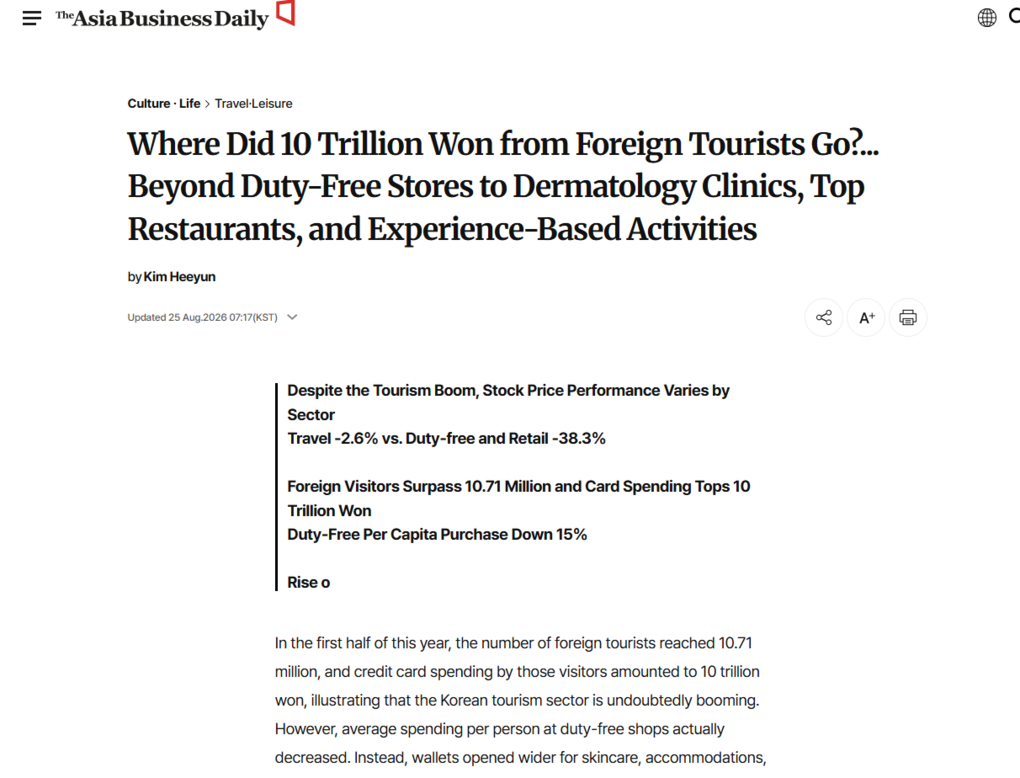
Informed sources tell The Moodie Davitt Report that the department store sector is regularly outpointing its duty-free equivalent in luxury sales to foreign shoppers. The Republic welcomed a record 10.7 million overseas visitors in the first half, according to the Ministry of Culture, Sports and Tourism.
Foreign visitors’ card spending also reached a record high, according to Korea JoongAng Daily, which reported that overseas visitors spent KRW1.04 trillion (US$753 million) by card during the first half, up +50.8% year-on-year – the highest total since the government began compiling such data in 2018.
The report noted foreign shoppers now account for almost 20% of sales at The Hyundai Seoul and the company’s Trade Center Store branch in Gangnam, Seoul, where foreign customer sales leapt +134% and +131% year-on-year, respectively.
“The weak Won, driven by the strong Dollar, has made shopping in Korea relatively more affordable [for foreign visitors], which led to an unprecedented boom,” a department store industry source told the title.
And in a telling insight into the shifting dynamics of visitor shopping, Lee Eun-hee, a Professor of Consumer Studies at Inha University, commented to Korea JoongAng Daily: “Department stores have steadily strengthened their offerings, such as K-culture-themed pop-up stores and curated product selections.
“Even if exchange rates stabilise, the department store boom is likely to continue for quite some time. The luxury image associated with department stores will also spill over into industries such as K-beauty and K-fashion, further boosting global confidence in Korean products.”
The Asia Business Daily said the highest growth rate in terms of H1 visitor spending by sector was in experiences and leisure at +121.7%, followed by medical services (+75.3%), food & beverage (+58.1%), transportation (+56.5%), and accommodation (+36.1%).
Shopping increased by +31.4% but department stores and specialist shops were the major beneficiary. “Conversely, duty-free shops have shown completely different signals,” the report said.
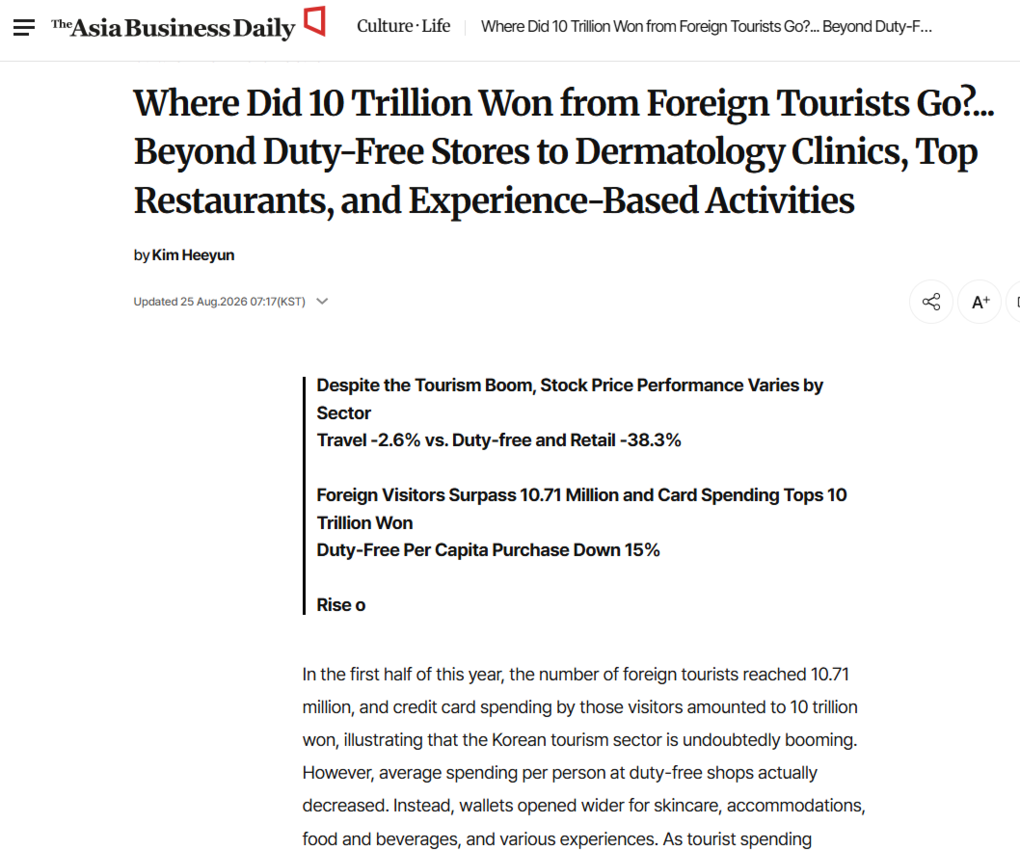
“In June, the number of foreigners using domestic duty-free shops reached 1,279,206, up +31.9% year-on-year. Sales from foreign customers grew +11.6% to KRW917.6 billion (US$665.3 million).
“However, the pace of customer growth outstripped that of sales, resulting in a -15.4% drop in per-person purchases among foreigners to approximately KRW717,000 (US$520) per person. Click here for latest South Korean duty-free monthly results.
“This appears to be due to a weakening in high-volume purchases previously dominant at duty-free shops, coinciding with a diversification of purchase locations among independent travellers.” ✈