

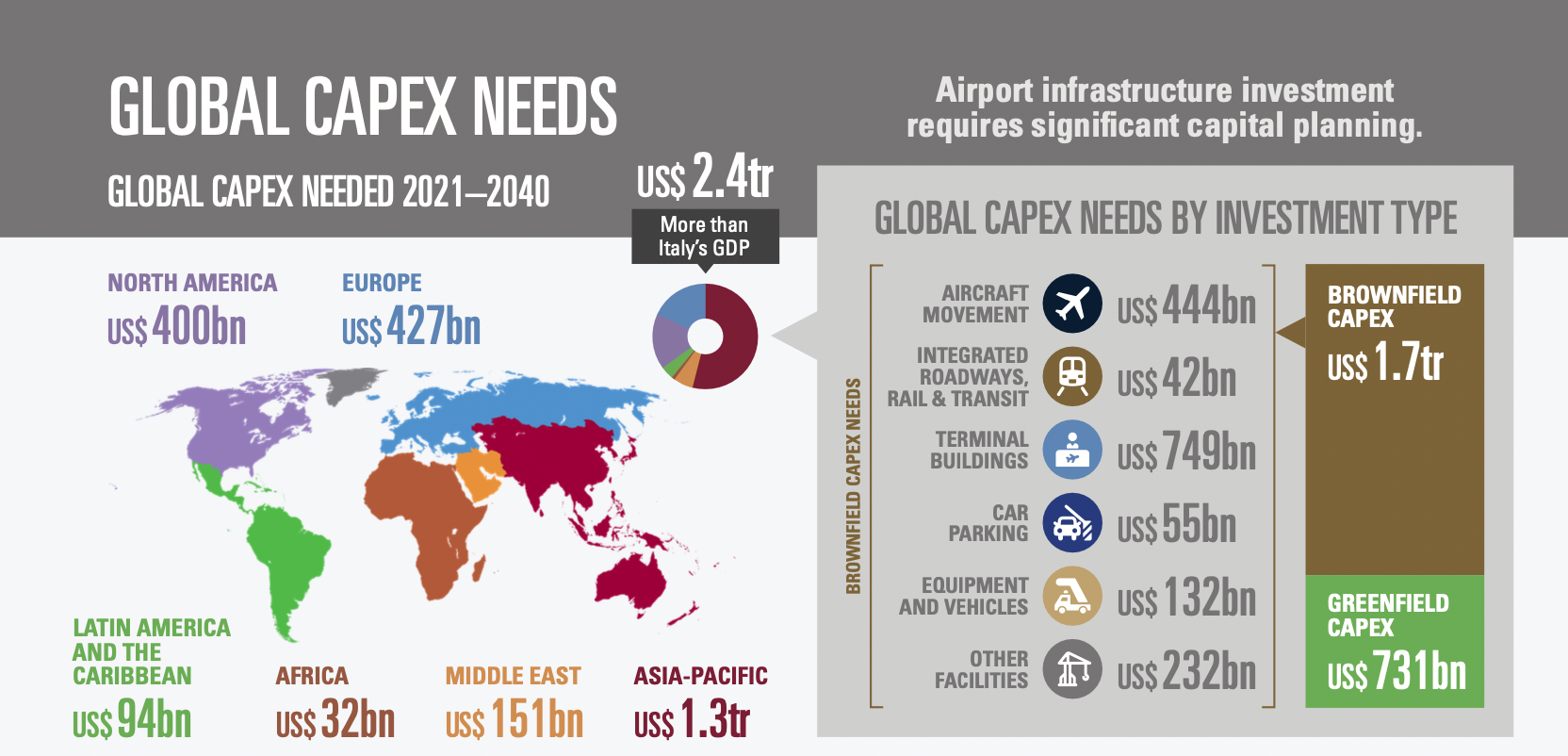
INTERNATIONAL. Airports Council International (ACI) World’s latest forecasts for the global airport sector show that around US$2.4 trillion in capital investments will be needed to address the long-term trend in passenger demand to 2040.
The Global Outlook of Airport Capital Expenditure – Meeting Sustainable Development Goals and Future Air Travel Demand, published today, shows that significant investment in new greenfield airports, as well as to expand and maintain existing airport infrastructure, is required. The study was supported by Hamad International Airport and developed in collaboration with Oxford Economics.
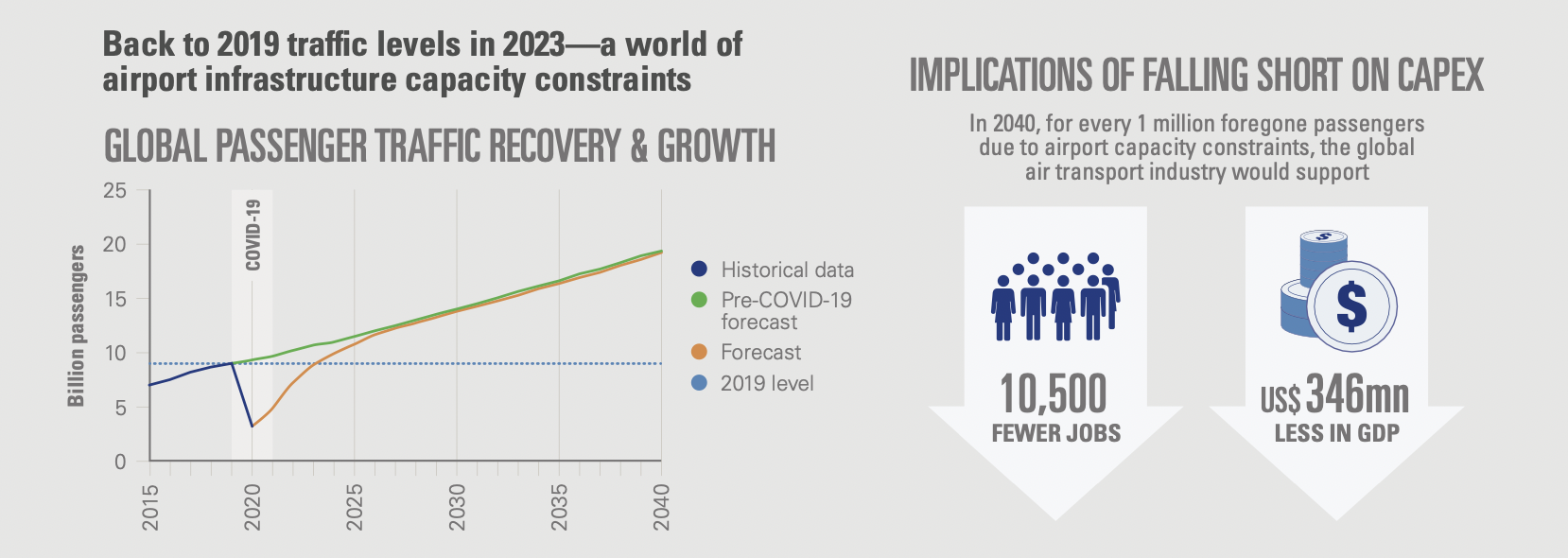
The estimated decline in capital expenditure between the pre-COVID-19 baseline year of 2019 and the depth of the global COVID-19 lockdown (2020) is -33% or about US$28 billion.
While capital investment partial recovery to about 14% (around US$12 billion) below 2019 baseline is expected in 2021, ACI World said that as air transport demand recovers to pre-pandemic levels, passenger demand will put increased pressure on airports’ infrastructure. It said that failure to invest and address capacity needs will have major socio-economic consequences.
If longer term capacity constraints are not addressed through capital investment, ACI World estimated a reduction of up to 5.1 billion passengers globally by 2040. For every million passengers airports cannot accommodate due to airport capacity constraints in 2040, 10,500 fewer jobs and US$346 million less in Gross Domestic Product would be the result, it warned.
“Airport infrastructure is key to the continued development of air transport which supports millions of jobs and provides social and economic development for the global communities we serve,” ACI World Director General Luis Felipe de Oliveira said.
“Beyond the recovery from the COVID-19 pandemic, our focus is to provide sustainable long term growth for the industry which will need increased airport capital investment in new and optimised existing infrastructure, reasonable policies for the use of slots, and developments improving the economic, social, and environmental footprint of airports.”
He added: “ACI World’s CAPEX study shows the airport industry’s current financial shortfall poses significant challenges to the modernising of infrastructure to improve sustainability and resilience which will be required if passenger demand into the future is to be met.
“In normal times, addressing the growth of passenger demand in the face of global airport capacity constraints already poses a significant challenge, but the pandemic has dramatically reduced airport revenues, adding even greater challenges to meeting long-term capacity needs.”
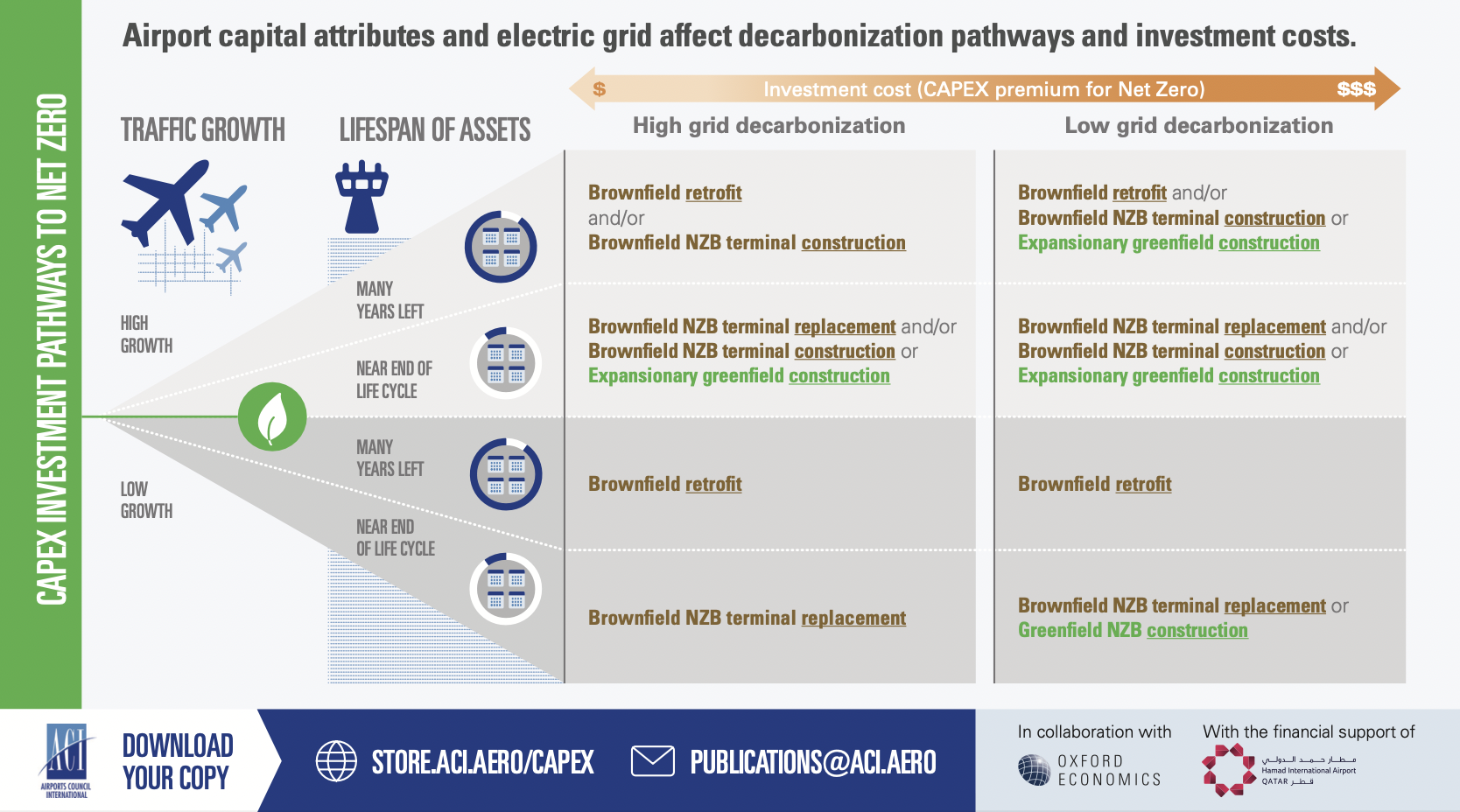
ACI World recently published its long term carbon goal whereby the world’s airports are committed to net zero carbon emissions by 2050.
“Governments will play an important role in supporting and incentivising recovery and to mitigate the risks of falling short on Sustainable Development Goals linked to airports,” Luis Felipe de Oliveira said.
“This support could take the form of the development and access to renewal energy sources, reducing electricity purchase through energy efficiency measures, improving access to green financing instruments, adapting airport infrastructure to serve alternative fuel aircraft, or fostering the development of negative emission technologies.”
Regional breakdown
Asia-Pacific comprises about US$1.3 trillion of the capital requirements for airports, reflecting the region’s rapid passenger growth and demand to develop new greenfield airports as well as to modernise and expand existing airport infrastructure. The Middle East is projected to need about US$151 billion.
Europe’s US$427 billion needs represent 18% of the 2021–2040 global total. More than half of this investment is expected in terminals to maintain and retro-fit the region’s infrastructure.
North America’s US$400 billion needed investment represents about 17% of the global total. Projections suggest that new greenfield airports are minimal or unlikely, as airports have strong geographic coverage in the region.
Latin America-Caribbean’s need represents an investment of about US$94 billion of which an estimated US$41 billion will be needed in new greenfield development. Africa’s needs exceed US$32 billion with the pace of needed new greenfield airport investment representing nearly 40% of this.