

MIDDLE EAST. The joint US-Israel strike on Iran on 28 February and subsequent regional escalation have combined to devastating impact on the travel, tourism and travel retail sectors.
Middle East airports, retailers and food & beverage operators face heavy daily losses while the crisis continues. Airport stakeholders abroad also continue to count the cost of suspended flights to, through and from the Middle East.
The Moodie Davitt Report is keeping readers updated on a crisis with steepening repercussions for our industry.
{Note: The Moodie Davitt Report’s role is to report on the business implications of the war, not to take any partisan position. However, we will report on both opposition to and support for the conflict to place the implications for our sector in rightful context.}
1 April
Qatar Airways plans to rebuild its schedule to more than 120 destinations by mid-May, a statement said today. The airline released a revised schedule, reflecting the gradual increase in flights to and from Hamad International Airport in Doha
All flights continue to operate through dedicated flight corridors established in co-ordination with the Qatar Civil Aviation Authority, noted the airline.
31 March
Korean Air has said that it is moving into “emergency management mode” to manage the impact of the fuel crisis caused by the Iran war. A BBC story reported that the airline is adopting “internal cost-reduction measures” to manage its finances.
Like other carriers, Korean Air is dealing with the effects of rising oil prices and a jet fuel shortage. Click here for more from the BBC.

30 March
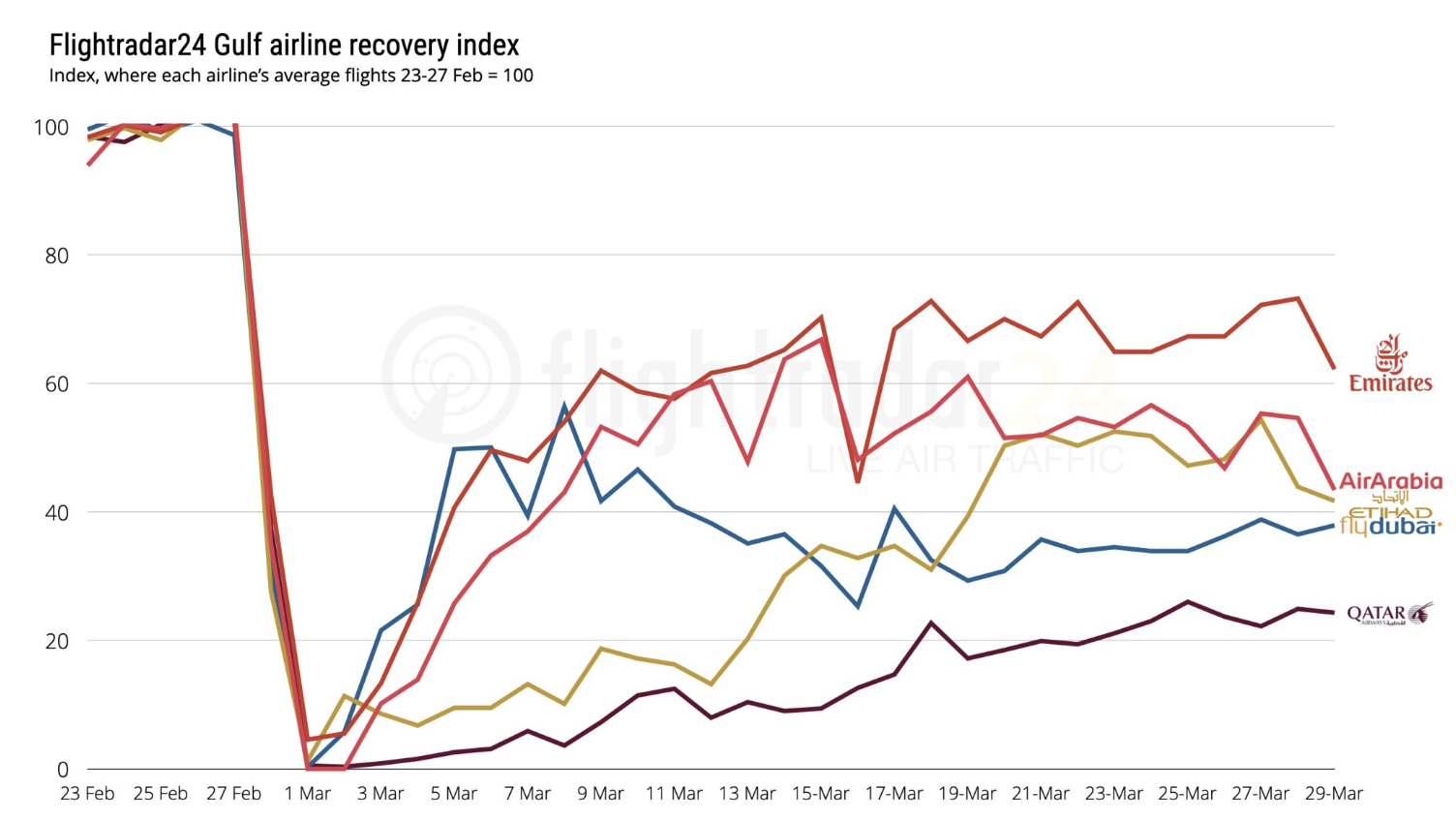
Live air traffic platform Flight Radar 24 has compiled a valuable recovery index that tracks flight activity by selected Gulf airlines as the crisis continues. The index benchmarks average flight numbers by airline pre-war and indexes these against current activity. The chart below shows flights by key carrier up to 29 March, with gradual increases despite much volatility since the virtual shutdown of air space on 28 February.
More from Flight Radar 24 can be found here.
27 March
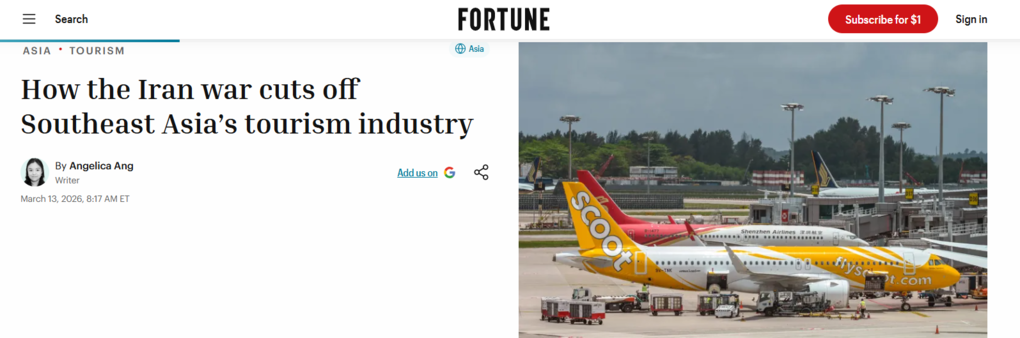
As war in the Middle East constrains global air capacity, passenger flows are shifting, placing pressure on the region’s hubs while Southeast Asia largely benefits from the diverted demand.
That is according to the latest findings from leading travel data provider Official Airline Guide (OAG), presented during a webinar on 25 March.
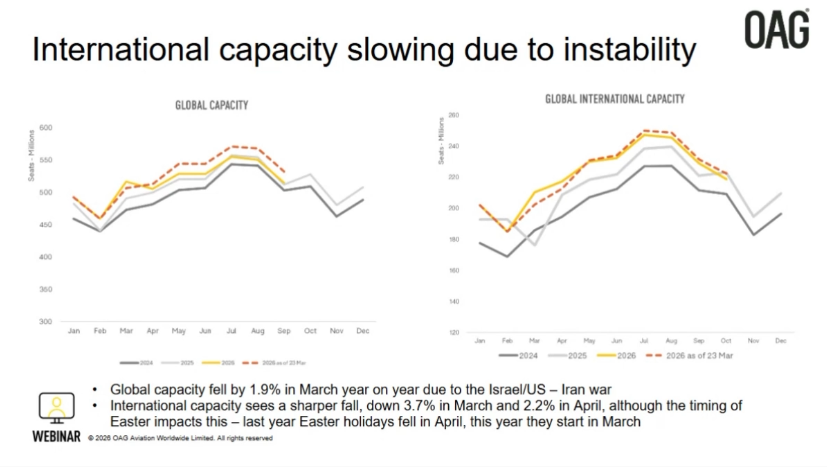
The report highlighted a -1.9%year-on-year drop in global air capacity in March, driven by the escalating Israel/US-Iran conflict.
The latest analysis reveals a deeper decline in international capacity, down -3.7% in March and projected to dip -2.2% in April, with analysts attributing the shift in part to the earlier timing of Easter this year.

These trends reflect the important role of Middle East hubs in global connectivity.
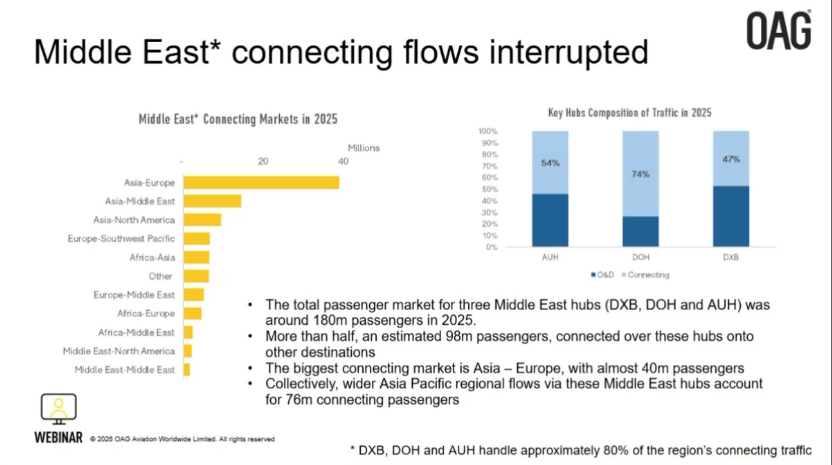
The three major Middle East airports, Dubai International, Hamad International in Doha and Zayed International in Abu Dhabi, served approximately 180 million passengers in 2025.
Of these, more than half (an estimated 98 million) were connecting travellers, with the Asia-Europe market alone accounting for nearly 40 million.
While major Middle East airlines continue to maintain operations, some international airlines have temporarily suspended their services to the region.
Click on this link for the full OAG report.
24 March
As Indian carriers seek to rebuild their services to the Gulf, where practical, Air India and Air India Express said they will jointly operate 24 scheduled and non-scheduled flights today.
Both airlines will continue operating their respective scheduled services to and from Jeddah, with a total of ten flights to and from their stations in India. Of these, Air India will operate one return service each from Delhi and two return services from Mumbai, while Air India Express will operate one flight each from Hyderabad and Kozhikode.
In addition, Air India Express will operate four scheduled flights to and from Muscat, including services from Delhi and Mumbai.
In addition to the scheduled services, Air India and Air India Express will operate a total of ten non-scheduled flights (mostly to repatriate stranded travellers) to and from the United Arab Emirates.
Air India said flights to and from North America, Europe, Australia and other regions continue to operate on schedule.
Yesterday, Indian Prime Minister Shri Narendra Modi spoke on the conflict in West Asia and the many challenges it poses for India.
He said the war has created “unprecedented economic, national security and humanitarian pressures”.
Click on this link for more.
22 March
US President Donald Trump is threatening to deploy Immigration and Customs Enforcement (ICE) agents to provide security at the nation’s airports unless an agreement is reached in Congress to fund the Department of Homeland Security (DHS).
Transportation Security Administration (TSA) airport security staff have been working without pay since mid-February, prompting long consumer queues and angry scenes of frustration.
“I will move our brilliant and patriotic ICE Agents to the Airports where they will do Security like no one has ever seen before,” Trump posted on his Truth Social platform yesterday (21 March).
For once Trump might be telling the truth as ICE agents receive no specific training for airport security.
“I look forward to moving ICE in on Monday, and have already told them to, ‘GET READY.’ NO MORE WAITING, NO MORE GAMES!” he added.

The Trump administration blames the problem on Democrats, who have refused to approve funding without reforms to ICE, part of the DHS.
“Numerous employees have reported to me that their bank accounts are at zero or negative,” Johnny Jones, a Dallas-based official in the government workers’ union AFGE, told USA Today.
“No funds for daycare, no funds for food. They just want to know why the hell they can’t get paid when we have money to shoot missiles into other countries,” he said.
Democrats have been demanding reforms to ICE since January when federal agents slayed two Minneapolis residents, Alex Pretti and Renee Good, who had been protesting against immigration raids.
20 March
Royal Jordanian Airlines Vice Chairman & CEO Samer Majali has spoken about the “significant operational and financial challenges on Royal Jordanian and on the aviation sector in the region” imposed by the crisis. The airline is operating a limited service to and from Amman Queen Alia International Airport.
In a statement issued by the company, he said Royal Jordanian faces “rising operational costs, most notably due to the use of longer alternative flight routes to avoid closed airspaces”. He also noted that the increase in global fuel prices, along with higher insurance and operating costs, is placing additional pressure on the company’s financial performance.

Majali added that this “comes at a time when travel demand is declining significantly, with booking rates and passenger numbers on some routes decreasing due to the prevailing uncertainty in the region, alongside a rise in ticket refund and booking change requests from passengers affected by the current circumstances, further negatively impacting the company’s liquidity amid the exceptional conditions facing the aviation sector”.
He affirmed that Royal Jordanian is taking “well-considered operational and financial measures” aimed at maintaining continuity of operations and mitigating the impact of the current conditions.
Majali explained that Royal Jordanian “will remain the national carrier for Jordanians and will continue to perform its role in connecting Jordan with various destinations around the world, while maintaining the highest standards of safety and service despite the challenges facing the aviation sector in the region”.
19 March
18 March
Dubai Airports CEO Paul Griffiths spoke earlier to radio station Dubai Eye 103.8 about the challenges facing the business and how the airport company and its partners have managed travel through various threat levels and the stop-start of operations.
He said that air traffic movements are now at around 40% of normal levels, with capacity reduced due to the conflict and the changes to flight corridors in the region.
Closing with a positive message, Griffiths said: “I am confident that as things improve and we go forward, the objectives to make the aviation industry [in Dubai] the best in the world are very much intact. We have the duty and care of all of our customers right in our hearts.”
Click on the LinkedIn entry below for more.
In a big network announcement on Tuesday, British Airways is cancelling all flights to Amman, Bahrain, Dubai and Tel Aviv up to and including 31 May, with flights to Doha cancelled until 30 April.
The London Heathrow to Abu Dhabi service will return for its planned winter schedule from 25 October.
The announcement offers an important view from a major European carrier about the prospect and potential timing of a return to normal service on flights to the Middle East.
It’s also worth revisiting the recently expressed views of the World Travel & Tourism Council about the impact of the Middle East war on the industry, underlined emphatically in the graphic below.
“The impact on international visitor spending across the Middle East is significant and averages around US$600 million per day, but history shows that the sector can recover quickly,” said World Travel & Tourism Council President & CEO Gloria Guevara in a statement.

“Our analysis of previous crises demonstrates that security-related incidents often see the fastest tourism recovery times, in some cases as quickly as two months, when governments and industry work together to restore traveller confidence.”
Certainly such resilience has been the case, too, for the travel retail sector. But when that ‘two months’ (an overly optimistic scenario in our view given the severity of this crisis) begins is anyone’s guess.
The challenge with this crisis is that through escalating fuel prices and the near total shutdown of the world’s busiest transit airspace (as well as point-to -point traffic to/from the Middle East), the impact burgeoned almost as quickly as the war itself. Buckle yourself in, we seem set for a long and turbulent ride.
17 March
The Association of Asia Pacific Airlines (AAPA) has called for multi-lateral support for the region’s carriers, which it says are coming under strain from escalating global conflicts.
The Malaysia-based association said, “Rising global conflicts in recent years have reduced the availability of safe airspace for airline operations, increasing potential safety risks to civil aircraft operating in or near conflict-affected airspace and, in some cases, contributing to interference with satellite navigation systems.
“The escalation in hostilities since 28 February 2026 [when the US and Israel attacked Iran] has further increased operational risks and costs for airlines. Safe pathways along the Asia–Europe air corridor are further constrained by conflicts not only in the Middle East but also over Russia, Ukraine, Afghanistan and Pakistan.
“Higher jet fuel prices and insurance premiums, together with increased operating costs from longer flight routings, are placing additional strain on the airline industry. Flight crews and operators rely on timely intelligence, robust risk assessments and clear, state-issued airspace information when operating near conflict-affected regions.
“If the hostilities persist, governments should consider measures to support the industry in mitigating operational challenges and maintaining global air connectivity, which remains vital to economic activity and social wellbeing.
“Governments can support airlines by providing timely threat information, maintaining clear and responsive airspace restrictions, facilitating coordinated repatriation arrangements, and considering measures to alleviate extraordinary operational costs if the situation is prolonged.”
AAPA said government–industry collaboration and mutual support were crucial in managing airline operations during previous crises, such as the September 11 attacks and the COVID-19 pandemic.
“Asia Pacific airlines remain committed to maintaining the highest levels of safety and operational resilience, and will continue working closely with governments and industry partners to sustain global air connectivity during this challenging period,” the association concluded.
16 March
As the Middle East conflict continues, other major tourism markets are acting to protect themselves against any impact.
Tourism Authority of Thailand (TAT) has set up a joint initiative with private sector players to stimulate both international and domestic business.
The Nation newspaper reported, “International tourists who purchase tickets to Thailand would receive domestic flight tickets from the government. At the same time, TAT is pushing domestic tourism alongside the Let’s go halves Plus programme to encourage Thais to travel within the country.”
Crucially, TAT has spoken with Airports of Thailand about reallocating unused flight slots by some airlines to other carriers for direct services to Thailand.
TAT Governor Thapanee Kiatphaibool said, “We are trying to negotiate with airlines to use Thailand, or Suvarnabhumi Airport, as a transit hub replacing the Middle East for flights arriving from Europe, in order to attract tourists and enable Thailand to compete with other aviation hubs such as Shanghai.”

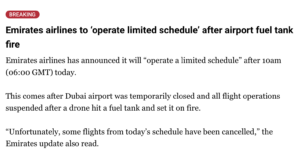
Flights at Dubai International Airport were temporarily suspended earlier today following a “drone incident” that resulted in a fire at a fuel tank in the airport’s vicinity.
This forced some inbound flights to land at Al Maktoum International Airport.
After Civil Defence teams contained the fire, the airport has “gradually resumed” operations to and from selected destinations, said a statement.
15 March
The World Tourism Network has surged fellow tourism-related organisations – including the World Travel & Tourism Council, UN Tourism, IATA, ICAO, Cruise Lines International Association, Global Tourism Resilience & Crisis Management Centre, Pacific Asia Travel Association, Destinations International and global travel leaders – to coordinate a collective response to the Gulf crisis.


{Global News examines how the price hike on oil as a result of the war is impacting the airline industry and what travellers have to say about the added costs}

13 March
12pm
Live air traffic platform Flight Radar 24, which delivers valuable real-time information on air travel, reports that Emirates schedules have reached around 60% of their pre-conflict levels in the past three days. Etihad Airways is operating at around 15% of its usual capacity from Zayed International Airport.
Emirates has been gradually increasing the number of destinations served to around 110 daily with plans to lift this further in coming days.
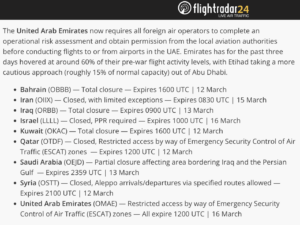
British Airways has scaled back its already limited service to the region. A statement from the airline on Thursday said, “Due to the continuing uncertainty of the situation in the Middle East and airspace instability, we’ve had to temporarily reduce our flying schedule in the region. We’re keeping the situation under constant review and are in touch with our customers to offer them a range of options.
“Since the situation in the Middle East began, we’ve helped thousands of customers return home including operating eight relief flights from Muscat in Oman. These flights have now paused but will be kept under continuous review.”
Meanwhile, Air India and Air India Express will between them operate 78 scheduled and non-scheduled flights to and from the West Asia region (the Gulf and wider Middle East) today.
12 March
2pm
The World Travel & Tourism Council (WTTC) estimates that the escalating conflict in Iran is already losing the travel & tourism sector across the Middle East at least US$600 million per day in international visitor spending.
The tourism body noted that the Middle East plays a vital role in global travel with the region accounting for 5% of global international arrivals and 14% of global international transit traffic.
WTTC’s analysis is based on its 2026 pre-conflict forecast for the Middle East, which projected US$207 billion in international visitor spending across the region this year.
Despite the disruption to travel, WTTC has emphasised that the sector has shown an ability to bounce back quickly following crises.
World Travel & Tourism Council President & CEO Gloria Guevara said: “Travel & tourism is the most resilient of sectors. The impact of international visitor spending across the Middle East is significant and averages around US$600 million per day, but history shows that the sector can recover quickly, especially when governments support travellers through hotel support or repatriation.
“Our analysis of previous crises demonstrates that security-related incidents often see the fastest tourism recovery times, in some cases as quickly as two months, when governments and industry work together to restore traveller confidence. WTTC commends governments who have worked tirelessly in recent days to support recovery efforts.”
1.30pm
Malaysia Airlines has further extended the suspension of its Doha services until 20 March. The Doha service was initially suspended from 28 February due to airspace closures affecting the region.
The airline said it is also increasing wide-body capacity between Asia and Europe to support onward journeys and reunite families, with flights operating on alternative routes.
All other services, including Jeddah, Madinah, London and Paris continue to operate as scheduled.
12.30pm
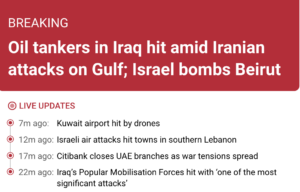
Kuwait International Airport has been hit by a drone attack, according to reports from the news agency cited by Al Jazeera.

11 March
12.30pm
Dubai Airports confirmed that following a brief airspace closure earlier today, operations at Dubai International have now resumed and the airport is open and operating. Dubai authorities earlier said that two drones fell in the area near the airport.
Dubai Airports said it is working closely with airlines and relevant authorities to ensure the smooth flow of operations.
11am
Live air traffic platform Flight Radar 24 has become a valuable real-time information source for industry and travellers since the conflict began. Its latest Blog update shows how flydubai returned to 50% capacity yesterday, with Qatar Airways flight volumes increasing from a low base. Click here for the latest.

In other developments, British Airways announced yesterday that it has cancelled all flights to and from Amman, Bahrain, Doha, Dubai and Tel Aviv until later this month and to and from Abu Dhabi until later this year.
10 March
12.30pm
Qatar Airways is extending its limited schedule of repatriation flights over coming days, after the Qatar Civil Aviation Authority gave temporary authorisation for a limited operating corridor from Sunday.
Today, outbound services will include these destinations: Cairo, London Heathrow, Jeddah, Manila, Kochi, Muscat, Istanbul, Mumbai, Delhi, Nairobi, Islamabad, Madrid, Frankfurt, Colombo, Moscow and Milan.
Flights will arrive to Doha on 10 March from Incheon, Moscow, London Heathrow, Delhi, Madrid, Islamabad, Beijing, Perth, Istanbul and Nairobi.
On 11 March departing flights are scheduled to Cairo, Toronto, Dallas/Fort Worth, London Heathrow, Paris CDG, Madrid, Rome, Delhi, Jeddah, Muscat, Hong Kong, Incheon, Bangkok, Kuala Lumpur and Melbourne.
Inbound flights to Doha are due on 11 March from Cairo, London Heathrow, Jeddah, Manila, Kochi, Muscat, Istanbul, Mumbai, Delhi, Nairobi, Islamabad, Madrid, Frankfurt, Colombo, Moscow and Milan.
Cruise sector schedules are being hit as other travel channels.
AROYA Cruises said at the weekend that it will not proceed with the remaining sailings scheduled in the Arabian Gulf for the current season.
It said its most recent guests disembarked in Dubai on 7 March.
CEO of Cruise Saudi and Interim President of AROYA Cruises Lars Clasen commented, “I am incredibly proud of the professionalism and care shown by our onboard and shoreside teams, who have worked tirelessly to ensure our guests are safe and supported.
“I would also like to thank the local authorities for their close coordination and assistance during this time, as well as our guests for their patience and understanding.”
Leading cruise to airline group TUI said it continues its repatriation measures for package holidaymakers. On Sunday, 600 package holiday guests flew back to Europe on special flights. Around 300 guests were flown from the Maldives to Manchester. Among those on board were British and German holidaymakers who were unable to make their return journey due to cancelled connecting flights in the Gulf.
MSC Cruises said guests on its sailings in the region have been repatriated to a range of destinations, including the UK, Italy, Germany, Spain, the USA and Brazil.
“I am immensely proud of how the whole company is coming together with this highly complex repatriation operation,” said Executive Chairman Pierfrancesco Vago.
“Our Ship Command and crew have worked tirelessly to ensure our guests are well cared for and our teams across the globe have worked round the clock to get our guests home safely and in a timely manner.
“We have received unparalleled support from our airline partner, Emirates as well as the regional and national governments who are supporting us to facilitate the necessary operational logistics and authorisation for the flights. We still have some guests on the ship, but we are working hard to secure their safe passage from the region.”
9 March
11am
Air India and Air India Express will together operate 24 scheduled flights to Jeddah and Muscat today, with these airports deemed “safe for operations”.
Air India said on Sunday that its services to Europe & North America are operating normally through safe alternative routings.
Etihad Airways has resumed a limited commercial flight schedule and announced plans to extend this through to 19 March.
The following destinations are scheduled to operate to and from Abu Dhabi over the next ten days:
Ahmedabad, Addis Ababa, Amsterdam, Athens, Atlanta, Bangkok, Barcelona, Beijing, Bengaluru, Boston, Brussels, Cairo, Casablanca, Chiang Mai, Chicago, Colombo, Copenhagen, Delhi, Denpasar (Bali), Dublin, Düsseldorf, Frankfurt, Geneva, Hanoi, Hong Kong, Hyderabad, Islamabad, Istanbul, Jakarta, Jeddah, Karachi, Kochi, Kolkata, Kozhikode, Krabi, Kuala Lumpur, Lahore, London (Heathrow), Madrid, Malé, Manchester, Manila, Medina, Melbourne, Milan (Malpensa), Moscow (Sheremetyevo), Mumbai, Munich, Muscat, Nairobi, New York (JFK), Paris, Phnom Penh, Phuket, Prague, Riyadh, Rome, Seoul (Incheon), Seychelles, Singapore, St Petersburg, Sydney, Taipei, Thiruvananthapuram, Tokyo, Toronto, Vienna, Warsaw, Washington and Zurich.
All other scheduled commercial services to and from Abu Dhabi remain suspended. Additional destinations will be added and communicated as conditions permit, the airline said.

8 March
10pm
Qatar Airways will extend its limited schedule of repatriation flights over coming days, after the Qatar Civil Aviation Authority gave temporary authorisation for a limited operating corridor from yesterday.
On Monday 9 March, departure flights from Hamad International Airport will go to Incheon, Moscow, London Heathrow, Delhi, Madrid, Islamabad, Beijing, Perth and Nairobi.
On Tuesday 10 March, outbound services will include these destinations: Cairo, London Heathrow, Jeddah, Manila, Kochi, Muscat, Istanbul, Mumbai, Delhi, Nairobi, Islamabad, Madrid, Frankfurt, Colombo and Milan.
Flights will arrive to Doha on 10 March from Incheon, Moscow, London Heathrow, Delhi, Madrid, Islamabad, Beijing, Perth and Nairobi.
On 11 March inbound flights are scheduled from Cairo, London Heathrow, Jeddah, Manila, Kochi, Muscat, Istanbul, Mumbai, Delhi, Nairobi, Islamabad, Madrid, Frankfurt, Colombo and Milan.
6pm
The Carter Center – a non-governmental, non-profit organisation founded in 1982 by former US President Jimmy Carter and his wife Rosalynn – has hit out at President Donald Trump’s “unilateral decision to launch a war of choice”.
In a hard-hitting statement (below), the organisation said the warring parties (Israel, the USA and Iran) “risk ensnaring the Iranian people, the American people, and the entire world in yet another war with no end in sight”.

4pm
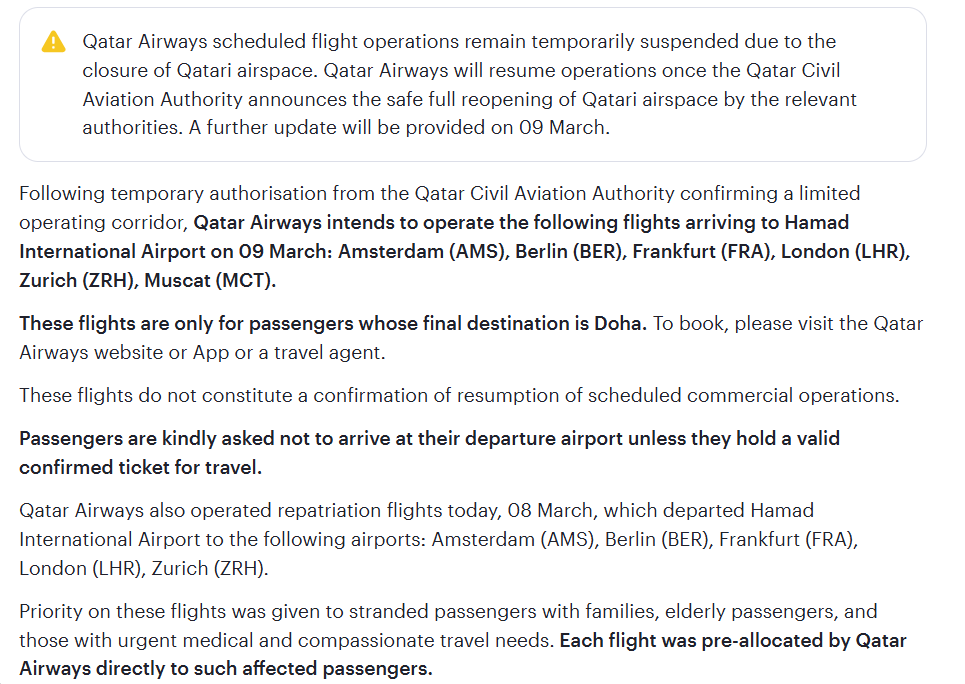
Qatar Airways resumed a highly limited schedule inbound to Doha today, saying the Qatar Civil Aviation Authority has given temporary authorisation for a limited operating corridor.
Flights are available today to Hamad International Airport from London Heathrow, Paris Charles de Gaulle, Madrid, Rome, Frankfurt and Bangkok.
Qatar Airways confirmed it had also operated repatriation flights today which departed from Hamad International Airport to Amsterdam, Berlin, Frankfurt, London and Zurich.
On Monday, the airline also intends to operate flights arriving to Doha from Amsterdam, Berlin, Frankfurt, London, Zurich and Muscat.
These flights are “only for passengers whose final destination is Doha” and “do not constitute a confirmation of resumption of scheduled commercial operations”, the airline said in a statement.
7 March
Oman Air said today that it is adding services to its schedule on 8 and 9 March, noting that Muscat International Airport is “operating as normal”. Oman has been a hub for relief flights from the Gulf to other regions over recent days.
Oman Air has introduced additional flights on 8 March to Istanbul, Cairo, Kuala Lumpur, London Heathrow, Mumbai, Rome and Bangkok. On 9 March extra flights will travel to Jeddah, London Heathrow, Milan, Rome, Istanbul, Amsterdam, Cairo and Bangkok.
2pm
Dubai Airports has confirmed partial resumption of traffic after a suspension earlier (see below), with some flights now taking off and landing at Dubai International (DXB) and Dubai World Central – Al Maktoum International (DWC).
The airport company stated, “Travellers are urged to not travel to the DXB or DWC unless they have been contacted by their airline that their flight is confirmed, as schedules continue to change.
“Dubai Airports continues to closely monitor the situation in coordination with relevant authorities and our focus remains on maintaining the highest standards of operational safety, security, and wellbeing of passengers and staff.”
Emirates also confirmed it has resumed operations, adding that only passengers who have confirmed bookings for this afternoon’s flights should go to the airport.
1.30pm
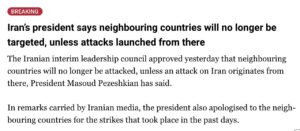
9am

Dubai Media office says falling shrapnel after air defence interception is what was seen recently over the city. Additional aircraft have now moved to a closer hold to the airport, though arrivals have not yet resumed. https://t.co/Xv8JfcamE6 https://t.co/B3xIaV3MpS pic.twitter.com/qylSriYrbS
— Flightradar24 (@flightradar24) March 7, 2026
2am
Following temporary authorisation from the Qatar Civil Aviation Authority confirming a safe operating corridor, Qatar Airways plans to operate repatriation flights later today departing from Hamad International Airport to the following airports: London Heathrow, Paris Charles de Gaulle, Madrid, Rome Fiumicino and Frankfurt.
Priority on these flights is given to stranded passengers with families, elderly passengers, and those with urgent medical and compassionate travel needs.
The airline noted that these flights do not constitute a resumption of scheduled commercial operations.
6 March
4pm
Travel specialist Mabrian today issued an update on travel demand and likely diversion of consumer travel spend in the months ahead due to the Middle East crisis.
It notes that many European and US travellers are leaning towards closer-to-home and long-haul alternatives. US travellers, it adds, are particularly sensitive to security concerns, while neighbouring destinations such as Egypt, Türkiye and Jordan are feeling spillover effects on traveller confidence.
The Mabrian by Data Appeal has examined traveller behaviour and sentiment, and three-month trends from the UK, Germany, France, Italy and the USA. These point to a “pronounced deterioration in travellers’ safety sentiment across GCC destinations, with varying intensity by country”.

A common denominator across all analysed destinations, said Mabrian, is the “pronounced reaction among US travellers, whose safety perception has proven more sensitive than that of other key long-haul source markets”.
Mabrian data intelligence shows that, amid the Middle East conflict and worsening security perception, three potential travel demand diversion scenarios are emerging across the five key outbound markets noted above.
“The first points to a growing inclination to remain closer to home. This tendency is particularly evident among German travellers—who are prioritising destinations such as Morocco and Greece—alongside Italians, whose interest is shifting towards Croatia, the Czech Republic, Norway and Spain. British travellers are showing a similar pattern, with Malta, Morocco, and Montenegro gaining prominence as alternative options.”
A second scenario highlights the continued strength of demand for Asia, supported largely by direct air connectivity. Mabrian said, “Interest remains particularly robust for destinations such as Japan, Thailand, Vietnam, Cambodia and the Philippines. The materialisation of this demand, however, will largely depend on the extent to which airfares on these direct routes remain competitively priced and attractive.”
Finally, several long-haul destinations are emerging as potential substitutes. Among British travellers, South Africa and the Maldives are gaining traction, while Latin American destinations are attracting attention from French, Italian, German and US travellers. In particular, Peru and Brazil are appearing as aspirational alternatives.
Another notable trend is also emerging within European demand, added Mabrian. “Egypt continues to maintain its appeal among German, Italian and French travellers; however, this demand remains highly exposed to developments in the Middle East conflict.”
3pm
Emirates issued its latest update today, saying it carried around 30,000 from Dubai on 5 March. By tomorrow, 7 March, it expects to have 106 daily return flights operating to 83 destinations, representing almost 60% of its route network.
A statement said, “In certain high-demand markets, Emirates has significantly scaled up its operations. In the UK alone, the airline will be operating 11 daily flights across five airports by 7 March, reflecting the strength of travel demand between the UAE and UK.
“Additional capacity is being deployed across India, with Emirates scaling up to 22 daily flights, serving all nine of its Indian gateways by tomorrow 7 March.
“In the United States, Emirates currently operates to seven of its American gateways, ensuring continued connectivity between the US and the UAE during this period.”
2pm
Dubai Airports has issued an update on its efforts to support relief and repatriation flights in recent days.
From 2-5 March, more than 500 flights have departed Dubai International and Dubai World Central airports, providing 105,000 outbound seats to more than 80 countries. The number continues to increase dramatically every day, it added. See LinkedIn post below.
11am
Qatar Airways has issued the latest in a series of updates to keep travellers informed as scheduled flight operations remain suspended today.
Qatar Airways said, “We are working around the clock to organise additional relief flights where operationally possible and will share further updates as soon as they are confirmed.
“Affected passengers will be contacted directly by Qatar Airways with their flight details, arrangements and next steps.
“Passengers are kindly requested not to proceed to the airport unless they have received an official notification from Qatar Airways confirming their flight.
“For Qatar Airways passengers currently in Doha, airline representatives are available in designated hotels to assist with questions regarding relief flights and travel arrangements.
“The safety and wellbeing of our passengers and crew remain our highest priority. We sincerely apologise for the disruption caused by circumstances beyond our control and thank you for your patience and understanding.”
In Abu Dhabi, Zayed International Airport (pictured below) yesterday resumed limited flights, in coordination with the emirates’s Emergencies, Crises and Disasters Management Center. An Abu Dhabi Media Office statement said, “Efforts were conducted over the past few days under strict coordination on safety protocols and in close cross-sector collaboration to ensure comprehensive support.
“This unified response included the provision of more than 4,300 complimentary hotel rooms across 74 hotels for approximately 7,000 passengers, ensuring those affected by scheduling changes were accommodated in comfort.

“Joint efforts with relevant authorities across the emirate facilitated a seamless support network, including shuttle services, refreshments, hospitality, medical care and retail vouchers to support passenger wellbeing during this transition.”
Muscat International Airport has hosted relief flights on behalf of other Gulf airports over recent days. An Oman Airports statement noted that Muscat, Salalah, and Sohar airports remain fully functional and open 24-hours a day to support global airlines during current regional disruptions.
5 March
12pm
Dubai Airports CEO Paul Griffiths today issued a statement of encouragement to teams and partners on LinkedIn as the world’s number one international airport remains largely closed to flights.
He said, “The past few days have been unprecedented but together with collaboration and resilience, we are navigating with confidence.
“Following the limited resumption of flights, I’ve been on the ground, along with other Dubai Airports senior leaders and the airport community, meeting frontline teams and providing support during this critical phase of recovery.
“Our teams at DXB and Dubai World Central – Al Maktoum International (DWC) have shown exceptional professionalism and commitment under pressure. At an airport of DXB’s scale, the safety of our customers, people and partners will always come first.”
The Republic of Azerbaijan closed its southern airspace after a drone attack it claimed came from Iran on Thursday, in a further worrying escalation of the conflict.
The Azerbaijan Ministry of Foreign Affairs said in a statement, “At around midday on 5 March, drone attacks were carried out against the Nakhchivan Autonomous Republic of the Republic of Azerbaijan from the territory of the Islamic Republic of Iran.
“One drone struck the terminal building of the airport in the Nakhchivan Autonomous Republic, while another drone fell near a school building in the village of Shakarabad.
“We strongly condemn these drone attacks launched from the territory of the Islamic Republic of Iran, which resulted in damage to the airport building and injuries of two civilians.”
11am
Qatar Airways is planning relief flights this week, starting today, to support passengers who are stranded due to the current situation across the region.
The following services are planned: Muscat to London Heathrow, Berlin, Copenhagen, Madrid, Rome, and Amsterdam, plus a flight from Riyadh to Frankfurt.
Flights from Doha remain grounded due to the closure of Qatari airspace. The company will issue a further update on scheduled flights on 6 March.
In Dubai, Emirates is operating a limited schedule from today until 23:59 on 7 March due to airspace closures.
In Abu Dhabi, all Etihad flights are suspended until at least 06:00 UAE time on Friday 6 March.
4 March
11am
Adding to the many messages from industry leaders to their teams and partners as the crisis deepens, Plaza Premium Group Chief Commercial Officer Jonathan Song has issued a heartfelt message to the company’s staff in the region via a LinkedIn post.
He said, “To our dear PPG colleagues in Saudi Arabia, Jordan, Oman, and the UAE – especially our teams in Dubai and Abu Dhabi – we’re really worried about you all right now. It’s hard to watch what’s happening and not feel anxious for you and your loved ones.
“Thank you for still turning up with that calm, warm welcome for travellers whenever it’s safe. That quiet strength touches us deeply.
We’re checking in with your team leads constantly. Your safety and peace of mind are our number one concern – no question. Please stay safe. We’re right here with you.”
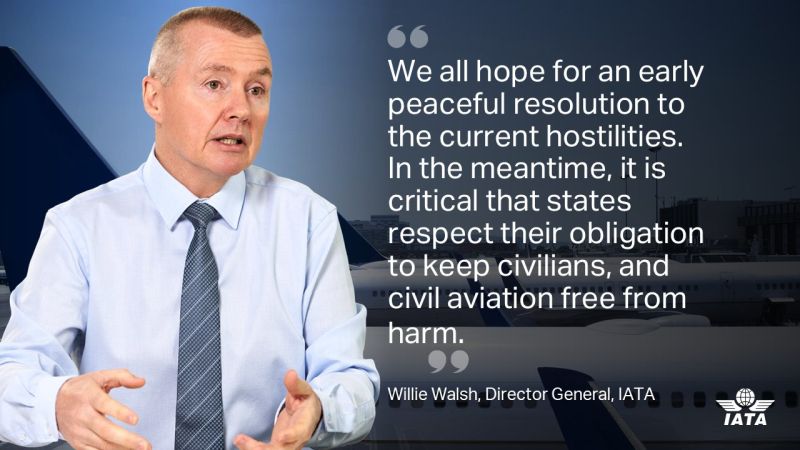
Separately, Willie Walsh, who leads airline body the International Air Transport Association, expressed his solidarity with those affected (see quote below).
Earlier today, Qatar Airways issued a further update on its travel schedules, noting that flights remain grounded due to the closure of Qatari airspace. The company will issue a further update on Friday 6 March by 09:00 Doha time.
All scheduled Emirates flights to and from Dubai remain suspended until at least 23:59 UAE time tonight (4 March), due to airspace closures across the region.
As airlines around the world react to the temporary changes in the Middle East flight landscape, Air Canada is among those to introduce alternative capacity to serve its long-haul business.
A post on X said: “With the ongoing Middle East situation, from March 7 to 21 we’re adding a frequency for double-daily Toronto-Delhi service and using larger aircraft on select Toronto-London-Mumbai flights to provide routing options.”
3 March
4pm
All scheduled Emirates flights to and from Dubai remain suspended until 23:59 UAE time on 4 March, the airline has announced. Emirates continues to operate a limited number of passenger repatriation and freighter flights through 3 and 4 March.
Elsewhere, Malaysia Airlines said today that it will temporarily resume return services to and from Jeddah and Madinah airports from 4 March, following the suspension of services since 28 February due to airspace closures in parts of the Middle East.
Services to Doha however will remain suspended until 7 March as the airline “continues to assess the security situation”.
All other flights, including services to London Heathrow and Paris Charles de Gaulle, remain on schedule. These are operating “on alternative routings well clear of the affected conflict zone”, said the airline.
10am
Qatar Airways issued a further update this morning, saying that flights remain grounded due to the closure of Qatari airspace. The company will issue a further update on 4 March by 09:00 Doha time.
5.30am

The drastic impact of the Middle East crisis on the travel industry – and therefore the travel retail sector – is not confined to the region.
OAG Regional Commercial and Industry Affairs Leader Regional Sales Director – Asia Pacific, Middle East & Africa Mayur Patel told The Moodie Davitt Report, “The escalating conflict in the Gulf region is sending shockwaves through global aviation, with widespread airspace closures forcing major carriers including Emirates, Etihad, Qatar Airways, Lufthansa, Air France and Air India to cancel or reroute flights, particularly those connecting Europe and Asia.
“The resulting capacity squeeze on alternative corridors is driving up ticket prices and surcharges, while reduced belly-hold space on re-routed passenger aircraft is simultaneously tightening air freight capacity and pushing cargo costs higher.
“Fuel prices are adding further pressure, with Brent crude benchmarks rising sharply as markets factor in supply risk around the Strait of Hormuz. Should hostilities escalate or threaten oil export routes, aviation fuel costs could climb materially, compounding an already significant financial burden on airlines and passengers alike.”
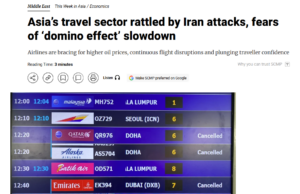
{Some positive news at least from Abu Dhabi Airports above and Dubai Airports below}
While oppositon to the war escalates around the world, the US/Israel alliance is clearly determined to step up its attacks on Iran in coming days as the Al Jazeera and CNN stories below underline.



‘The supreme international crime’
US-based Democracy for the Arab World Now (DAWN) has called for an immediate end to USA and Israel’s “unlawful” military assault on Iran.
In a letter sent on 2 March to the permanent missions of all UN member states in New York, DAWN called on governments to formally request an emergency special session of the UN General Assembly to declare the assault a war of aggression in violation of the UN Charter and to demand the immediate cessation of all hostilities.
In a second letter to members of Congress, DAWN urged both chambers to vote immediately on a War Powers Resolution to end a war they never authorised.
“No legal framework, international or domestic, can justify this US-Israeli war of aggression against Iran,” said DAWN Executive Director Omar Shakir. “This war is patently illegal, and it must be stopped.”
DAWN said: “No Chapter VII resolution authorised this war. The United States has initiated a war of aggression, which UN General Assembly Resolution 3314 defines as ‘a crime against international peace’ and which the Nuremberg Tribunal, established by the United States itself, called ‘the supreme international crime’.”
*DAWN is a non-profit organisation that supports democracy and human rights in the Middle East and North Africa.
[Note: The Moodie Davitt Report’s prime role is to report on the business implications of the war, not to take any partisan position. However, we will report on both opposition to and support for the conflict.]
2 March
9pm
Leading brand association TFWA today also expressed its “sincere support and solidarity with all our industry colleagues, partners and friends across the Middle East during this incredibly difficult time”.
It added: “As a global community, we believe that the true essence of travel is to build bridges, foster understanding, and connect people across borders. To see these connections replaced by such profound devastation is heartbreaking.
“Our thoughts are with every individual and family affected, whose lives have been suspended. We stand in solidarity with our partners in the region, including Middle East & Africa Duty Free Association, hoping for a swift resolution, the restoration of safety, and a return to the stability that allows our community to thrive once again. Stay safe, and look after one another.”
7pm
Dubai Airports has said that a limited resumption of operations will begin this evening (2 March), with a small number of flights permitted to operate from Dubai International (DXB) and Dubai World Central – Al Maktoum International (DWC).
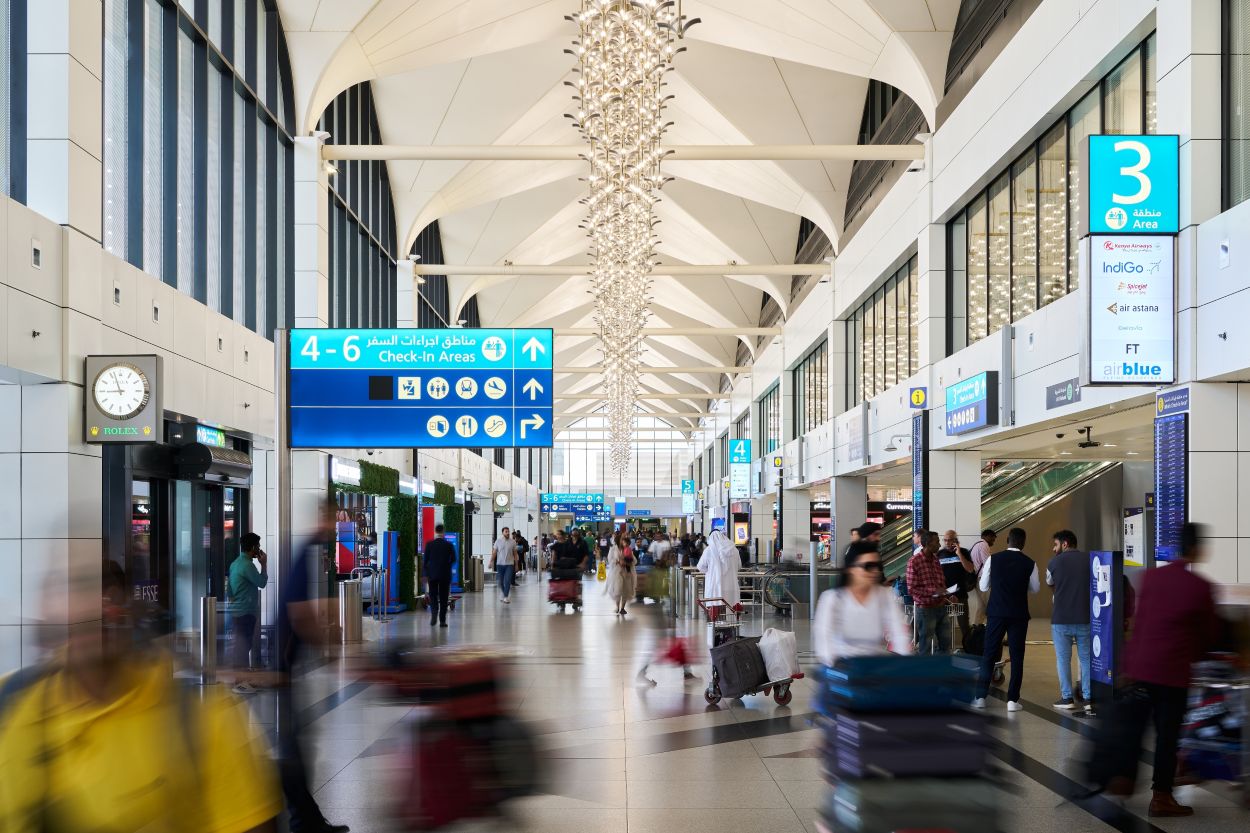
A spokesperson said, “Travellers are advised not to proceed to DXB or DWC unless they have been contacted directly by their airline with a confirmed departure time, as schedules remain subject to change.
“Dubai Airports continues to closely monitor the situation in coordination with relevant authorities, and our focus remains on maintaining the highest standards of operational safety, security, and wellbeing of passengers and staff.”
Emirates Airline said it will begin operating a limited number of flights from this evening.
A statement said: “We are accommodating customers with earlier bookings as a priority, and those who have been rebooked to travel on these limited flights will be contacted directly by Emirates. Please do not go to the airport unless you have been notified.”
Also this evening, Abu Dhabi Airports confirmed operations have partially resumed at Zayed International Airport.
Meanwhile, ACI World expresses solidarity with its airport membership across the region (see below).
4pm
Shares of leading travel-related companies slid sharply today amid the continuing crisis in the Middle East.
Leading travel food specialist SSP Group has seen its share price fall almost -5% in the day so far (12 noon UK, 4pm UAE), with Avolta down over -5%. Among leading airport groups, Aena and Fraport have seen falls of 2-3%.
Shares in Europe’s largest travel group, TUI, have slipped -8% during the day so far, while the value of both IAG and Lufthansa shares are each down more than -5%.
1pm
In a statement of solidarity today, the Middle East & Africa Duty Free Association said: “In light of the current circumstances in the region, we have received many kind messages and would like to sincerely thank everyone for their concern. We are safe and continuing our work as usual. Our thoughts are with all communities affected. May everyone stay safe and protected during this time.”
11am
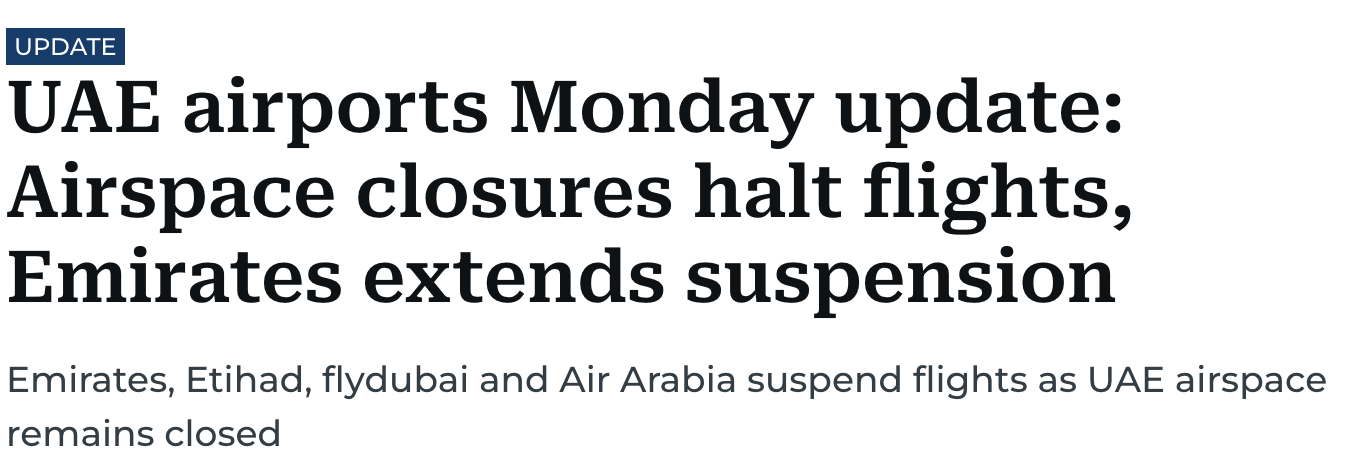
Flights across the region remain suspended today as the crisis continues. Qatar Airways issued an update this morning, saying that flights remain grounded due to the closure of Qatari airspace. The company will issue a further update on 3 March by 09:00 Doha time.
UAE airports and leading airlines have also continued their flight suspensions for another day.

1 March
9pm
ARI, the leading multi-site duty-free retailer in the region, issued a statement on LinkedIn, saying: “Our thoughts are with our colleagues, partners, and the wider communities during this period of uncertainty in the region.
”The safety and wellbeing of our people remain our highest priority. We are in close contact with our local leadership teams and can confirm that our colleagues across our Middle East operations are safe and continuing to be fully supported.

“We have wonderful, dedicated teams who support travelling passengers and work alongside our airport partners with care and dedication every day, but for now, safety is the priority for all.
“ARI will continue to monitor developments closely, with the safety and wellbeing of our people, partners and communities remaining our guiding priority.”
6pm
More leading travel retail companies have reacted to the crisis. Gebr. Heinemann expressed its deep concern for all those affected.
A statement said: “At Gebr. Heinemann, people have always been at the centre of everything we do. As a family-owned company with a strong presence in the Middle East – including our regional headquarters in Dubai, locations in Israel and Jeddah, and many long-standing partners and customers across the region – the current situation affects our community directly.
CEO Heinemann Middle East Africa Bernard Schlafstein said, “We extend our heartfelt concern and support to our employees, partners, and customers throughout the region during these challenging times.
“Our thoughts are with our colleagues, their families, and everyone affected. The safety and wellbeing of our people remain our top priority, and we are in close contact with our teams across the region during this difficult time.

“We understand the uncertainty and difficulties many are facing, and we stand in solidarity with our community. Continuously monitoring the developments and the ongoing dialogue with our teams enables us to ensure we are providing the safety, security, and support our colleagues need right now.
“We are committed to doing everything we can to contribute positively and responsibly in these circumstances. Heartfelt support is offered to all those affected, and our commitment to the safety of our team is reaffirmed. We hope for a swift settlement of the situation and an end to the military conflict.”
2pm
Qatar Airways flight operations remain suspended today due to the closure of Qatari airspace. Qatar Airways says it will resume flying once the Qatar Civil Aviation Authority announces the safe reopening of the airspace. A further update will be provided on 2 March by 09:00 Doha time.

In Dubai, leading airline Emirates issued a statement saying it has temporarily suspended all operations to and from Dubai, up until 15:00 UAE time on Monday.
Etihad Airways has also suspended all flights to and from Abu Dhabi until 02:00 UAE time on Monday due to the regional airspace closures.
Air France has cancelled its scheduled flights to and from Tel Aviv, Beirut, Dubai and Riyadh until 3 March.
Earlier, news agencies reported that Bahrain International Airport was targeted on Sunday in a drone attack, causing minor material damage. Authorities said they had activated emergency plans in advance and evacuated the passenger terminal to protect passengers and staff. Click here for the latest from Gulf News.
Click here for an earlier BBC story on the impact of strikes on Dubai and Abu Dhabi (Zayed International) airports, with one person killed at the latter location.
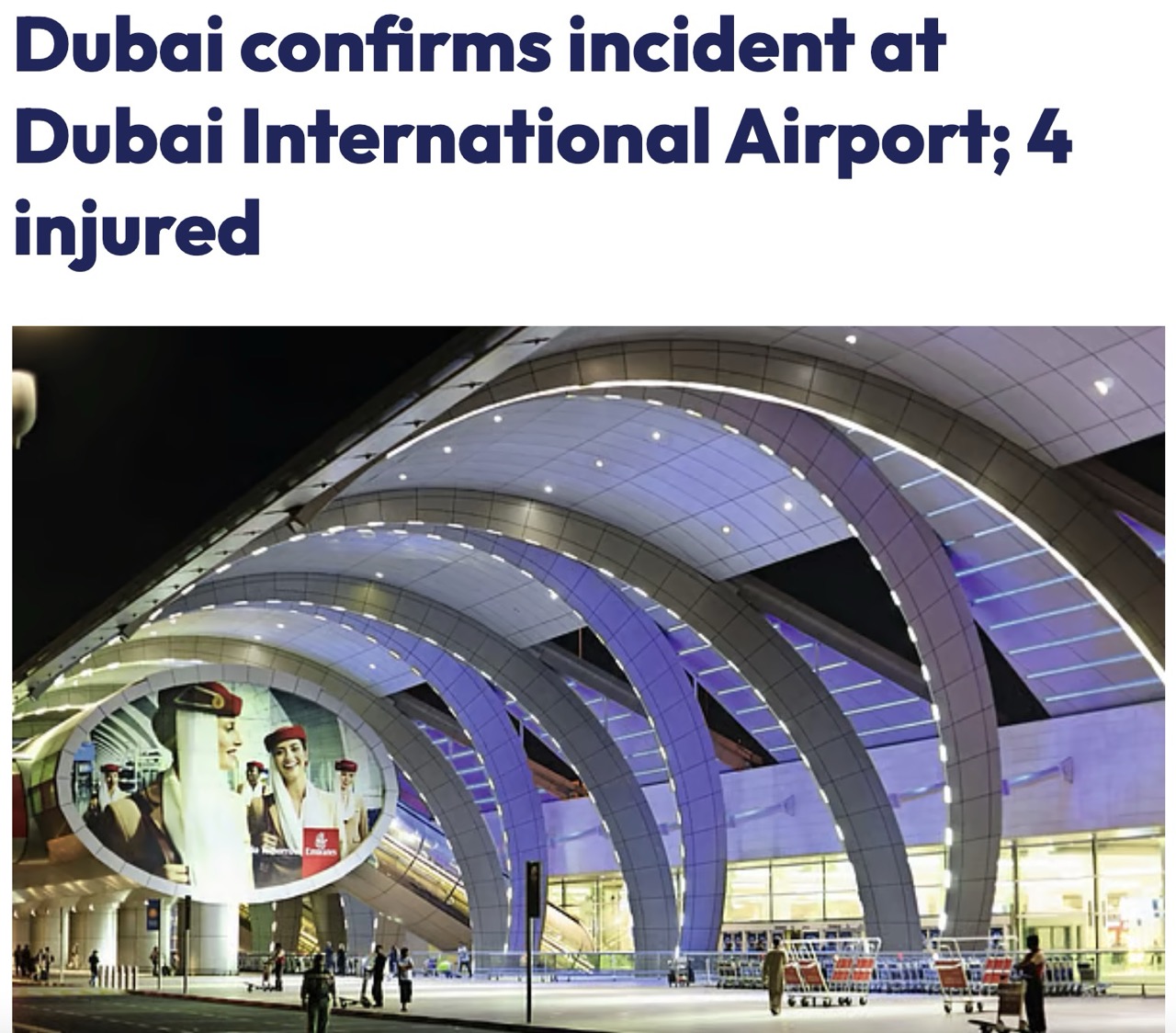
Dubai Airports confirmed that a concourse at Dubai International (DXB) sustained minor damage in an incident, which was quickly contained.
A Dubai Airports spokesperson said: “Emergency response teams were immediately deployed and are managing the situation in coordination with the relevant authorities. Four staff sustained injuries and received prompt medical attention. Due to contingency plans already in place, most of the terminals were previously cleared of passengers. Further updates will be provided as they become available.”
28 February
11pm
Leading travel retail industry players have been reacting to the unfolding crisis.
A statement shared by Avolta tonight said: “We have been closely following developments across the Middle East. Our priority is, and always will be, our people. We can confirm that all Avolta team members are safe, and none of our colleagues have been hurt.
“To our teams across Jordan, Kuwait, Saudi Arabia and the UAE – including Abu Dhabi, Dubai and Sharjah: please know that you are very much in our thoughts. Where it is safe to do so, many of you continue to show up every day in busy airports, serving travellers and partners with professionalism and care, even in moments of uncertainty.
“We remain closely connected to our local teams and will continue to monitor the situation, with the safety, wellbeing and support of our people as our clear priority.”
Avolta CEO Xavier Rossinyol separately said on LinkedIn: “Avolta operates across many countries, cultures and communities. What defines us in moments like this is how we look after one another. That sense of responsibility and care is part of who we are, and it matters deeply to me. To our team in the Middle East: please take care of yourselves and of each other. We will stay close.”
Lagardère Travel Retail CEO Frédéric Chevalier said on LinkedIn: “The developing situation in the Middle East is a cause of great concern to all of us. My first thoughts are with our Lagardère Travel Retail teams and their families in the countries affected. I can well imagine their anxiety as events unfold, and I would like to assure them that their safety and well-being are our absolute priority.”
He added: “I also extend our support and solidarity to all our airport partners, brand partners and industry friends across the Middle East at this time of great uncertainty. The people of this region have suffered the consequences of conflict for too long, and we can only hope for a rapid return to the peace and stability that they deserve.”
10pm
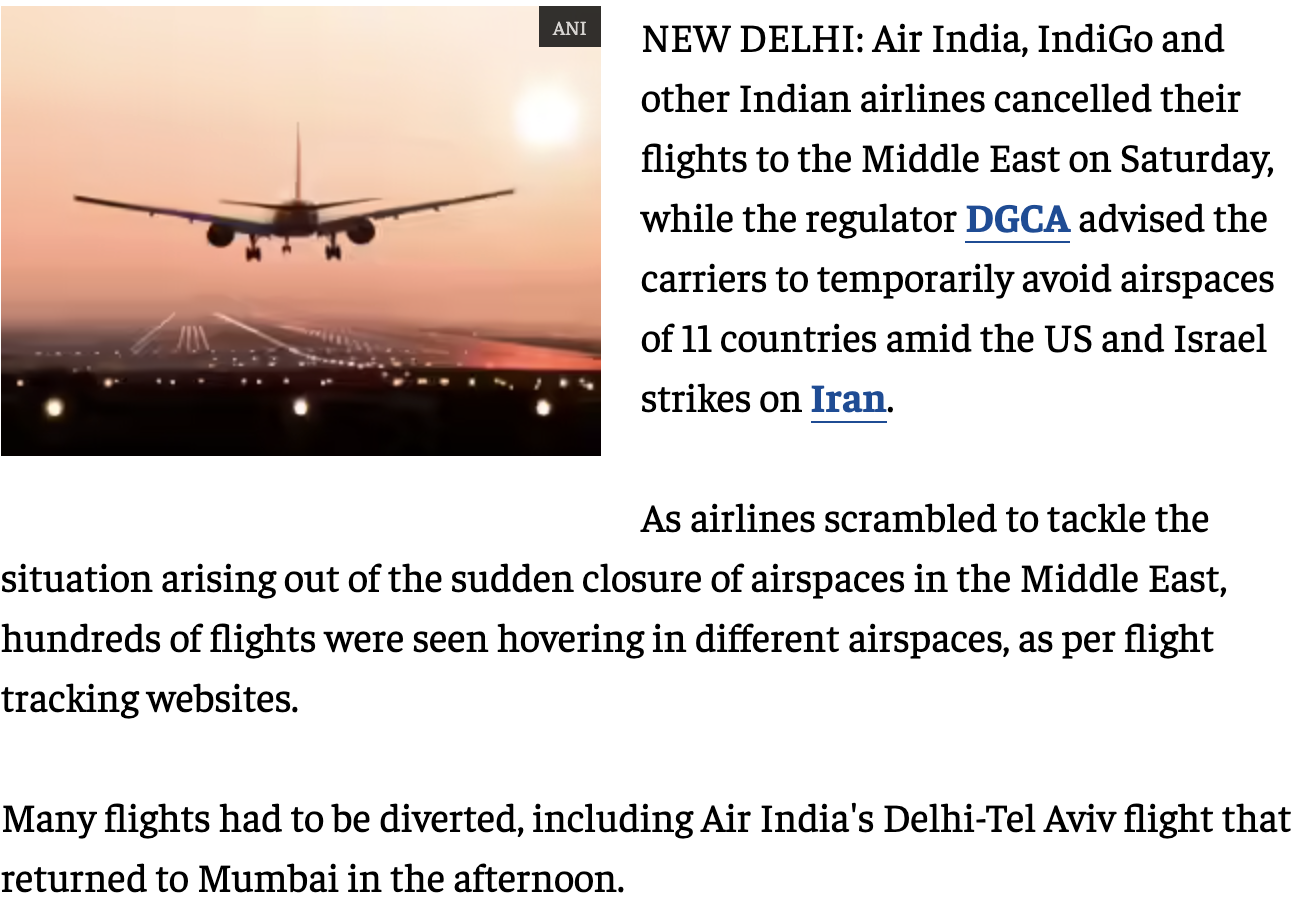
Underlining the reach and severity of this crisis. Air India has cancelled flights to the Middle East planned for Sunday as well as many to London, New York and Paris.
In addition, Air India Express has extended the suspension of all westbound travel for Sunday. Indian travel and spend are critical for the airport retail sector in the Middle East.
Airports across India have been placed on operational alert to manage possible flight diversions, unscheduled landings and additional passenger needs.
9pm

7pm
According to Dragon Aviation Capital on LinkedIn, the UAE’s General Civil Aviation Authority (GCAA) has announced that the state will cover all expenses for passengers stranded in the country due to flight disruptions caused by the regional airspace closures.
The Khaleej Times and Gulf News stated approximately 20,200 passengers have been affected over the past hours as flights were cancelled, rerouted, or rescheduled.

Stranded travellers are being provided with temporary accommodation, meals and refreshments, and assistance with rebooking their flights.
The GCAA said the country’s airports and national carriers are working together to manage operations, rerouting flights between UAE airports, accelerating rescheduling, and strengthening coordination within terminals to handle congestion.
Transit passengers have been transported to accommodations, and all costs are being covered by the state.
Some vacation rental companies in Dubai have also stepped in, offering free stays to stranded tourists, according to Zee News.
The airports remain under adjusted operations as the situation in the region continues to develop.
6pm
3pm
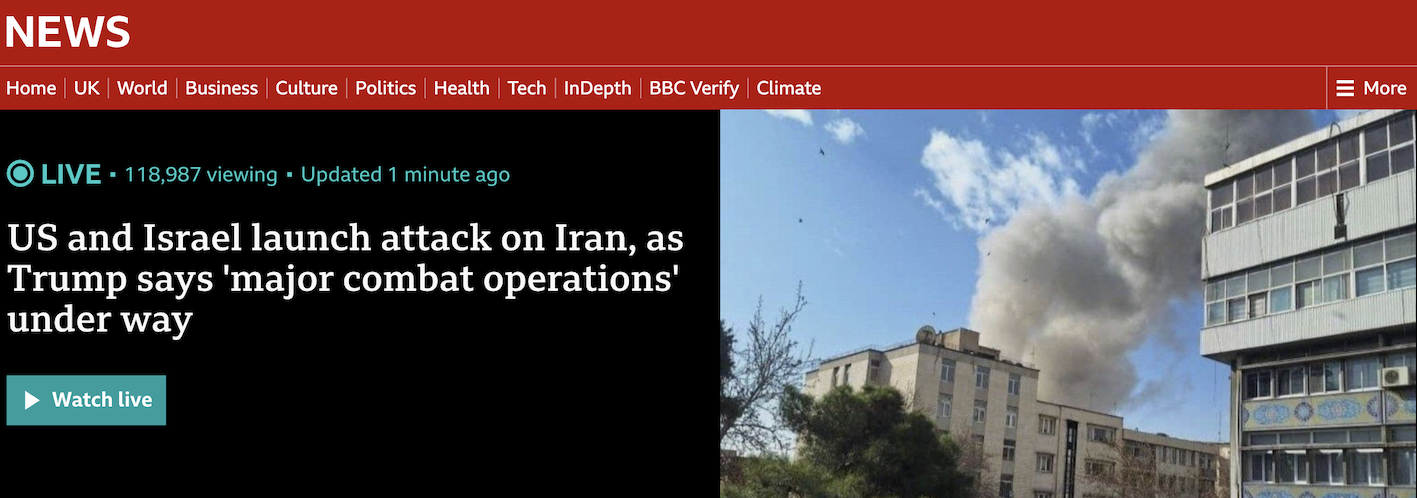
Recent tensions, focused in particular around Iran’s nuclear weapons programme, culminated in missile attacks on five Iranian cities, including Tehran, with Iran pledging a “crushing response”.
US President Donald Trump confirmed earlier that “major combat operations” are under way.
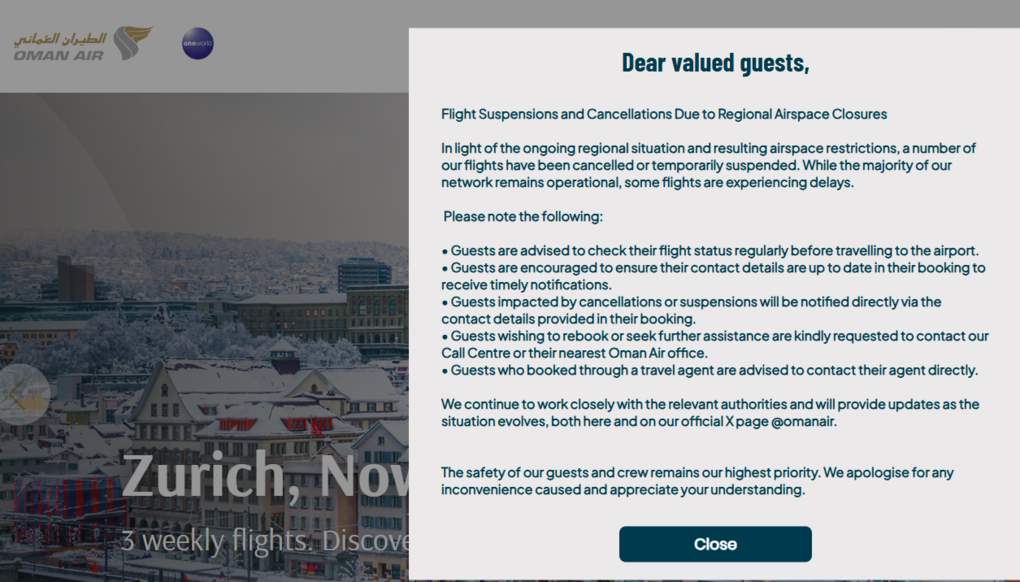
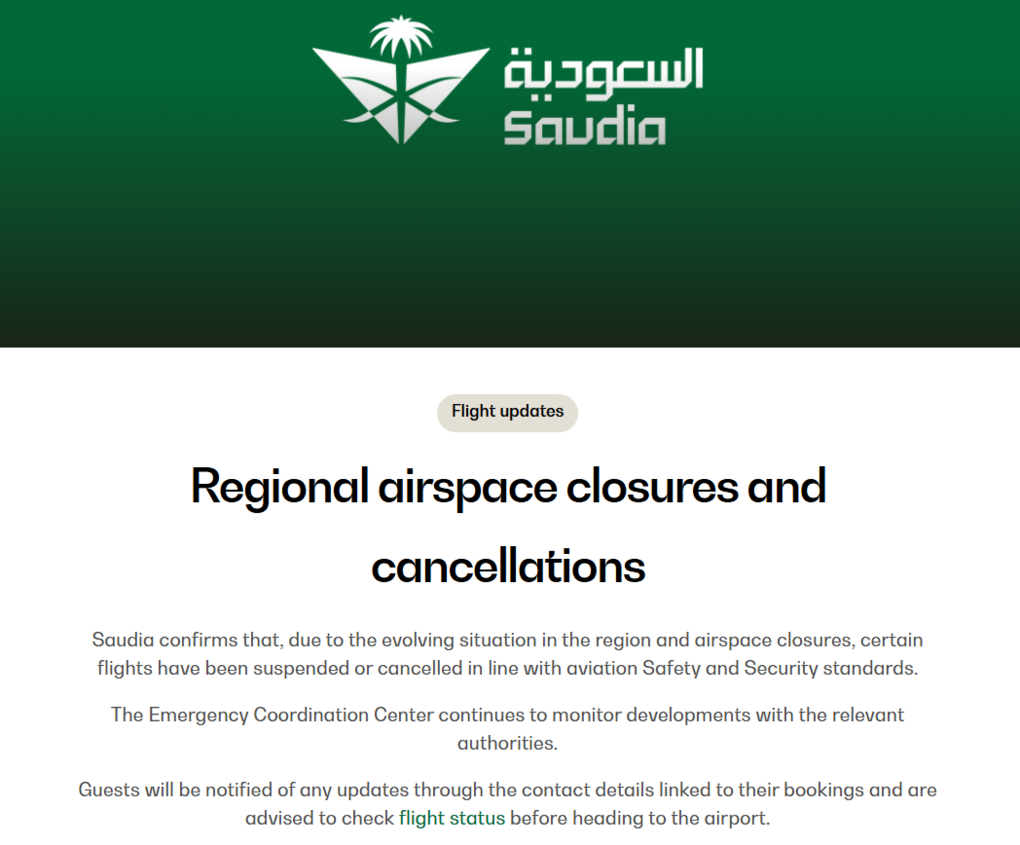
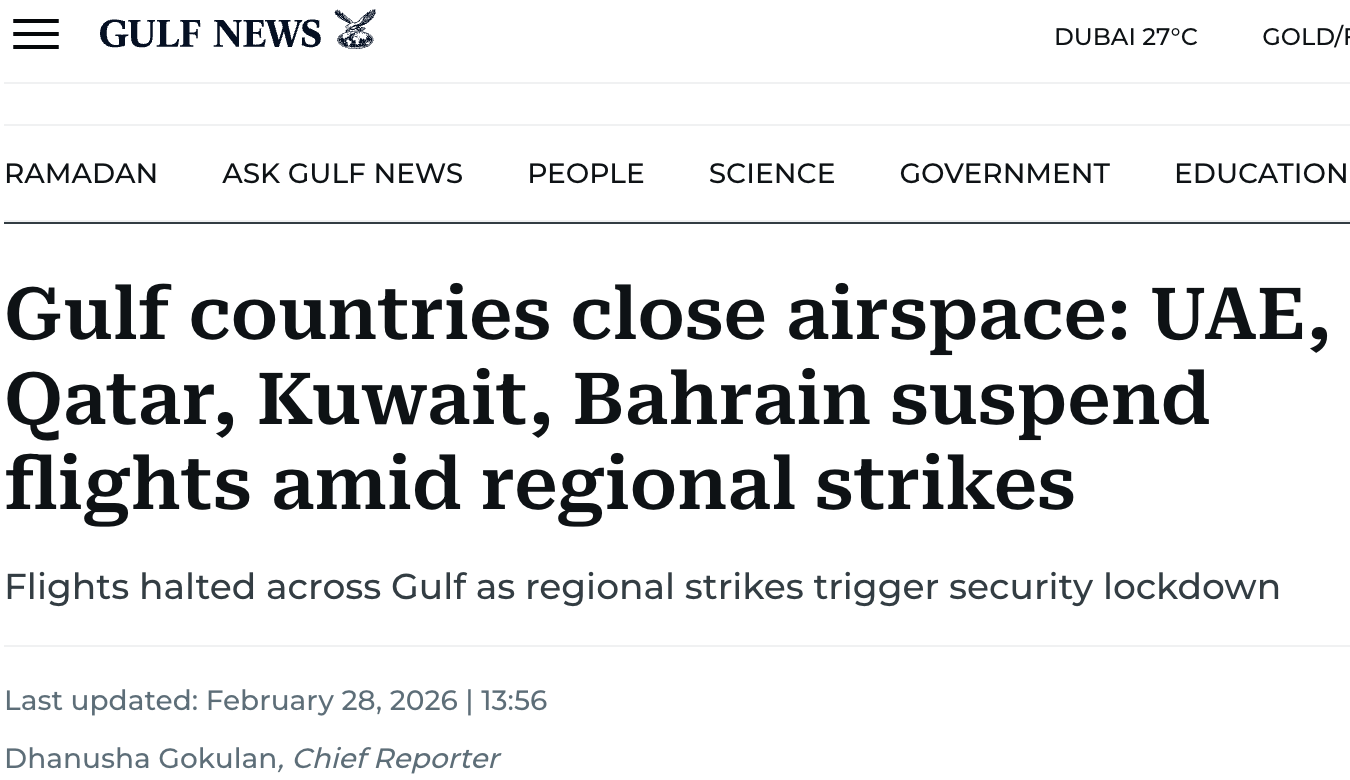
Flight schedules have been hard hit by the campaign, with Qatar and Kuwait closing their air space and the UAE issuing notice of a partial closure.
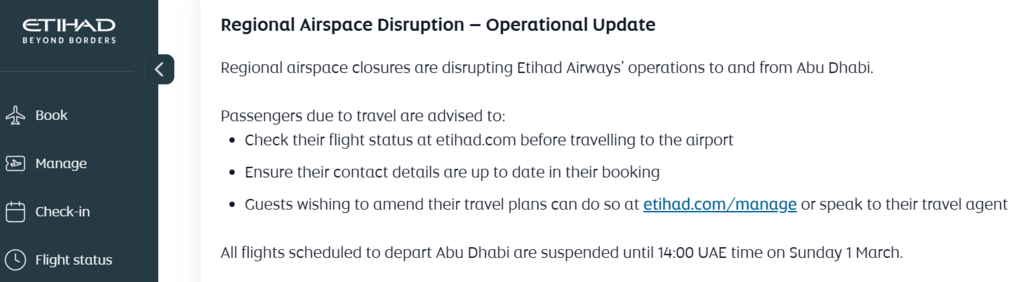
In the UAE, Dubai Airports said that all flight operations at Dubai International (DXB) and Dubai World Central – Al Maktoum International (DWC) are suspended until further notice. Passengers have been advised not to travel to the airport at this time and to contact their respective airlines directly for the latest updates regarding their flights.
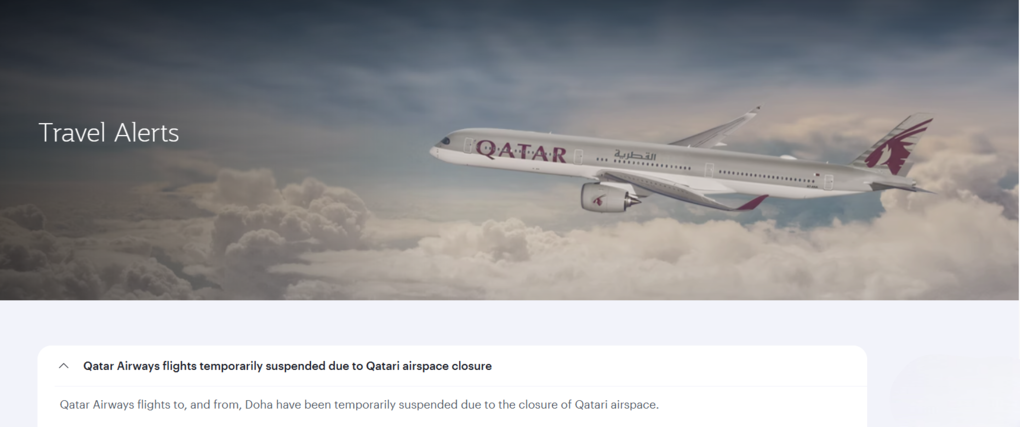
Qatar Airways Group has temporarily suspended flights to and from Doha.
A statement read: “The airline is working closely with government stakeholders and the relevant authorities to support impacted passengers and will resume operations when the airspace re-opens. Once usual operations resume, we anticipate delays to our flight schedule.”
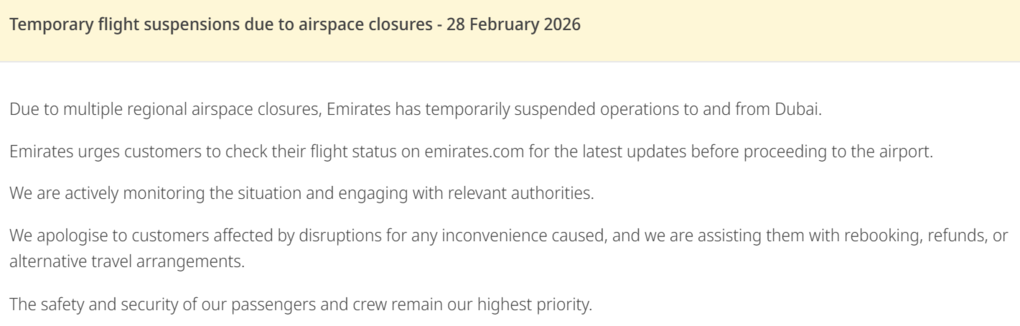
Emirates Airline said: “Regional airspace closures have caused disruption to several Emirates flights. We are actively monitoring the situation, engaging with relevant authorities, and adjusting our operations in line with the latest developments. Emirates adheres to all regulatory requirements and follows guidance issued by aviation authorities.”
Heathrow Airport, which has many connections to regional destinations, said, “Due to the ongoing situation in the Middle East and resulting airspace closures in the region, a small number of flights at Heathrow have been cancelled or delayed.”
British Airways said today: “We are closely monitoring the situation and have cancelled a number of our flights to the Middle East. Safety is always our top priority and we would never operate a flight unless it was safe to do so.
“If you are due to fly between London Heathrow and Abu Dhabi, Amman, Bahrain, Doha, Dubai or Tel Aviv, you can change your flight free of charge up to and including 6 March.”
Wizz Air has suspended all flights to and from Israel, Dubai, Abu Dhabi and Amman with immediate effect, up to and including 7 March and to and from Saudi Arabia until 2 March.
Many airlines have also suspended flights to and from Tel Aviv.
We will continue to report on the impact on travel, tourism and travel retail in coming days. ✈