

Airport development expert and historian Max Groot is the Editor of AirportHistory.org, which chronicles the development history of the world’s great airports. Here, as part of a wider series of articles on the history of New York John F. Kennedy Airport, he focuses on the design of the Pan Am Terminal, which architects began work on in 1956 and was completed 60 years ago. He describes it as one of the most iconic terminals of the 20th century.

Location
Before 1970, only the International Arrivals Building (IAB) had federal inspection facilities at New York’s Idlewild Airport (later renamed New York John F. Kennedy Airport), so all international flights, apart from a handful with pre-clearance facilities, had to arrive at the IAB.
Thus, the US’s two main international carriers, Pan American World Airways and TWA were allocated the sites immediately adjacent to the IAB.
A design challenge
Pan Am’s site was only 17 acres (6.9 hectares) and had a particularly short landside frontage.
In 1956, architects Walther Prokosch of Tippets-Abbett-McCarthy-Stratton, and Emanuel Turano of Ives, Turano & Gardner Associated Architects, designed a signature building finding a fresh approach to terminal design.
Most new terminal buildings at the time used piers and corridors to bring the passenger to the aircraft, before they boarded the aircraft by stairs, fully exposed to the elements.
The solution
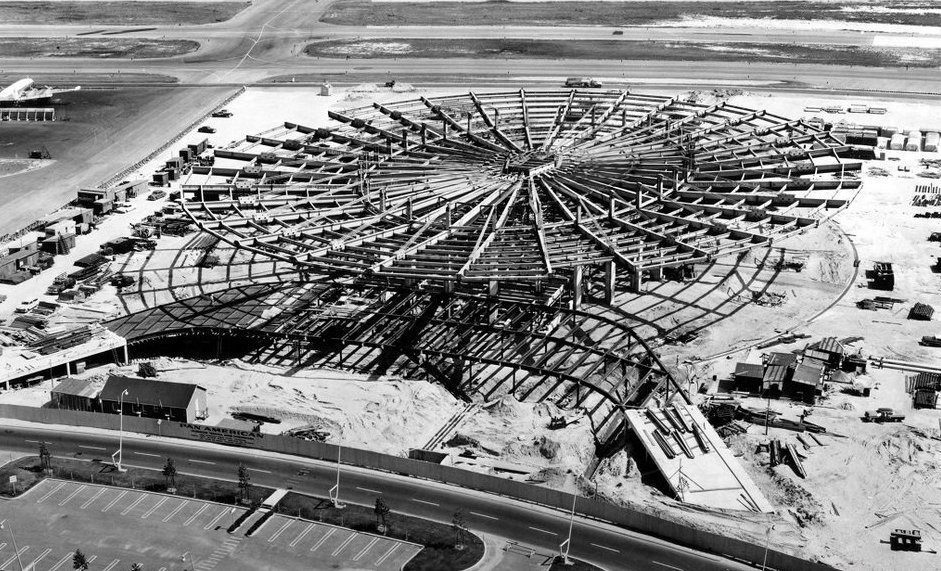
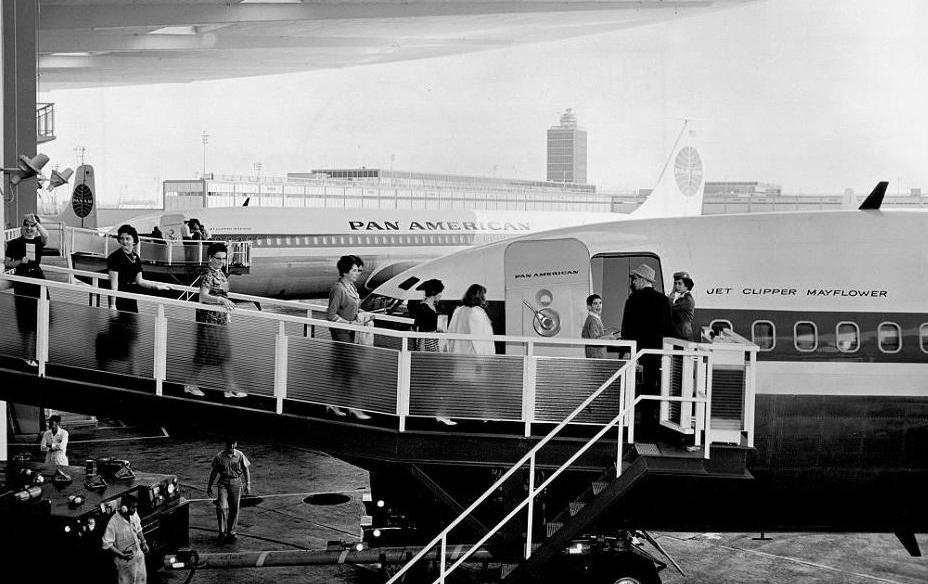
The architects did a new take on an existing concept – a large roof overhanging the aircraft ramp, pioneered at Berlin’s Tempelhof Airport in 1941. The roof would protect airplanes, passengers, ground staff, baggage, cargo and mail from the weather. Aircraft would park directly around the main building, “bringing the plane to the passenger”, as a marketing slogan proclaimed.
Six aircraft would parallel park under the canopy. Movable gangplanks would allow people to board directly from the glassed-in central lobby.
A rectangular structure containing lounges and administration offices protruded from under the roof. Three extra aircraft could park at the top of this structure during peak times, with passengers boarding via stairs.

Design changes
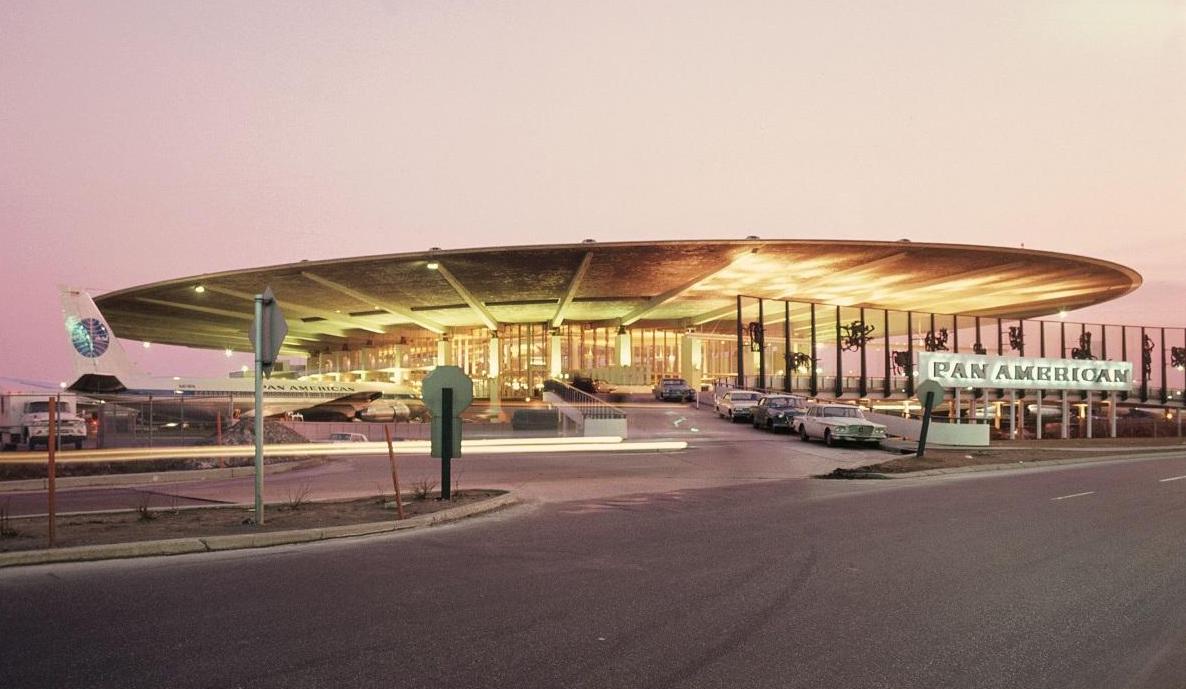
Later, several changes were made to the design. Parking parallel to the terminal proved unfeasible. Now the planes would park nose-in to the building. The boarding planks had to be re-designed accordingly. Also, the three extra gates at the end of the breakout were reduced to two and would be equipped with conventional boarding bridges.
In the final design, the terminal was capable of handling eight fully loaded 120-passenger Jet Clippers every hour. The terminal’s eight lanes of roadway could handle 60 to 62 cars every two minutes.
Inside, the layout was also changed. The proposed three rectangular islands with 48 check-in positions was changed to a two-step check-in. The terminal would incorporate innovations, such as a partially automated baggage system.
By May 1960, the work had been completed.
The passenger process
Passengers entered the terminal through an open entrance with an air curtain maintaining the building’s climate, a novel feature. Passengers checked their baggage at one of four islands and then proceeded to one of two seat selection points to complete the pre-check formalities. They could then wait in the lounge areas at the gates, step out onto the observation gallery, visit the concessions, or ascend to the mezzanine, which featured a cocktail bar, restaurant, coffee shop, bar, a nursery and the Clipper Hall Museum.
When flights were called, the adjacent lounge lights were dimmed and the gate doorway illuminated.
Arriving passengers entered the main concourse and descended to the ground level for baggage reclaim before proceeding to the arrivals roadway beneath the departures ramp.
Opening
Pan American’s terminal was the smallest of the airline terminals at the airport at 101,68sq ft (9,446 square meters). With a price tag of US$12 million, it was also the most expensive per square foot. The cantilevered roof was estimated to have cost an extra 25%.
The Pan Am terminal opened on May 24, 1960.
In that year’s annual architectural competition, sponsored by the Queens Chamber of Commerce, the terminal won a special award as Queens’ most outstanding structure.
Read the article in full and see many more original images from the Pan Am Terminal development here.

About AirportHistory.org: The website chronicles the development and history of the world’s greatest airports, from their modest beginnings. It claims to feature thousands of images that cannot be found elsewhere on the net, in magazines or books. It also rediscovers once bustling airports which have been closed and are now all but forgotten, as well as revealing spectacular plans for airports that were never built.