


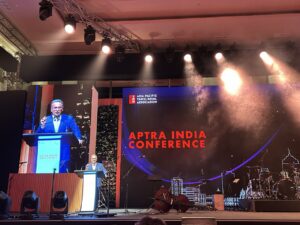
INDIA. The Asia Pacific Travel Retail Association (APTRA) India Conference took place in Bengaluru this week, hosted by Bangalore International Airport Limited.
The Moodie Davitt Report President Dermot Davitt has been on location and presents the main takeaways from a once again outstandingly successful event.
Below we bring you pictorial highlights before a more extensive report and analysis in our TFWA Asia Pacific show magazine in May and across our platforms.
[Note: While Duty-Free News International correctly describes itself as the official ‘exclusive media partner’, as appointed by APTRA, The Moodie Davitt Report is proud, once again, to bring readers an unrivalled quality of coverage from the event as a fully paid-up delegate.]
27 March
Journey to Jaipur: As a high-quality event closes on Friday afternoon, APTRA announces the 2027 India Conference will take place from 10-12 February in Jaipur, Rajasthan.
The event will be supported by Adani Airports and Ospree Duty Free, with 13 February also set aside for a social programme in the city.
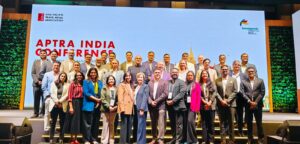
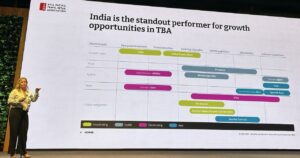



APTRA Executive Director Anne Kavanagh (above left) leads a great conversation about consumption trends among Indian travellers overseas with (from second left) TravConsult Co-Founder Lilly Choi-Lee, Heinemann Asia Pacific CFO Rajshree Dugar and Luxe Analytics Founder & CEO Dr Sheetal Jain.
Sheetal Jain assesses the “experience-led consumption shift”, the rise of Tier 2 city luxury travellers and other market drivers that will shape the travel retail opportunity.
Lilly Choi-Lee says that common mistakes made by international retailers with India travellers is that they behave like western counterparts simply because they speak English – but have many purchasing habit differences – and misunderstanding the Indian buying journey.
Rajshree Dugar talks about travel mood and its importance in the shopper trip, and about the vast diversity of the Indian traveller and how to speak to their range of needs.

A high-level panel of airport leaders – (from second left) Adani Airports CEO Arun Bansal; Bangalore International Airport Limited Managing Director & CEO Hari Marar; GMR CCO Non Aero Tarun Arora – talk about the ambitious design thinking of India’s extraordinary, culturally-rich airports with moderator, consultant Kevin Roche.
Each sets out the idea of creating experience and entertainment zones landside that become economic drivers for the region and enhance commercial gains at the airport.
On taking control of commercial and partnership with specialist concessionaires, Marar says, “There are things aligned with our strategic vision that we can do ourselves. We take pride in doing our hospitality as a strength but we don’t want to do everything. It should be a mix of high-quality partners alongside doing some things ourselves.”
Bansal adds, “We cannot compete with brands and are not a product company. We want to co-create success. Everyone should make money and their success is our success. Our new analytics platform (Aviio) will be shared with all brand partners so we can grow together.”
Encouragingly, each notes, incubating local brands is a key part of the airport’s role today, with the platforms that airports offer potentially helping local heroes to become global brands.

‘From movement to meaning’ is the lovely title of a short presentation by Bangalore International Airport Limited Chief Marketing Officer Shalini Rao (above) on what an airport should represent.
She talks about the “brand personality” of Kempegowda International Airport, about the importance of human interaction and warmth at scale, curating spaces for travellers to suit every mood and becoming a destination of choice not only for flyers but for locals.
“We’d like everyone to leave us with a strong feeling, something they’d like to talk about and share, something that feels like BLR.”

26 March

Would you let AI run your (travel retail) business? That is the pointed question asked in a ‘think tank’ pulled together to examine the role of AI in our sector, led with verve and welcome feisty provocation by Voiceback Analytics CEO Shubhra Misra.
Speakers include (pictured from left) GMR Duty Free Head Marketing Abhijit Das; incoming Bacardi Global Travel Retail Managing Director Charlotte Rann; Avolta Chief Digital, Data and Technology Officer Vijay Talwar; Cococart Chief Operating Officer Mudit Srivastava; and SAP APAC Regional Head of Artificial Intelligence Varun Thamba.
Vijay Talwar declares an emphatic ‘no’ to the above question, highlighting the importance of human input and the slow adoption of new technology that comes from the power of long-standing habits. He also makes the powerful point that physical retail has bounced back since Covid, which in turn says something about the need for human connections. “The power of AI is to get it into the hands of our front line people.”
“The sweet spot is what AI and humans can do together,” says Abhijit Das.
“AI has a role but not as CEO,” says Charlotte Rann. “It will help us save time, spending that time on building our brands. I am not sure AI is going to build our brands for us as it only puts out what we put into it. It’s hard to get past the power of emotional connections, which we build our brands’ reputation on. It’s hard to see how AI can take the place of the human, but it can provoke better discussions and offer data that helps us think things through.”
Summarising the views of most, Mudit Srivastava says that AI can help improve efficiency, but should not be a driver of big business decisions.
This has been a fun final plenary session of the afternoon, closing off with a lively (bordering on heated) conversation around AI, discounting and dynamic pricing.

‘Laboratories of luxury’ is the snappy title for a session led by well-known Indian industry figure Manishi Sanwal (above left). Speakers include (above from second left) Delhi Duty Free CEO Chiragh Oberoi; GMR Duty Free CEO Regional Duty Free Kishore Devarakonda; Rémy Cointreau CEO Global Travel Retail Fida Bou Chabkel Ospree Duty Free COO Shah Nawaz Khan; and Bangalore International Airport Limited VP Hospitality & Bangalore Airport Services Limited CEO George Kuruvilla.
The session delivers a welcome and candid conversation with stakeholders across the Trinity on how to ensure luxury can succeed across price points, consumer groups and brand needs.
Key questions that the channel has long grappled with: how do we in duty free manage the mix and appeal of high-end and lower-end appeal of luxury, velocity of sales on one hand versus ensuring a memorable experience on the other; space versus adjacency and impulse versus planned shopping?
Chiragh Oberoi notes that zoned merchandising is one way of addressing the tensions these questions raise; others involve strong brand story-telling and ensuring staff are expert in the brand or category.
Speaking on the challenge of handling luxury at smaller scale airports, Kishore Devarakonda says brand support is critical, but so too is managing brand expectations, with a model between retailer and supplier required to fit new (and many existing) airports that emerge to serve demand.
On how to manage time-poor travellers when also seeking to make high-end sales, Fida Bou Chabke says that building relationships is one element. “Staff are instrumental. In luxury you don’t hard sell, but you tell the story based around history, liquid and craft. You can take it further via your CRM and offer experiences beyond the airport so the touchpoints can continue.”
A huge challenge facing Indian airport lounges is demand often outstripping supply. George Kuruvilla says that a diversified offer is key and that luxury can be pitched at levels that ensure all consumer groups can be satisfied.
“Every zone offer a different experience, whether it’s chef-led cooking or a cocktail or simply silence before you fly,” he says. In tailoring the lounge offer yet more deeply for new demand, Kempegowda Airport has created its own Gen Z-focused lounge, which Kuruvilla describes as a world first.
Inspired by and curated for Gen Z, it has a different curation to other lounges, he notes. “Experience is the product, monetisation is the outcome.”
A call-out for brands from Shah Nawaz Khan – as Ospree Duty Free renovates its departures stores at Mumbai International Airport – is to understand that not everyone can have all they want. “Adaptability is needed and there is also evolution [of brands]. We are rezoning to ensure the correct adjacencies. What we can say is that we are working to end up with a better customer experience.”


Bangalore International Airport Ltd VP, Regulatory & Business Development Shobhit Agarwal (below left, one of many excellent guest moderators) leads a terrific conversation with Air India Chief Marketing Officer Sunil Suresh (pictured below right) that lends a further upbeat note about India’s aviation future.
Air India has an order book of around 600 aircraft, with a new aircraft coming into play around every six days for the next couple of years from 2027. “But we can only win if we provide a superior experience,” says Suresh. “We are on a multi-year transformation programme. Last year we concluded a refit of our domestic aircraft, now wide-body is following, with premium economy introduced and communicated widely.”
Suresh says that loyalty – if applied in meaningful ways for the consumer – will be a big part of the future of travel retail, with a play on leveraging partnerships beyond airports. For example, Air India has struck a commercial alliance with Bicester Village, the outlet shopping centre in Oxfordshire, which is now drawing many Air India flyers to the location during their UK visits.
And how about this for big thinking? “We see the opportunity for our loyalty programme to be the second currency of India, after the Rupee,” says Suresh. “But it must be usable, redeemable and part of an wider eco-system. That’s why we must all collaborate to create the right partnerships.”
He is bullish on duty free but notes that operationally it presents issues, taking up space and burning fuel. “We see the future as a hybrid system, where we can present tailored offers, with fulfilment at the right place in the journey, through partners who can help us.”
One key message from Suresh: Air India will be the country’s global, premium, full-service carrier in the long term and will help position India as a hub linking east and west in years to come, as long as regulatory and investment challenges can be addressed quickly.

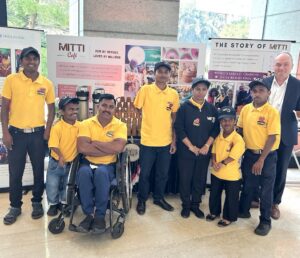
APTRA uses the platform of its India event in a fine way to cast a spotlight on the work of cleft charity Smile Train, which has positively changed lives through over two million surgeries in 75 countries since its founding in 1999.
Smile Train Project Director at Bhagwan Mahavir Jain Hospital in Bengaluru Dr Krishnamurthy Bonanthaya (below left), who has performed over 15,000 surgeries in the past 25 years, eloquently outlines the impact of the charity, not only in performing surgeries, but in supporting those afflicted in becoming full members of society.


Movingly, we also hear from two young women who have been through his surgery and are now pursuing business studies in university and have aspirations to work in the aviation sector.
APTRA also launched a silent auction with proceeds going directly to Smile Train, with a range of prizes and experiences donated by event partners on offer. This fund-raising drive will culminate in a public auction at the Gala Dinner tonight.

A big highlight of the day comes as Adani Airports CEO Arun Bansal talks about “democratising data”, critically through a new innovation, Aviio by Ospree.
This represents a huge investment in understanding detailed sales and promotional performance, improving availability and lifting basket sizes.
Bansal says, “We only succeed if our partners – operators and brands – can make money here in India. We have researched our travellers – 100 million people through our airports represent a good sample size – and we are launching this in the market for your benefit, to use this data to grow your market share at airports in India.” Full story to come.

BIAL CFO Bhaskar Rao (above centre) leads a fascinating conversation on how investors view the Indian aviation opportunity, with BCG India MD & Partner Anshul Gupta (left) and BIAL COO Girish Nair.
On the public-private partnerships (PPP) model, and whether its success can extend from major cities to lower-tier airports, Gupta says it can work but must involve tailored risk-sharing with governments. PPP projects are planned for 25+ airports in India. “For these to work we need commercial bundling of more attractive airports with smaller locations, we must look at the financial modelling of these agreements, and real estate monetisation is such as growth driver that we need more land to be acquired and made use of close to these airports.”
To encourage overseas investment we must “de-risk” investment with more on-time, at-cost delivery of land purchases and certainty and consistency in the investment process, alongside ensuring clear exit pathways for investors. “Global capital wants predictability and comfort,” adds Nair.
Nair says that investors will be eyeing how to unlock airport value through better creation and execution of non-aeronautical opportunities alongside a solid, stable aeronautical base. Valuations today are largely built around projections for non-aeronautical activities, from in-terminal retail to land assets, stresses Gupta.
A persistent theme is how India can move from a vast, largely domestic market, to a global market with hub airports built on international traffic connectivity to rival the Middle East.
Nair says, “We need a large, strong home carrier to exploit the potential, which we have now (in Air India), but beyond that it is about all stakeholders coming together like Doha or Dubai have done. We are going in the right direction but it is a question of how long it takes.”
Gupta adds, “Every delayed or lost piece of baggage loses trust and makes you think about transferring at an airport. We have the infrastructure, now it’s about mapping the right journey design, meaning connection between terminals, fast baggage movements, predictable security, coordination between airlines. It all needs to come together.”
Asked what locations Indian airports should look to for inspiration, both cited Changi for experience, while Nair highlighted Dubai for how it manages scale.
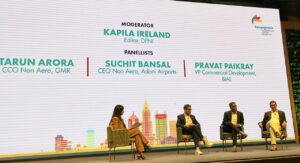
BIAL Vice President & Bengaluru Airport City Limited CCO Avishek Bambii Das and Bangalore International Airport Ltd Vice President Commercial Development Pravat Paikray bring one of the world’s great airports wonderfully to life on stage in their joint keynote. They take guests on a breezy journey – in words, images, video and a lovely dash of humour – through the rise of the airport from 8 million travellers in 2008 to 48 million a year today.


T2 is not only a terminal, it’s the “pride of our country”, says Paikray, referencing an arena that houses art, culture, food and dining all inspired by Benguluru.
The event staging also nicely represents the Garden City of Bengaluru; note the greenery in the backdrop to the on-stage screens.

25 March