


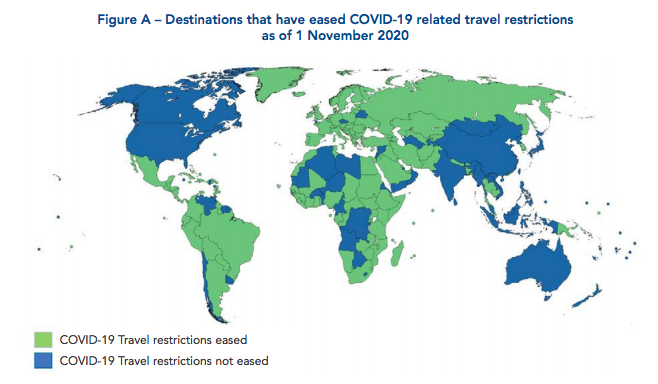
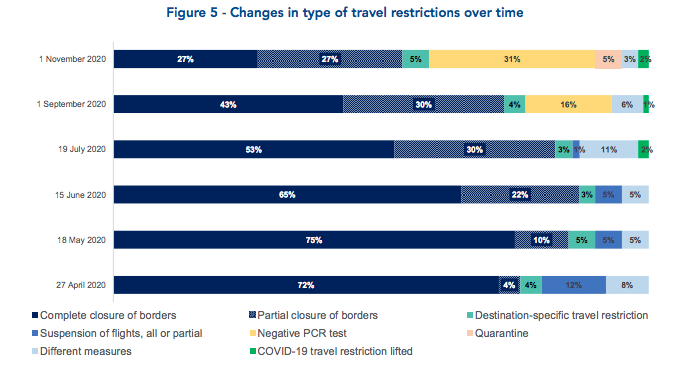
INTERNATIONAL. By 1 November, 70% of global destinations had eased restrictions on travel introduced in response to the COVID-19 pandemic. In comparison, just one in four destinations remain fully closed to international tourists. That’s according to the latest UN World Tourism Organization (UNWTO) Travel Restrictions Report, released today.
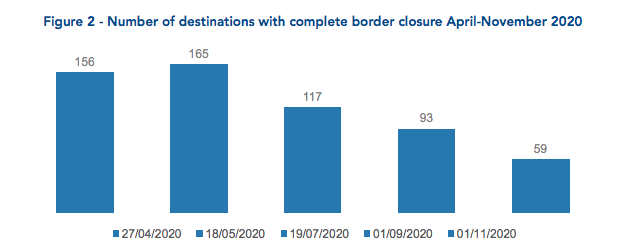
Of 217 destinations worldwide, 152 have eased restrictions on international tourism, up from the 115 recorded on 1 September. But 59 destinations have kept their borders closed to tourists, a decrease of 34 over the same two-month period.
UNWTO Secretary-General Zurab Pololikashvili said: “The lifting of travel restrictions is essential to drive our wider recovery from the social and economic impacts of the pandemic. Governments have an important part to play in giving data-led and responsible travel advice and in working together to lift restrictions as soon as it is safe to do so.”
The report sheds light on the factors connecting those destinations which have eased restrictions and those where borders remain closed. The study found that destinations with higher scores in health and hygiene indicators as well as on the environmental performance index are among those to have eased restrictions faster.
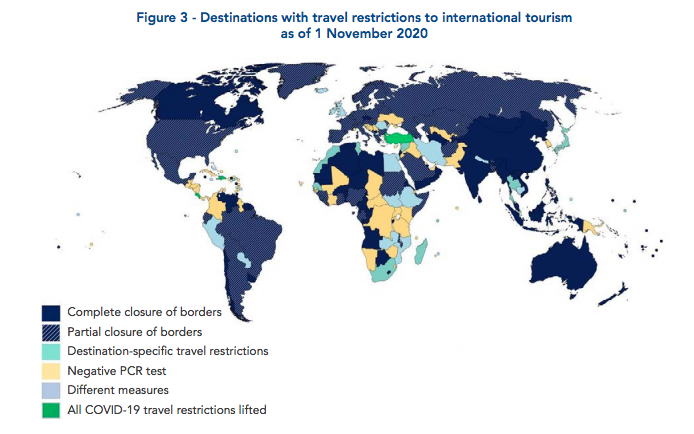
In comparison, destinations choosing to keep their borders closed tend to be within emerging economies with relatively low scores in health and hygiene indicators and environmental performance index. The majority of these destinations are in Asia and the Pacific, with many belonging to the SIDS (Small Island Developing States), LDCs (Least Developed Countries) or LLDCs (Landlocked Developing Countries).
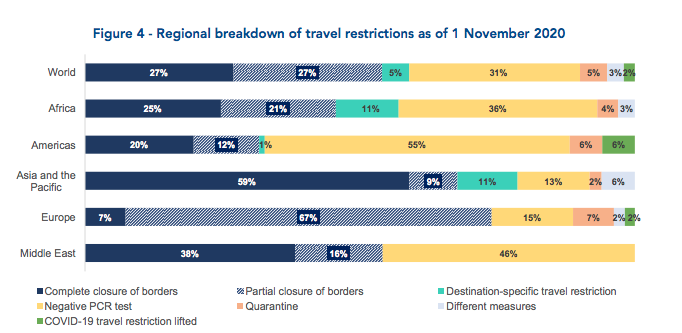
Europe continues to lead the way in lifting or easing travel restrictions followed by the Americas, Africa and then the Middle East, said UNWTO. Asia and the Pacific continues to be the region with the fewest travel restrictions eased and more complete border closures in place for international tourism.
 The report also highlights the important role governments can play in restarting tourism, said UNWTO. Out of the ten biggest tourism source markets, four (representing 19% of all outbound trips in 2018) have issued guidance advising against all non-essential international travel. The other six (representing 30% of all outbound trips in 2018), however, have issued more nuanced travel advisories, basing their guidance on evidence-based risk assessments.