


SPAIN. Airports group Aena posted an increase in revenues and profit for the first half of 2026, but warned of “limited visibility” for the second half as airlines’ fuel hedges expire and amid continuing uncertainty caused by war in the Middle East.
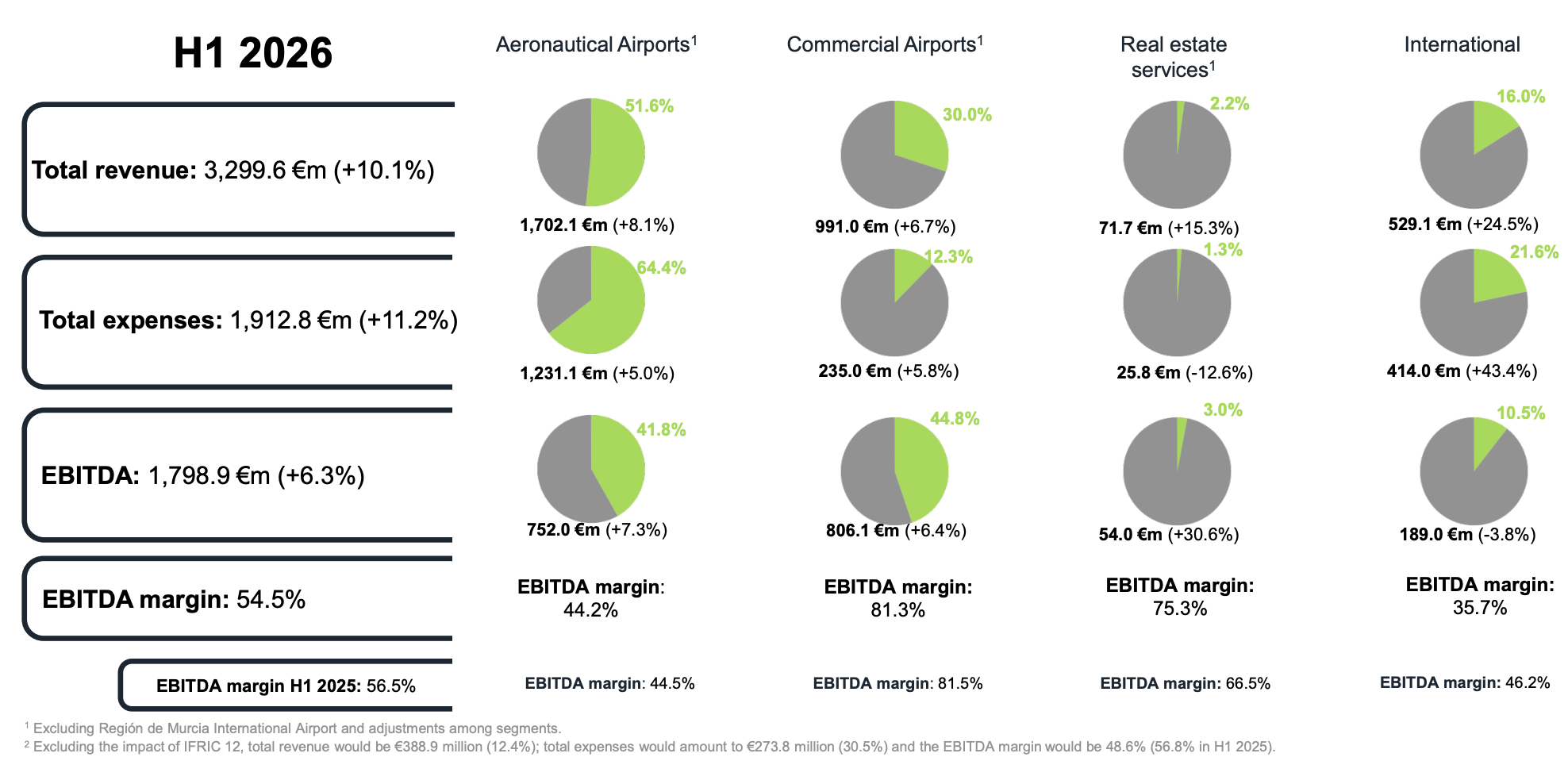
Consolidated revenue for the first half reached €3,299.6 million, a rise of +10.1% year-on-year, with EBITDA climbing +6.3% to €1,798.9 million and net profit up +12.1% to €1,002 million.
Commercial revenue across the group reached €991 million, up +6.7% year-on-year, with gross sales climbing +5.9%. Sales per passenger saw an uplift of +2.1% year-on-year in the half. Revenue to Aena from fixed and variable rents invoiced posted a +9.6% increase in the period.
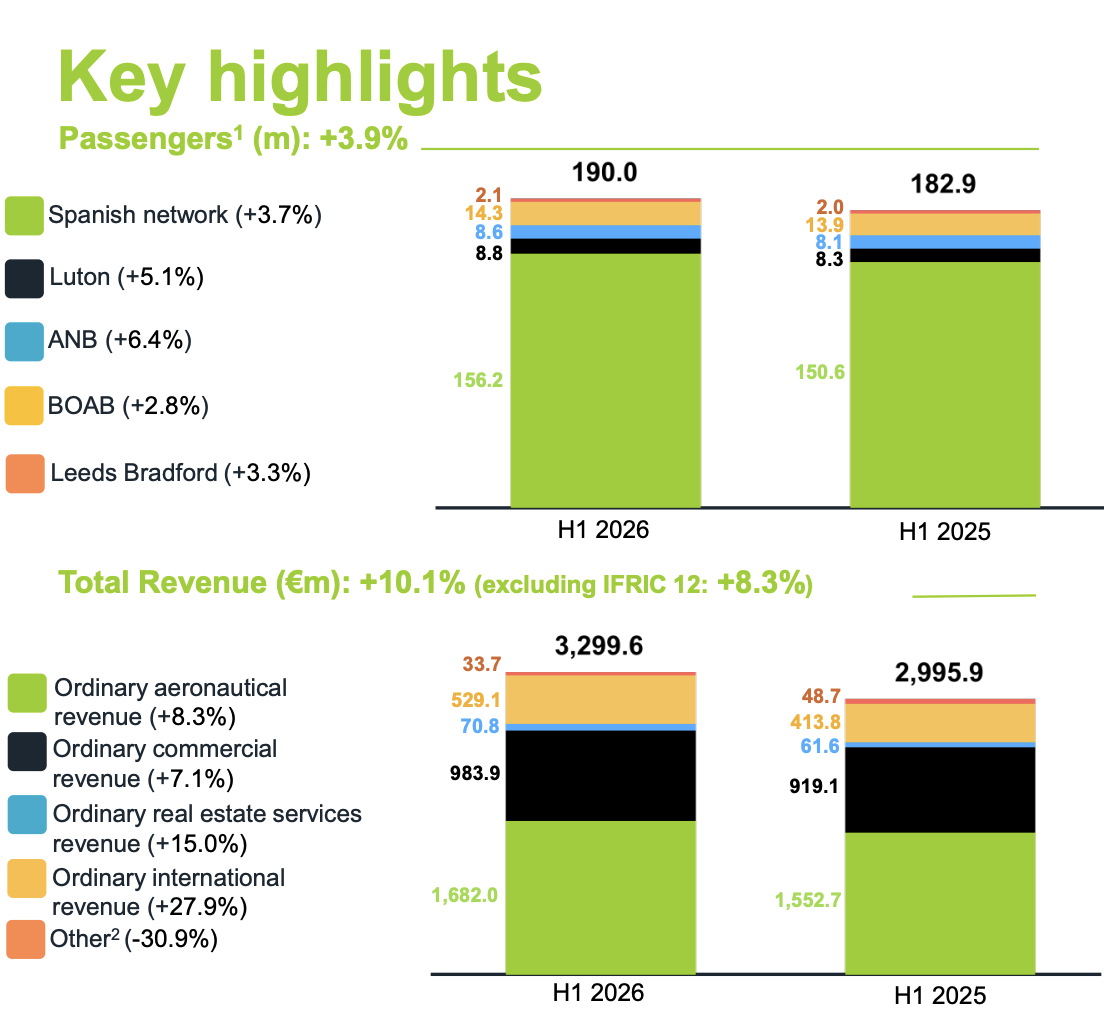
Passenger traffic across the Aena Group grew +3.9% year-on-year to 190 million with airports in the Spanish network alone showing an increase of +3.7% to 156.2 million.
Aena also highlighted improved terms from commercial contracts awarded in the period. In food & beverage the Minimum Annual Guarantee (MAG) from contracts struck in the first half represents an increase of +11% in 2027 and +37% in 2028, each compared to 2025.
In speciality shops the MAG from contracts awarded in the first half of 2026 represents an increase (compared to 2025) of +82% in 2027 and +83% in 2028.
Looking ahead, Aena underlined the difficulty of making accurate projections in an uncertain market.
A statement said: “Before the Strait of Hormuz crisis, traffic trends were in line with Aena’s forecasts, with growth rates of under -3%. However, following the crisis, there has been a temporary diversion of traffic to Spain, which is regarded as a safe tourist destination. Certain constraints on rail transport are also occasionally diverting passengers to air travel.
“Within this scenario, Aena estimates that traffic growth in 2026 could stand at around +3%, compared to 2025. However, these annual forecasts take these specific circumstances into account and, above all, it should be noted that the lack of visibility that is characterising the second half of this year, which is resulting in the expiry of fuel hedges and high uncertainty regarding the conflict in the Middle East.
“Signs of weakness may already be seen in the load factor, which translates into actual traffic growth, is lagging behind seat capacity growth, and is affecting trends in the capacity offered by airlines.” ✈