

Why parking, mobility and e-commerce are becoming part of the airport retail journey
By Chris Wortley MBA
Airport Commercial & Mobility Advisor, Airport Mobility Partners*
Fifteen years ago, I wrote an article for The Moodie Report (as it was then known) about airport car parking and the need to think about it as more than a place to leave a vehicle.
The industry has changed enormously since then.
Customers now shop, compare, book and pay on a smartphone. Dynamic pricing is commonplace. Automatic number plate recognition can make entry almost invisible. Barrierless systems are removing physical friction. Airports can know far more about the customer before they arrive than was imaginable when I wrote that first article.
And yet one fundamental issue remains.
Many airports still manage parking largely as an infrastructure asset when it increasingly behaves like a digital retail product.
That distinction matters.
Because for a significant proportion of passengers, parking is not simply the first physical airport asset they encounter.
It is often the first airport product they search for, compare and buy.
Airport retail, therefore, may begin much earlier than we traditionally think.
It may begin weeks before departure.
At home.
On a mobile phone.
With a search for airport parking.
Munich offers an interesting glimpse into the direction of travel
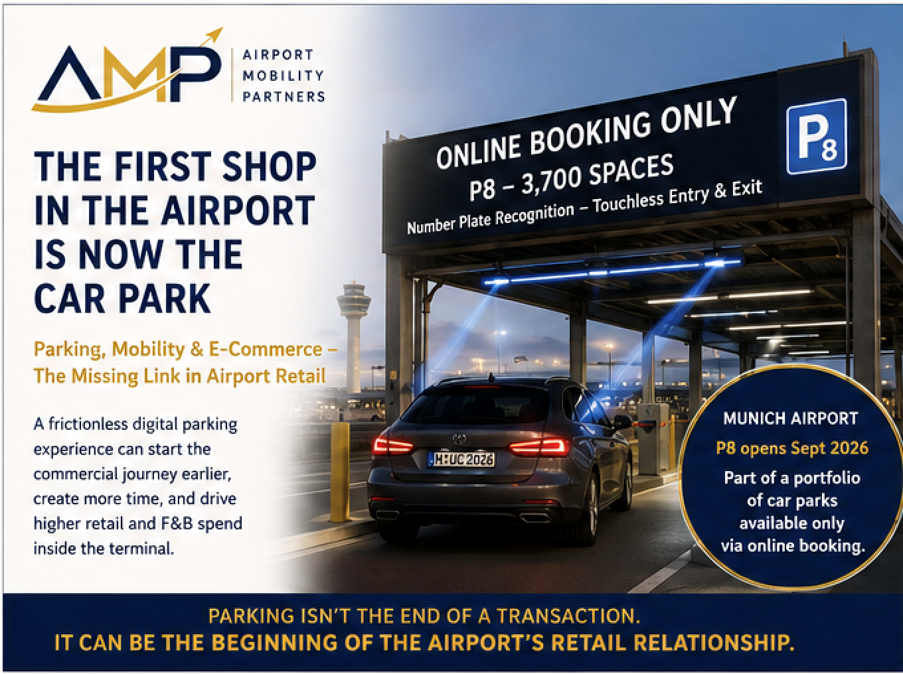
Munich Airport provided a timely example recently with the opening of its new P8 parking facility.
The new car park provides around 3,700 spaces in a central location between Terminals 1 and 2.
Customers can book online at preferential rates and, where their number plate is registered, access the facility using automatic recognition rather than relying on the traditional ticket process.
Elsewhere within Munich’s parking estate, several Economy parking products are available only through online reservation.
That is an important evolution.
The physical space still exists.
But commercially, access to parts of that inventory is increasingly controlled through a digital channel.
The customer searches.
The customer compares.
The customer chooses.
The customer pays.
The airport allocates inventory.
The vehicle is recognised when it arrives.
The physical product has effectively been transformed into digital inventory.
That is much closer to retail than traditional car-park management.
And once parking becomes digital inventory, airports can manage it very differently.
They can determine which product the customer sees.
At what price.
At what point in the booking window.
Through which channel.
With what cancellation terms.
With what additional benefits.
And alongside which other airport products.
The parking space has effectively become an airport SKU.
Having a booking engine does not necessarily mean having an e-commerce business
Most sizeable airports today allow customers to reserve parking online.
But there is an important distinction between operating a reservation system and operating a sophisticated e-commerce business.
A reservation system answers:
Can I book a parking space?
A mature e-commerce platform should answer many more questions.
What is the customer trying to achieve?
Which product is most relevant?
How price-sensitive are they?
How far ahead are they booking?
Should we lead with price, convenience or flexibility?
Which inventory should we sell now?
Which should we protect?
What happens when the first-choice product is unavailable?
Where are customers abandoning?
Are mobile customers converting differently from desktop users?
What is the true cost of acquiring the booking?
Should this customer be encouraged to trade up?
Would they pay for flexibility?
Could we sell another relevant airport product at the same time?
Those are not parking-management questions.
They are retail questions.
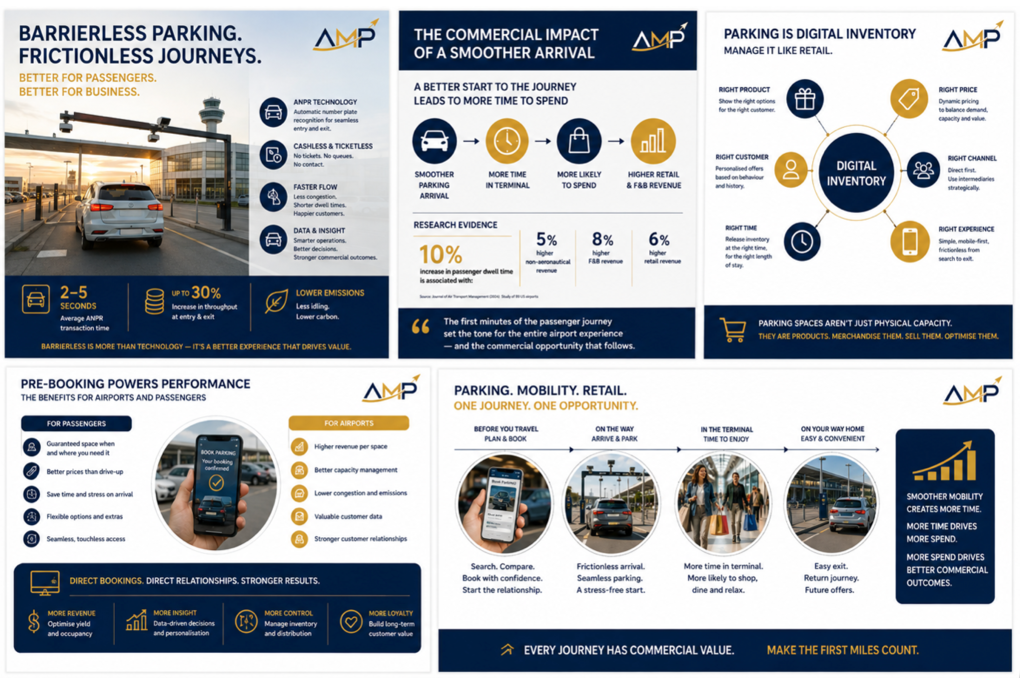
We should merchandise parking like a retail product
Airports have spent decades becoming very sophisticated at terminal retail merchandising.
Presentation matters.
Location matters.
Range matters.
Price architecture matters.
Choice matters.
Consumer psychology matters.
Yet airport parking products can still be presented in terminology created around operational infrastructure.
P1.
P2.
P3.
Long Stay.
Mid Stay.
Short Stay.
Economy 2.
The problem is that customers do not naturally think like that.
They think:
Cheapest.
Closest.
Covered.
Easiest.
Premium.
Valet.
I am travelling with children.
I have six bags.
My flight leaves at 06:00.
I don’t want to wait for a bus.
My plans might change.
That is the language of customer intent.
A modern parking proposition should therefore merchandise around needs, not simply infrastructure.
For example:
VALUE
Best price. Transfer included.
WALK
Park and walk directly to the terminal.
PREMIUM
Closer, faster and more convenient.
VALET
Drive to the terminal and hand over the vehicle.
Now we are starting to talk to the customer rather than asking them to decode our estate.
The same principle applies to digital merchandising.
“Most popular.”
“Best for families.”
“Closest to departures.”
“Only £15 more for a two-minute walk.”
“Free cancellation included.”
“EV charging available.”
Retailers would consider this basic merchandising.
Airport parking should too.
The airport parking funnel deserves far more attention
One of the most important questions in parking today is not:
How many bookings did we receive?
It is:
How many customers tried to book and did not complete the transaction?
That changes the conversation.
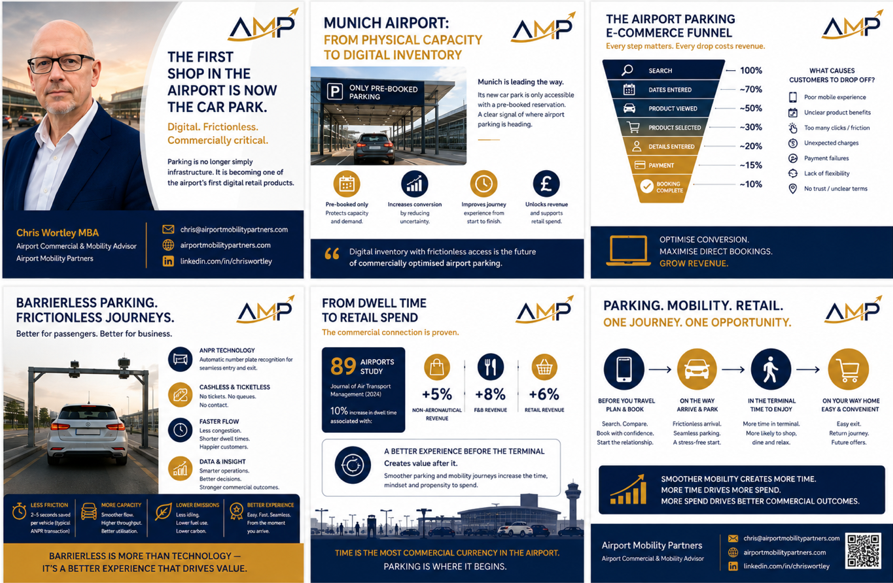
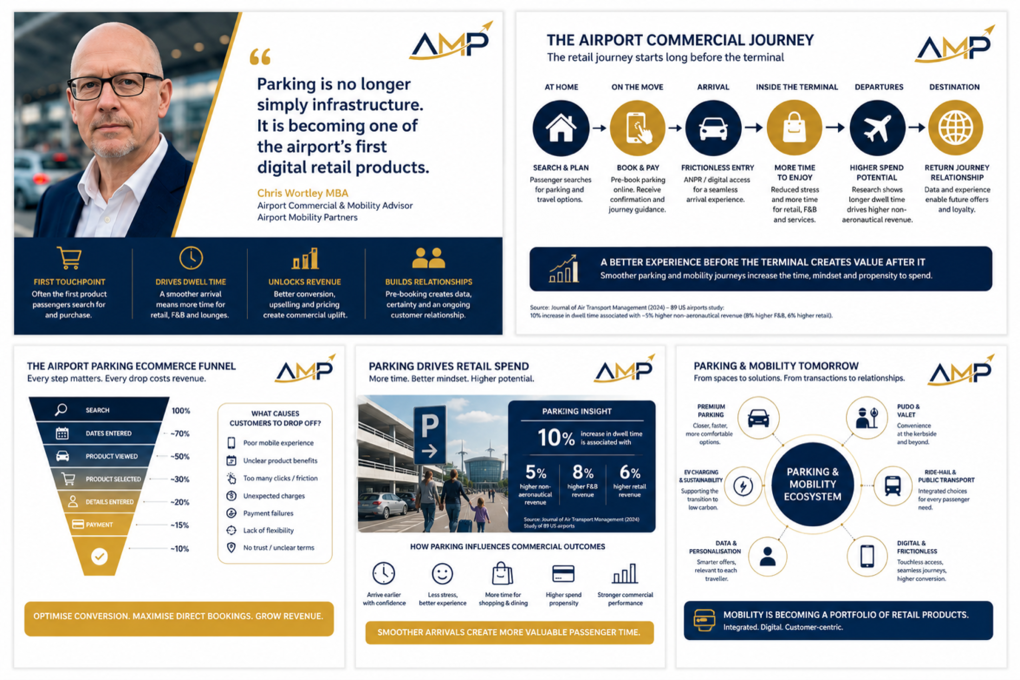
Consider a typical digital funnel:
Search.
Landing page.
Travel dates entered.
Products displayed.
Product selected.
Extras.
Customer details.
Payment.
Confirmation.
Every stage potentially leaks revenue.
A customer may leave because the website is slow.
The products may be confusing.
Mobile functionality may be poor.
The calendar may be difficult to use.
The price may change unexpectedly.
A preferred product may appear unavailable without a sensible alternative.
Cancellation terms may be unclear.
Payment may fail.
The customer may simply decide it is easier to use an aggregator.
Airport commercial teams should know where this happens.
By device.
By acquisition channel.
By product.
By lead time.
By customer type.
By price point.
By day of week.
By time of day.
And ideally by customer intent.
A parking booking funnel should be treated with the same seriousness as any other major e-commerce funnel.
Because spending significant money acquiring traffic only to lose customers during checkout is not a parking problem.
It is a conversion problem.
The mobile experience now matters enormously
A large proportion of customers interact with airport parking on a mobile device.
That brings a very different behavioural environment.
The customer might be simultaneously checking a flight, discussing travel plans, comparing another parking provider and dealing with family arrangements.
Their tolerance for friction is very low.
An airport may have only seconds to establish three things:
I have the right product.
I understand the value.
I trust the transaction.
Any unnecessary complication creates an opportunity for somebody else to win the customer.
That could be another airport product.
An off-airport operator.
An intermediary.
Or a different mode of transport entirely.
Digital friction therefore has a very real commercial cost.
Barrierless parking should mean more than removing the barrier
There is considerable excitement around barrierless parking, ANPR and free-flow access.
And rightly so.
They can remove tickets.
Reduce physical interaction.
Simplify entry and exit.
Improve traffic flow.
Create a much cleaner passenger experience.
But I would argue that the physical barrier is only one barrier in the journey.
The customer may already have encountered several others.
A confusing website.
Poor product descriptions.
An awkward booking process.
Inconsistent terminology between the website and road signage.
Unclear directions.
Difficulty finding the correct entrance.
A booking that the customer is uncertain has been recognised.
True frictionless parking therefore begins long before the car reaches the entry lane.
The complete journey is:
SEARCH → SELECT → BOOK → PAY → NAVIGATE → RECOGNISE → PARK → WALK → TERMINAL
Every unnecessary interruption in that chain is friction.
And every piece of friction potentially destroys value.
Why should airport retailers care about any of this?
This is where I believe the argument becomes much more interesting.
Airport commercial teams have spent years thinking about dwell time.
We want passengers through formalities efficiently.
We want security processes to work.
We want people relaxed.
We want them to have enough discretionary time to browse, eat, drink, use lounges and engage with the commercial environment.
There is sound evidence behind that.
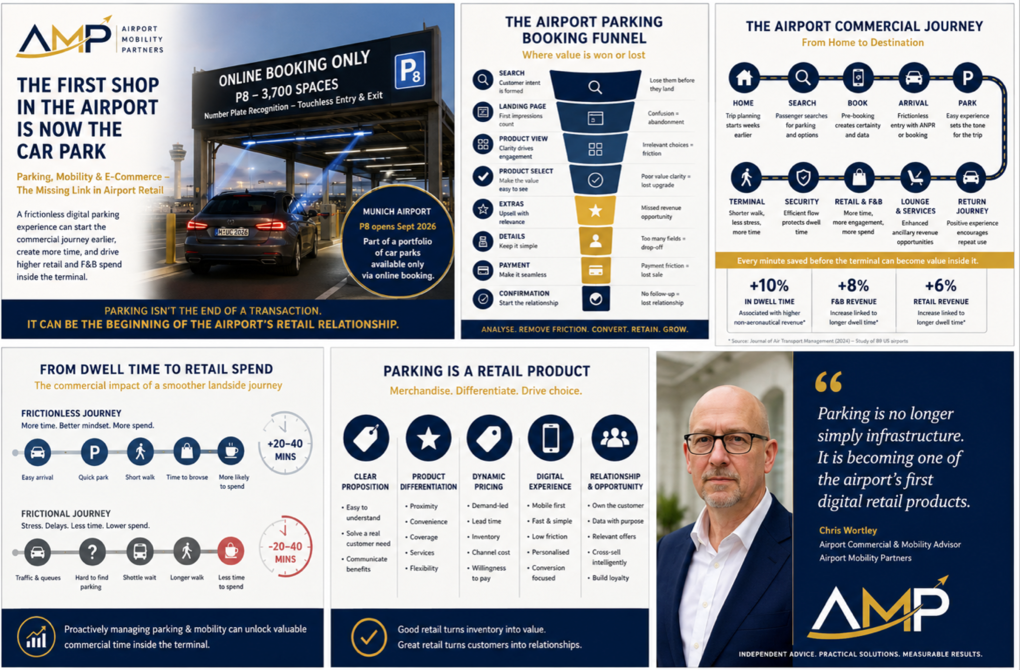
Academic research using passenger dwell-time data from 89 US airports found that greater dwell time was associated with stronger non-aeronautical revenues.
A 10% increase in dwell time was associated with approximately:
+5% higher overall non-aeronautical revenue.
+8% higher food & beverage revenue.
+6% higher retail revenue.
That should interest anybody managing airport commercial performance.
But it also raises another question.
If time inside the terminal is commercially valuable, why do we concentrate almost exclusively on protecting it inside the terminal?
What happens before the passenger reaches the front door matters too.
Two passengers. Same flight. Very different commercial opportunities.
Imagine two passengers leave home at exactly the same time.
Passenger A has booked directly with the airport.
They know exactly which car park they are using.
The confirmation includes clear directions.
Their vehicle registration has already been captured.
When they arrive, the vehicle is recognised.
There is no ticket.
No uncertainty.
No need to find a payment machine.
The pedestrian route is obvious.
They reach the terminal calmly and efficiently.
Passenger B has a very different experience.
They are unsure which entrance to use.
Roadside terminology does not match what they remember seeing online.
They circle once.
They enter the wrong lane.
They have to reverse out.
They eventually find the correct parking facility.
The available space is further away than expected.
There is a transfer wait.
They reach the terminal 20 minutes later than Passenger A.
Both eventually clear security.
But are these passengers commercially equivalent?
Probably not.
One has time.
The other is recovering time.
One may browse.
The other may head straight for the gate.
One may sit down for breakfast.
The other may grab a coffee and run.
One arrives relaxed.
The other arrives frustrated.
That matters.
Perhaps airports should measure ‘Lost Commercial Dwell’
We measure passenger dwell time.
Perhaps we should also begin measuring Lost Commercial Dwell.
How many potentially valuable terminal minutes are being lost before the passenger reaches the terminal?
Parking queues.
Traffic circulation.
Confusing signage.
Shuttle waits.
Pedestrian routes.
Congested pick-up and drop-off facilities.
Entrance problems.
Payment issues.
Valet handover.
Landside friction rarely appears in the retail director’s performance dashboard.
But perhaps some of it should.
Because the passenger does not experience an airport organisational chart.
They experience one airport.
If ten minutes are lost outside the terminal, the retail environment cannot recover those ten minutes later.
This is why parking and mobility should increasingly form part of the wider airport commercial conversation.
Pre-booking creates something even more valuable than revenue: a relationship
The commercial significance of pre-booking is not limited to securing revenue before arrival.
It gives the airport information.
The airport may know:
When the passenger intends to arrive.
How long they are staying.
Which product they selected.
What they paid.
Their vehicle registration.
Their terminal.
Potentially their airline or flight.
Whether they have booked previously.
Whether they selected flexibility.
Whether they responded to a promotion.
That is significantly more valuable than an anonymous drive-up transaction.
One is a parking payment.
The other can become a customer relationship.
And that relationship should not necessarily end when the parking confirmation email is sent.
What happens after the parking booking?
This is where I believe airports still leave substantial value on the table.
A customer books seven days of parking.
The airport now knows they are travelling.
The customer’s attention is focused on their journey.
The transaction is complete.
What happens next?
Frequently:
“Thank you for booking your parking.”
Then silence.
Why?
Why should a parking booking not become the beginning of an intelligent airport retail journey?
Perhaps the customer may value:
Fast Track.
A lounge.
Food pre-order.
Retail offers.
EV charging.
Valet.
Car wash.
Premium arrival services.
Click & collect.
Dining reservations.
Not every customer should receive every offer.
That would simply create noise.
But relevant cross-selling is exactly what sophisticated digital retailers do.
Parking may therefore provide the airport with one of its earliest opportunities to establish a direct commercial relationship with a passenger.
That makes it strategically important far beyond the parking P&L.
Airports also need to understand the economics of direct and intermediary bookings
Aggregators and intermediaries have an important role.
They generate demand.
They invest heavily in search marketing.
They allow customers to compare products.
They can introduce customers to airport parking who might otherwise choose a different option.
There is nothing inherently wrong with distribution.
Hotels use it.
Airlines use it.
Retailers use it.
But airports should distinguish between incremental demand generated by an intermediary and demand the airport could reasonably have converted itself.
If a customer searches specifically for an airport’s official parking but ultimately books the airport’s own product through an intermediary because the intermediary’s digital experience was easier, that is a very different commercial equation.
The solution is not necessarily to remove distribution.
It is to make the airport’s own proposition competitive.
Direct customers bring more than commission savings.
They bring data.
Relationship.
Remarketing potential.
Cross-sell potential.
And greater control of the customer experience.
Revenue management also needs to evolve
Many airports now dynamically price parking.
That is progress.
But dynamic pricing alone is not sophisticated revenue management.
A modern parking commercial model needs to connect:
PRICE × CAPACITY × CONVERSION
Pricing tells us what the customer paid.
Capacity tells us what was available.
Conversion tells us whether the customer bought.
All three matter.
Imagine premium parking repeatedly sells out 14 days before departure.
Was the price too low?
Was too much inventory released too early?
Should capacity be expanded?
Was another product poorly positioned?
Could customers have been traded into an alternative?
Could the airport create a product between standard and premium?
Revenue management should therefore be connected to product management and digital conversion.
Otherwise we optimise only one part of the problem.
Flexibility is itself a retail product
Travel plans change.
Airlines and hotels have understood for years that customers place different values on flexibility.
Airport parking can do the same.
Some customers want the absolute lowest price and are prepared to accept restrictions.
Others will pay for the ability to cancel.
Others may pay more for late-return protection.
Some may value a premium product that combines convenience and flexibility.
The key is not necessarily to create endless complexity.
It is to recognise that customers have different willingness to pay for different attributes.
Again, this is familiar retail territory.
Parking is also becoming mobility
The next stage goes beyond the private car.
Airports increasingly need to think about the entire landside commercial ecosystem:
Parking.
Drop-off and pick-up.
Taxi.
Ride-hail.
Rail.
Bus.
Coach.
Rental cars.
Chauffeur services.
Valet.
EV charging.
Shared mobility.
Future autonomous mobility.
The important commercial unit may therefore no longer be the parking space.
It may be the passenger journey to and from the airport.
That creates new opportunities.
Some revenue will be space-based.
Some transaction-based.
Some commission-based.
Some subscription-based.
Some data-enabled.
And some may not involve parking a vehicle at all.
This is why the language is increasingly shifting from simply airport parking to Parking & Mobility.
A useful question: what would Amazon change?
Sometimes I ask airport teams to imagine Amazon operating their parking business.
Would it call its products P1, P2 and P3 and expect customers to work out the difference?
Would it ignore what somebody searched for?
Would it show an unavailable product without recommending an alternative?
Would it regard mobile conversion merely as an IT statistic?
Would it allow customers to abandon a basket and learn nothing from it?
Would it collect valuable customer data and then end the relationship immediately after purchase?
Would it fail to recommend another relevant product?
Of course airport parking is not Amazon.
Nor should it be.
But customers bring the expectations created by Amazon, Uber, Booking.com, airlines and digital retailers with them when they visit an airport website.
They do not reduce those expectations because the product happens to be a parking space.
The physical asset is becoming a digital product
That may ultimately be the most important change happening in airport parking.
For decades the business was largely about physical infrastructure.
Land.
Spaces.
Barriers.
Machines.
Roads.
Buses.
Today those things remain essential.
But increasingly the commercial value is created by a digital layer sitting above them.
Search.
Pricing.
Inventory.
Personalisation.
Payments.
Distribution.
Customer data.
ANPR.
Upselling.
Cross-selling.
Revenue management.
Artificial intelligence will inevitably accelerate this further.
The airport car park is still physical infrastructure.
But commercially it is becoming a digital product.
Fifteen years later
When I wrote about car parking for The Moodie Report 15 years ago, I argued that airports should make a stronger connection between parking, the passenger journey and wider commercial performance.
Today that connection is much clearer.
Parking may be one of the first products a passenger buys.
It can be one of the airport’s earliest direct customer relationships.
It influences how the passenger arrives.
It can protect or destroy valuable time.
It provides valuable demand data.
It can feed a broader airport e-commerce ecosystem.
And it is increasingly becoming part of a much larger mobility portfolio.
So perhaps we should stop asking only:
How do we maximise parking revenue?
The bigger question is:
How do we maximise the commercial value of the passenger journey from the moment it begins?
Because airport retail no longer begins at duty free.
It may not even begin at the terminal.
Increasingly, it begins several weeks earlier.
On a smartphone.
With a search.
And very often with two words:
Airport parking. ✈
|
Note: The Moodie Davitt Report is the only international business media title to cover all airport or other travel-related consumer services, revenue-generating and otherwise.
Our reporting includes duty free and other retail, food & beverage, property, passenger lounges, art and culture, hotels, car parking, medical facilities, the Internet, advertising and related revenue streams.
Please send relevant material, including images, to Martin Moodie at Martin@MoodieDavittReport.com for instant, quality global coverage.