

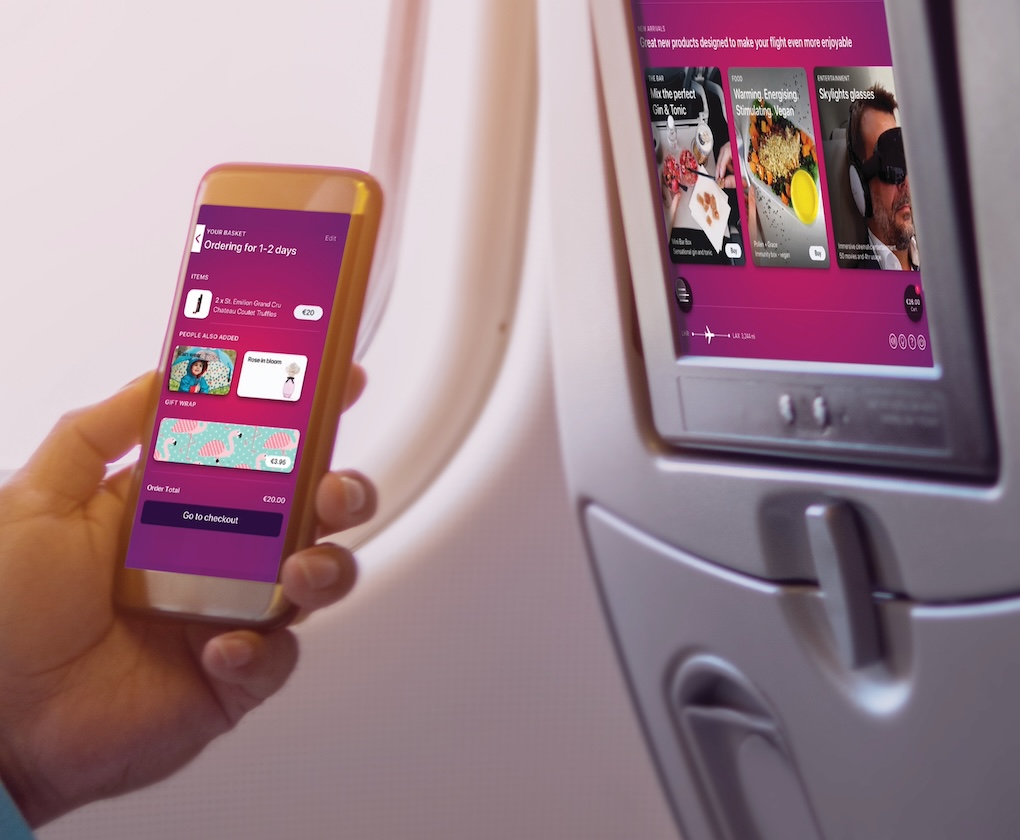
INTERNATIONAL. From transaction to a fully integrated travel retail proposition – that’s how gateretail Global Managing Director and Vice President José Lirio Silva views the evolution and potential of inflight retail today.
The gategroup division delivers inflight services solutions onboard more than 1.5 million flights a year, serving an audience of over 200 million passengers.
The company processes over 25 million transactions per year including 200,000 monthly pre-orders.

Speaking to The Moodie Davitt Report, Lirio says its 2026 focus has been firmly on “protecting and growing our existing partnerships, improving customer profitability and satisfaction, and strengthening commercial and operational execution”.
The company continues to invest behind its faith in the future of onboard retail, with Lirio Silva citing opportunities to make the duty-free proposition “more relevant, dynamic and digitally enabled”.

Elaborating, he says, “The aircraft is a unique retail environment: we have a clearly defined audience, a defined period of engagement and, increasingly, the ability to understand and interact with customers digitally.
“The opportunity is therefore much broader than trolley sales. We want to connect pre-order, in-seat ordering, onboard retail, inflight entertainment and connectivity, loyalty and post-flight engagement into one retail journey.
At the same time, better use of data should allow us to optimise assortment by airline, route, passenger profile and season rather than applying a one-size-fits-all range.
“Ultimately, our ambition is simple: more relevant products, more reasons to purchase and a better commercial return for our airline and brand partners.”
Addressing the key consumer trends that are driving the business, and to which gateretail is reacting, Lirio cites three in particular.
“First, passengers increasingly expect convenience and immediacy. They are accustomed to frictionless digital commerce on the ground and increasingly expect the same experience when travelling. Pre-order, digital browsing, simple payment and eventually in-seat ordering all respond to this expectation.
“Second, there is a move from purely functional purchasing towards discovery and experience. This is particularly relevant for Boutique and duty free. Passengers are interested in products that feel special to the journey: exclusives, limited editions, gifting, premium products and brands or products they may not encounter in everyday retail.
“Third, personalisation and relevance are becoming increasingly important. A passenger flying Barcelona–London has different purchasing opportunities from someone travelling to a holiday destination or on a longer leisure journey. The better we understand that context, the more relevant we can make the offer.
“The important shift for us is from asking ‘what can we put on the aircraft’ to ‘what is this passenger most likely to want at this point in their journey’?”
The answers to those questions are informing how gateretail is compiling relevant, tailored assortments.
Lirio says, “We are seeing the strongest opportunity in categories that combine premiumisation, gifting, convenience and discovery.
“Beauty and fragrance remain strategically important in duty free, but the proposition needs to evolve beyond simply reproducing the airport assortment. Travel exclusives, discovery formats, sets and accessible premium products are particularly attractive because they give passengers a reason to buy onboard.
“We also see opportunities in jewellery, accessories and lifestyle products, particularly where products have a strong visual story and an accessible price point. Gifting continues to be important, while destination-relevant and airline-exclusive products can create differentiation.”
He notes that traditional large, static ranges are now less compelling.
“Space and weight onboard are too valuable to carry a broad assortment with low productivity. We therefore see the future as a more curated physical range supported by a much broader digital assortment through pre-order and connected retail.
“That allows us to offer customers more choice while carrying less inventory onboard – improving both the customer proposition and the economics.”
Digital integration that connects pre-order, onboard, in-seat and post-flight shopping are key to delivery and execution.
Lirio says, “Technology is increasingly the backbone of the retail proposition rather than simply the point-of-sale system.
“Over the past year, we have continued integrating the different components of the retail ecosystem: EPOS, payments, product and inventory management, pre-order, connectivity and data analytics, with the objective of creating a much more connected retail journey.”
He says one especially exciting development is the growing connection between inflight connectivity and commerce.
“This creates opportunities for passengers to browse and potentially order directly from their seats but also allows us to extend the available assortment beyond what can physically be loaded onto an aircraft.
“Our next phase is about using technology and data much more intelligently: better demand forecasting, more dynamic assortment decisions, improved inventory visibility and ultimately greater personalisation.”

The company is also exploring how AI can support forecasting, supply-chain optimisation and commercial decision-making.
Lirio stresses that the objective is not “technology for technology’s sake”. Every investment needs to “improve the passenger experience, increase sales, reduce complexity or improve profitability – ideally several of those at the same time”.
When we interviewed Lirio a year ago, he noted that inflight retail must compete on “curation, exclusivity and emotional connection”. How have those principles come to life since, we ask?
“An aircraft cannot and should not compete with an airport or online marketplace on assortment size,” he says. “Curation means being much more selective. Rather than offering hundreds of products simply because they are available, we want a smaller number of products with a clear reason to be there – based on passenger profile, destination, season and actual sales performance.
“Exclusivity gives customers a reason to purchase during the journey. That can mean travel-exclusive formats, airline-specific products, limited editions, bundles or collaborations that cannot simply be compared with an identical product online.
“And emotional connection is where airlines have an advantage that conventional retailers do not. Travel is emotional. Holidays, reunions, celebrations and discovering new destinations all create purchasing occasions. Airline-branded products, destination products, gifting and exclusive brand collaborations can tap into that.
“The opportunity is to make Boutique feel less like a catalogue being transported through the cabin and more like a curated travel retail experience specifically created for that airline and its passengers.”
Clearly, only by establishing profitable partnerships can the inflight retail business survive and thrive, and here, says Lirio, the Trinity of airline, retail operator and brand must all pull together.
“The airline brings the customer relationship, the environment, loyalty ecosystem and digital touchpoints. The brands bring innovation, desirability, storytelling and marketing investment. And gateretail brings the retail expertise: assortment, commercial management, technology, data, logistics and the operational capability to turn the proposition into sales across a complex airline network.
“The biggest opportunity comes when we stop optimising those elements independently.”
Brands, he says, can create airline-specific products, exclusives and campaigns and use their own marketing channels to create demand before passengers board. Airlines can provide greater access to digital touchpoints, loyalty programmes and connectivity. And gateretail can use retail data and operational expertise to identify what works, where it works and continuously adapt the proposition, he adds.
“Importantly, the commercial opportunity does not need to end with the products physically loaded onto the aircraft. Pre-order, digital marketplaces, connectivity and media create opportunities to dramatically expand the retail shelf without adding weight or inventory onboard.
“That changes the economics of inflight retail. Instead of the Trinity negotiating over how to divide an existing pie, we should be asking how we use our combined assets to make the pie bigger.
“That, for me, is where the next generation of travel retail becomes particularly exciting.” ✈