



ASIA PACIFIC. International passenger demand across Asia Pacific weakened in May, with the Association of Asia Pacific Airlines (AAPA) reporting a -1.1% decline to 31.7 million passengers as continued geopolitical tensions in the Middle East weighed on travel.

Preliminary May traffic data released yesterday (29 June) point to moderated increase as some airlines reduced international services, resulting in lower passenger volumes.
Measured in revenue passenger kilometres, international demand grew +1.8% year-on-year as longer-haul routes continued to lead growth.
With available seat capacity remaining broadly unchanged (+0.3%), the average international passenger load factor rose by 1.2 percentage points to 82.0%.
AAPA Director General Wong Hong said, “International passenger markets remained broadly stable in May, with firm demand on longer-haul routes.”
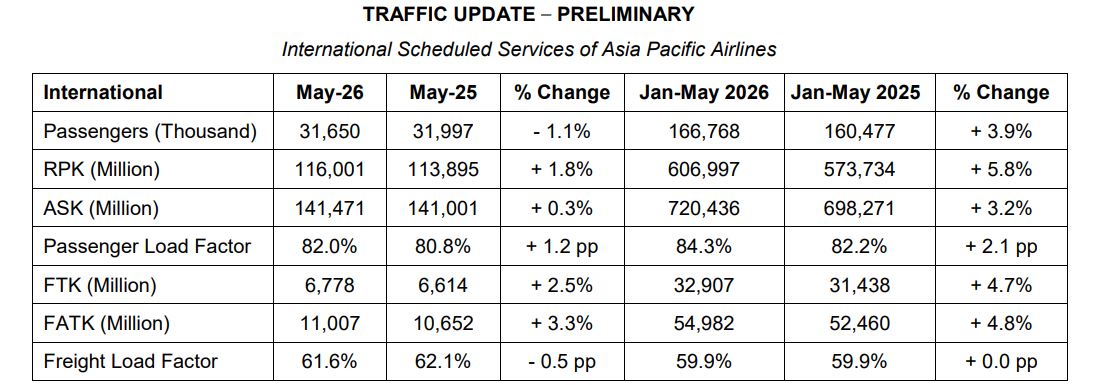
Wong continued, “For the first five months of the year, Asia Pacific airlines carried a combined total of 166.8 million international passengers, representing a +3.9% increase compared to the same period in 2025.”
Looking ahead, Wong said improving geopolitical conditions may ease cost pressures, though elevated fuel prices continue to impact airlines. “While jet fuel prices have eased from recent highs, the average price of US$137 per barrel in the first two weeks of June continues to place pressure on airline operating costs.
“Airlines continue to face uncertainty stemming from geopolitical developments, trade policy shifts and broader economic headwinds. Rising inflationary pressures are also contributing to higher non-fuel operating costs, and may weigh on consumer spending and travel demand in the months ahead.”
Wong concluded: “Overall, operating conditions for carriers remain challenging. Nonetheless, Asia Pacific carriers have responded well to evolving demand patterns, and remain agile in adjusting their networks and capacity deployment to capture growth opportunities while maintaining strict cost discipline.” ✈