ASIA PACIFIC. The 2014 TFWA Asia Pacific conference was held on Monday on the theme, ‘Asia: Shaping the World’, at the Marina Bay Sands Expo and Convention Centre in Singapore.
In his annual state-of-the-industry address, TFWA President Erik Juul-Mortensen hailed the travel retail industry’s performance in 2013, citing global sales of US$60 billion. The fragrances & cosmetics category ranked number one in sales at US$6.6 billion (+14% year-on-year over 2012), followed fashion & accessories (+15% to US$4.2 billion) and wines & spirits (+11.4% to US$3.1 billion).
Juul-Mortensen underlined the diversity of the booming Asian market – forecasted to grow its market share from 39.4% in 2015 to 45.0% in 2025 – and cautioned against thinking of the prized Asian consumer as a single entity.
APTRA President Jaya Singh, in his first appearance at the TFWA Asia Pacific in his new role, paid a fitting and well-deserved tribute to his predecessor Sunil Tuli. He then outlined in detail the organisation’s four pillars of strategy and support – Connectivity, Research, Advocacy, and Training – and urged the industry to continue to support APTRA as the voice of the region’s duty free stakeholders.
 |
TFWA Conference, Research & Corporate Affairs Director John Rimmer opens the conference |
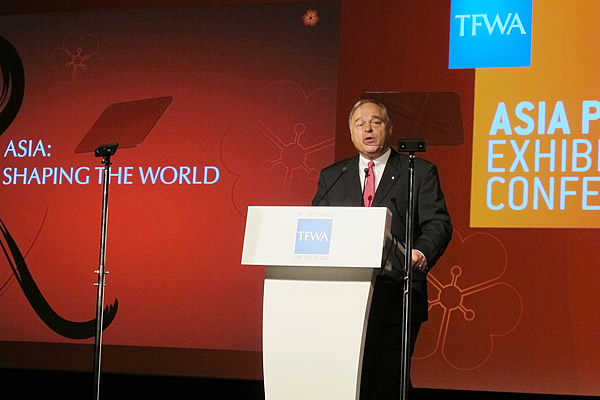 |
TFWA President Erik Juul-Mortensen underlines the diversity of the booming Asian market |
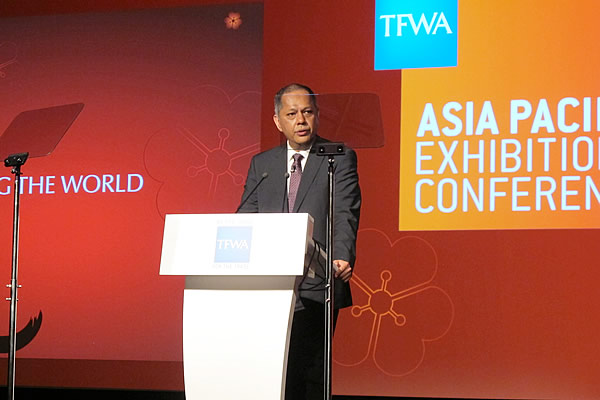 |
Jaya Singh addresses the industry in his first appearance at TFWA Asia Pacific as President of the Asia Pacific Travel Retail Association (APTRA) |
Delivering the keynote address was former Prime Minister of Australia Julia Gillard, who said that Australia’s relationship with Singapore – their government-to-government ties, strategic ties and commercial ties – informed much of her thinking on a key policy paper entitled, “˜Australia in the Asian Century’. She explained how the rise of the middle class across Asia had turned Australia’s traditional disadvantages into strengths, and how the travel retail industry is poised to benefit from the same group – by maintaining the push for free trade agreements, ease of tourist visa requirements, more investment in airport infrastructure, and continued development and modernisation of tourist facilities.
[Martin Moodie writes: Ms Gillard’s presentation was a dreadful low point in an otherwise good conference. Most of the time she failed to tailor her material to the audience at all, spending much of the time justifying her former government’s performance and policies. It was also disappointing that during the question and answer session she was not asked about her regime’s decision to slash the inbound duty free allowance in Australia, a decision introduced with minimal consultation and severe impact on travel retailers in Australia and elsewhere. As I say on Moodie Live (the real-time feed to this website from the show), Ms Gillard would have been paid a very large fee to speak. She delivered very poor value indeed, prompting one leading travel retailer to say: “I was ashamed to be Australian.”]
Angkasa Pura Marketing & Business Development Director Robert Waloni set the stage for a more in-depth look later in Workshop C at the growth potential of Indonesia’s 200+ airports. The airport operator aims to grow its non-aeronautical revenues as a proportion of total income by focusing on customer service and “partnership, partnership, partnership”.
Author and Strategist Parag Khanna highlighted the evolution of a USA-centric global economy (“All roads lead to Washington”) in the 1990s to the interconnected global marketplace today. He underlined the importance of a long-term vision in terms of harnessing travel opportunities, which should not be deflected by ‘speed bumps in the road’. Urbanisation, changing demographics, connectivity and investment underpin ASEAN’s growth rates, he maintained.
In a powerful presentation, Duty Free Philippines COO Lorenzo Formoso thanked the travel retail industry for its help in the aftermath of last November’s Typhoon Haiyan in the Philippines. DFP Cares, initially set up to help in fundraising and coordinating disaster relief efforts, has a new long-term goal: to bring hope and rehabilitation to thousands by rebuilding their homes.
 |
Former Prime Minister of Australia Julia Gillard delivers the keynote address |
 |
Angkasa Pura Marketing & Business Development Director Robert Waloni aims to grow the airport operator’s non-aeronautical revenues to 50% of total revenues by 2017 |
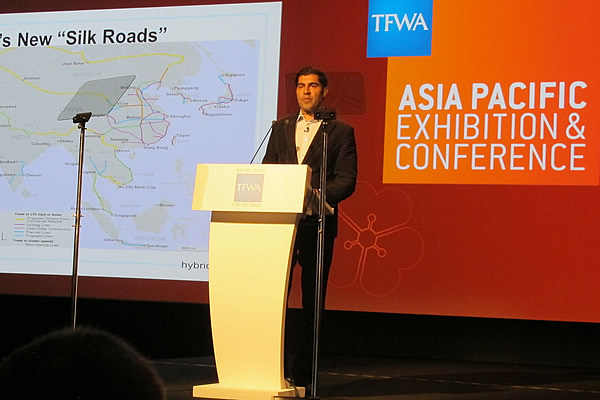 |
Urbanisation, changing demographics, connectivity and investment underpin ASEAN’s growth rates, says author and strategist Parag Khanna |
 |
Duty Free Philippines COO Lorenzo ‘Enchong’ Formoso thanks the travel retail industry for its help in the aftermath of last November’s Typhoon Haiyan in the Philippines |
Workshop B cast the spotlight on the Australasian region, home to some of Asia Pacific’s foremost airport retail environments. A couple of major tenders will take place in Australia and New Zealand in the coming year, notably at Sydney Airport and Auckland Airport, making them markets that are rich in opportunity.
JR Duty Free Chairman Garry Stock described Australasia as a mature duty free market that is getting more and more challenging, with limited growth opportunities and multiple threats to profitability. Besides the rise in online shopping and the strengthening of Australian and New Zealand currencies, tobacco regulations are another major challenge for retailers in the region. Following the reduction of tobacco duty free allowances in Australia to 50 sticks from packs of 200 or 250 sticks on 1 September 2012, passenger spend has suffered; a similar result is anticipated when New Zealand follows suit in November. Stock predicted that tobacco’s share of the New Zealand duty free market is set to fall from 15% to around 3%. In spite of these challenges, Stock believes that there remain opportunities for brands, airports and retailers to reap rewards.
“In a mature relationship, there are no rewards without hard work,” he emphasised. The key, he added, is to focus on the shopping experience instead of the travel experience, while acknowledging the region’s four key markets: Trans-Tasman, Australians and New Zealanders traveling overseas, visitors from Asia (especially China), and “Rest of the World” visitors.
Differentiating between these key markets is integral to “the retail conversation” between retailers and customers, said LS travel retail Pacific CEO Mattieu Mercier. Reminding the audience that “people buy from people”, Mercier underlined the importance of personalised service to customer engagement and sales growth. He also cautioned against focusing too much on the Chinese passenger – while visitors from China are undeniably important spenders, the Trans-Tasman market still made up more than half of the spending population at Australasian airports.
The importance of the Trans-Tasman market is echoed by Auckland International Airport General Manager of Retail and Commercial Richard Barker, who revealed that the Trans-Tasman market at Auckland Airport has grown +15% in passenger numbers since 2010 and is eight times the size of the Chinese market. Trans-Tasman routes, described by Barker as “the backbone of Auckland Airport”, make up 60% of all international flights at Auckland Airport. Nevertheless, the Chinese market – at 8% of the passenger mix with compound annual growth of +22.7% since 2010 – has an average spend of two and a half times that of other passengers. Their conversion rate (ratio of shoppers to travellers) at Auckland Airport is a significant 63%.
These figures, combined with the high duty free liquor allowances, strong growth in cosmetics and specialty retail, underline the massive opportunity afforded by the upcoming tender at Auckland Airport, Barker said. Tender documents will be issued in July and close end-September, with winners being announced in February 2015 ahead of the commencement of the contract on 1 July 2015.
The airport is looking for retailers who can deliver “creativity, differentiation and sales growth” and who are able to adapt their offer to meet the needs of key target customers. They will be assessed based on both financial and qualitative criteria, which include experience and expertise in online retailing and social media, as well as access to “unique, high interest brands”.
Running at the same time as the Australia-New Zealand workshop was a hugely well attended session on China, Japan and South Korea. More details in the stories here and here.
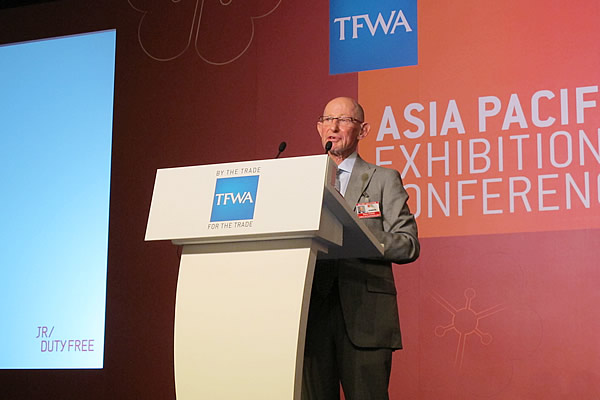 |
“In a mature relationship, there are no rewards without hard work,” says JR Duty Free Chairman Garry Stock, who urges brands not to ignore mature but stable markets such as Australia/New Zealand |
 |
LS travel retail Pacific CEO Mattieu Mercier emphasises the importance of personalised customer service in “the retail conversation” with consumers |
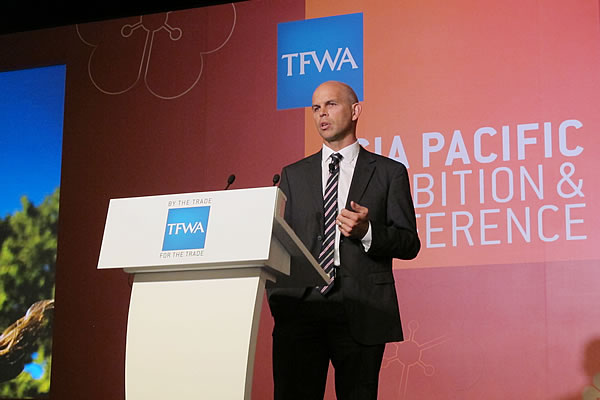 |
Trans-Tasman routes are “the backbone of Auckland Airport”, says Auckland International Airport General Manager of Retail and Commercial Richard Barker |
Workshop C shifted the focus to Southeast Asia, which has witnessed the rise of rapidly emerging markets such as Vietnam and Indonesia. Taking to the stage a second time was Angkasa Pura Airports Commercial and Business Development Director Robert Waloni, who reiterated the potential of Indonesia’s airports. Despite being “a more matured democracy” with about 200 airports, tourist arrivals to Indonesia numbered over eight million in 2013, while tourism receipts reached US$10.3 billion.
Capacity expansion remains Angkasa Pura’s priority and several of its 14 airports are undergoing expansion/redevelopment. With the growing Indonesian middle class, average passenger growth rate of +15% and the support of a newly established travel retail division and international partnerships, the airport operator is projecting revenue growth of +59% for 2014. Non-aeronautical revenues accounted for 39% of income last year, up from 20% in 2010, with 50% the target by 2017.
Examining the fast changing face of Asian aviation, Centre for Aviation (CAPA) Executive Chairman Peter Harbison noted that airlines’ fleet expansion plans are a good indicator of the future. For example, many of the next-generation aircraft are on order by long-haul LCCs such as AirAsia X, Jetstar, Cebu Pacific and Scoot. Although LCCs are growing fast, they are also evolving to become more and more like full-service airlines – with Business Class seats and long-haul destinations – and this has major implications for airports and retail.
With Southeast Asia’s combined GDP predicted to hit US$1,901 billion by 2020 and increasing passenger traffic and demand for aircraft, the region is undeniably attractive to investors, said Inflight Sales Group Managing Director Tony Detter. The rise in usage of the internet, social networks and mobile devices, as well as the increasing willingness of consumers to spend, have implications for the evolution of inflight duty free, he added.
Two decades ago, the inflight duty free market was driven by the demand for luxury products; ten years later, the product mix was made up of core duty free products such as liquor, tobacco and fragrances. Today’s consumers are becoming increasingly unique and complex, Detter said, and this is reflected in some new trends in inflight duty free. He noted the riser of the confectionery category, driven by demand for brands/products that are exclusive and not easily found. Gifting is also becoming increasingly important, and watches are now seen as both a status symbol and a fashion item. Passengers are demanding a broader range of valued assortments, and are turning to technology to shop online and to secure inflight purchases through pre-ordering.
 |
Centre for Aviation (CAPA) Executive Chairman Peter Harbison notes that airlines’ fleet expansion plans are a good indicator of the future |
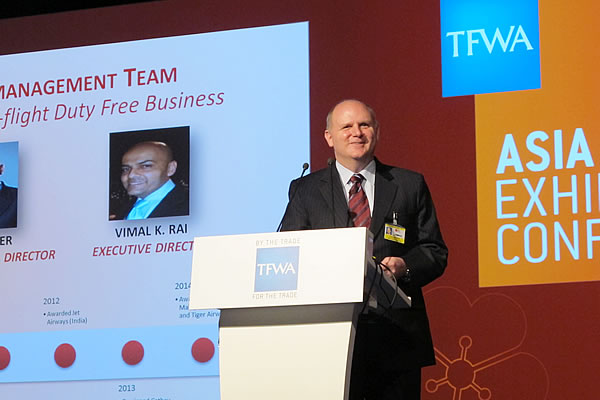 |
Inflight Sales Group Managing Director Tony Detter examines how the inflight duty free market has evolved over 20 years |
Elsewhere a strong session on India and south Asia featured Times OOH CEO Arghya Chakravarty, Delhi Duty Free CEO Duncan Lawley and Flemingo Board Director Paul Topping. Refreshinly, the speakers not only higlighted the vast opportunities on offer in India but did not shy away from the challenges – from recent currency exchange problems to counterfeit spirits.
In the closing plenary entitled “˜Asia 2020′, presenters explore the Asian traveller of tomorrow. Brand Alliance Group Director Jorge Rodriguez offered insights into the shopping patterns and preferences of Singapore’s “˜Generation Y’ consumers (aged 18 to 28), based on a survey conducted among 1,000 respondents online and face-to-face interviews in the first quarter of 2013. He said there are three aspects to understanding “Gen Y-ers”: through their shopping behaviour, social media and e-commerce, and new categories.
For Gen Y-ers to make a purchase, several fundamental criteria must be met: quality, affordability, brand reputation and recommendations; other factors include the presence of a healthier or organic/natural option. The key to reaching out to them is to focus on factors that matter; creating brand presence and likeability via channels of trust (recommendations, reviews); working harder in-store to induce impulse purchases; managing price positioning and perception; and identifying attractive new categories.
In his concluding presentation, SimpliFlying Vice President Products and Operations Shubhodeep Pal said that today’s ‘connected travellers’ have changed and brands need to adapt to their individual needs. Travellers now are “feisty users” of social networks; they are deal seekers, multi-screen shoppers and they want a dialogue with brands and advertisers. The increasing blurring of the lines between the business and leisure traveller also presents new challenges.
The future of airport retail, Pal believes, is in virtual shopping, digital immersion and “˜iBeacons’, a system which can be used in retail stores to alert customers about discounts on nearby items.
 |
Brand Alliance Group Director Jorge Rodriguez (far left) and SimpliFlying Vice President Products and Operations Shubhodeep Pal (middle) explore the Asian traveller of tomorrow |