

INTERNATIONAL. Dubai International Airport (DXB) once again topped Airports Council International (ACI) World’s annual ranking of the busiest airports for international traffic in 2025, with 95.2 million passengers.
Traffic at the UAE hub grew +6.1% year-on-year and was +7% higher than pre-pandemic 2019 levels.
London Heathrow remained second, with passenger volumes rising 0.9% year-on-year to 79.9 million, while Incheon International Airport continued to rank third, serving 73.56 million passengers, up 4.1% year-on-year.
The top ten was rounded out by Singapore Changi, Amsterdam, Istanbul, Paris Charles de Gaulle, Hong Kong International, Frankfurt and Hamad International airports.
International passenger traffic grew strongly in 2025, rising +5.9% year-on-year to reach 4 billion, an +8.3% increase above 2019 levels.
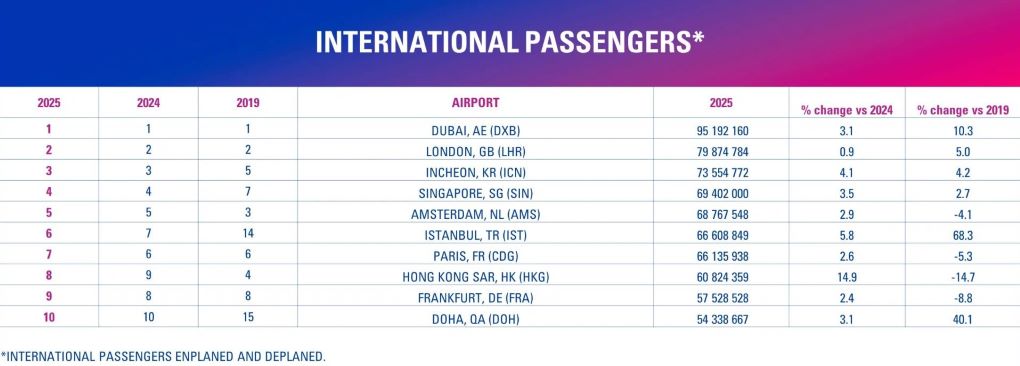
The ten busiest airports for international passenger traffic account for 17% of global volumes.
The data comes from an exclusive initial preview of global air traffic and may vary slightly, with the full rankings set to be confirmed in July based on detailed information from more than 2,700 airports worldwide.
The latest figures cover the world’s busiest airports in 2025 across three major categories: passenger traffic, air cargo volumes, and aircraft movements.
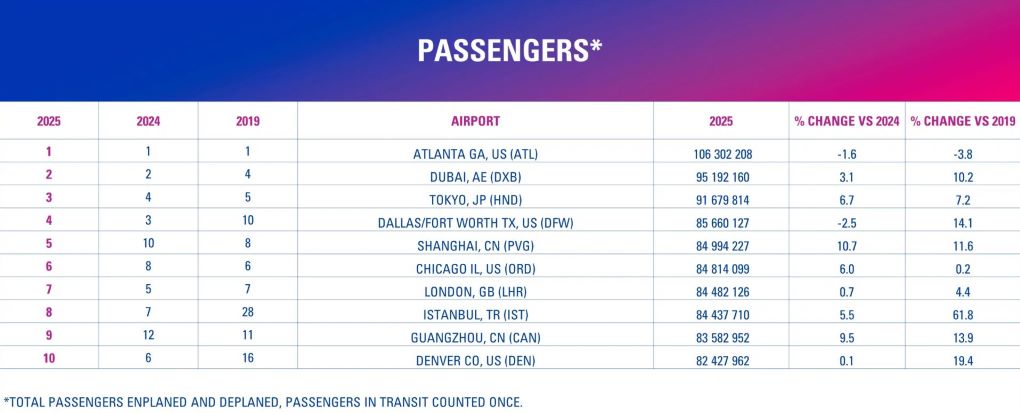
Hartsfield-Jackson Atlanta International Airport remained the world’s busiest overall airport for total passenger traffic during the year, including international and domestic travel, with 106.3 million passengers.
It was followed by Dubai International Airport, with Tokyo Haneda Airport in third place, recording 91.7 million international passengers, up one position from the previous year.
Another notable observation comes from Asia Pacific airports, which rebounded strongly, driving shifts in global airport rankings.
Shanghai Pudong was the best-performing airport in the top ten, rising from tenth to fifth, driven by the recovery in international traffic, easing of visa policies and expanded connectivity. Guangzhou Baiyun climbed from 57th in 2022 to ninth place in 2025.
In the US, four airports made it to the top ten, highlighting sustained market strength, with domestic traffic accounting for 80-95% of total volumes at each airport.
Total global passenger volume reached an estimated 9.8 billion in 2025, up +3.6% year-on-year and +7.3% above pre-pandemic levels in 2019.
The top ten busiest airports represented 9% of this total, or 882 million passengers.
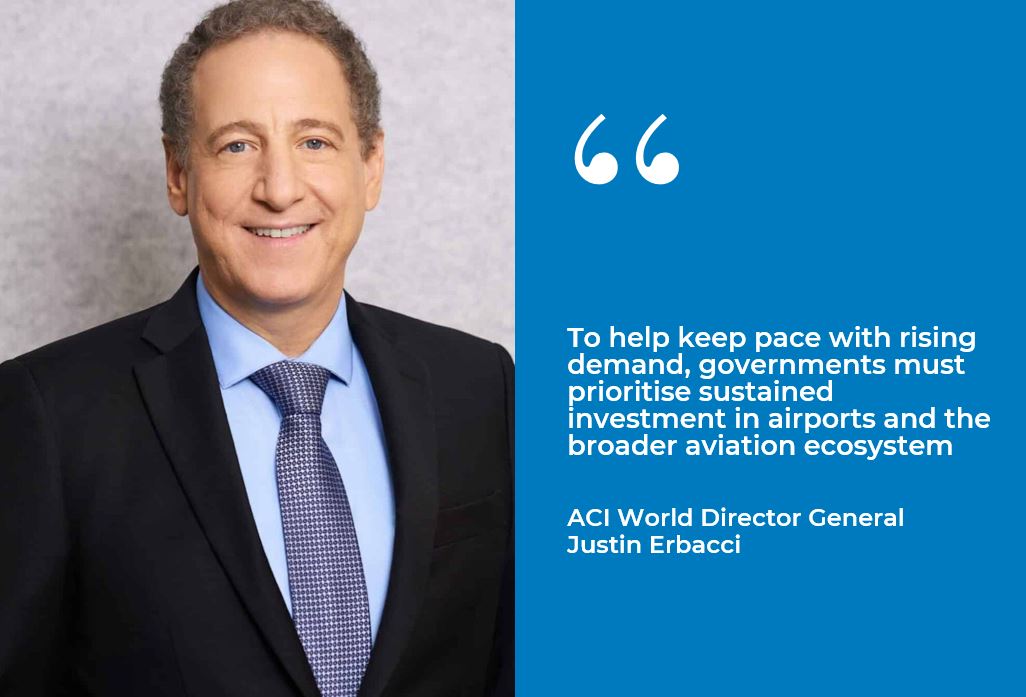
ACI World Director General Justin Erbacci said: “We congratulate the world’s busiest airports for managing growing air travel demand amid increasing operational complexity.
“These hubs keep people and goods moving, supporting global trade, tourism, and economic growth in their communities and regions. To help keep pace with rising demand, governments must prioritise sustained investment in airports and the broader aviation ecosystem.”
Global aviation in 2025 at a glance
ACI described the 2025 global economy as “resilient but fragile,” with GDP growth of around +3.0-+3.2%, above expectations but below historical averages, amid risks from trade tensions, protectionism and policy uncertainty weighing on air travel demand.
Demand was supported by lower fuel prices (~13% year-on-year) and easing inflation, which strengthened purchasing power and sustained strong passenger demand despite volatility.
The recovery in global travel demand drove strong international traffic growth of +3.6%, underpinned by a robust rebound in Asia-Pacific, while North American and European hubs neared saturation.
ACI also identified capacity as a key constraint, as growth faced mounting pressure from regional infrastructure and slot limitations, aircraft delivery backlogs, and air navigation limitations.
In addition, geopolitical factors have increasingly reshaped traffic flows, with airspace closures and conflicts raising flight times and costs, leading to rerouting and a shift towards alternative hubs.
China’s travel rebound emerged as a key growth driver, lifting Asia Pacific performance and strengthening links across major global hubs. ✈