



EUROPE. The European Travel Retail Confederation (ETRC) today (16 September) launched a new academic study which explores airport-retailer tender and contract models in travel retail.
Among the key conclusions from the study are that flexibility, data and partnership represent key elements in the success of the various models.
At a webinar attended by The Moodie Davitt Report, the findings were presented by lead author Professor Paul Freathy from the University of Stirling, which jointly conducted and published the study – Exploring and Testing the Prevailing Business Models in Travel Retail – with the Institute for Retail Studies.

Taking into account how recent disruptions – in particular the COVID-19 pandemic and conflicts in certain parts of the world – have exposed the vulnerabilities of traditional commercial models, the research combines academic rigour with real world insight. It was informed by extensive interviews with 27 stakeholders across airports, retailers and brands.
The results brought a nuanced understanding of the major business models – including fixed Minimum Annual Guarantee (MAG), variable MAG, profit-share and joint ventures – and the different scenarios in which each may succeed or fall short.
The report, which presents various contract scenarios across fictional airports varying in size and passenger numbers, aims to provide a framework for decision-makers to tailor strategies based on airport size, traffic composition, economic conditions and stakeholder objectives.
Critically, the study does not advocate a one-size-fits-all solution. Whatever the model chosen, the report highlights the centrality of any tendering process employed and suggests that several key principles are applied.

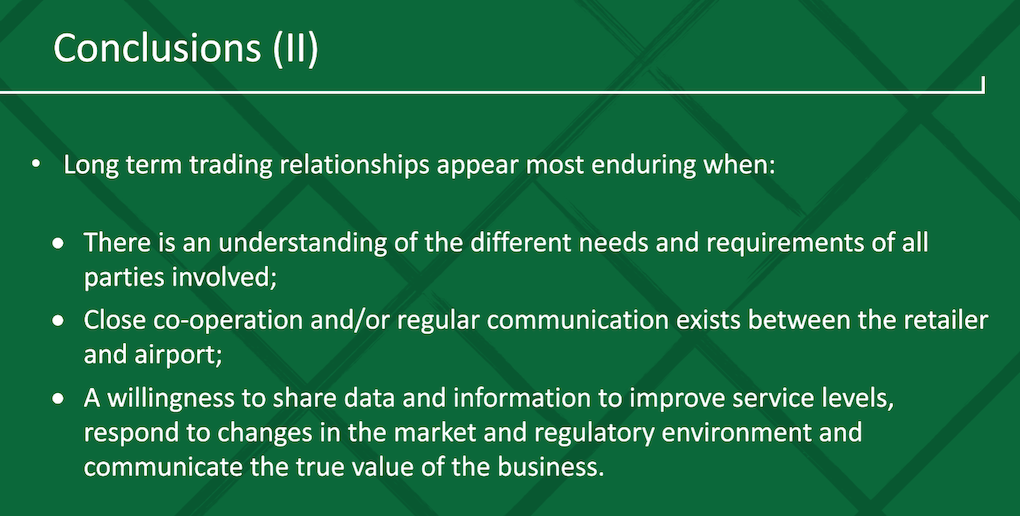
They include knowing the business and its true value; ensuring the model can withstand sudden change; building the model based on reliable, transparent data; and adopting an approach based on partnership.
Introducing the webinar, ETRC President Nigel Keal said: “In commissioning this study, ETRC sought to provide all partners in travel retail with not just a diagnostic tool, but a roadmap – one that reflects the diversity of Europe’s airports, the variety of retail formats and the evolving expectations of passengers.
“There is no silver bullet, but our hope is that the findings will inspire greater collaboration and a shared commitment to building a stronger travel retail ecosystem for a sustainable future.”
In a joint statement, Vienna Airport Senior Vice President Centermanagement Philipp Ahrens and Kinetic Consultancy Managing Director Martijn Steur, Chair and Vice Chair of the ACI Europe Commercial Forum respectively, said: “On behalf of the ACI Europe Commercial Forum, we would like to thank ETRC for commissioning this timely and insightful report.
“As Chair and Vice Chair, we see strong support among our members, airports and world business partners alike, to build on these findings and take the next step: modernising the ACI Europe Tender Code.
“Together, we are shaping a framework that is adaptable, partnership-oriented and customer-centric – one that truly reflects the realities of today’s commercial environment and equips our industry for the challenges ahead.”
Talking points
Among the key themes raised in the webinar was around airports sometimes overstating the value of the retail business at the tender stage and some landlords being unwilling to award lengthy contracts and share sufficient risk; a shared risk which would allow retailers to invest more in the store fixtures and retail offer that would help grow revenues to something bigger over time.
Report lead author Freathy suggested these issues are particularly pronounced in some Southeast Asia airports. “Talking to some of the retailers there, they say trying to get the landlords to take a long-term non-financial perspective is very difficult. What they [the airports] want is stability and those high minimum guarantees for a particular concession over a period of time.
“There have been examples where despite [retailers] being able to offer that stability and a level of investment that could grow the business, they’ve been outbid by with unrealistic financial offers from another retailer. They find it very frustrating that the landlord is going for the extra [guaranteed] money.
“There’s no easy answer – you’d like the landlords to be able to take a more informed decision and look at the technical aspects of what the retailer offers. But all too often that is put to one side in the pursuit of short-term financial gains – that seems to be a common problem in the relationship between landlord and retailer.”
Giving a landlord’s perspective, Ahrens commented: “I think it’s a very important point. Looking what we are currently do [in retail contract terms] for our South Extension project [at Vienna Airport], which we will open in 2027, we really look into the bits on the quality of the investments involved in operating and building out those units.
“Because if it’s a cheap aspiration, that might be the wrong message we are sending to our travelling guests and we want to have a quality-driven guest journey, rather than maybe a trashy and too commercialised one.
“I think this is the hard line which we [landlords and retailers] are all walking these days, to find a middle way between a high quality approach towards the presentation of retail offers and generating enough revenue, not only for the operator, but also for the airport in order to finance huge infrastructure investments.”
Ahrens continued, “I think there is a lot of change going on when it comes to the mindset of these points within the industry, and that’s why it’s so very exciting to work in the business these days, because it’s not anymore 80% MAG and one or two variables.
“There are a lot of opportunities on the plate where you can work around according to the needs of your airport and as we know also from the information sharing we do among the members at ACI Europe, there is no one airport like another. And, therefore, there is no [contract] model like another from the commercial perspective. A balance needs to be struck between delivering qualitatively high, but also sustainable, retail to today’s travellers and those of the future.
“This is the really hard challenge we are all facing, that we should maybe think of not being too ‘greedy’ anymore, but still be able to deliver what is needed at our airports. This is the fine tune we need to find for the years to come.”
A pdf copy of the full study can be downloaded from the ETRC website here. ✈