

ASIA PACIFIC. There were 636 million foreign arrivals into Asia Pacific in 2017 – a new record for the region.
That’s according to the latest report released by the Pacific Asia Travel Association (PATA). The PATA Annual Tourism Monitor 2018 Early Edition reviews foreign arrivals over the past five years, covering 47 destinations across the region with eight in the Americas, 15 in the Pacific and 24 across Asia.
Asia received the majority of foreign arrivals in 2017 with a 72% share, followed by the Americas with 24% and the Pacific with the remaining 4%.
A similar distribution was seen for the additional volume of foreign arrivals generated into each region between 2016 and 2017, PATA said.
Click on image to enlarge
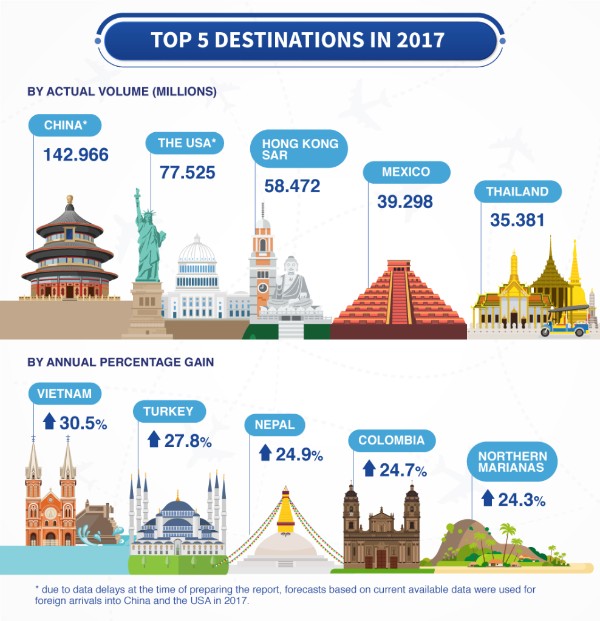
The top five destinations in 2017 by actual volume were China, the USA, Hong Kong, Mexico and Thailand. By annual percentage gain, the top five were Vietnam, Turkey, Nepal, Colombia and Northern Marianas.
PATA noted that another annual performance marker is the increase in the absolute number of foreign arrivals between 2016 and 2017, and the top five with the highest actual annual volume increases in 2017 are pictured below.
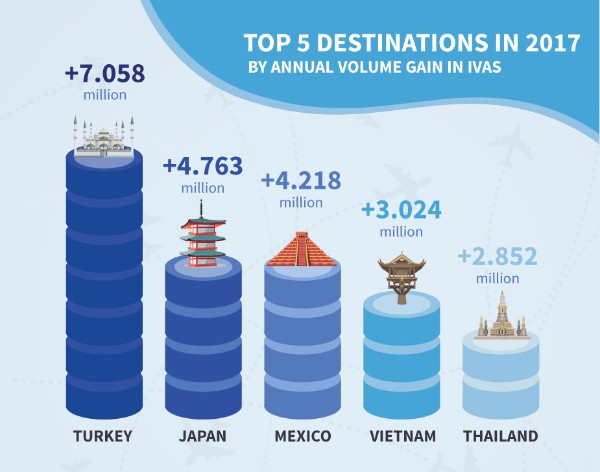
In total, 11 Asia Pacific destinations received more than one million additional foreign arrivals between 2016 and 2017. Only four of the 47 destinations reported declines in their inbound foreign arrival numbers. These ranged from a minor loss of 4,000 arrivals to a much more significant contraction of nearly 3.9 million, PATA said.
There were nearly 35 million more foreign arrivals into the region in 2017 compared to 2016.
Intra-regional travel flows remained very strong for most Asia Pacific regions in 2017, PATA noted. Almost 94% of the foreign arrivals into Asia originated from within Asia itself. For the Americas, the intra-regional proportion of international travel was 78%.
The Pacific went against this trend though, with less than one-third (32%) of its foreign arrivals in 2017 originating from within. More than half (53%) of the foreign arrivals into the Pacific in that year came from Asian origin markets.
In terms of supplier markets into Asia Pacific in 2017, the vast majority of foreign arrivals came from Asia (62%), followed by the Americas (18%) and Europe (12%). The Pacific supplied a little over 2% of the total arrivals into Asia Pacific in 2017, followed by Africa with less than 1%. A significant proportion of arrivals (5%) came from origin markets that were unspecified.
At the single origin market level, the major suppliers of foreign arrivals into Asia Pacific destinations in 2017 were China (112.4 million), Hong Kong (95 million), USA (47.5 million), South Korea (28.5 million) and Canada (27.3 million).
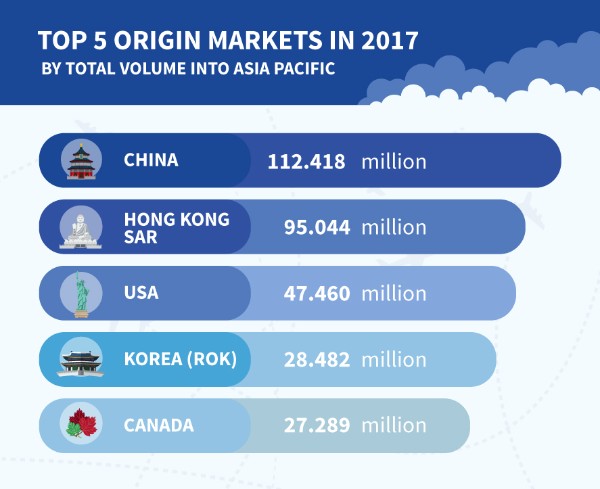
In total, there were 14 origin markets that generated in excess of 10 million arrivals into Asia Pacific in 2017.
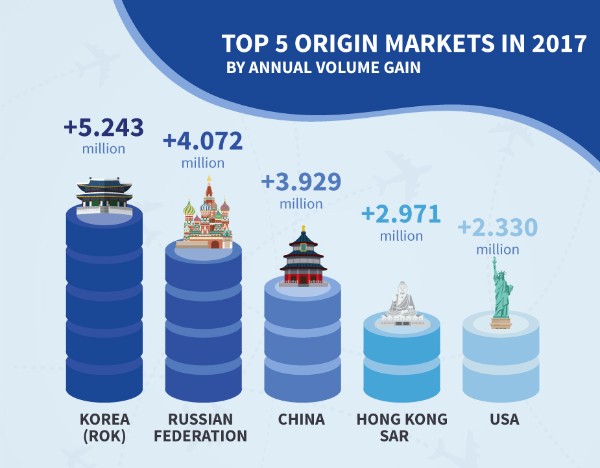
By additional volume of arrivals generated between 2016 and 2017, the top five origin markets delivering the most additional volume of foreign arrivals into Asia Pacific were South Korea (+5.2%), Russian Federation (+4.1%), China (+3.9%), Hong Kong (+3%) and USA (+2.3%).
“2017 was yet another record year for the aggregate volume of foreign arrivals into Asia Pacific,” said PATA CEO Mario Hardy. “Significant variability was once again evident with 30 of the 47 destinations covered in this report showing annual growth increases in excess of +5% – in fact 17 of these were in the double-digit growth range, with only a few showing contractions.
“Overall, it was another very robust year for international travel within Asia Pacific. The link between perceptions of safety and travel have always been obvious. What is also becoming clearer however, is the link – in some cases at least – between public policy and destination choice. The need for continued political harmony is ever more important if our sector of the global economy is to flourish equally across destinations.
“There will always be winners and losers in attracting the ever-changing travel consumer. Our hope is that destination choices will be left to the traveller, without too much in the way of external pressure being added to that decision-making process. In this way, the traveller benefits by increased competition across a level playing field, and that is to everyone’s advantage going forward.”