

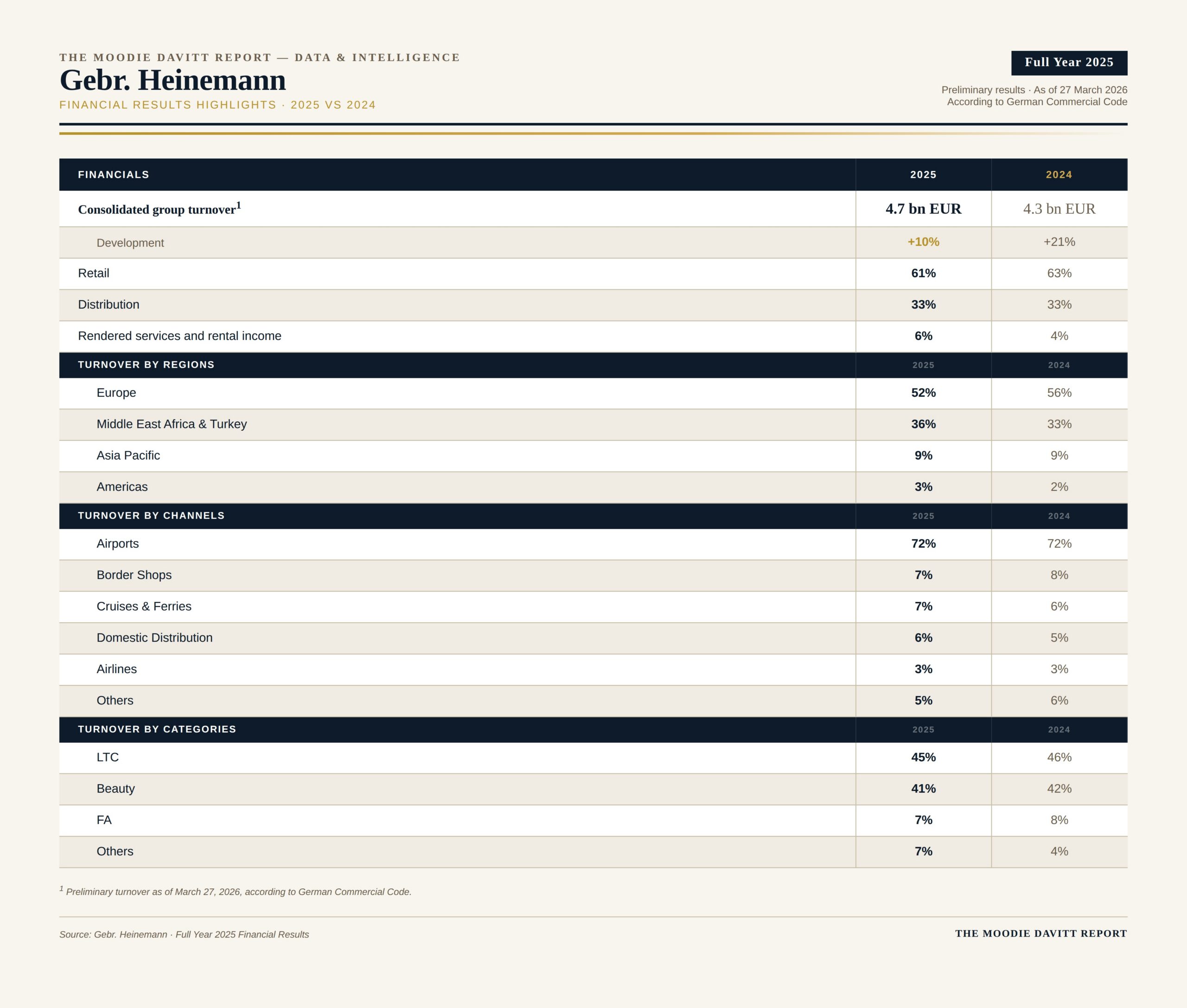
GERMANY. Family-owned travel retailer and distributor Gebr. Heinemann has reported consolidated group turnover of €4.7 billion for 2025, a rise of +10% year-on-year.
At the company’s annual press conference on Tuesday (5 May), senior management said the performance, with growth built largely on new business, showed resilience “against a global backdrop of geopolitical tensions, economic volatility and shifting consumer behaviour”.
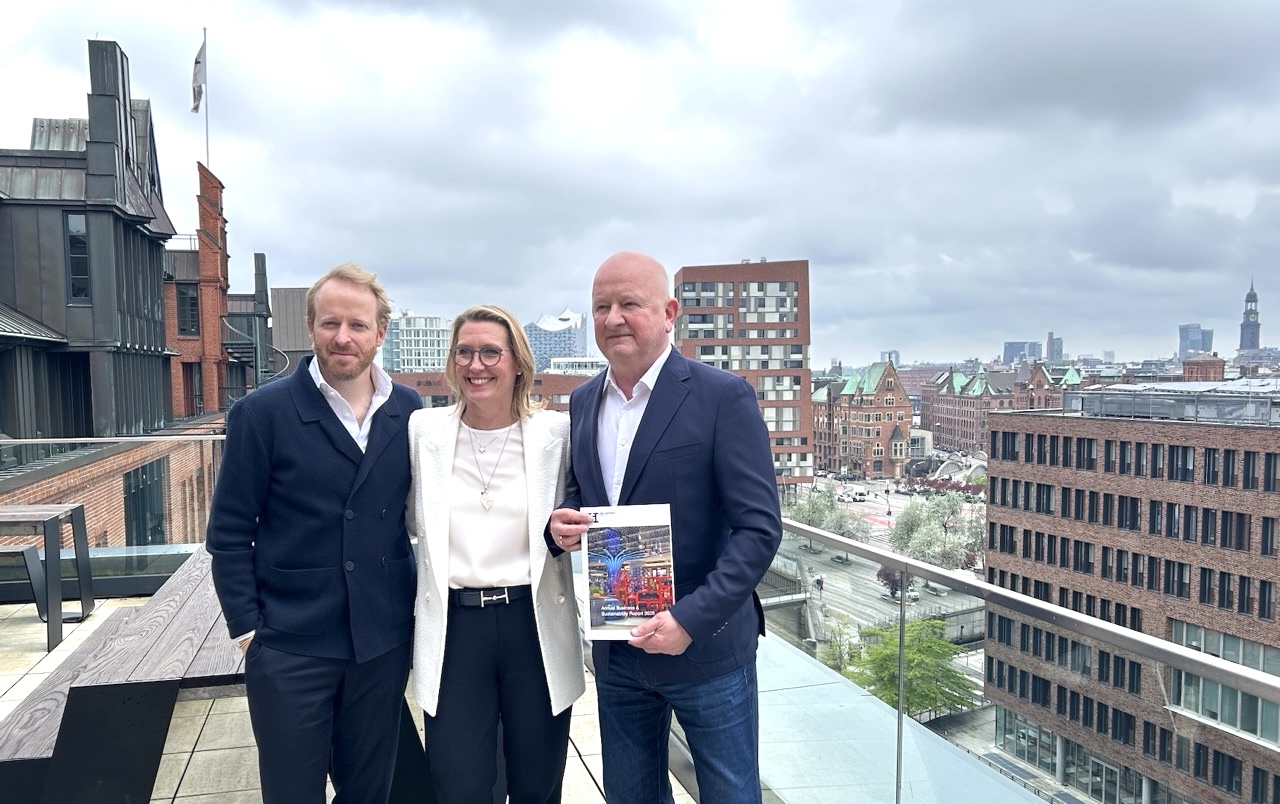
Speaking to media guests, including The Moodie Davitt Report, board members underscored the challenge of declining spend per passenger across the industry, notably in Europe.
They also spelled out the urgent requirement to remain relevant to a new generation of travellers and the imperative to use databeta across the travel retail eco-system while coming together as a community to co-create new experiences for travellers.
Gebr. Heinemann Owner and Co-Chief Executive Officer Max Heinemann said, “Volatility has become our baseline; planning cycles are repeatedly interrupted, and too often we find ourselves switching back into crisis mode instead of tackling the structural changes reshaping our industry. That is why it is crucial that we not only react to each disruption but also prepare for the traveller of tomorrow.
“The fundamentals of travel remain strong. People want to travel and that enduring demand gives us responsibility and opportunity.”
Co-Chief Executive Officer Raoul Spanger added: “2025 was a year that demanded focus and adaptability. Amid ongoing challenges, we achieved broadly based growth across regions and channels. This confirms the strength of our diversified business model and our ability to act with discipline while continuing to invest in the future.”
In 2025, airport retail remained the company’s strongest channel, accounting for 72% of turnover, followed by border shops (7%), cruise & ferries (7%), domestic distribution (6%) and airlines (3%). Others channels contributed 5%.
Europe maintained its status as the largest region, accounting for 52% of turnover, though growth was only +3% year-on-year. The combined weight of Türkiye (the largest national market for the group) and the Middle East Africa region reached 36% of turnover, with revenue rising +23% year-on-year.
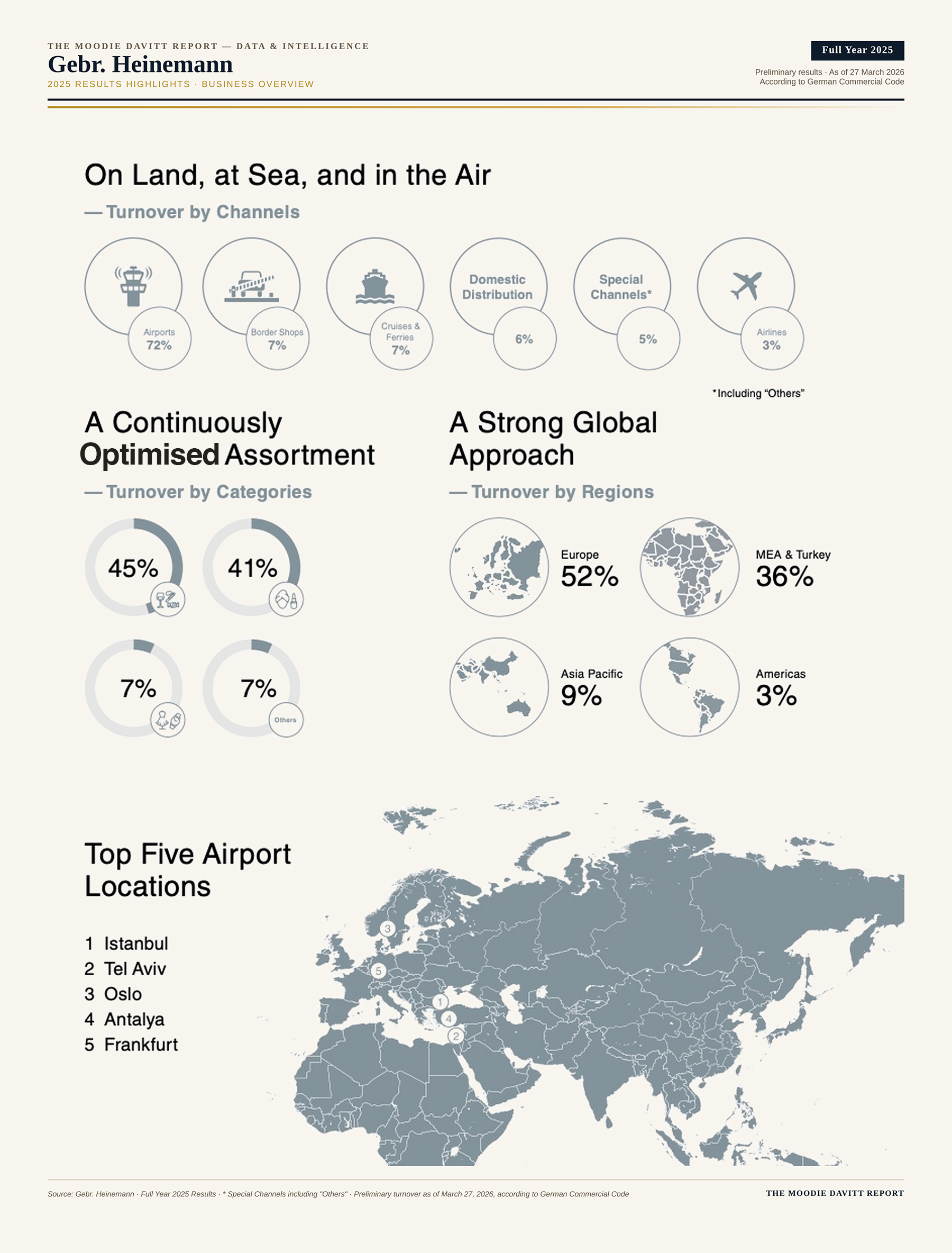
Spanger noted: “Middle East-Africa will remain an important priority for us. Despite the significant instability affecting parts of the region, the fundamentals that make it relevant for global travel are still intact.”
Asia Pacific accounted for 9% of turnover (-1% year-on-year). Spanger said, “We have downsized our business to the new reality in Asia. That means fewer Chinese customers and a new clientele, a new message and a new approach to the market.”
The company said it had renegotiated contracts with airports in the region, leading to “improvement in results” and reinforcing “the growth perspective with airport partners”.
Spanger said later, “We had an intense and tough negotiation with Sydney Airport, because we have to face a new reality, which is mainly based on much less Chinese customers, who are also spending much less. It is a different profile. We have agreed on a good formula for the future. And this is important, because even if Asia is reshaping we see part of our future in Asia.”
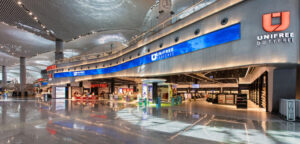
The Americas (with a sole focus on cruise) saw new business gains drive +31% growth as the region contributed 3% of group turnover (+31% year-on-year).
By location, Istanbul remained the number one ranked airport by turnover, followed by Tel Aviv with a record performance in 2025 despite regional conflict.


Oslo remained third though it is still challenged by the weakness of the Norwegian Krone. New in the top five (ranked fourth) is Antalya, a subsidiary of TAV Airports and the Unifree Duty Free/Gebr. Heinemann joint venture, with Frankfurt Airport in fifth.
Of the last named, Spanger said, “We have seen a trend towards more German customers and less international customers and therefore we are also suffering in Frankfurt. But the new Terminal 3, with our next generation shop, offers us some opportunities.”
Twin pillars offer balance
Retail delivered 65% of group turnover (+9% year-on-year) with distribution at 35%. (+11%)
Management saluted the “stabilising role” of distribution within the portfolio. New business and extended partnerships included those with Fjord Line, Brittany Ferries, Norwegian Cruise Line, Zaragoza Airport and British Airways in 2025.
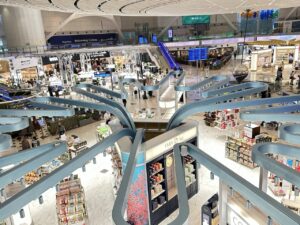
The expanded retail network includes Keflavík Airport, Antalya Airport, Jeddah King Abdulaziz International Airport, Plaza Petea border shop in Romania, plus further expansion in cruise.
Spanger said the broadly equal growth rates of retail and distribution were encouraging. “It is important for us to share our risk globally, and if we do that the less we are affected by single or regional effects.”
Value, premiumisation and relevance
Gebr. Heinemann said it continued to refine its assortment strategy, which has included cutting close to 10% of ranges across the board (led by spirits and beauty) in the past year.
The company continues to implement the results of a major global Assortment Steering and Efficiency project, which features clearer processes and digital tools such as an assortment engine for continuous optimisation (more on this to come).
“Our ambition is to focus on curated assortments, strong brands, travel retail exclusives, and clear value propositions, all supported by data-driven pricing and close collaboration with our partners,” said Chief Commercial Officer Inken Callsen. “Always with the goal to turn data and insights into impact, thereby creating more relevant offers for the traveller.”
Liquor, tobacco and confectionery (LTC) accounted for 45% of turnover and grew by +8% year-on-year.
“The major challenge is the wide assortment. If we have brands that are pushed through social media or we introduce new beauty brands, we see a big increase. But the core brands are suffering quite a lot, and are maybe not giving the right answer to the new consumer in beauty.” – Inken Callsen
Within that grouping, tobacco continued to play a crucial role in drawing customers into stores and increasing basket size, with strong performance across both traditional products and next-generation alternatives. These alternatives have helped attract new audiences, with female shoppers’ contribution growing by +7% last year.
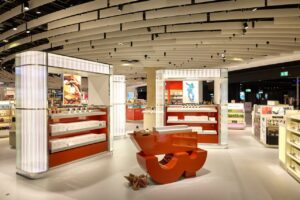
Confectionery remains “a highly relevant impulse category, benefiting for example from gifting occasions, while at the same time facing considerable pressure on pricing.” This category grew by +19% last year with travel retail exclusives also playing “a major role”, said Gebr. Heinemann.
Beauty accounted for 41% of turnover with revenue rising +7% compared to 2024. Niche fragrances continue to represent a driver of premiumisation, supported by “curated assortments, exclusive concepts and strong traveller demand for individuality and storytelling”.
Alongside this, travel retail sets, special offers and base-price propositions are developing in parallel to the luxury niche segment.
In subsequent discussion with media guests, Callsen said that beauty, though a dynamic category, was not hitting double-digit growth as it used to.
“Fragrance is performing at +10% over the beauty trend and niche fragrances help us a lot. But also we see growth in the base price and entry price levels. Today the beauty base price products represent 16% of turnover, which is high. We have to play the two angles, luxurious premiumisation and the entry price.”
By contrast, she added, skincare and colour cosmetics are underperforming the global trend.
“The major challenge is the wide assortment. If we have brands that are pushed through social media or we introduce new beauty brands, we see a big increase. But the core brands are suffering quite a lot, and are maybe not giving the right answer to the new consumer in beauty.”
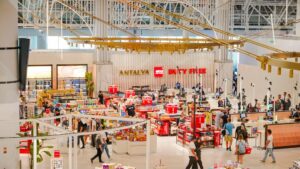
Fashion & accessories accounted for 7% of turnover and grew by +13% (including Istanbul) compared to the previous year, with the category playing a vital role at new locations such as Jeddah and Antalya airports.
The company said monobrand boutiques at Istanbul Airport maintained their strong performance.
Child’s play becomes serious business but key core categories face challenges
As a subcategory, toys saw healthy growth, “driven by increasing appeal among both younger travellers and adult collectors, as well as by larger spaces and dedicated shop-in-shop concepts that created a more emotional, experience-driven positioning”.
Sunglasses showed encouraging retail growth of +14.8% compared to the previous year.
Callsen delivered a valuable insight into how spirits in particular fell short of the wider +10% turnover growth in 2025.
“Spirits and beauty are the areas where we have a wide assortment and a lot of products, and where we still have too much of a one-size-fits-all solution. If we go deeper into spirits, we see that celebrity brands and premiumisation bring results.
“But at the same time, it helps to have more base-price products. Last year, we took our base-price model from beauty and brought it into spirits, with offers for €29 and €39 [per bottle], and this is having tremendous success.
“Spirits is under pressure globally but there are answers in the sub-categories. We can create whisky worlds, for example, and can still grab the customer with a different approach, a smaller assortment and a clearer message to the customer.”
She also added that Champagne remained much in demand for gifting while wines benefited in locations where Heinemann has introduced speciality concept Vivino –which supplies product details via digital tools – with an average +19% rise in sales where deployed.
Summarising the new thinking around categories, Callsen said, “Relevance drives the performance. We have to have the relevant assortment for each airport, and even sometimes for each terminal we need different assortments, prices and promotions. Our role is to scale what we do and bring this to life.”
Strategic investments
Gebr. Heinemann said it continued to invest in the “long-term resilience” of the company in 2025.
“As a family-owned company, preserving long-term financial independence is a core objectiveIn this context,” it observed. “The successful refinancing and strengthening of Heinemann’s financing structure in 2025 provided a solid foundation for future investments.”
Max Heinemann added, “Profitability and discipline are essential for maintaining our entrepreneurial freedom. They enable us to think beyond short-term cycles and to invest in people, in partnerships and in infrastructure.”
Priorities included the modernisation of Gebr. Heinemann’s logistics infrastructure in Germany and preparations for a new logistics hub in Istanbul to open soon. The latter will shorten replenishment times for Türkiye and the Middle East.
Inken Callsen said, “The new Istanbul hub is a strategic expansion of our supply chain strategy. It brings our logistics network closer to key growth markets, shortens lead times, and strengthens our resilience. Together with the modernisation of our logistics sites in Germany, it creates the foundation for scalable growth, high service levels and a future-ready commercial platform.”
Progress on sustainability
Gebr. Heinemann’s Sustainability Strategy 2030 led the company to reduce emissions across all scopes in 2025, with expanded use of renewable energy and a focus on sustainability as a core criterion for its supply chain – from expanding rail transport to increasing the use of electric trucks.
An important step was the Sustainable Supply Chain Forum held in Hamburg in September 2025, where Gebr. Heinemann brought together key suppliers. The focus was on inbound logistics, with stakeholders developing concrete measures to reduce emissions.
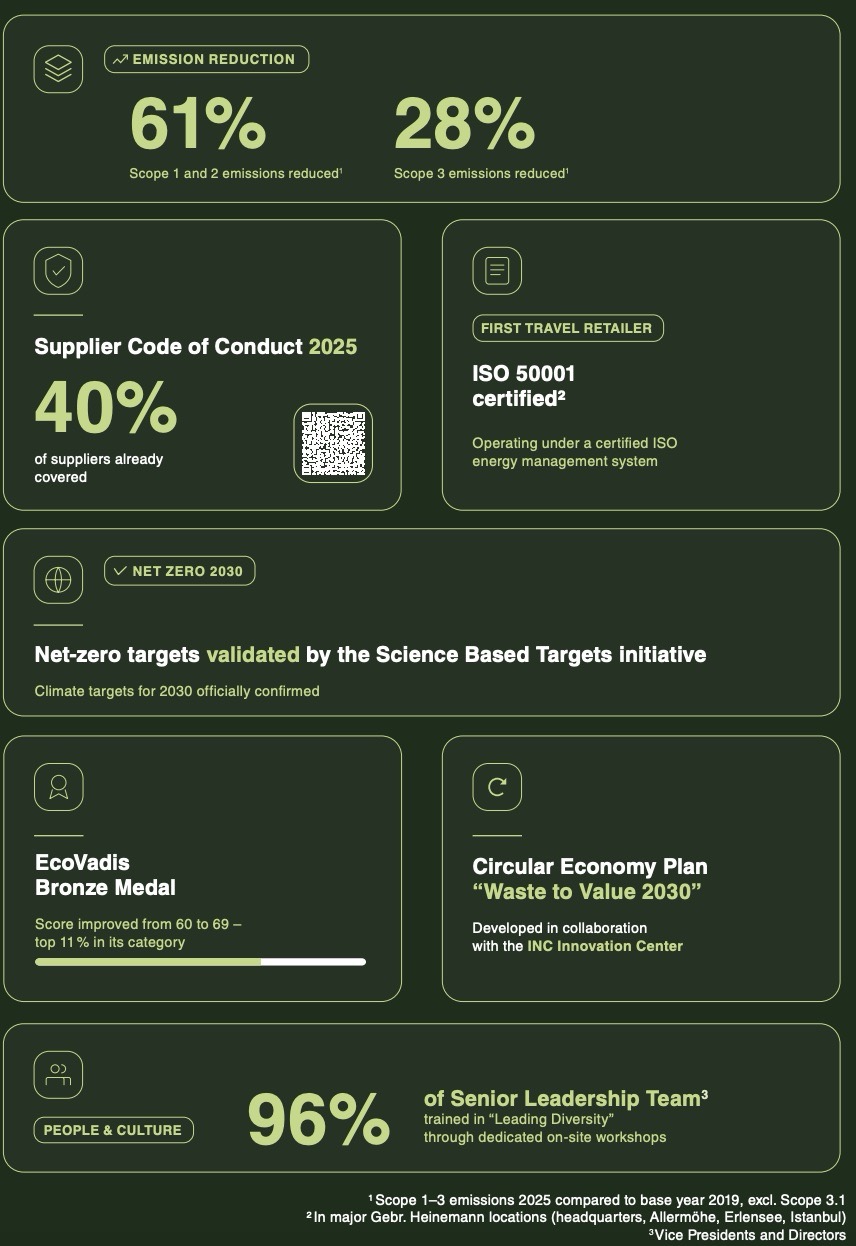
“Our partners increasingly value credible sustainability performance,” said Spanger. “It is not only the right thing to do but also a competitive factor in tenders and long-term collaborations.”
Embracing the challenge to remain relevant
Looking ahead to the second half of 2026, Gebr. Heinemann management aims to focus on “sharpening operational excellence, expanding in high-potential markets and further strengthening long-term partnerships across the value chain”.
The company said it aims to bring assortment and pricing strategies to “full impact” and to intensify collaboration with suppliers to deliver “distinctive experiences” for travellers.
“The industry is changing structurally,” said Max Heinemann. “Success will depend on relevance for travellers, resilient business models, and partnerships built on trust. We are confident that our long-term mindset and diversified set-up position us well to actively shape the future of travel retail.”
Elaborating later on how profoundly the market is changing, Max Heinemann said the generational shift “is the single most powerful driver of change in our industry, and it forces us to rethink how we design experiences, how we use data, how we collaborate across the different channels and stakeholders, and how we essentially define value.”
He also reiterated his view of global volatility as part of the “new normal”.
On what Gebr. Heinemann brings to the table in reaction to these forces, Heinemann said the company takes seriously its “huge responsibility of pushing this industry forward and keeping it healthy”.
He said, “In a world of uncertainty, our answer is not to be everything to everyone, but to be excellent at the things that truly define us.”
First among the group’s core competencies is what he termed “a flexible portfolio of services and business models across all sales channels. That is one of our most historic core competencies, the flexibility of the business model in itself, and how we address different players, B2B or B2C side, and how we can cater tailor-made solutions basically for every position.”
The second core competency Heinemann outlined as “people-powered partnership excellence”. He added, “We combine human-centric relationship skills, building trust over time and acting in partnership. Here, we see this as meeting external instability with internal stability.
“Third, we leverage data intelligence across the value chain. Everyone talks about data, but what we are doing is to systematically leverage traveller and operational data to generate actionable insights, optimise assortments, pricing and operations.
“Coupled with that human-centric element to really understand the people that we are dealing with is going to be, hopefully, a superpower of Heinemann in the future, and is something we are invested in.”
{Main article continues after the panel below}
Diversifying into new marketsDuring the press conference, Gebr. Heinemann Co-CEO Raoul Spanger highlighted strends in the market that will help define the company’s next stage. He said, “The business is moving further away from Hamburg. Growth in Germany is not a given. Growth in Europe is limited. Growth in other regions will be more substantial, and this will have effect on our global organisation and on our supply chain.”
He singled out the importance of opening at Noida International Airport in India, a country representing “a clear target market for us” given the robust outlook for long term travel. In Europe, Spanger added, spend per passenger is “under pressure”, and he linked the implications for the business to thinking around concession contracts.  “What is important is not the concession percentage but the amount. The race for concession fee percentage is over. Heinemann will not further participate in this race, but we will find formulas to increase airport revenue by increasing the amount of the concession fee. “The classic duty-free store, whatever it might be in the future, has to remain the anchor store. The shopping centre without an anchor store does not work. That means we have to keep concession fees high, but that means concession fee income and money, not percentage. “Prices have to go down in our industry. If we don’t offer better prices to our consumers globally, we will really have a problem, because this young generation is better informed than any other. That is a clear message to all.” Spanger also said there was no reliable way to predict performance for 2026. “We are prepared as Heinemann for various scenarios, but nobody can really give a forecast on this year.” |
Summing up the vision for the next five years, Max Heinemann said, “The ambition for our sector should be incredibly clear – to make travel retail much more relevant, more emotional, more frictionless and more reflective of what the traveller actually needs.
“What does that require? It requires a shared responsibility for pricing and competitiveness. It requires flexible commercial frameworks that enable us to test and learn instead of locking everyone into rigid structures into which we fall back when things go wrong. The instinct is to save on innovation or risk because we might not know where we end up.
“We require better use of data across the ecosystem, to understand behaviour and personalised journeys. And we need to co-create experiences across retailers and brands.”

Heinemann rounded off his analysis of the dynamics shaping our sector with a call to move forward “even when the world doesn’t stand still”.
He added, “We cannot wait for geopolitical calm. We cannot wait for perfect conditions. The world is moving too fast and travellers are changing even faster.
“The question is not whether we evolve, it is whether we evolve together. At the Heinemann Group, we are committed to being a constructive, reliable and forward-thinking partner in this transformation.
“We know what we stand for and we know where we bring essential value, and we are ready to co-shape the next chapter of this industry, not by looking back but by looking forward with the traveller in the centre.”
Footnote: More detailed takeaways from the annual press conference will follow. This coverage will include insights from Oliver Kreft about the Commercial Effectiveness department and the latest on GHARAGE Ventures’ start-up investments from Managing Director Lennard Niemann. ✈