


INTERNATIONAL. The International Air Transport Association (IATA) has revealed long-term projections for air travel, forecasting that global air passenger traffic could more than double by 2050.

The data is based on the association’s Long-Term Demand Projections (LTDP) model of global passenger air transport.
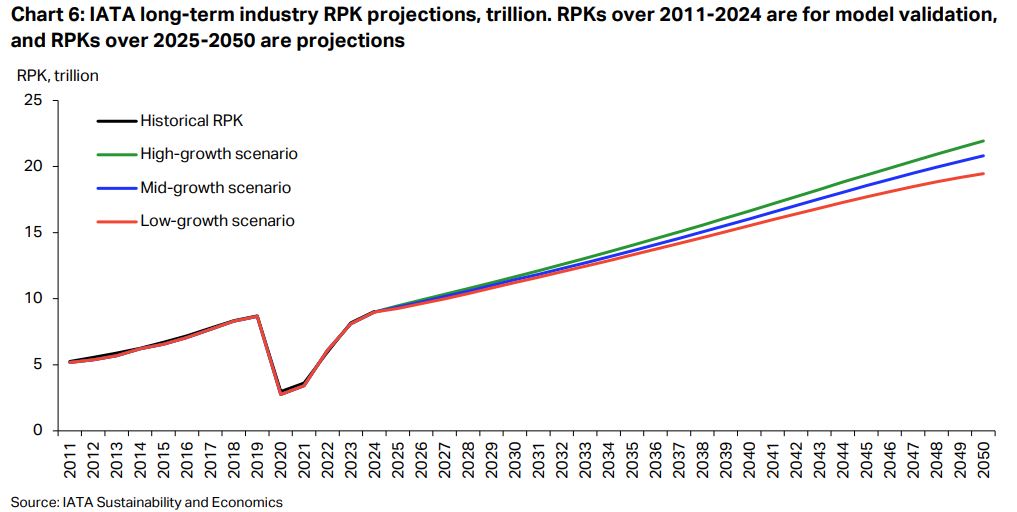
Measured in revenue passenger kilometres (RPKs), demand is expected to reach 20.8 trillion under a mid-range scenario, reflecting a 3.1% CAGR (2024-2050) from 9 trillion RPKs in 2024.
In a higher-growth scenario, RPKs could climb to 21.9 trillion (3.3% CAGR), while a lower-growth scenario would see demand reach 19.5 trillion RPKs (2.9% CAGR) by 2050.
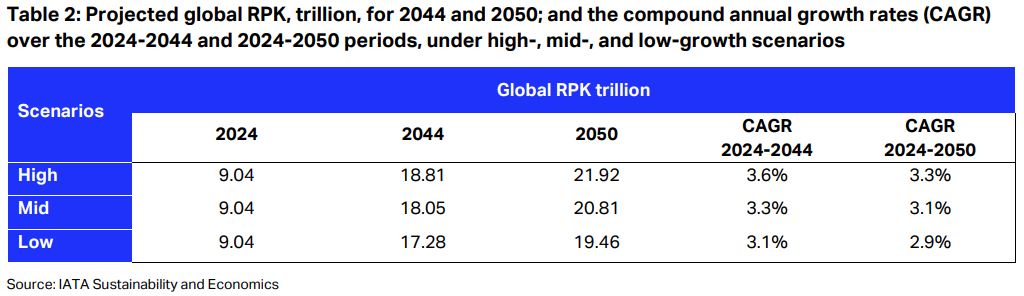
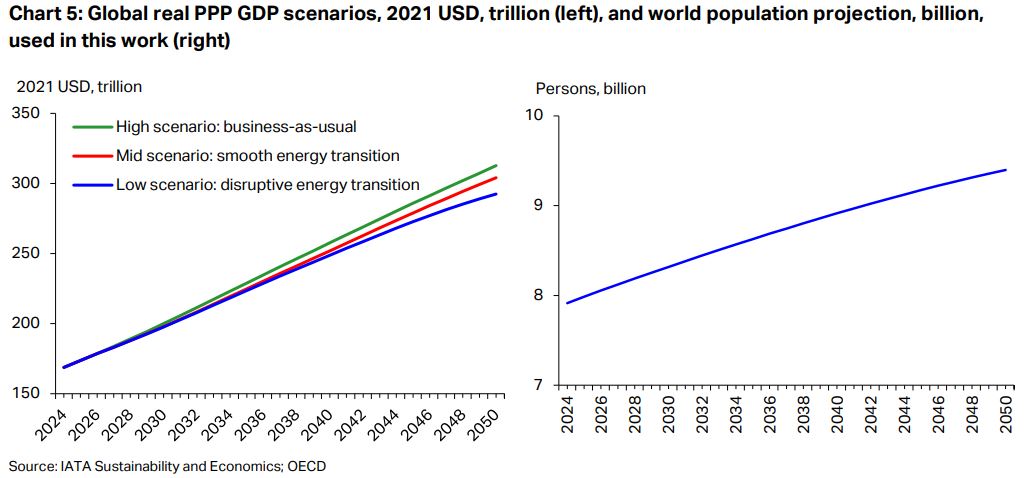
The different scenarios are based on alternative modelling of long-term economic growth, populations, aviation fuel price trends, the global energy transition and air transport supply-side capacity development.
IATA Director General Willie Walsh said: “The outlook for air travel is positive. People want to travel and, under all our modelled scenarios, the demand to fly is expected to more than double by mid-century.
“That is good news for global economic and social development because aviation growth will catalyse opportunities, including jobs, around the world. Our Long-Term Demand report gives governments, industry and energy suppliers a robust basis for long-term planning.
“It underscores the need for policy frameworks to support key success enablers, such as efficient infrastructure development, market access facilitation, regulatory harmonisation and an effective clean energy transition.”
Regional outlook: Emerging markets to lead passenger traffic surge
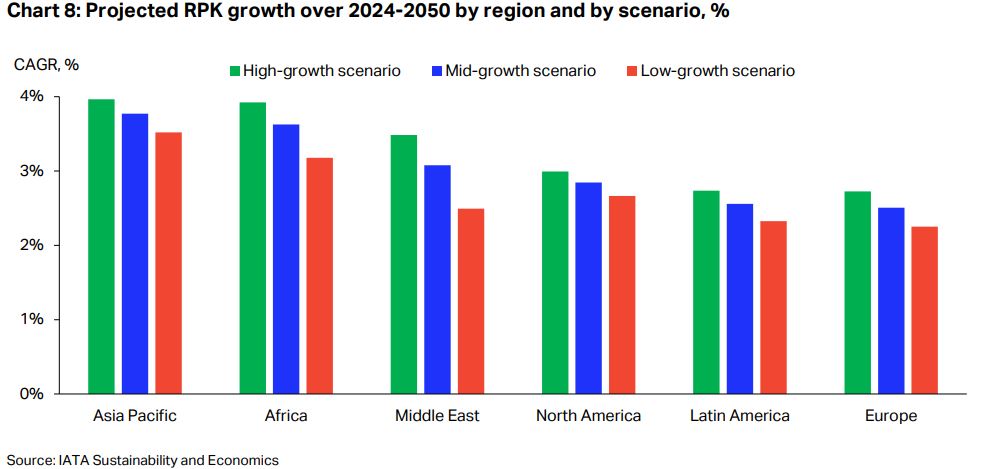
Growth rates will vary across regions, reflecting differences in demographics, market maturity, economic development and connectivity potential.
Asia Pacific and Africa are seen to lead regional air travel growth under the mid-range scenario, with CAGRs of 3.8% and 3.6%, reflecting strong market potential and demographic trends.
Slower growth is projected for Europe and North America, with CAGRs of 2.5% and 2.8%, respectively.
IATA projects strongest growth on intra-Africa routes (4.9%), followed by Africa-Asia Pacific (4.5%), Asia Pacific-Middle East (3.9%), intra-Asia Pacific (3.9%), and Africa-North America (3.8%), reflecting the critical role of investment in aviation infrastructure and regulatory frameworks in developing regions.
Markets centered on Europe, meanwhile, indicate the slowest growth projections.
Long-term global trends
Two notable long-term trends were identified in the report.
According to the LTDP, the COVID-19 pandemic caused a permanent structural shift in aviation demand. A persistent gap from the unprecedented collapse in RPK remains, and even under high growth, will not realign with pre-pandemic GDP trends by 2050.
Despite strong long-term demand, the growth rate is gradually easing.
Historical trends indicate that average annual growth dropped from 6.1% CAGR between 1972 and 1998, to 4.5% CAGR between 1998 and 2024.
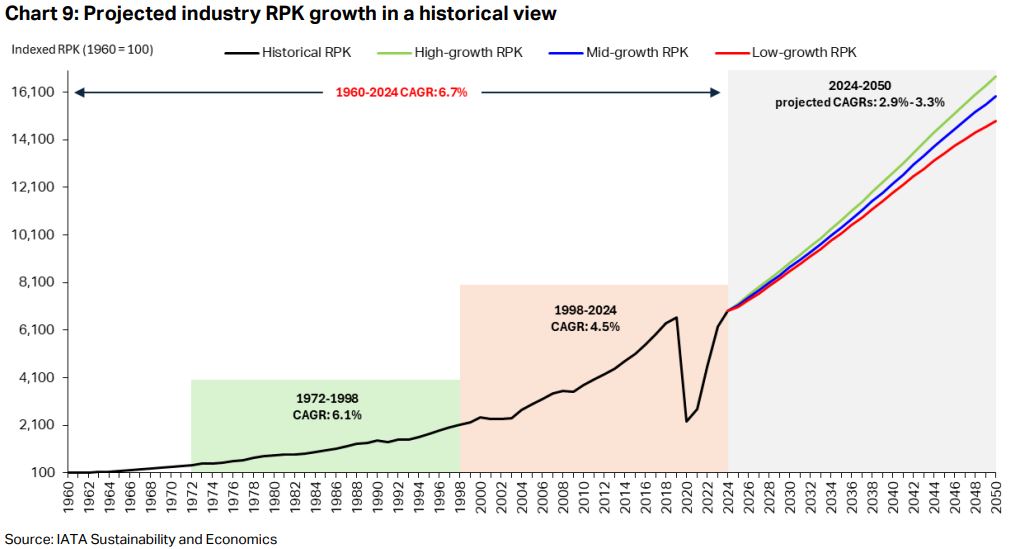
Under the central 2024‑2050 scenario, growth moderates to 3.1% CAGR, reflecting market maturity rather than softer demand, as passenger numbers continue to rise sharply.
Factors impacting the model
The LTDP uses IATA’s proprietary model, based on an extensive global econometric model that combines data from international institutions and the association’s DDS demand database.
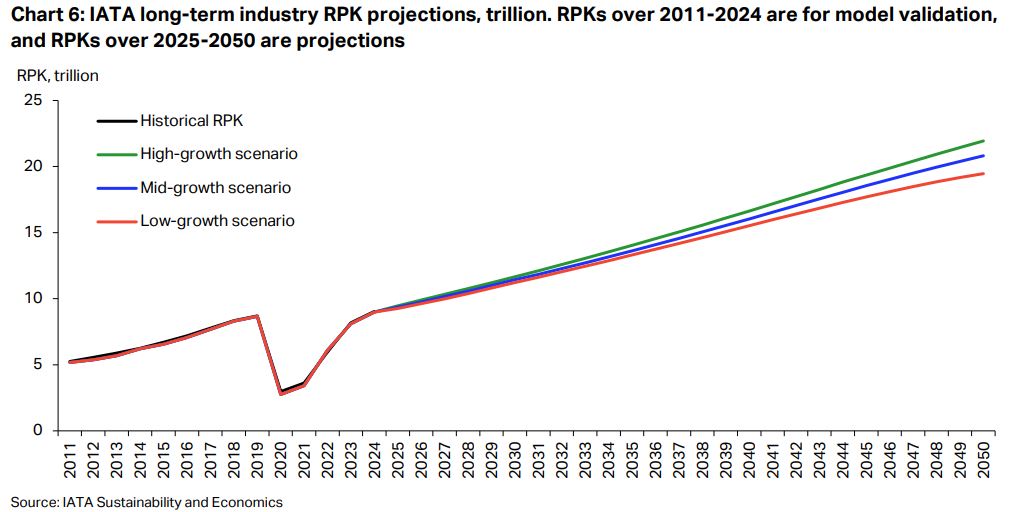
The unique dataset compiled for this work includes more than half a million observations across 41,000 directional country pairs from 2011 to 2024.
The LTDP model incorporates population, employment, flight frequencies and aircraft size at the country level, with the real PPP-adjusted GDP per capita driving demand.
The study combines long-term country projections from publicly available OECD global long-run economic scenarios.
LTDP scenarios also incorporate global energy trends to forecast long-term demand. Validated against historical data, the model achieves 98% industry-level accuracy. ✈