


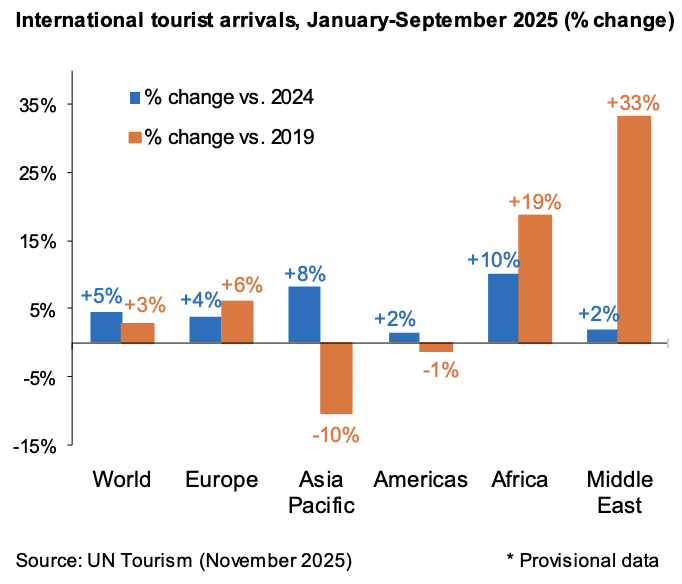
INTERNATIONAL. Over 1.1 billion tourists travelled internationally in the first nine months of 2025, a rise of +5% year-on-year and +3% ahead of the pre-pandemic 2019, according to the latest UN World Tourism Barometer. The third quarter saw a +4% increase over 2024 due to a strong northern hemisphere summer season.
UN Tourism noted in a statement, “Results reflect sustained travel demand throughout the year despite high inflation in tourism services and mixed traveller confidence due to geopolitical and trade tensions.”
Key World Tourism Barometer takeaways include:
- Africa saw a +10% increase in arrivals through September, according to limited available data. Both North Africa (+11%) and Sub-Saharan Africa (+10%) recorded double-digit growth in arrivals.
- Europe, the world’s largest destination region, received 625 million international tourists between January and September 2025, a +4% increase from the same months in 2024. All European subregions enjoyed solid results during the third quarter, reflecting a strong summer season. Western Europe (+5%) and Southern Mediterranean Europe (+3%) saw robust performance, while Northern Europe (-1%) recorded more modest results. Central and Eastern Europe continued to rebound strongly (+8%), though arrivals remained -11% below 2019 levels.
- The Americas recorded +2% growth, with a +3% increase in Q1 and Q2 but a slight drop in Q3 (-1%). Results among subregions were mixed. South America (+9%) posted the best performance, despite a flat third quarter. North America (-1%) saw weaker results partly due to small declines in the USA and Canada. Arrivals in Central America increased +3% through September, while the Caribbean (+1%) recorded comparatively more modest growth.
- Arrivals in the Middle East grew +2% in January-September compared to the same period in 2024. This represents +33% more arrivals than in 2019, the strongest regional results relative to the pre-pandemic year.
- Arrivals in Asia and the Pacific grew +8% in the first nine months of 2025, reaching 90% of pre-pandemic numbers (-10% compared to January-September 2019) as the region continues to recover. North-East Asia stood out with a +17% increase in arrivals relative to 2024 but remained -12% below 2019 levels.
- Some of the highest growth rates in arrivals in January-September 2025 were recorded in Brazil (+45% versus 2024), Vietnam and Egypt (both +21%), as well as Ethiopia and Japan (both +18%). South Africa reported +17% growth, Sri Lanka and Mongolia both +16%, and Morocco +14%. All of these destinations surpassed 2019 levels.
According to IATA, international air traffic (RPKs) grew +7% in January-September 2025 compared to the same months of 2024, with international air capacity (ASKs) ip +6% in this nine-month period. Global occupancy in accommodation establishments reached 68% in September 2025, matching the rate of September 2024 (based on STR data).
Strong visitor spending
Monthly data on international tourism receipts show strong visitor spending in several destinations through September 2025. Japan (+21%), Nicaragua (+19%), Egypt (+18%), Mongolia and Morocco (both +15%), Latvia (+13%), Brazil (+12%) and France (+9%) were among the best performers in terms of growth in receipts in the first nine months of 2025.
There was also strong demand in outbound spending from some large markets such as the USA (+7% through August), France (+5%), Germany and Italy (both +4%), as well as Spain (+15% through August) and the Republic of Korea (+7%).
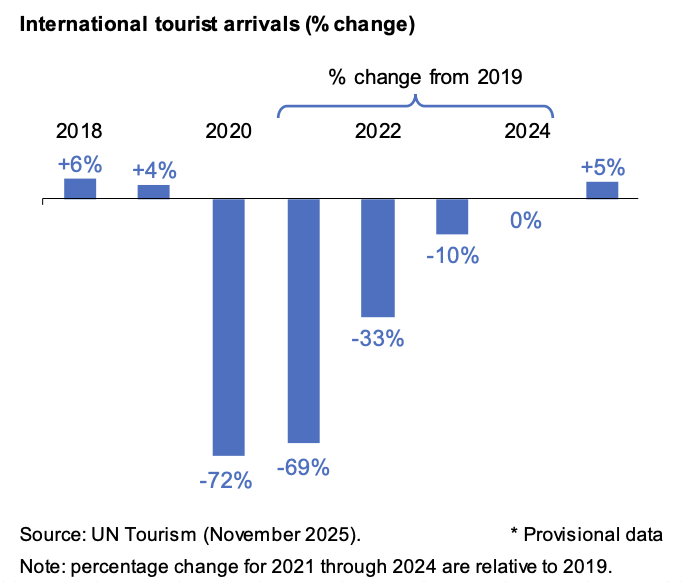
According to UN Tourism’s projection in January this year, international tourist arrivals are expected to grow by +3-5% year-on-year in 2025.
While results through September are in line with UN Tourism’s forecast, the agency said that factors such as high travel prices and a challenging geopolitical environment remain downside risks.
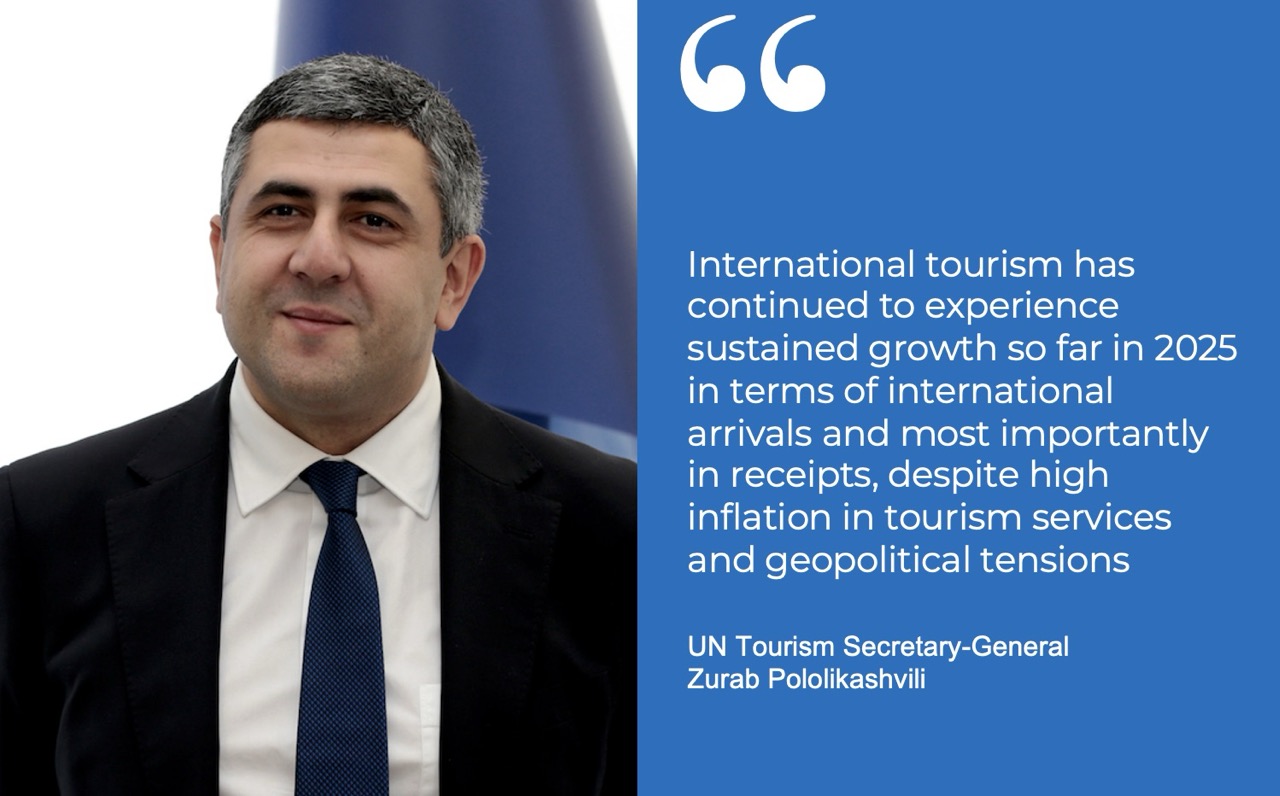
UN Tourism Secretary-General Zurab Pololikashvili said: “International tourism has continued to experience sustained growth so far in 2025 in terms of international arrivals and most importantly in receipts, despite high inflation in tourism services and geopolitical tensions. Africa and Europe in particular stand out for their results.” ✈
INDIA STUDY
Out now: Leading Indian data management solutions company Voiceback Analytics has partnered with The Moodie Davitt Report on a major new study of Indian global travellers’ shopping habits. To ensure rich and actionable insights, Voiceback Analytics conducted 1,000 interviews at major international airports across India with fieldwork and analysis conducted in June, July and August 2025. To order a copy of the report or for more details, please email Irene Revilla at Irene@MoodieDavittReport.com.