



INTERNATIONAL. Istanbul Airport has been named the world’s most connected airport for the first time, overtaking London Heathrow in the OAG Megahubs 2026 rankings.
The annual study from aviation data and intelligence specialist OAG underlines the continuing reshaping of global aviation connectivity, with Asia Pacific airports occupying eight of the top 20 positions and Chinese hubs recording a strong recovery.
For the travel retail sector, the findings offer an important perspective on the airports benefiting from the greatest concentration of connecting passengers and international network reach – key factors in driving passenger flows and commercial opportunities.
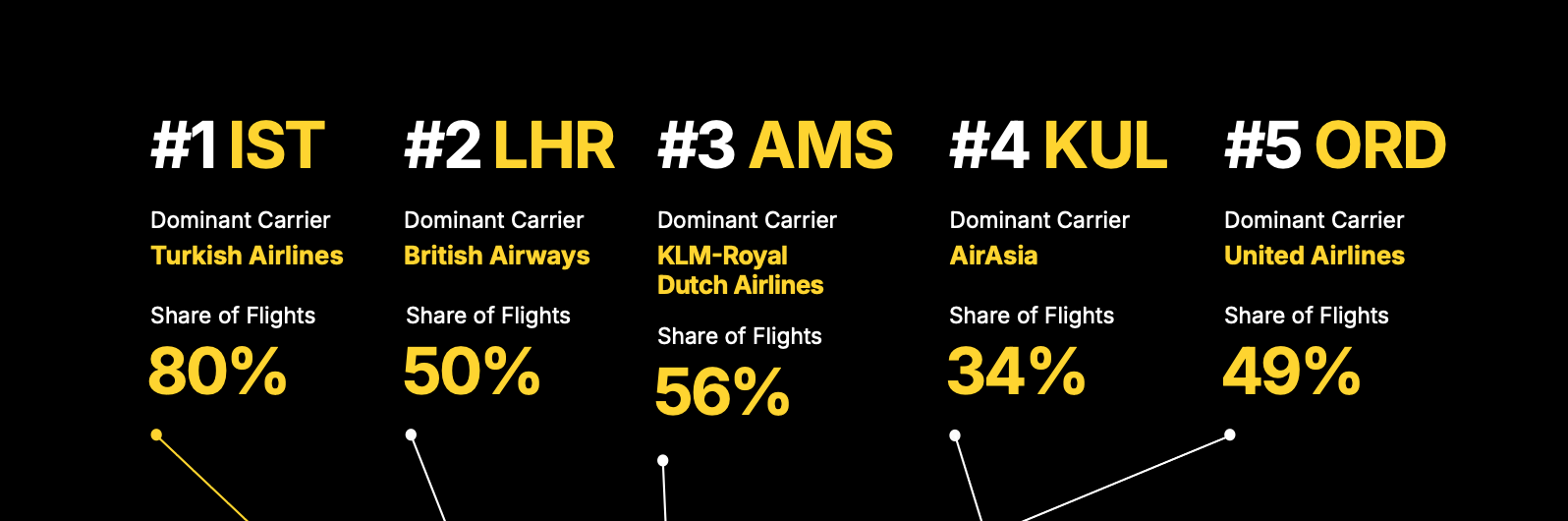
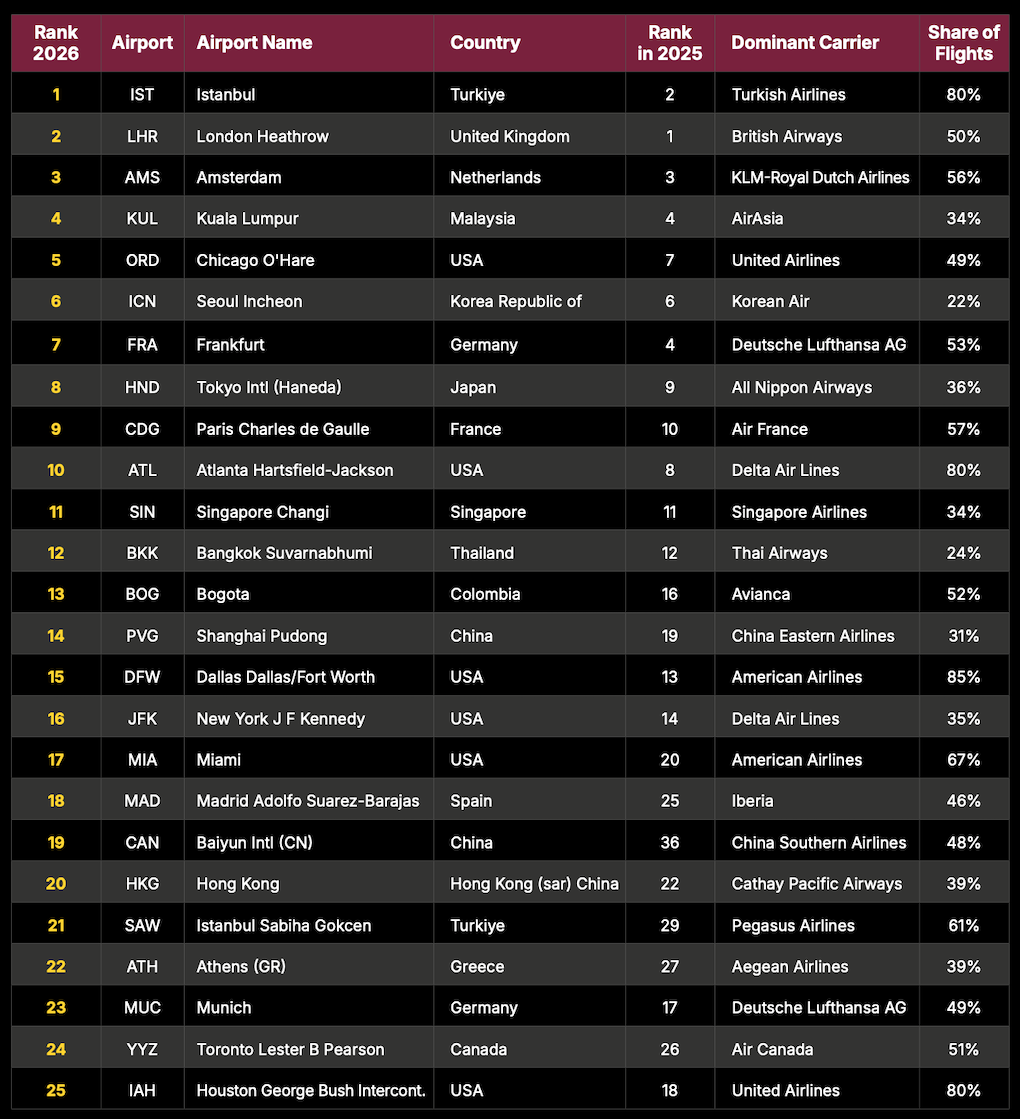
Istanbul Airport rises from second place in 2025 to lead the global ranking, offering connections to 337 destinations worldwide. Turkish Airlines is overwhelmingly the dominant carrier, accounting for 80% of capacity at the hub.
The airport achieves the highest potential connectivity among the world’s major airports despite ranking eighth globally by capacity, illustrating the strength of its transfer model and the breadth of the Turkish Airlines network.
London Heathrow slips from first to second, with potential connections on the busiest day down -6% year-on-year. OAG said the airport’s connectivity has been affected by disruption to Middle East schedules, with Heathrow capacity to the region down -25% in August compared with a year earlier.

Amsterdam Schiphol retains third place, supported by growth in both capacity and destinations.
Kuala Lumpur International Airport holds fourth position and remains Asia’s most connected megahub, with destinations served increasing to 154.
Kuala Lumpur also tops OAG’s separate Low-Cost Megahubs ranking, with almost 15,000 possible low-cost connections across 154 destinations. AirAsia is the dominant airline at the Malaysian gateway, accounting for 34% of total flights.
Chicago O’Hare International Airport climbs from seventh to fifth globally and is the highest-ranked airport in the Americas. Potential connections increased +9.8%, while the number of destinations rose from 297 to 308. The latter figure gives O’Hare the third-widest international reach of any airport worldwide, behind Istanbul with 337 destinations and Frankfurt with 310.
Chicago and Atlanta Hartsfield-Jackson are the only North American airports in the global top ten.
OAG Chief Analyst John Grant said: “The 2026 rankings reflect a global aviation landscape that is still recalibrating after significant disruption. Istanbul’s rise to the top reflects the strength of Turkish Airlines’ network and the airport’s geographic position as a connecting hub between east and west.
“The recovery of Chinese airports is equally significant. The data suggests the post-pandemic adjustment in that market is now complete.”
Commenting on Istanbul’s rise to the top of the global ranking, iGA Istanbul Airport CEO Selahattin Bilgen said: “Being recognised as the world’s most connected airport is a significant achievement for iGA Istanbul Airport and everyone who has contributed to our growth.
“This achievement reflects our strategic development, together with the breadth and reach of Turkish Airlines’ network. From the outset, iGA Istanbul Airport was designed to accommodate future expansion, supported by Istanbul’s unique geographical position and our ever-growing airline network.
“As we continue to expand our global connectivity and enhance passenger experience, we remain committed to further strengthening Istanbul’s position as one of the world’s leading aviation hubs.”
Asia Pacific strengthens its connectivity position
Asia Pacific accounts for eight of the world’s top 20 megahubs, compared with six in Europe, the Middle East & Africa, five in North America and one in Latin America.
Several Chinese airports made significant gains. Shanghai Pudong International Airport rises from 19th to 14th, Guangzhou Baiyun International Airport surges from 36th to 19th and Hong Kong International Airport returns to the top 20, climbing from 22nd to 20th.
OAG said the performance indicates that Chinese megahubs appear to have finally shaken off the residual effects of the pandemic.
Tokyo Haneda also improves, moving from ninth to eighth globally.
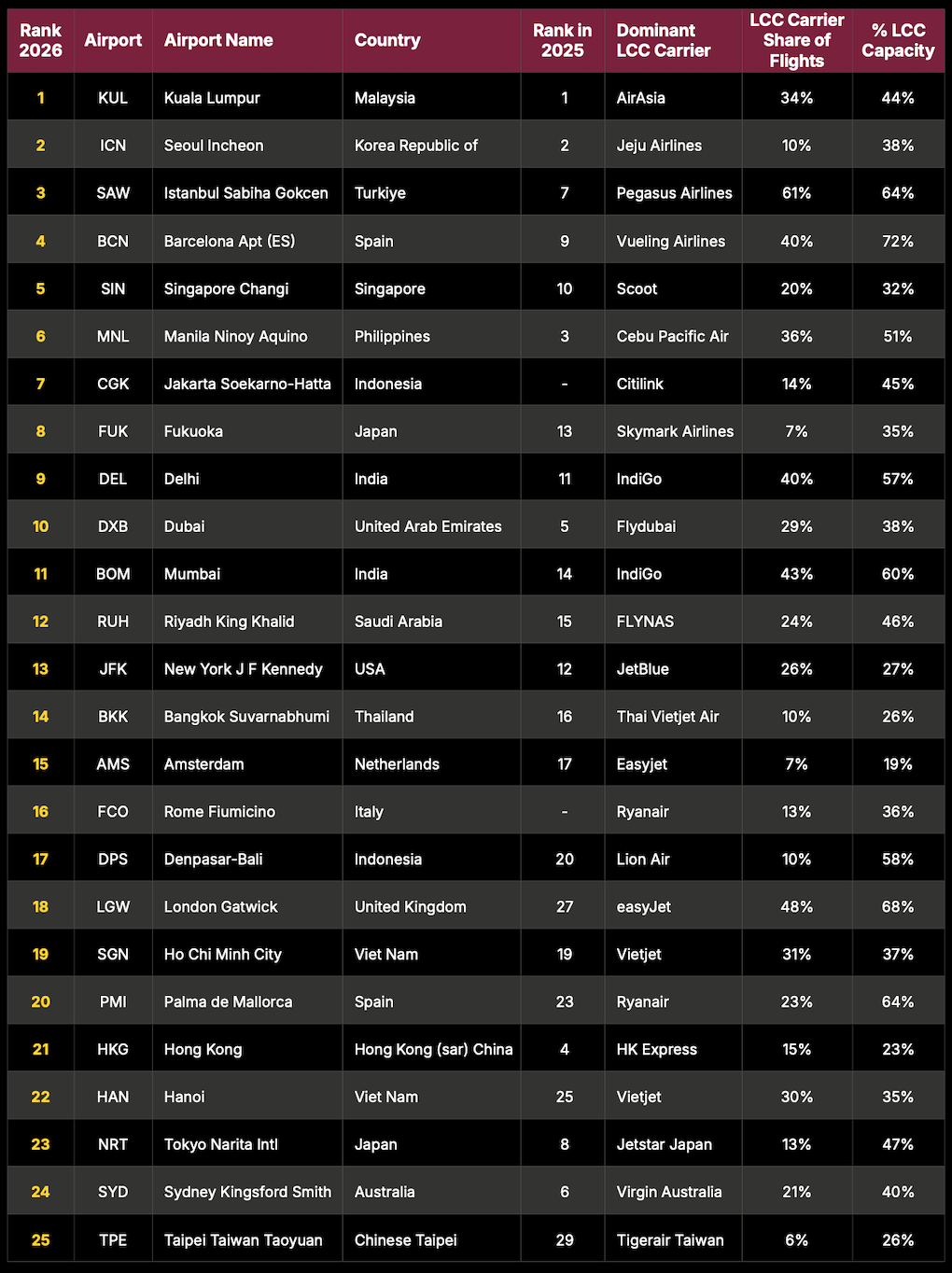
The strength of Asia Pacific is particularly pronounced in the low-cost segment. The region accounts for 16 – or 64% – of OAG’s top 25 Low-Cost Megahubs.
Low-cost carriers represent 51% of all seats across Southeast Asia, substantially above the 34% global average.
Seoul Incheon retains second place in the low-cost ranking, offering a high ratio of low-cost connectivity to 198 destinations.
Istanbul Sabiha Gökçen is one of the biggest climbers, rising from seventh to third. Capacity at the airport increased +10% year-on-year and ten destinations were added, taking its network to 162. Pegasus Airlines accounts for 64% of low-cost capacity at the airport.
Barcelona rises five places to fourth and remains Europe’s highest-ranked low-cost megahub. Singapore Changi advances from tenth to fifth, while Fukuoka climbs from 13th to eighth.
Middle East disruption impacts rankings
OAG cautioned that this year’s results have been affected by continuing disruption to Middle East aviation.
Scheduled capacity in the region in August 2026 was -5.7% below August 2025, affecting the positions of Middle Eastern airports and other hubs with substantial connectivity to the region.
Dubai International Airport falls from 15th to 31st in the global ranking, while Doha drops from 34th to 46th.
Elsewhere in the region, Riyadh King Khalid International Airport ranks 43rd globally.
US connectivity led by Chicago
Chicago O’Hare also retains first place in OAG’s US Domestic Megahubs ranking.
Although Atlanta handles greater domestic volumes, Chicago provides more potential connecting options across a wider network. Its domestic capacity increased +12%, while the number of destinations rose from 214 to 227 – the widest domestic reach of any US airport.
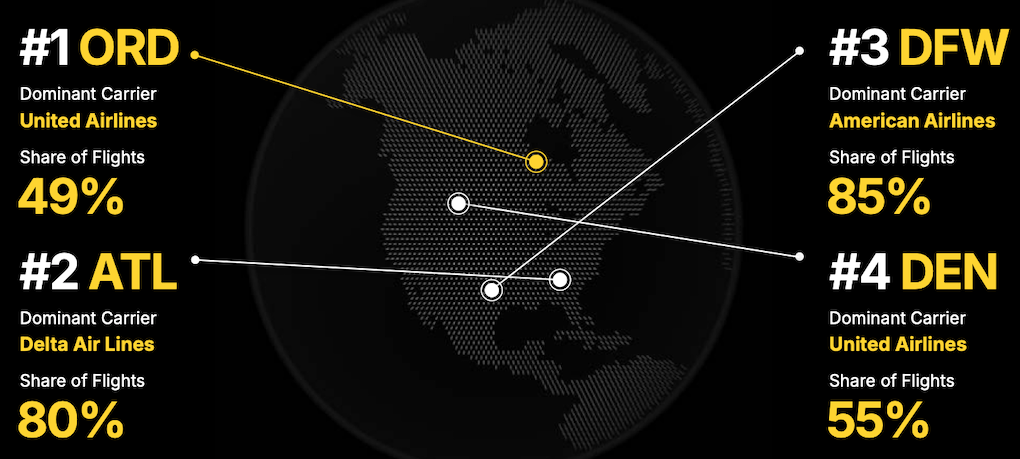
OAG calculated 83,647 potential connections at O’Hare on the busiest day measured. United Airlines is the largest carrier but accounts for 49% of flights, giving Chicago what OAG describes as the most diverse airline portfolio of any US hub.
Atlanta ranks second, with potential connections across 170 domestic destinations and Delta Air Lines accounting for 80% of flights.
Dallas Fort Worth is third, followed by Denver and Charlotte.
San Francisco records the biggest rise in the US domestic ranking, climbing from 17th to 11th, while Los Angeles advances from tenth to seventh.
Access the full OAG 2026 Megahubs report here.
Research notes: OAG’s Megahubs Index measures airport connectivity by comparing the number of scheduled connections to and from international flights with the number of destinations served.
For the international ranking, OAG analyses possible connections between inbound and outbound flights within a six-hour window where either flight is international.
The 2026 index is based on Sunday 2 August, the busiest day for global aviation in the 12 months to August 2026. Destinations are those served from each airport between September 2025 and August 2026.
The separate US Domestic Megahubs ranking is based on 23 July 2026, the busiest day for US domestic flights, and applies a maximum three-hour connection window. ✈