

SOUTH KOREA. Lotte Duty Free parent company Lotte Group has formally signed a land-swap deal with South Korea’s military that will see the deployment of the US anti-missile system Terminal High Altitude Area Defense (THAAD) go ahead as planned.
Lotte Group confirmed the deal to The Moodie Davitt Report. Lotte’s decision risks a further strong backlash from China which could have a dramatic impact on visitor numbers to Korea and duty free sales.
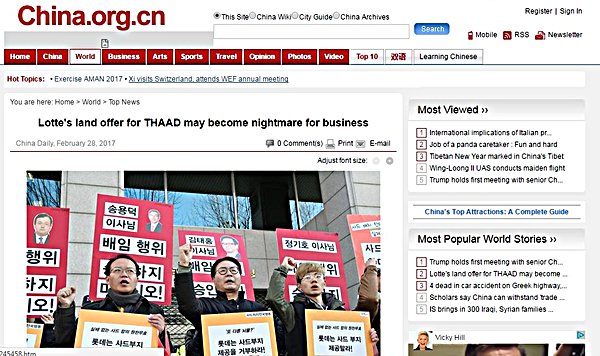
Chinese state media China.org let rip a furious blast at the decision yesterday, commenting: “The decision could turn into a nightmare for Lotte, which depends heavily on Chinese tourists to South Korea for revenue from duty free stores.”
![[LDF]Main Store 12F_1](https://moodiedavittreport.com/wp-content/uploads/2023/07/LDFMain-Store-12F_1.jpg)
The THAAD system will be deployed later this year.
As reported, South Korea’s decision to support THAAD has outraged Chinese authorities, prompting a strong backlash against Korean entertainers and businesses. Lotte Duty Free is the most exposed of all Korean travel retailers, partly by dint of its market dominance but more critically because of the land-swap deal.
Ahead of the confirmation of the deal, Chinese state news agency Xinhua had said there could be “severe” consequences for Lotte if it agreed to the land-swap. “The proposed deployment of a US missile defence system in the Republic of Korea is a threat to regional security and stability, and Lotte Group is one decision away from becoming an accessory to the act,” it wrote in a commentary piece.

“The Lotte Group board of directors […] are playing with fire that could inflame regional relations. If Lotte agrees to the deal, the Republic of Korea and the US governments will speed up the planned THAAD deployment. By association, Lotte will hurt the Chinese people and the consequences could be severe.
“The Chinese people will not support a company complicit in damaging China’s interests. Lotte, the Republic of Korea’s fifth-largest conglomerate, has over 150 branches in China in the retail sector alone, and its business ranges from food, retail, tourism, construction to finance and service. Chinese customers contributed 70% of Lotte’s overall sales at its duty free shops in the first quarter of last year, company data shows.
“Lotte stands to lose Chinese customers and the Chinese market. That would be a very large slice out of their business pie. The right decision would be for Lotte to defer or reject the deal, thus, forcing the Republic of Korea government to review the feasibility of this regionally sensitive project. One misjudged step could have severe consequences.”

According to a report in Pulse (Maeil Korea Business News), Lotte’s Chinese business have suffered a series of raids from the Chinese authorities since the THAAD controversy erupted, prompting several shop closures.
The 8,067,722 Chinese visitors to South Korea last year accounted for 46.8% share of total arrivals and a much higher percentage of duty free spending. Any downturn in Chinese visitors – particularly from the group tour sector considered most vulnerable to political influence – will hit Korean travel retailers hard. The MERS crisis of 2015 underlined the devastating effect that a slump in Chinese visitors can cause.