

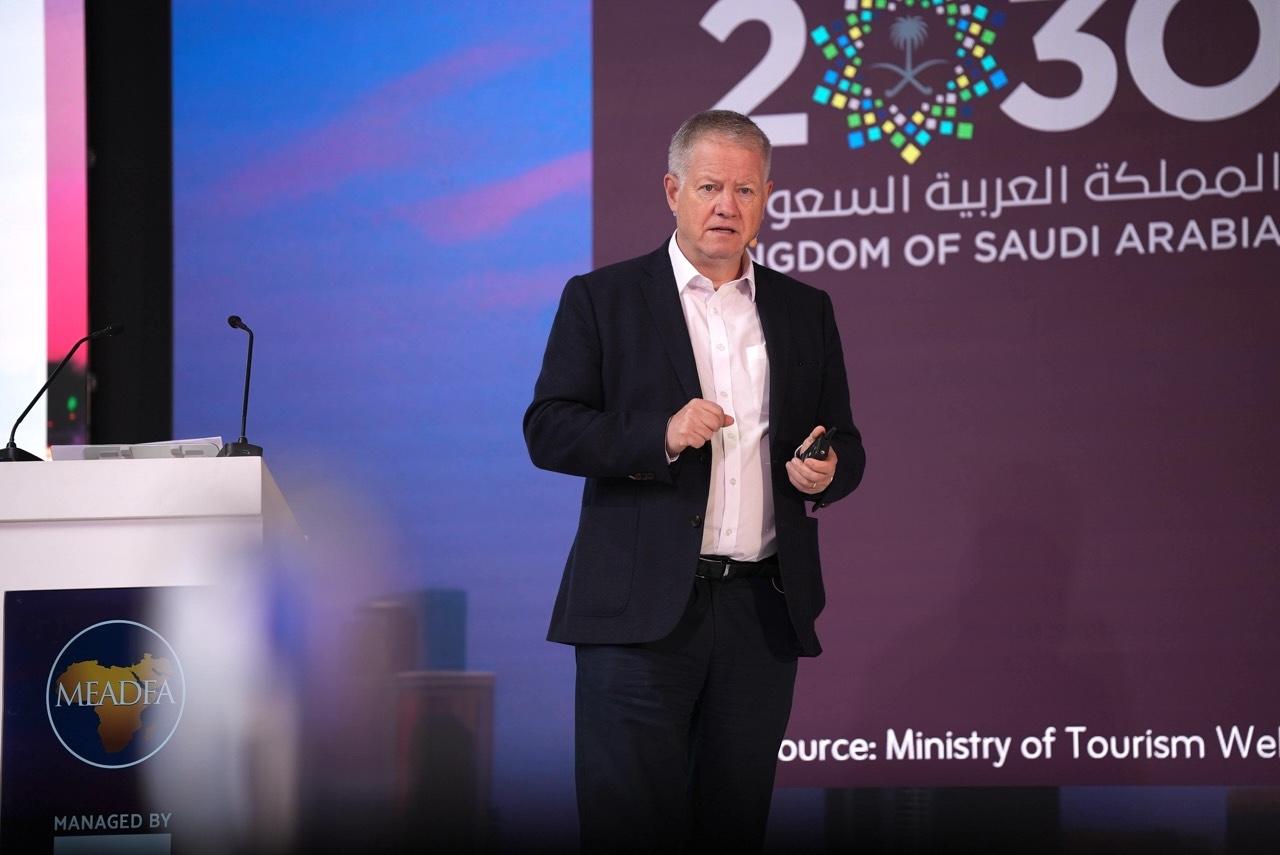
SAUDI ARABIA. In one of the highlight addresses of the Middle East & Africa Duty Free Association (MEADFA) Conference in Dubai, Al Waha Duty Free Company CEO Jack MacGowan outlined the ambitions for this new Saudi Arabian travel retail force and explained how its mission is aligned with Vision 2030, the Kingdom’s ambitious national plan.
As reported, Saudi Arabia’s Public Investment Fund (PIF) announced the establishment of the travel retailer in March, with a pledge to create a Saudi-owned leader in travel retail and secure a greater share of passenger spending for the Saudi economy.
Setting the scene at MEADFA with the rationale behind Al Waha’s creation, MacGowan zoomed in on the transformation of Saudi Arabia, with retail becoming a much more dynamic sector and the ambition through Vision 2030 to attract 330 million travellers a year by the turn of the next decade.
This is being backed by strategic investments in tourism and aviation infrastructure and by hosting global events that promote Saudi Arabia’s reputation – from Expo 2030 in Riyadh to the 2034 FIFA World Cup – as capital allocation into non-oil projects accelerates.
Against this backdrop the aviation market is also growing rapidly. Passenger traffic at Riyadh Airport grew from 22 million a year in 2015 to over 37 million last year. The new King Salman International Airport will have capacity for up to 100 million passengers a year by 2030, while Jeddah Airport’s expansion will allow it to serve similar numbers into the next decade.
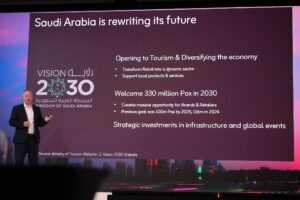
MacGowan said, “This is hugely exciting, not just from a passenger point of view, but also for brands to think about how you can sit within these state-of-the-art facilities.”
Turning to the luxury market, MacGowan introduced some key numbers to support the picture of a strong Saudi consumer appetite for brand consumption, but with a clear localised element.
95% of affluent 18-34-year-old Saudis think it is important to support and engage with Saudi-first enterprises and celebrate local craft and design, he noted. Some 77% believe that luxury brands should offer localised collections or special seasonal offerings for occasions like Ramadan.
MacGowan said: “With the spending power of Saudi Arabians on luxury, never has there been such an attractive segment but one so underserved. Now that is changing but many travel abroad to spend and that is unfortunate when that demand can be served at home.” To illustrate this, of US$7 billion spent on luxury by Saudi Arabians, US$4 billion is spent overseas [Fashion Futures 2024].
MacGowan also cast a lens on the younger travelling consumer, noting that the average age of Saudi Arabian travellers is six years younger (at 37) than the worldwide figure of 43 (m1nd-set data). He added that Riyadh Airport has 2.4 times more Gen Z passengers than the global airport average.
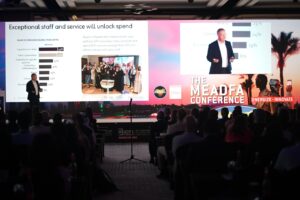
Bringing up a chart that should appeal to brand owners across categories, he revealed research conducted by Al Waha with 1,500 travellers at Riyadh Airport from June and July this year. It showed how Gen Z flyers love international brands, want exclusivity and limited editions, seek out authentic local brands and are willing to spend high transaction amounts.
MacGowan said: “If you want to recruit Gen Z consumers, this is the region to focus and invest in. Learn how to engage with this audience who are very different, at Riyadh Airport and elsewhere in Saudi Arabia. If we work together to effectively engage this audience across the consumer journey, they are going to buy.”
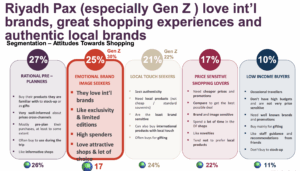
Shoppers at Riyadh who interacted with sales staff were +11% more likely to buy products and spend +31% more on average than those who did not interact with sales staff, he said.
Laying out the background to Al Waha as a PIF company, MacGowan explained more about the wider vision from government.
“We want the first and last impression of Saudi Arabia to be exceptional and challenge wider perceptions and expectations. We want to send tourists and visitors home from Saudi Arabia as ambassadors, talking to their friends and family about how good the trip was, what they experienced, just like I did when I first visited two years ago. Al Waha Duty Free has a significant role to play in this mindset change.
“It is not simply about making money, it is to transform the first and last impression for the tourists and to create a new customer experience in the airports and across other travel hubs. We are an ambassador for the country.”

From a start-up under two years ago, Al Waha occupies an office in Riyadh with 53 support staff today, and across management and teams has a blend of international experience and local talent. MacGowan also highlighted the fully Saudi Arabian workforce on the shop floor.
“Across Saudi Arabia, led by the malls downtown, we are seeing a much higher level of service so this will be key in travel retail. We are starting to see that we will have competition, so step changing the customer travel retail experience is not just about staff, but that is a large part of it. We want people to see travel retail as a career, one in which they can learn and grow. We are investing heavily in training to create an elite Saudi sales force.”
The company is establishing a training academy and working with learning institutions in the region to deliver consistent, high-quality and travel retail-specific training, he said.
In terms of regional collaborations, Al Waha Duty Free has been named as the official brand partner of the Al Ahli women’s football team. This marks a pioneering collaboration in support of women’s football in the Kingdom, said MacGowan, which will include brand integration, creation of exclusive content, social media competitions plus related engagement with consumers in airport terminals.

Of the wider store experience, MacGowan said: “We want the consumer to walk in and to understand how and where to shop easily, see that staff are helpful, knowledgeable and recognise that we offer great value. This is not just about price but about exclusives and global brands which are critical elements of the total value offer.”
Elaborating on the role of price, he said: “We don’t have to be the cheapest, but we do not want to be more expensive than the competitive set. If you are flying to other airports we want to be in the mix for consideration, and in short, we take the attitude that we check prices so you don’t have to.
“But that said, it is not easy to compete if you don’t have price as a lever. We are figuring out what ranges we should create for Saudi passengers.
“Our research showed a huge appetite for authentic and quality local products and localisation of global brands. This is with Saudi residents, not just tourists, and is a primary shopping trigger for Gen Z. This creates value and exclusivity beyond price.
“We need to work together with brands. If you have got an internationally famous brand, how do we make it relevant to a Riyadh customer?
“If it’s a promotion that has worked in 17 out of 25 countries abroad, do you download it to us without any change, or should you be trying to adapt and make it more relevant to our consumers and to the Saudi culture and assortment?”
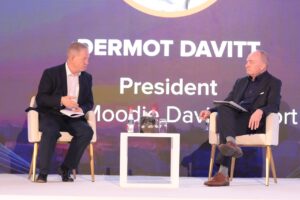
Summarising the commercial philosophy, he said that Al Waha was “committed to building a world-class retail experience, driven by deep understanding of Saudi passengers and executed by a team of international and local retail experts”.
On other shop floor priorities, MacGowan highlighted speed at the cash till, curated offers and flexibility in merchandising and in the space allocation strategy, alongside investment in digital tools to ease the path to purchase.
Above all, creating stop points of local interest is vital. “As an industry we have a challenge in disrupting the journey so that people stay and browse in our store for a while. Most travellers are time poor. To address this, we plan to create large-scale events celebrating local culture and seasons that are relevant and engaging.”

Beyond airports, the largest channel, MacGowan said that Al Waha will also target expansion in resorts, border crossings, rail stations, cruise and downtown retail.
“The definition of Al Waha’s scope is all tourist touch points. It is at the airport on their way in and way out. If they are at the Red Sea, in Shura Island, we should be there. If they’re on a cruise, we should be there. If they cross the border, we should be there. Not all of this will be done in the next three or four months but over a number of years that is our plan.”
He added, “I believe that with the offer we will present, and the right partnerships with Riyadh Air, with Saudia, with MATARAT and Riyadh Airports Company and King Salman International Airport later – all broadly with the same shareholder – is a combination that will allow us to flourish and also to unlock the data-sharing challenge the industry has faced for years.
“And all of that growth we see ahead can contribute to Saudi Arabia becoming a global top ten travel retail market in the coming ten to 15 years.”
The conversion challengeIn his address at the MEADFA Conference, Al Waha Duty Free CEO Jack MacGowan gave a big-picture assessment of how travel retail must respond to declining spend per passenger and seek to recruit a new generation of consumers. “It has become harder for us to recruit a new generation, but why?” he asked. “I see two reasons. First, we are a consolidating industry. Bigger companies are just a little harder to change, a little more risk averse, less willing to try new things because there is a lot more at risk – higher rents, Minimum Annual Guarantees – there is just more at stake.  “It’s not the same everywhere. In the Middle East there is still a positive perception of good value in duty free, which does not exist to the same extent in other parts of the world. “The Middle East is not only the fastest-growing region in the world, but the attitudes are also far more positive. So if anything, the message back to head offices is that the Middle East is where you should be looking to invest.” ✈ |
 Out now: Leading Indian data management solutions company Voiceback Analytics has partnered with The Moodie Davitt Report on a major new study of Indian global travellers’ shopping habits. To ensure rich and actionable insights, Voiceback Analytics conducted 1,000 interviews at major international airports across India with fieldwork and analysis conducted in June, July and August 2025. To order a copy of the report or for more details, please email Irene Revilla at Irene@MoodieDavittReport.com.