


EUROPE. A new report from the European Travel Commission (ETC) and Eurail suggests that interest in travel to Europe from several key source long-haul markets remains limited for the months ahead, though it has improved compared to a year ago.
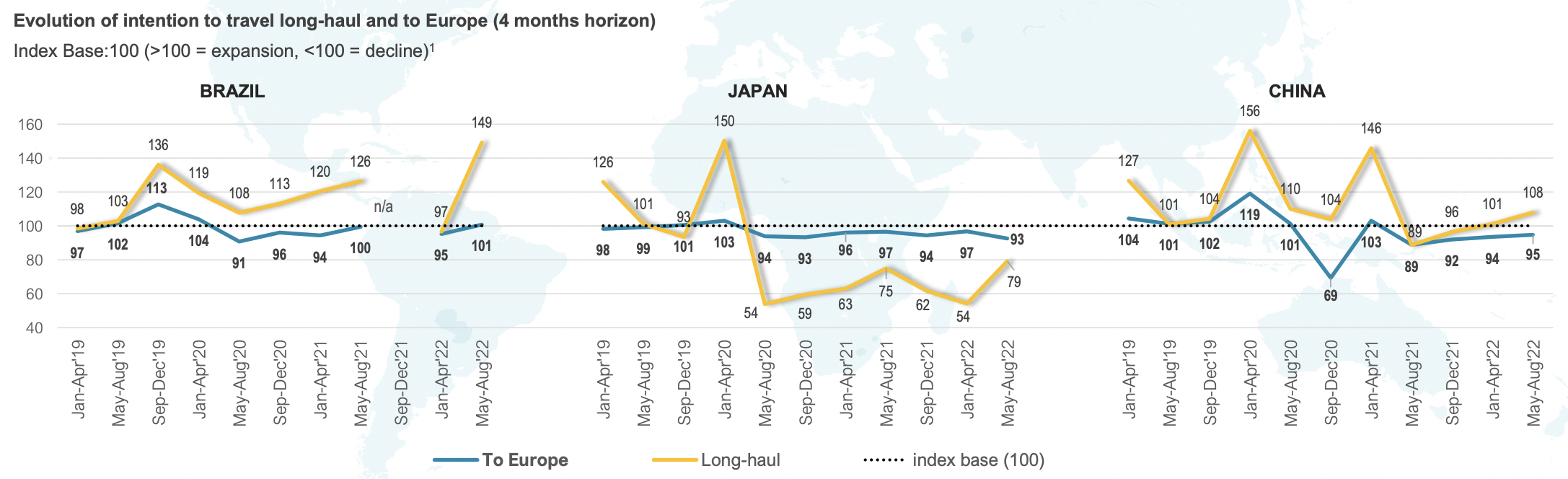
The latest Long-Haul Travel Barometer (LHTB) for Q2 2022 covers the period from May to August. It examines travel intentions in six overseas markets – Brazil, Canada, China, Japan, Russia, and the US every four months. Intention to travel is measured in an index that reflects the dominant sentiment expressed by a market, either positive or negative.

Although the Russia-Ukraine conflict has created new challenges for the European travel sector, it appears to have had a limited impact on sentiment in most long-haul source markets except in China and Russia.
The majority of respondents (76%) stated that the conflict has not affected their travel intent. Results show that COVID-19 concerns, travel-related costs and the lack of convenient travel connections are the main deterrents to long-haul travel this Summer.
ETC President Luís Araújo said: “ETC is pleased to see that long-haul travel sentiment is gradually improving as the world continues to recover from the pandemic – albeit at a slow pace. It is heartening that the ongoing conflict in Ukraine has not become another deterrent to international travel to Europe. Europe remains a safe and attractive travel destination. Nonetheless, the fallout from the conflict, such as rising costs of living and travel related costs are hampering the sector’s recovery. Promoting Europe in overseas markets and restoring international mobility will be crucial for the sector’s recovery in 2022.”
Due to the ongoing conflict in Ukraine and sanctions imposed on Russia, Russian travellers desire to visit Europe reached the lowest level on record.
In the short-term, over half of surveyed Russians (60%) do not plan to travel outside the Commonwealth of Independent States (CIS). Among the few Russians (20%) who do have plans to travel but not to Europe, 9% stated that the current situation has negatively impacted their interest in visiting Europe in the coming months, while 7% still consider the region an attractive destination and would love to visit it in the future. The conflict has dampened Chinese traveller sentiment in visiting Europe, even if overseas travel is restricted under government rules. The appeal of European cities has strengthened among Chinese residents compared to 2021 figures, with a noticeable increase in appetite to explore multiple types of European destinations (e.g., coastal, metropolitan, rural, etc.).
The travel sentiment index in the US has remained stable from last Summer though sentiment for visiting Europe has slightly deteriorated. According to the survey results, this trend is mostly related to concerns surrounding the impact of inflation on personal finances and increased travel costs.
June and August are likely to be the most popular months for Americans planning European holidays. However, over half of Americans who stated their intention to travel to Europe during the Summer season have not yet booked their plane tickets, suggesting that last-minute bookings will be a prominent factor in this market.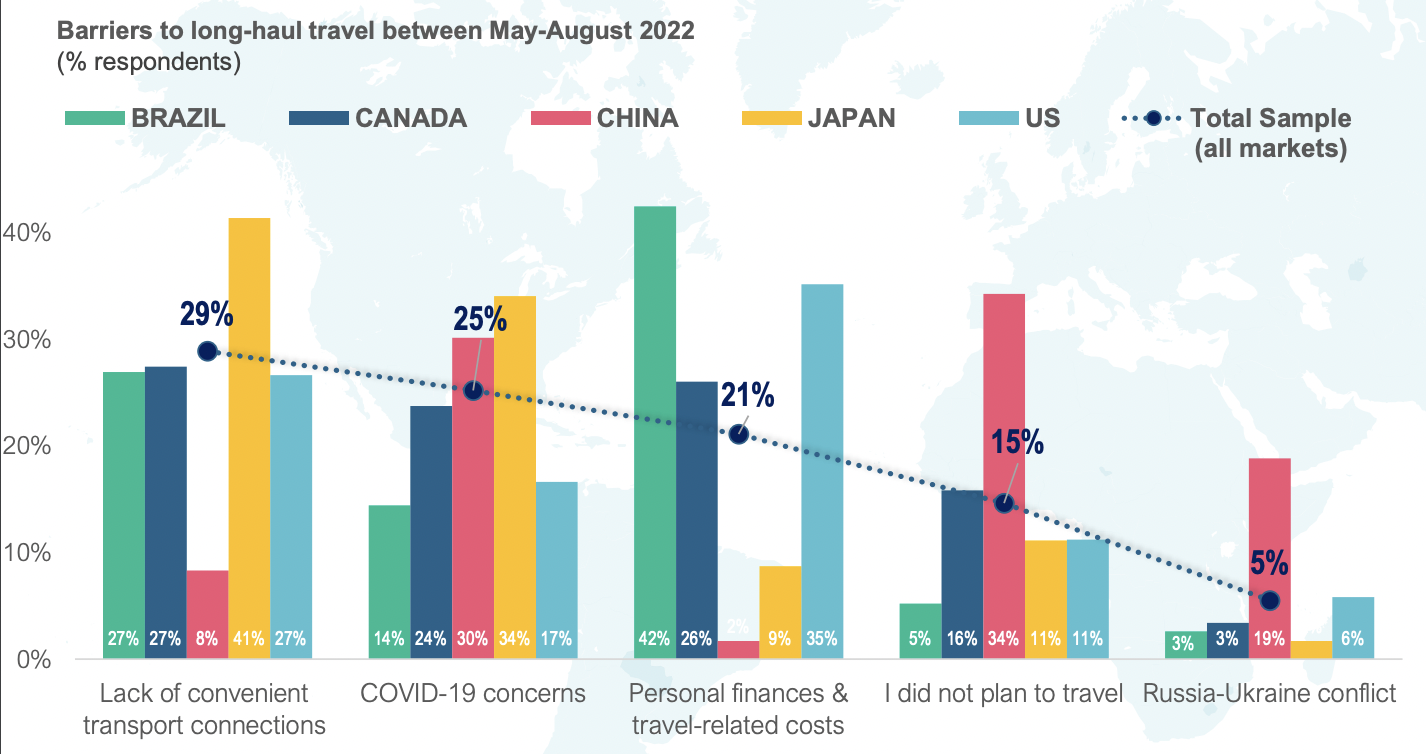 Canadians are similarly hesitant about when to take their next European holiday, with only 30% having booked their flight tickets for Summer 2022. Respondents from Canada wish to visit coastal and metropolitan destinations with France, Italy and the UK ranking as the most popular countries to visit.
Brazilian respondents have the most upbeat attitude towards long-haul travel to Europe. The resumption of flights to popular European destinations has positively influenced travel sentiment, with 1 in 2 Brazilians preparing to visit Europe during the next four months.
Of these, 45% have already booked their flight tickets, with July and August being the most popular holiday months. Brazilians prefer coastal destinations, as well as trips to the mountains. Train passes are their preferred transportation service for touring around the continent.
Despite a marginal increase in travel sentiment, Japanese enthusiasm for long-haul travel remains low. Only 14% of respondents have plans to take a trip to Europe in Summer 2022. In particular, 41% of respondents stated poor travel connections between Europe and Japan as their primary reason for not visiting Europe.
This is to be expected following the cancellation of many flights between the two destinations recently due to concerns about using Russian airspace in the wake of the Russia-Ukraine war. For those willing to take longer journeys to reach Europe – Italy, France, Germany, and the UK continue to be the most appealing destinations.