
EUROPE. The ash cloud from Iceland’s erupting Grimsvotn volcano has cleared UK airspace but now threatens major travel disruption in northern Europe.
Around 500 flights were cancelled in the UK after the eruption began on Saturday, leaving passengers stranded at certain Scottish and northern England airports, as well as travellers bound for those locations. Now the geographic focus is shifting.
“˜Ash Cloud Leaves UK But Closes In On Europe’ screamed the headline on Sky News.com this morning as the situation worsened. “˜European Airports Prepare for Icelandic Ash Cloud’ declared Bloomberg.
 |
Northern Germany is today feeling the impact of the drifting ash cloud |
Several airports in Northern Germany and Scandinavia may close today as the ash cloud drifts across the North Sea, Bloomberg warned, citing the UK Met Office’s Volcanic Ash Advisory Center.
Germany news service Deutsche Welle said this morning: “Germany’s flight safety authority (DFS) announced early Wednesday that a number of the country’s northern airports would be closed due to ash from an Icelandic volcano entering German airspace.
“No planes were permitted to take off or land at City Airport Bremen starting at 5 a.m. local time on Wednesday, and the same flight ban was imposed on Hamburg Airport one hour later. A spokesperson at Berlin’s Tegel airport said both of the capital’s airports – Tegel and Schönefeld – would be shut down starting at 11 a.m. local time.”
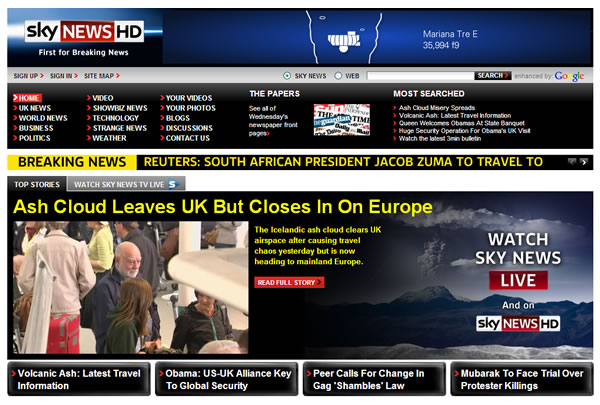 |
Sky News warns of a deteriorating situation in continental Europe |
Swedish airports group LFV said this morning at 07.20: “There is some remaining ash in the airspace in Götaland. This could mean some effect on air traffic. The prognosis for Wednesday says that Swedish airspace will be free from ash later during the day. Concerned passengers are requested to contact their airline company.”
Although so far much less serious, the situation echoes last April’s aviation crisis when another Icelandic volcano, Mount Eyjafjallajökull, erupted, causing weeks of travel chaos around the world. The crisis had a profound effect on airport revenues, with commercial income hit badly in many cases.
European air traffic safety organisation Eurocontrol said last night: “Approximately 500 flights were cancelled from the approximately 29,000 that would have been expected today [Tuesday, 24 May] across Europe.
According to the Volcanic Ash Advisory Centre predictions, there is a strong possibility that the ash cloud may impact parts of Denmark, southern Norway and south-west Sweden by tomorrow. This would have some impact on flights.
“However, given the new procedures in place and the predicted movement of the ash cloud over the coming days, the actual impact on flights is expected to be relatively low.”
UK air traffic body NATS confirmed the easing of the UK situation at 21.00 last night, noting: “Latest information from the Met Office shows that following the recent eruption of Grímsvötn in Iceland, no volcanic ash is currently predicted in airspace over the UK from 0100 UK time on Wednesday 25th May.”
The 64 million Euro question is what happens today in continental Europe and beyond that throughout the whole of the region.
 |
Bloomberg underlines the shifting geographic focus of the crisis |
“LESSONS HAVE BEEN LEARNED” SAYS ACI EUROPE
Europe’s airlines and airports, represented by the Association of European Airlines (AEA) and ACI Europe(Airports Council International), met yesterday with senior European Commission officials to review progress made in the handling of the latest volcanic eruption.
In the hours following the eruption of the Grimsvötn volcano, the European Commission and Eurocontrol activated the European Aviation Crisis Co-ordination Cell. This high-level group is tasked with managing crisis situations as they evolve so as to ensure full co-ordination and an “optimised, uniform response” from all actors involved. It includes senior representatives from the European Commission, Eurocontrol, the European Aviation Safety Agency, Member States, the aviation industry and unions.
Olivier Jankovec, Director General ACI Europe, said “For those feeling a sense of déjà vu, I can tell you that this latest eruption is being handled in a very different manner. Lessons have been learned from the previous volcanic ash shock in April 2010. This past year, the European Commission, Eurocontrol and EASA have worked intensely to devise an alternative procedure for flight operations, safeguarding the highest possible level of safety, while minimising disruption. This procedure is at the disposal of national governments. It now needs to be applied promptly and consistently throughout Europe.”
“Compared with a year ago, so far we are seeing a stronger unity and clarity of response which is absolutely vital to airlines and the travelling public,” said Ulrich Schulte-Strathaus, Secretary General of AEA. “European institutions are actively communicating as the situation unfolds and Member States are widely endorsing safety risk assessments, which are performed by individual airlines and agreed by national authorities. Our governments and airlines are, of course, maintaining safety as their key priority.”
Schulte-Strathaus recalled that back in April 2010 governments pursued a ‘blanket’ approach to airspace closures. This led to nearly 8,000 flight cancellations on the first day of the ash crisis, compared with just 500 flights cancelled so far this year. On an average day 29,000 flights are handled in European airspace, according to Eurocontrol.