


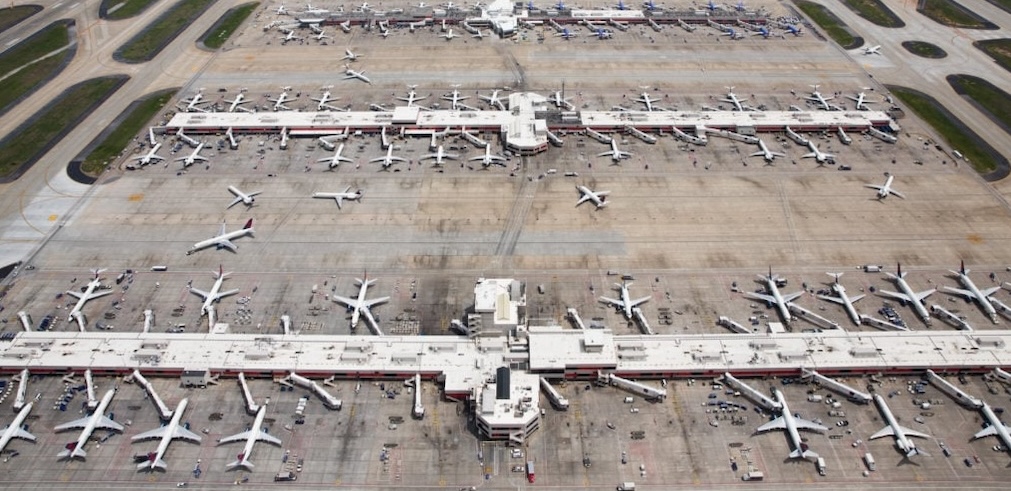
INTERNATIONAL. Atlanta Hartsfield-Jackson International Airport has once again retained its status as the world’s busiest airport, according to new insights released by travel analyst OAG from its Global Airline Schedules Data.
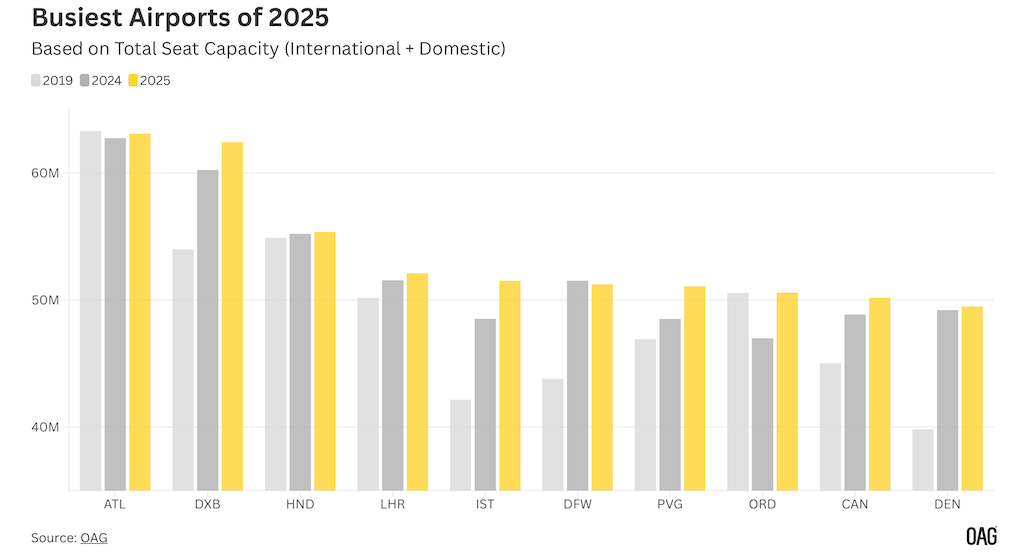
With 63.1 million seats scheduled in 2025, the Georgia gateway extended a dominance that stretches back to well before the COVID-19 pandemic and marks a third straight year of leadership.
Although capacity was up a modest +1% year-on-year, significantly Atlanta has closed in on its 2019 position, trailing by just over 221,000 seats.
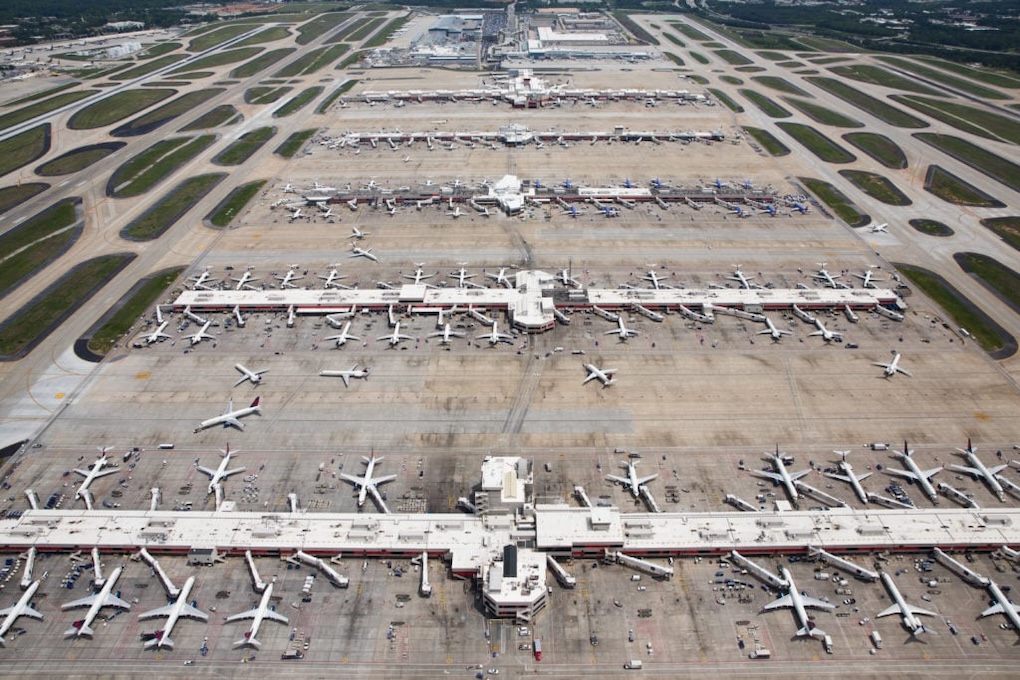
Dubai International Airport, however, is close behind. With 62.4 million seats, Dubai remains the second-busiest airport globally and, during certain months, actually surpasses Atlanta, OAG noted.
The travel analyst observed a longer-term trajectory is particularly striking. Capacity has expanded by +16% compared to 2019 and +4% versus 2024, a combination that suggests the gap at the top could narrow further in 2026.
For travel retail, Dubai International’s sustained growth reinforces its status as the world’s most influential international shopping airport, with scale and spend potential still rising. Read our story on Dubai Duty Free’s 2025 financial performance here.
Tokyo Haneda Airport holds third place globally with 55.4 million seats. While year-on-year growth is essentially flat, Haneda’s capacity now sits +1% above 2019 levels, signalling a steady and largely complete recovery.
The Japanese hub’s resilience is notable given the slower reopening of parts of Asia, and it remains a critical node for both domestic and regional traffic.
Elsewhere in the global top ten, the momentum is with airports that have redefined their competitive position since 2019. Chicago O’Hare and Istanbul Airport stand out, recording the largest year-on-year capacity increases among the leaders.
Chicago O’Hare’s +8% growth in 2025 marks a return to its pre-pandemic capacity, while Istanbul’s +6% rise takes it to a level +22% above 2019. Istanbul has now climbed to fifth place globally.
Performance from Denver International Airport also stands out. While its year-on-year growth in 2025 is a relatively muted +1%, its longer-term expansion is unmatched among the global top ten.
Capacity at Denver is now +24% higher than in 2019, lifting it into tenth place worldwide and reflecting the sustained strength of the US domestic market and Denver’s growing role as a connecting hub.
Compared to 2019, four airports have newly entered the global top ten. Along with Denver, Istanbul, Dallas Fort Worth and Guangzhou Baiyun have all surged up the rankings, displacing more established names and signalling a structural shift in global aviation flows.
Busiest International Airports 2025
Dubai International once again ranks as the world’s busiest international airport in 2025, with its 62.4 million international seats amounting to 13.5 million more than second-placed London Heathrow.
Heathrow, with 49 million international seats, continues its steady growth, now sitting +4% above 2019 levels. Read our recent story on Heathrow’s 2025 performance here.
South Korea’s Incheon International holds third place globally for international capacity, reaching 43 million seats and moving +2% above its pre-pandemic position.
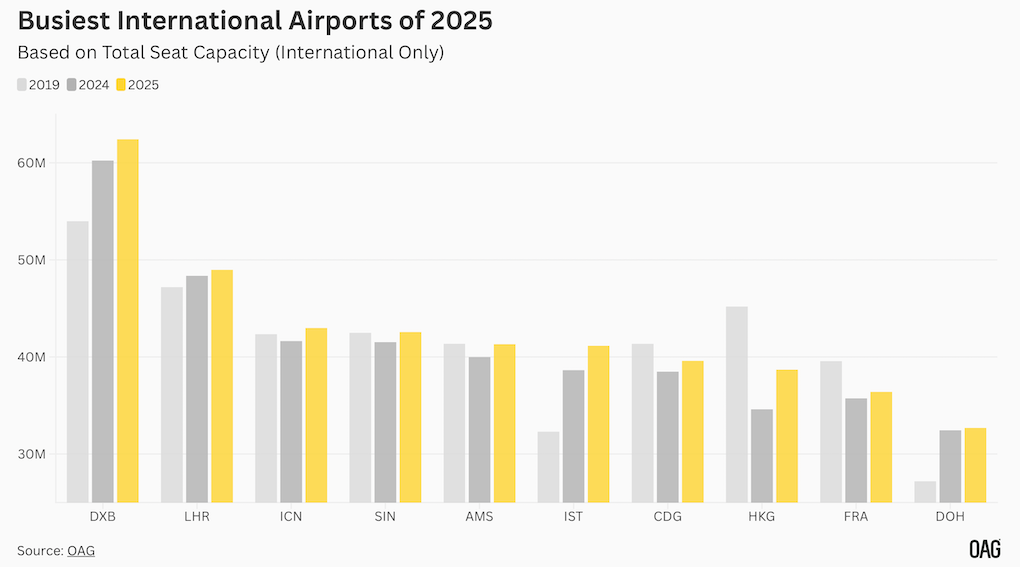
Singapore Changi follows closely in fourth place with 42.6 million seats, its +3% year-on-year growth bringing capacity back into line with 2019.
Hong Kong International Airport, meanwhile, posted the fastest year-on-year growth among the top ten international airports, up +12% to 38.7 million seats. Despite this strong rebound, the airport remains -14% below its 2019 capacity, highlighting the depth of the earlier downturn.
Istanbul again features prominently, with 41.2 million international seats, up +7% on 2024 and an impressive +27% above 2019.
Frankfurt and Doha complete the top ten, with Frankfurt still -8% below pre-pandemic levels, while Doha sits +20% ahead of 2019, reflecting the sustained expansion of Qatar Airways.
Busiest European Airports 2025
Europe is led by London Heathrow, taking into account both international and domestic seats, with a combined total of 52.1 million.
Istanbul follows closely with 51.5 million seats and continues to post the strongest long-term growth among Europe’s top airports, now +22% above 2019.
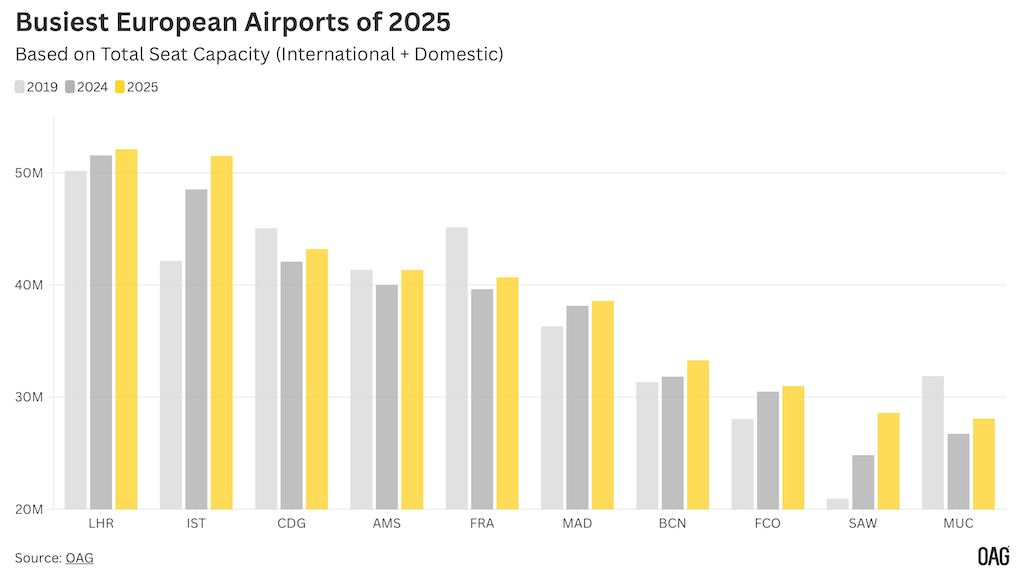
Paris Charles de Gaulle ranks third, still -4% below its pre-pandemic capacity despite steady year-on-year improvement.
One of the most eye-catching European stories is Istanbul Sabiha Gökçen. With a +15% capacity increase in 2025, the airport reached 28.6 million seats and stands +37% above its 2019 level.
By contrast, Frankfurt (-10%) and Munich (-12%) remain the furthest behind their 2019 seat benchmarks among Europe’s top ten, though both continue to edge forward year-on-year, with growth of +3% and +5%, respectively. ✈