
IRELAND. Dublin Airport has rounded out a diverse, well-tailored food & beverage offer that is driving strong commercial results across terminals 1 and 2. The Moodie Davitt Report recently toured many of the new sites in the company of Head of Commercial B2B Sorcha Nic Eoin and Commercial Director Ronan Fitzsimons.
The updated line-up concludes an F&B transformation programme that began pre-COVID and brings the number of outlets to 50 in landside and airside locations across both terminals.
The portfolio today features more choice, including healthy and gluten-free options that did not exist before, Asian, Italian and Mexican cuisines, power brands such as Pret A Manger, an enhanced Irish pub offering, plus much more besides.

From around a dozen concession partners in the past, airport company DAA is now working with fewer, namely SSP, Lagardère Travel Retail, Irish food services and hospitality specialists KSG and The Wright Group, plus Coca Cola HBC.
These partners operate under long-term contracts (typically ten years) that allow for regular investment, with new Service Level Agreements (SLAs) that include incentives to drive performance.
“We work in close partnership with the operators to help them navigate the airport, but also to hold them accountable and manage standards,” says Nic Eoin.
“We ask all our operators to commit funding for innovation each year and we sit down twice a year to look at how they invest that. We are happy with the blend of partners we now have, from Irish to the larger global operators.
“We wanted to ensure competition and a brand mix that represents the best of Irish hospitality from much-loved local brands to international favourites and the mix today is now more balanced than ever.”

Beginning in Terminal 2, and Ryan’s is probably the closest representation yet of an Irish pub to arrive at the national gateway. It houses downtown Dublin-like nooks and crannies, a salvaged bar and memorabilia that all speaks to a close attention to detail and carries a lovely sense of Dublin identity.
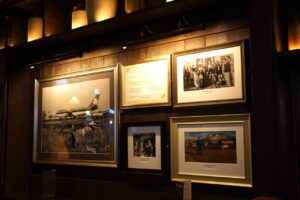
Created by The Wright Group and opened in December 2025, the name takes inspiration from a famous 1970s photograph of local resident Mary Ryan hanging out her washing close to the airfield, with an Aer Lingus jet in the background. The Ryan family have long had close connections to the airport, with several generations having worked there – and continue to do so to the present day.
Its popularity is such that people are arriving earlier to experience the bar, says the Dublin Airport team, which presents less as an airport location than a slice of central Dublin come to life.
With food hall Marqette also part of operator The Wright Group’s portfolio, food can be prepared there and finished at Ryan’s, offering economy of scale. Performance to date has been strong, says Nic Eoin.
“While we have The Gate Clock bar in T1, the traditional Irish pub was a missing category in T2. We are thrilled with how it is trading so far.
“The Wright Group know pubs downtown as they operate off-airport, but also they have long experience at the airport, so that helps us on the operational and quality side.”
Close by, SSP-run The Fallow, one of the largest outlets at the airport, is introducing an edited Italian concept leading on pizza and pasta plus breakfasts to extend the reach of its existing menu offer.
That speaks to a constant evolution of the offer, which is also relevant at The Mezz, the SSP-run food hall on the mezzanine level. Here, the flexibility of the concept – which houses a range of brands under one roof and one kitchen – is key. Bird, a fried chicken concept popular with families, is the latest swapped in.
“We are trying and changing concepts out to try and drive more footfall to the mezzanine and to get more visibility to the bar area up there as well, to make that a destination in itself,” adds Nic Eoin.
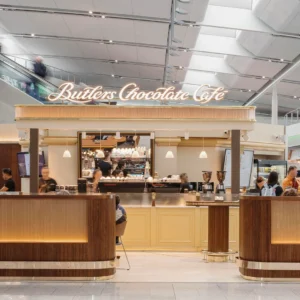
A revamped Butlers Chocolate Café features an expanded menu, spacious banquette seating and on-the-go and self-service ordering options.
Nic Eoin says: “Butlers is a much-loved local hero brand that has become a meeting point for Irish passengers. They also have travelised the offer and enhanced the food menu for a grab & go proposition. We are very happy with where we are with Butler’s in both terminals.”
Also in T2, Dublin Airport filled a gap for a wine-led premium offer that now exists in The Reserve with SSP. This high-end 50-cover wine and F&B concept comes complete with a strong range of international wine labels and other tipples complemented by an all-day dining menu.
A stroll to T1 brings us to Marqette, the FAB Award-winning food hall and bar that is one of the busiest destinations across the airport’s F&B offering.
This location undergoes an upgrade planned for Q4 this year, with some redesign and repositioning of key categories.
The main T1 concourse leading to 100 and 200 gate areas has seen 800sq m of additional F&B outlets added in the past year, yet Marqette’s numbers have held up well. This also underscores the demand for the added space and new concepts nearby, says the Dublin Airport team.
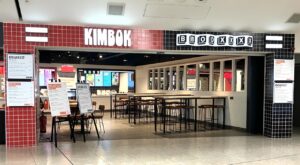


Among the biggest spaces rezoned with F&B at its heart is along this T1 concourse with the restyled 800sq m noted above. The entire row of space was won by KSG as part of a package.
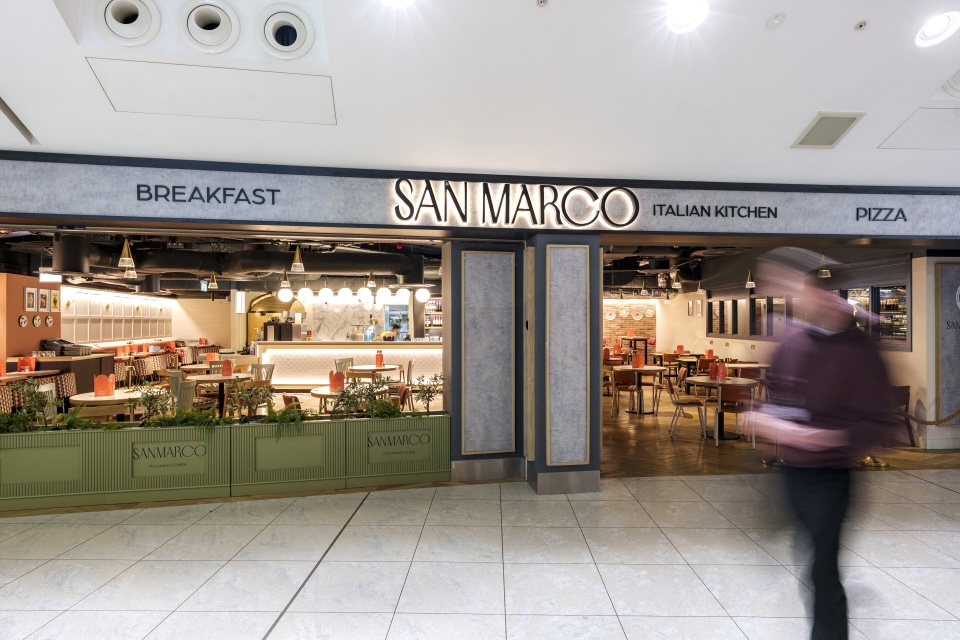
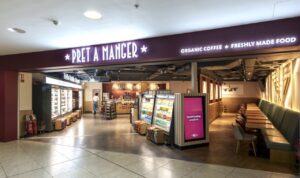
New brand entrants include street food concept Kimbok & Box (which fits with the flexibility demanded by DAA with menu changes from breakfast to dinner); Arthur Guinness (a collaboration with Diageo), San Marco (a nod to the consumer demand for Italian cuisine, serving freshly made pizza and pasta) and Pret A Manger, a highly recognisable and consistent brand leader in the grab & go space.
Other options here include a revamped Nomad offering healthy options; Street Kitchen, featuring authentic Mexican street food; Mexican bar Cantina and Bluebird Coffee Roasters and Wine Bar.

Fitzsimons says, “In sales terms this zone is up double digits since we did the full transformation, which means we are converting the passenger who otherwise wasn’t engaging with the offer.”
One level up, the long-standing SSP-run Garden Terrace has a new-look bar with more efficient use of space, while the Burger King managed by Lagardère Travel Retail retains its popularity in this highly trafficked mezzanine area.
Commenting on the changes that new partnerships and contractual agreements have spurred, Fitzsimons says: “Freshening the offer is a key part of what we should be doing. We used to have longer, looser tenders but now we have more input on encouraging operators to be more on-trend. It should not get stale and it’s our job to ensure it does not do so.
“We need operators to pivot often through their contracts as they all have longer terms and flexibility built in. We manage this carefully with our team and we are firm on standards and follow-through on how our SLAs are fulfilled.”
Nic Eoin adds: “We have good partnerships that allow us to have hard conversations when necessary but also to focus on the things that we can do together. We are here to help these partners navigate our airports, and provide them with insights and data, and all of other things that they need to operate efficiently.”
The results are coming through positively in a variety of ways. One is in customer satisfaction.
Fitzsimons says: “What we find is that the operators are now producing to a different and higher standard, which has led to a drop-off in complaints. With quality comes a perception of value that is not only linked to price, though that always has a role.”
Nic Eoin adds, “We recently got our Q1 passenger satisfaction results and our overall rating for F&B is now at its highest level ever. And while we are never done, that gives us reassurance that we are doing the right things.”

This is the result of new concepts, quality standards plus other improvements to the experience. For example, across F&B partners over 90% of the food served is produced on-site; in the past much of it was made off-site.
Fitzsimons adds: “We have more seats now in most restaurants. Seating is a key driver in terms of their satisfaction with food & beverage, because it provides that reassurance to passengers and is a driver of satisfaction.”
Crucially, commercial performance is strong too. Since 15 units opened or were updated in 2025, F&B sales turnover has climbed sharply versus pre-transformation, well ahead of passenger growth over the same period.
Now the key is to consolidate the offer and ensure every square metre plays a part in lifting productivity. This will be especially important as Dublin Airport, already squeezed on space, deals with fast-rising passenger numbers, which hit 36.4 million in 2025.
As the airport reaches 40 million passengers, an estimated further 1,000sq m of F&B space will be required to cater for demand.
“Some of this we have planned for, and we are looking for extra space where we can find it,” says Nic Eoin. “Elsewhere we are constantly looking at how our commercial offerings are performing, and what is best placed to contribute.
“We want flexibility and to transform quickly, but we should never adopt a knee-jerk reaction to changing tastes. We must ensure that the units are connected and part of a package that allows the operators to deliver a really good quality offer, ensure a good landside to airside balance, access to storage production while planning properly and never losing sight of those things that we have learned in the past few years.
“Most importantly we want to maintain and grow the programme we have in place now, with our strong input allied to that of our excellent operators.”