 |
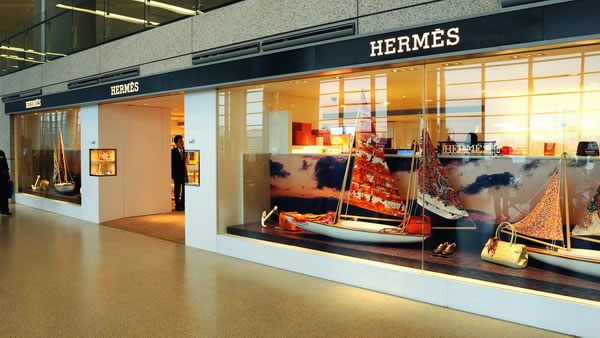
Hermès opened its first store at a Chinese domestic airport at Hongqiao |
CHINA. Shanghai Hongqiao International Airport (HQIA) is planning to add 8,000sq m of new retail and food & beverage space at Terminal 2 over the next three years amid a major commercial drive at the city’s domestic airport.
The terminal’s commercial expansion will include a Luxury Brand Boulevard, which is being developed this year and next, and which will include a range of leading luxury brand names. The project is under way and the new stores (the identity of which has yet to be finalised) there will be opened by the third quarter of next year.
Currently in T2, the key retail concessionaires are Dufry and Huaihai, which operate fashion outlets; Yunxing, a local company, which operates packaged food and liquor & tobacco concessions; Fuxin, which operates book stores; plus Yapin and Yeasun, which are the two main food & beverage operators.
The HQIA Retail Department is managed by Shanghai Hong Kong Airport Management Co., Limited. Established in October 2009, this is a joint venture company between Shanghai Airport Group and Airport Authority Hong Kong (AAHK). The Retail Department is responsible for all aspect of the retail business for both terminals including leasing, marketing and promotions, operations and business development. Its current General Manager is Ms Cammy Wong, who has been seconded to Shanghai for two years and has worked for AAHK for over 14 years.
 |
 |
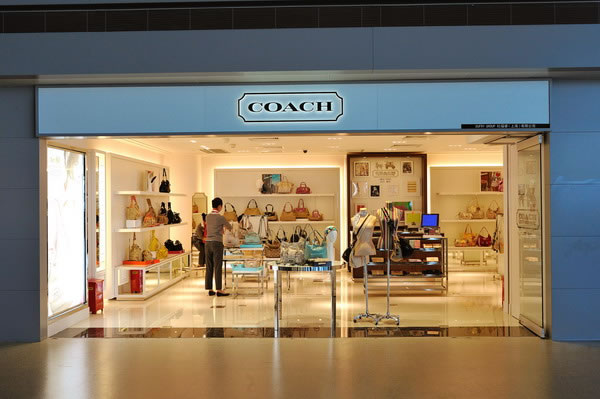
Coach and Emporio Armani were among the firsts for Chinese airport retail when Hongqiao T2 opened in March 2010 |
She told The Moodie Report that creating a better, more premium consumer environment was key to driving penetration and spending levels.
“The airport environment is one of the most important factors influencing the business,” she noted. “HQIA Terminal 2 is a domestic airport, different from Hong Kong International or other key airports. The challenge is how to attract passengers to spend [when] it is not tax free.
“In addition, retail and F&B at Chinese airports have always been known to be expensive. There is very little incentive to come to the airport to spend. To break this traditional concept, we have [added] the following: a downtown pricing strategy, a different retail mix, frequent promotional events and reached out to media [to promote the offer].”
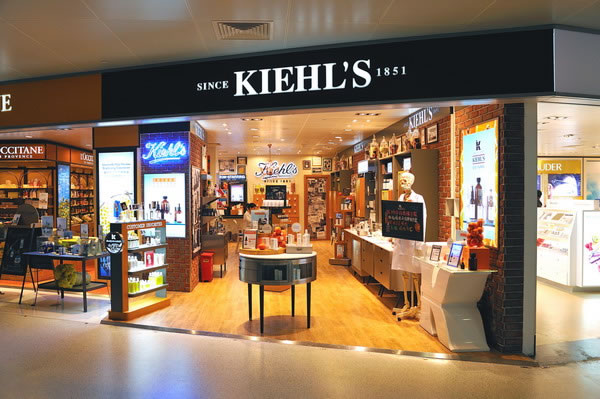 |
The Kiehl’s brand’s new-look design made its Chinese domestic airport debut at Hongqiao |
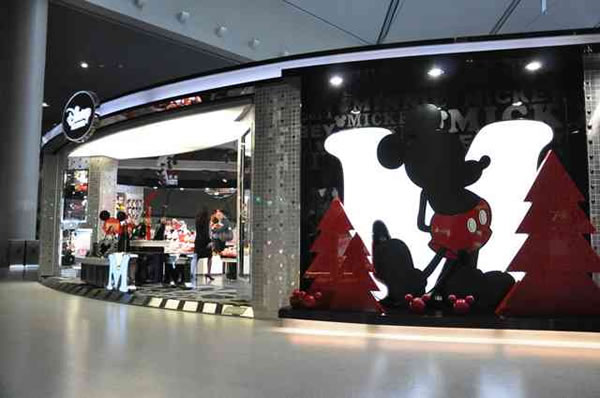 |
Disney chose Shanghai to unveil its flagship fashion store at China’s airports in December 2010 |
That strategy has paid dividends, she noted. Since the opening of Terminal 2 (in March 2010), HQIA’s retail and F&B rating in Airports Council International’s ASQ (Airport Service Quality) lists have improved dramatically.
“For example, restaurant/eating facilities [have improved] from No.120 in Q4 2009 to No.14 in Q2 2011,” said Wong. “Restaurant facilities’ value for money went from No. 126 to No. 12; shopping facilities from No. 97 to No. 28; shopping facilities’ value for money went from No. 98 to No. 19 (all in the same period). This success has brought strong attention from the aviation industry across China.”
T2 is already home to many leading luxury brands and international F&B brand names. High-end luxury names include Hermès, Cartier, Emporio Armani, Zegna, Dunhill, Hugo Boss, Swarovski, Bvlgari and Chopard. Leading international F&B brands include Starbuck’s, Costa Coffee, Pacific Coffee, KFC and McDonald’s.
“There are many “firsts” at HQIA,” noted Wong. “For example, there is the first Emporio Armani shop and first Coach shop at all China’s airports; a first Hermès shop for China domestic airports and a first Kiehl’s shop with its new design for China domestic airports.” These opened in March 2010.
“Also there is a first Disney fashion flagship store for Chinese airports (opened in December 2010) and a “˜Discover Shanghai’ souvenir shop operated by Lagardère Group opened in September 2011.
 |
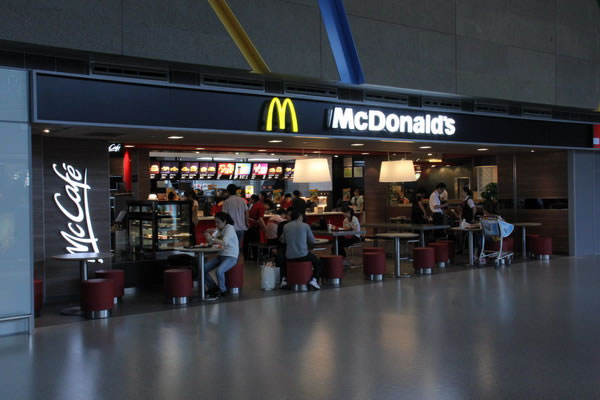 |
With a diverse range of brands and a strong position on pricing, HQIA aims to change the perception of airport F&B |
“For F&B, “firsts” for China’s airports include Costa Coffee, Pacific Coffee (opened in September 2011), and there is a first McDonald’s/McCafe for China’s airports in the restricted area, which opened in September 2011.”
Hongqiao Terminal 2 has an existing retail area of around 12,000sq m. Recent market research shows that business travellers account for 63% of total passengers. Among all passengers at Terminal 2, over 50% are at “management level”. About 37% of passengers travel frequently, many about once every two months. Research also indicates that passengers in HQIA possess strong buying power, said the airport, and on average over 50% have family monthly income over RMB20,000, well above the Shanghai average household income, and over 25% have monthly family income over RMB40,000.
Hongqiao lies 13km from the city centre, and is the closer of the major airports to Shanghai’s downtown area. It has two terminals: Terminal 1 operates international flights to Korea, Japan, Taiwan, Hong Kong, and Macau and limited domestic flights.
Terminal 2 operates domestic services, with an average of 550 daily flights serving 55 cities around China, including major cities like Beijing, Guangzhou, Shenzhen and Tianjin. Passenger volume for both terminals is estimated to exceed 33 million in 2011, and Terminal 2 accounts for 85% of the total. It is forecast that by 2013, the total passenger volume will exceed 36 million.
 |
 |
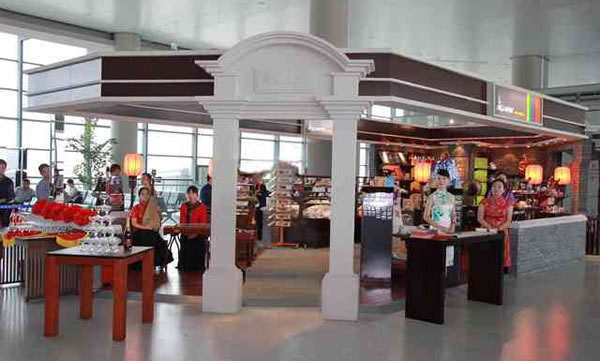
The airport plans to deepen the food & beverage offer still further its its next phase of development |