
ASIA PACIFIC. South Asia posted a surge of +14% year-on-year in visitor arrivals for the first nine months of 2011, leading regional growth within Asia Pacific. That’s according to figures from the Pacific Asia Travel Association (PATA).
The other sub-regions posted nine-month growth as follows: Southeast Asia (+12%), Northeast Asia (+4%) and the Pacific (+1%).
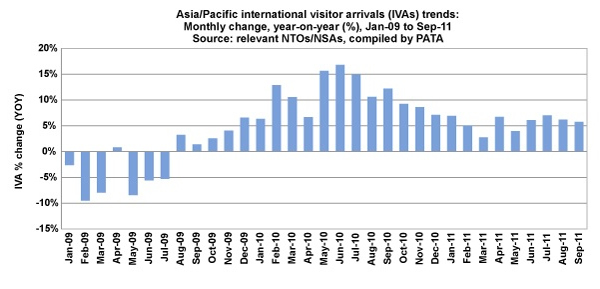
In September arrivals to Asia Pacific grew by +5.7% year-on-year, but this was down by half a percentage point on the previous month.
South Asia also led the increases in September with a rise of +11%. It added nearly 60,000 more international visitors to the sub-region over the corresponding period last year. For the four smaller volume destinations reporting source market information (Bhutan, Maldives, Nepal and Sri Lanka) arrivals from Asia increased significantly in terms of both volume and growth rate.
The number of arrivals from Asian origin markets – supported by strong demand from China and India – was well above that of the European generating markets for the fifth consecutive month. This was also influenced by a downturn in arrivals from the UK and Italy to various South Asia destinations, said PATA.
Southeast Asia registered a relatively slower growth rate of +9% in September driven in part by a strong negative performance by Vietnam (-13%). But the growth rates into all other destinations remained relatively strong: Myanmar (+25%), Thailand (+23%), Cambodia (+21%), Indonesia (+16%), the Philippines (+15%) and Singapore (+9%). Malaysia is still unable to release arrivals figures for 2011 because of difficulties with a new immigration system, noted PATA.
International arrivals to Northeast Asia showed moderate growth for September with a collective gain of +5% year-on-year. Despite the slower sub-regional average growth rate, foreign arrivals into specific destinations within the sub-region were very strong. Korea (ROK) for example had a gain of +19% for the month. Macau SAR saw a +18% increase. Hong Kong SAR expanded by +17%, while Chinese Taipei reported a +10% gain.
At the other end of the spectrum, however, China saw another relatively passive month of weak demand (+0.5%), said PATA. Foreign inbound traffic into Japan (-25%) continued to improve progressively but still very slowly. Year-to-date growth in arrivals to this sub-region remains somewhat slower at +4% following a strong increase of +12% in the January to September period of 2010. This downward shift reflects some softening in travel demand to the sub-region that can be attributed – at least in part – to the continuing uncertainty associated with radiation in Japan, PATA added.
Travel demand to the Pacific remained sluggish during September with arrivals to the sub-region growing by only +1%. Growth for the sub-region was supported by the Rugby World Cup in New Zealand which saw an increase of +26% in foreign arrivals. On the back side of that however, the Rugby World Cup also had some role in dampening outbound from New Zealand to Australia, resulting in an overall decline of -9% for Australia during September.
Most Pacific island nations recorded year-on-year increases in international arrivals for the month of September. The only exceptions were the Northern Marianas (-15%), Samoa (-14%), Guam (-6%) and the Cook Islands (-1%).
PATA CEO Martin Craigs said: “International arrivals momentum into the Asia Pacific region continues to hold at a relatively strong average rate of around +6%. The rising tide is not, however, lifting all boats equally. A few Asia Pacific destinations are facing difficulties and experiencing contracting numbers of visitors.”
 |
Advertisement | |