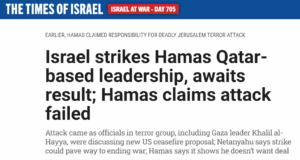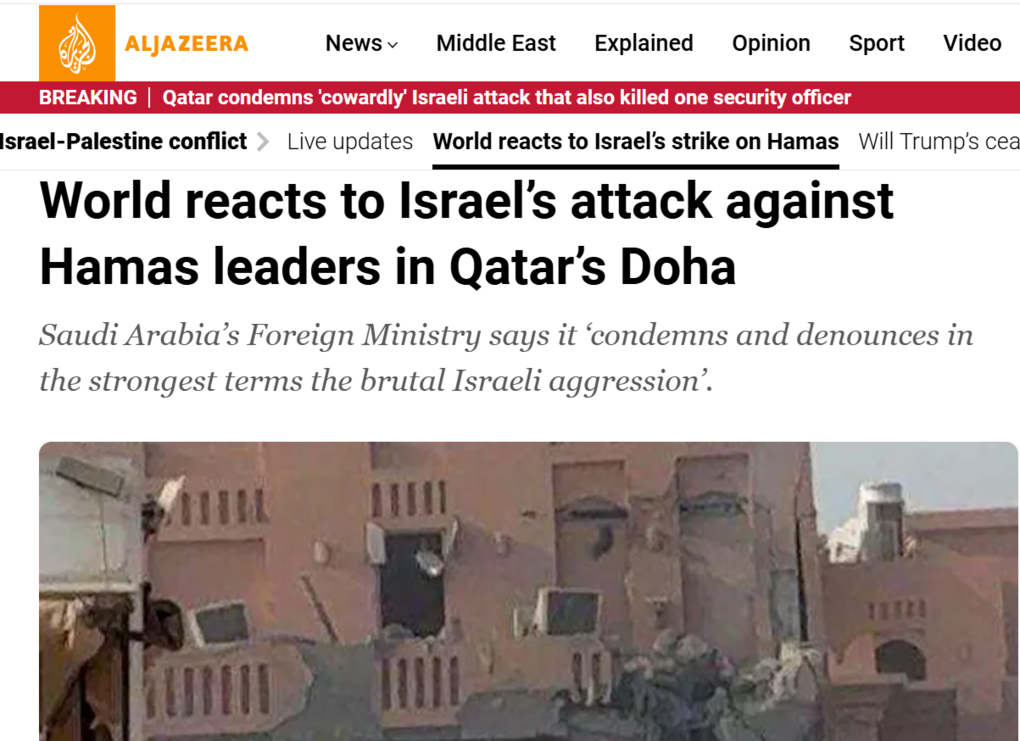


MIDDLE EAST. Israel’s strike on Hamas leaders and negotiators in Qatar’s capital Doha today (9 September) has prompted widespread fears of further violence and a full-blown pan-regional crisis.
The attack, ordered by Prime Minister Benjamin Netanyahu, killed five of its members but not the targeted negotiating delegation, Hamas claimed. The strike followed shortly after Hamas’s armed wing, the Izz ad-Din al-Qassam Brigades, claimed responsibility for a deadly terror atrocity in Jerusalem on Monday (8 September).
Qatar described the Doha strike as a “blatant violation” of international law while Netanyahu said it “can open the door to an end of the war in Gaza”.
In a post on Truth Social, US President Donald Trump said his administration had been notified by Israel of the attack “which, very unfortunately, was located in a section of Doha, the capital of Qatar”.


Trump claimed he immediately directed Special Envoy Steve Witkoff to inform the Qataris of the impending attack, “which he did, however, unfortunately, too late to stop the attack”.
Trump said he had subsequently spoken to the Emir and Prime Minister of Qatar and thanked them for their support and friendship to the USA. “I assured them that such a thing will not happen again on their soil,” he added.

Qatar has been a key mediator between Israel and Hamas but today’s events – met with outrage by the Qatari government which called the strike a “blatant violation” of international laws – seem to spell an end to its diplomatic efforts, at least for now.
Travel and tourism sector repercussions?
While Qatar Airways says its operations are “unaffected by recent events in Doha”, today’s developments will have spooked all travel ecosystem stakeholders in the region.
The sector – including travel retail – was hit hard, albeit temporarily, after Israel struck Iranian nuclear sites in June. Today’s attack threatens longer-lived repercussions and both flight and tourism bookings to or through the region will be closely watched in weeks to come. ✈
Also read