 |
Author Yan Liang is a Chinese student majoring in sport, leisure and tourism management at the Groupe Escrennes business school in Paris. |
CHINA. The Moodie Report is pleased to present the summary of a special report on Chinese consumer purchasing behaviour by Yan Liang, a Chinese student at the Groupe Escrennes business school in France.
Yan Liang is majoring in sport, leisure and tourism management and as part of her studies was commissioned by The Moodie Report to examine the fast-evolving attitudes and desires of Chinese travellers. We present edited highlights of this outstanding young student’s work in progress.
PREFACE
Since the easing of travel restrictions on Chinese citizens by the Chinese government, there has been a growing amount of independent travel and an increasing number of people who desire to travel abroad at least once a year.
Because of the complexity of the Chinese culture and customer behaviour which cannot be simply be assessed by western consumer behaviour models, much research has been done into Chinese culture and customer purchase behaviour. Yau’s 1994 book [Consumer Behavior in Asia – Routledge, NY] on consumer behaviour in China demonstrates the importance of understanding consumer behaviour in a particular cultural setting. It is very important for global marketers to identify Chinese consumer behaviour while travelling in order to understand their needs and to develop effective marketing strategies appealing to the specific needs of this market.
As Chinese outbound tourism – and more specifically leisure travel by Chinese Mainlanders – is such an important and recent phenomenon, the first questions that arise are:
– What is unique about outbound tourism from China?
– What do Chinese travellers purchase during their trips?
– What influences their purchasing decisions?
– What’s the most efficient way of advertising to them?
– Where do they get the information?
 |
SETTING THE SCENE – AN OVERVIEW OF CHINESE OUTBOUND TOURISM
The outbound travel of Chinese citizens is now composed of three main elements: travel to Hong Kong and Macau, to the border areas and to foreign countries.
Since the open door policy adopted by the Chinese government in 1979, the Chinese economy has developed rapidly as has the country’s tourism market.
Previously China’s tourism industry was concerned predominantly with inbound tourism. But through the 1990s the number of Chinese travellers to Hong Kong, Macau and South East Asian countries boomed. These destinations became the most fashionable locations for Chinese citizens to spend their holidays. This new form of tourism increased rapidly, although the size and location choice of Chinese outbound travel were still limited by the policies of both China and destination countries.
On 1 January 2002, the Hong Kong government and China National Tourism Administration decided to abolish the quota system regarding travel to Hong Kong. As a consequence, all 67 travel companies which were entitled to conduct outbound travel business could now organise tours to Hong Kong and Macau. In the past, only four companies were allowed to do so. It was a landmark moment.
To date the government has opened 43 cities in mainland China to individual travel to Hong Kong and Macau. Additionally about two million Chinese citizens visit neighbouring countries through border travel each year.
All these factors have helped drive an extraordinary growth in outbound travel over the past decade. In 2004 the number of outgoing departures climbed to 29 million, more than double the 1999 level. And it has far from finished yet.
ANALYSIS OF CHINESE PURCHASING BEHAVIOUR – KEY DRIVERS
SOCIAL CLASS
China remains a communist country, even if this status is gradually becoming even more nominal in reality. A so-called middle-income class is now becoming larger and more influential in China.
Though trying to give it a definition is very difficult it is emerging as an equivalent to the idea of middle class in western society (the Chinese government does not use the term middle class).
According to a report released by the Chinese Academy of Social Sciences (CASS), there were 35.2 million “˜middle class’ members in China last year, about 2.8% of the total population.
 |
The old and new worlds meet on the streets of China Photo by Hui Min Neo |
This study group’s definition of “˜middle class’ was a person with a monthly income of 5000 Yuan, or about US$617, with a bachelor’s degree or above, and who works as a civil servant, company manager, technician or private business owner.
Zhang Wanli, an associate research fellow from the China Academy of Social Sciences, believes that China’s “˜middle class’ has grown to 13-15% of employees since the late 1990s, taking into account general knowledge, prestige of career, type of work, income, expenditure and social influence.
Zhang Wanli said that when the middle class population grows to 30% in China, which is an ideal ratio, they could become a driving force for social modernisation, stability, strong social values and high levels of consumption.
Above the “˜middle class’, there is a certain ruling class and super-rich class in China. These are small groups, although they are growing fast, especially the super-rich group. Below the “˜middle class’, there are the so-called “˜comfortable’ classes. These classes represent huge growth potential in consumption, and are drawn from the employees of foreign-investment or joint venture companies, government cadres and technical personnel.
At the bottom of the social class structure are the subsistence class and then poverty class.
WEALTH BY REGION
Shanghai is by far China’s wealthiest province and the coastal strip including Shanghai, Zhejiang, Fujian and Guangdong is the richest region and developing very fast. Beijing is the capital of China, so follows just after Shanghai in wealth terms.
GENDER, AGE AND EDUCATION
According to the latest figures from the Statistics Bureau of PRC, as of 11 January 2005 the total population was 1,306,280,000, with a +3.2% year-on-year increase. The number of males was 673,090,000 and females 633,190,000.
Age breakdown is as follows
0 to 14: 264,780,000 (20.27%)
15-59: 897,420,000 (68.70%)
Over 60: 144,080,000 (11.03%)
Education breakdown
Above college level: 67,640,000 (an increase of
21,930,000 year-on-year)
Above senior level: 150,830,000
Junior level: 467,350,000
Primary level: 407,060,000.
MY SURVEY
I surveyed Chinese consumers travelling in Paris. While the samples were not big, the questionnaires, interviews and observations were very well organised so that I believe we can draw some important and credible conclusions from the collected figures.
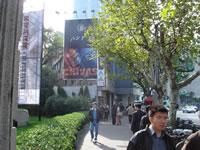 |
International brand images reach out to the new Chinese ‘middle-income’ class in Shanghai Photo by Martin Moodie |
The audiences were mostly from Shanghai and Dalian. The respondents from Shanghai were typically managers, engineers, sales, professors involved with conferences in Paris and so on.
The audiences from Dalian were group travellers. I also surveyed some individual travellers, mostly students. They were invariably on study tours which we consider a serious, mainstream trend for the travel retail industry.
Some 38.7% of the audience was male while 61.3% were female. The percentage of the audience that travels more than 5 times per year is around 35.5%, 3-4 times is 38.7% and 1-2 is 25.8%.
For the Chinese citizens, the top destinations were: Europe, Hong Kong, Asia (except China), America and Australia.
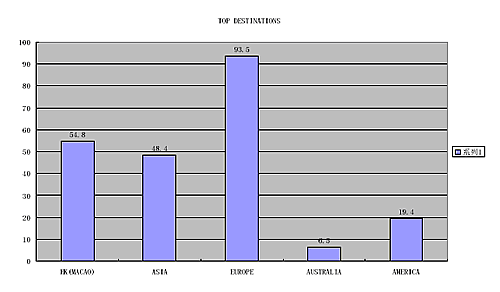 |
Thanks mainly to cultural and environmental attractions Europe is the major beacon for Chinese travellers |
Although a lot of previous research has showed that older people travel more than the young generation, the data from the recent ACNielsen and TFWA study (www.tfwa.com) found differently as follows:
Age 20-29: 36% of travellers
Age 30-39: 29%
Age: 0-44: 16%
Age: 45+: 19%.
Our results were very similar with the percentage in the age 20-29 bracket even higher. But what has caused this big change? In our opinion, the most significant points are:
◆ The increase in business travel: since a lot of foreign enterprises are doing business in China and a huge amount of Chinese people are doing international business, more and more senior managers are now travelling around the world. Many groups are also involved in international conferences.
◆ Study tours play an important role in the travel industry: many Chinese students are now going abroad to study. As they travel they buy considerable amounts in duty free stores and in the local market shops of the destinations. In the past 20 years, a total of 300,000 Chinese students went abroad to study. Now each year, about 25,000 students go abroad to study.
The student market in China is attracting the attention of more and more countries; even the US now is opening the door to Chinese students.
◆ More women work and they are a big part of the travelling and purchasing mix. According to the ACNielsen/TFWA study some 69% of outbound travellers in 2005 were women. Inside China, more women are working and getting good salaries now. Even if most women earn a little less than the “˜middle income’ benchmark, they are very sensitive to beauty care, make-up and fashion items – and are therefore a key target for travel retailers.
Additionally, while their male friends, boyfriends or husbands are travelling, they are certain to be asked to buy a lot of products for them. While many males do not purchase much in shops (for themselves) they are increasingly likely to bring back what their friends and families ask them to – and most of the friends are women.
PURCHASING PREFERENCES
So what do Chinese travellers purchase during their trips? And what will influence their buying decisions?
According to the data collected by the questionnaires, most travellers would like to buy gifts for their families and friends, souvenirs for themselves and then cosmetics (by women for themselves and by men for women friends/family).
Our research showed that roughly half of the products bought by Chinese customers were for self-consumption and half for gifts.
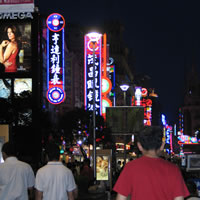 |
Brands such as Omega hope to benefit from their heavy Chinese advertising campaigns when the Chinese travel abroad Photo by Hui Min Neo |
Women will certainly buy more fragrances, cosmetics, fashion or confectionery for self-consumption while men will opt for alcohol and tobacco, often for friends and family.
There are many factors that influence the decision-making process of Chinese travellers. Self needs, tastes and budget top the list.
Generally Chinese travellers are becoming increasingly aware of what they want and need now. They are seeking cheaper but better quality products in order to satisfy themselves and at the same time save some money.
They care deeply about price; most of them go to duty free shops because of the price attraction. They therefore enjoy buying – in their minds they have saved up considerable amounts of money and finally purchased items that they have long wanted to.
The culture of the destination and the means of travel are also key factors to Chinese travellers. One should not underestimate just how keen Chinese people are to travel and see the world.
Why is Europe so popular among Chinese people? First, the environment of Europe is considered very good, which means less pollution and nice weather. Second, European culture is very attractive to Chinese people. It is a totally different culture from Asian culture and Europe is seen as one of the cradles of civilization within China.
Because of visa problems and the language barrier, Chinese people usually opt for outbound travel in group tours except for those from the Hong Kong region and business travellers who are highly educated.
However, according to our research and that of others, most Chinese citizens would like to travel individually or with friends or family. That is why Hong Kong opens its doors to so many mainland Chinese cities for individual travel and why a number of EU countries are making an effort to follow suit.
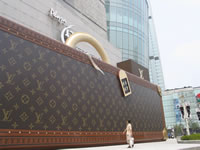 |
All eyes on Louis Vuitton, one of China’s hottest international brands Photo by Hui Min Neo |
INFORMATION SOURCES FOR CHINESE CONSUMERS
Where do China’s would-be international travellers get their information?
According to the CIA world fact book, the number of Chinese Internet users in 2004 was 94 million, effectively ranking behind only the US in single country usage.
A similar exercise was conducted by the China Internet Network Information Center (CINIC) which pointed out that as of May 2005 Chinese internet users numbered over 100 million, just behind the US.
In broad terms the impact of traditional media such as newspapers and magazines is decreasing while the influence and power of new media, particularly the Internet, is growing very quickly.
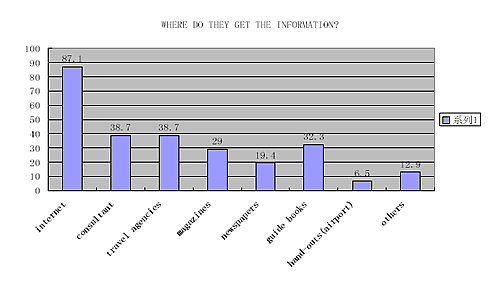 |
Note the vital role of the Internet in informing Chinese consumers. How well is the travel retail market embracing that information channel? |
WHAT KIND OF SHOPPING ENVIRONMENT DO CHINESE TRAVELLERS WANT?
◆ Simple and convenient: The space should be well organized and not crowded.
◆ Communication: The sales staff should be patient and should explain the products clearly to the customers.
◆ Interestingly Chinese business travellers would prefer sales people to speak English with them.
◆ Be respectful to the customers.
◆ Stores to offer self help and comfortable facilities.
◆ Nice or special merchandising in the shops
◆ As full a range of products as possible.
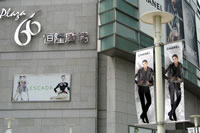 |
Route 66: Upscale retail locations such as China’s Plaza 66 are providing the right showcase for the world’s most upscale brands in their assault on the Shanghai market Photo by Hui Min Neo |
In our survey, a very interesting phenomenon suggested that most Chinese travellers are not highly brand conscious. That runs contrary to other studies which suggest Chinese customers are very sensitive to the brand.
I saw an attempted sales transaction in Benlux, where a salesperson was introducing a famous fragrance to a Chinese group traveller. But the man did not seem to be very interested in it, simply because he did not know the brand. If he bought it and gave it to someone as a gift, he feared the recipient too would not know it and he thought he would “˜lose face’.
THE CRITICAL INFLUENCE OF THE INTERNET
It is obvious that the Internet has had an enormous impact in China. Certainly it is changing the purchasing habits of Chinese people.
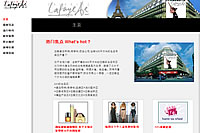 |
French department store Galeries Lafayette is showing the way in reaching out to the travelling Chinese consumer with its dynamic, constantly updated Chinese language pages |
In the past Chinese people would never imagine buying products on the Internet, because they tended to only believe in what they could actually see themselves. They also did not appreciate the convenience of Internet buying.
That has changed dramatically. Now it is very popular to purchase on the Internet and there is a saying among Chinese people that translates as “˜You can get what you want by not stepping out of your house at the cheapest price’.
Travel retail is caught up in this dynamic. Many advertisements tell people that they do not have to travel and that they can get “˜duty free’ products or cheaper products from the hottest destinations, including Hong Kong, France, Australia, and South Korea.
Increasingly Chinese people not only get information from such websites but also actually purchase on them.
Here, in order to give a detailed idea of this significant phenomenon, I have conducted a real case study on one of the most popular web-sites which offers information and purchasing opportunities in China – www.onlylady.com
 |
Onlylady.com is one of the most popular women’s websites in China. The average traffic per day is nearly ten million Photo by Salina Christmas |
Thanks to their co-operation, I got a lot of important information. Onlylady.com was founded on 25 May 2002, targeting 18-35 fashionable women in middle and big cities in China. The web-site is composed of fashion information, popular topics and products (especially for women). It specialises in practical purchasing information for modern women.
Onlylady.com is one of the most popular women’s websites in China, and has hundreds of thousands of registered members and covers the important cities and regions all over China – Shanghai, Beijing, Jiangsu, Guangdong, Zhejiang, Hubei and others. The average traffic per day is nearly ten million, and it is ranked the top 2,000 web-sites in the world.
Every day there are approximately 500 new posts and an amazing 7,000 related responses on OnlyLady.com’s Forum |
It also has the largest database for skincare products in China, providing detailed information about tens of thousands of products from 90 brands, as well as customer ratings for each product’s attributes and comments.
Users of Onlylady.com can easily search the products based on their stated needs. The site is the most professional and most practical database for women’s products in China.
It also offers an Online Forum, divided into 31 different sections such as beauty, clothing, emotion, and family. The forum is a community for discussion on topics of interest, especially on consumption. Every day there are approximately 500 new posts and an amazing 7,000 related responses.
The style of the forum, simple, often humorous and categorised by topics, is designed for women and has a lot of loyal users.
Well-being association
As a marketplace for women’s products it boasts the lowest price for luxury products in China and handles the distribution of overseas brands. You can purchase global products at home and many consumers do just that -daily transactions number over 100,000.
The Media section
This covers six categories: beauty, clothing, furniture and interior design, weddings, family and food. Each column is run by professional editors who discuss fashionable subjects for consumers based on the topics discussed on the forums and on current trends.
This section also has the most detailed discount information China-wide, including the latest in-store promotions and the various brands’ promotions. All this information is updated on a daily basis.
It’s all there – body care, fashion trends, information and shopping. As of October 2005 OnlyLady.com had 380,000 registered members with 190,000 visitors per day. New members were being registered at around 8,000 per month.
There is clearly great potential in on-line purchasing in China and the increasing number of internet users is amazing. We can tell that on-line promotion is crucial to retailers now. The trends and information that can be gleaned from such web-sites as OnlyLady.com could certainly help international travel retailers to gain a better insight into what Chinese customers are thinking right now.
CONCLUSION AND RECOMMENDATIONS
Thanks to the open door policy and other policies applied in China, more then 30 million Chinese travelled across the borders of mainland China in 2005. They use this new freedom to see foreign countries and to indulge in their favorite pastime: shopping.
China’s outbound tourism continues to boom, which requires the stakeholders involved in the industry to co-operate more, in the way that big duty free retailers enjoy a close co-operation with the travel agencies in China.
Simultaneously, China’s booming outbound tourism is not only a huge opportunity for the duty free and travel retail industry but also a major challenge. Competition for the Chinese spend is heavy and almost all countries – and their travel retailers – are trying hard to attract Chinese tourists now.
Travel retailers need to be more flexible, creative, customer-focused and understanding of the Chinese culture |
The more Chinese people travel, the more they will require from the duty free and travel retail industry in terms of environment, offer and service.
They want to be respected; they want good quality service but for less money; they are sensitive to price and service. They are brand conscious in the sense of buying gifts but not wanting to lose face. They wish that they could communicate with sales people and they do not like crowded environments.
All this requires travel retailers to be more flexible, creative, customer-focused and understanding of the Chinese culture.
Chinese women have more overall power in the purchasing decision and they also have great influence in men’s purchasing.
Remember, Chinese women are quite different now; they are modern; they are very hard workers; they are keen to develop good reputations in society; they are more independent; they care about their skin, bodies, looks, feelings and friends. But they don’t care about men or about having children as much as before. Thus, the women’s market in travel retail and duty free in outbound tourism is big and will certainly get bigger.
In Taiwan there are so many TV programmes which cover all the hottest women’s topics in beauty, sports, trends, fashion, style and so on. We can download all these programmes in mainland China. Many women are crazy about doing just that.
About the author |
 |
Yan Liang hopes to forge a career in the luxury goods or retail sector. She can be contacted by e-mail at fiona.liangyan@gmail.com |
In addition, the young generation is growing stronger by the day. They are quite different from the older generation. Some of them are very “˜style’. They are a “˜rebellion’ generation which does not follow old thoughts and ways and are very fond of fashionable items such as electronic items. They are also eager to go outside to see the world; their education level is getting ever higher and they do not save money as their parents do.
In China, there is an interesting saying – Yue Guang Zu – which means a group of white collar workers spending all their monthly salaries within a month. We can see a very positive market evolving here, full of purchasing power.
In conclusion I would qualify my findings by pointing out the limited time for this project and the fact that I was the only one involved in it. So it was complex and difficult and conducted in a tight time frame. I am a full time student in a business school and it would be good to invest in a bigger study over a longer period of time.
I intend to continue this study by making the research as my thesis for my Masters degree. I hope the work will get better and better and that it offers useful opinions, insights and recommendations. Thank you for your interest. – Yan Liang, Paris, August 2006.
USEFUL LINKS
MORE COVERAGE OF THE IMPORTANCE OF THE INTERNET TO CHINESE CONSUMERS
Letter from Shanghai: why brand companies and retailers must harness the internet’s power – 03/08/06