 |  |
| Lenrianta’s top management honour 17 years of partnership at St Petersburg-Pulkovo Airport – and the 51st birthday of Director General, Anatoly Shashin. (Left to right): Liam Flood, General Manager; Bill Maxwell, Aer Rianta International Retail Operations Director; Andre Murov, Chairman; Anatoly Shashin, Director General; Alexander Kosovsky, Commercial Director; Evgeny Popov, Director | |
ST PETERSBURG, RUSSIA. It’s early June on a hot St Petersburg summer’s day and the tributes to Lenrianta Director General Anatoly Shashin on the occasion of his 51st birthday from his Irish partners at Aer Rianta International are equally warm.
Over a glass or three of vodka at a downtown St Petersburg restaurant, General Manager Liam Flood and Aer Rianta International Retail Operations Director Bill Maxwell in turn gracefully acknowledge the contribution and influence of Shashin, underlining the company’s unusually excellent continuity of staff and management – “a direct tribute to the Director General” – and describing the Lenrianta joint venture as “without question one of the most progressive companies in Russia.”
Progressive – and successful. From start-up in 1989 Lenrianta (a 51.7/48.3% partnership between Pulkovo Aviation Enterprise and Aer Rianta International) has grown into a vibrant and creative retail force, achieving consistently strong year-on-year sales increases despite frequent bureaucratic, political and legislative challenges in a Russia that has changed beyond recognition in the intervening years.
Lenrianta was Aer Rianta International’s second duty free venture in what was then the Soviet Union, the first having been Moscow Duty Free in 1988. The name of the company stems from an amalgamation of the former name for St Petersburg – Leningrad – and Aer Rianta.
Exact turnover is not disclosed but the business is believed to have grown almost tenfold since its first year when it posted sales of just US$4 million.
Today Lenrianta operates a number of stores at St Petersburg-Pulkovo Airport’s two terminals as well as onboard Pulkovo Airlines’ international scheduled routes – Paris, London, Berlin, Barcelona, Frankfurt, Rome, Milan, Copenhagen, Helsinki, Amsterdam, Hamburg, Munich, Hanover, Beijing – as well as on charter flights.
Anatoly Shashin, like his partners, is hugely proud of that development. “We have worked with our Irish partners for 17 years now,” he says. “We are the only Russian joint venture to still have the original shareholding arrangements so I think that is a testament to how well we work together and how successful the company has been. We sometimes have different priorities and different business philosophies but decisions are always arrived at by consensus and relationships have always been excellent.”
SHARE OF LENRIANTA SALES BY CHANNEL
T2: 66%
T1: 27% (of which domestic is 4%)
Inflight: 7%
T2, the main international terminal, covers all scheduled international flights except those to fellow CIS countries. T1, a sprawling facility formerly classed as a domestic terminal in the days of the USSR, handles CIS flights, holiday charters to a range of international destinations and domestic business.
 |  |
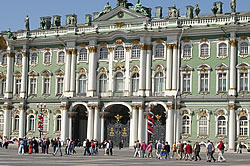 |  |
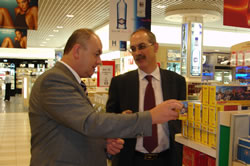
| (Top left to right): Liam Flood and Alexander Kosovsky in the main T2 store; Liam Flood says his St Petersburg experience has been “immensely satisfying”; (Below): Scenes from St Petersburg, undoubtedly one of the world’s most beautiful and historic cities | |
Lenrianta’s showpiece is its main T2 store, a neat and well-segmented 485sq m outlet covering all main duty and tax free categories and nicely situated just beyond security and immigration clearance. Alongside the main store sits a small bar, one of four that Lenrianta operates across both terminals. Upstairs is a gallery of four small shops, each averaging around 130sq m.
Pulkovo is a tale of small passenger numbers and big spends. According to Airports Council International some 2,469,455 passengers used the airport last year, many potential European visitors undoubtedly deterred by the need to obtain a visa to visit Russia. 2006 has started strongly with a +9.8% year-on-year rise in passengers to 785,373. If that visa requirement is ever lifted – and surely one day it will be – visitor levels to such an historic city are sure to boom.
The spend is high, particularly among Russians who represent 70% of overall sales. The average spend per passenger is an impressive US$26 with the per customer average rising to US$60.
Commercial Director Alexander Kosovsky, who has been with the company since 1990 – “I have worked here throughout all the big changes in Russia” – says that the past decade and a half has seen a profound shift in external conditions and the passenger base.
“Besides all the social changes there has also been a big change in our passenger profile,” he says. “We have seen a big increase in the number of Russian travellers and also foreign visitors. Firstly the business travellers started to come to St Petersburg from Europe – including Germany and all the Scandinavian countries – and then came the big [outbound] tourism increase. 2006 will be a record year for Russian tourists going abroad. The wealth of the Russian people is rising all the time.”
Kosovsky points out that Russians are selecting an increasingly diverse range of destinations for their holidays. “It was mainly Turkey in the past but in 2006 more people are travelling elsewhere. Greece is becoming very popular and a record number of Russians are going there this year.”
By category liquor and fragrances are the two key categories, accounting roughly equally for a combined 66% of turnover. Here is the full breakdown of sales for 2006 to date:
Liquor: 33%
Perfumes and cosmetics: 33%
Tobacco: 7%
Food (Caviar): 5%
Confectionery: 4%
Fashions: 4%
Jewellery: 4%
Souvenirs: 2.5%
Watches: 2%
Music/Video: 1.5%
Travel: 2%
Toys: 1%
Glass/Linen/China: 0.5%
Books: 0.5%
Tobacco’s low share is largely explained by an ultra-cheap domestic market for locally-produced brands. “Our USP is that we sell only the internationally-manufactured cigarette brands,” says Flood. “Our average price is €18 a carton – we try to position ourselves lower than the main destination airports such as London, Paris and Frankfurt.”
Liquor price comparisons with the domestic market are much more favourable, thanks to punitive local duty rates. Hennessy (the Russian market leader) VSOP, for example retails at €42 compared with an equivalent of around €150 downtown.
 |  |
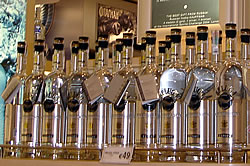 |  |
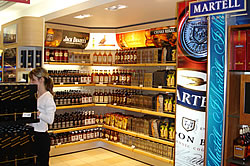
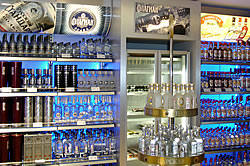
| Liquor generates around 33% of sales, driven by Cognac (no 1 in value) and volume leader blended Scotch; vodka understandably occupies centre stage with a comprehensive offering from the standard to the super-premium to a sure fire success – a vodka decanter shaped like a kalashnikov rifle, selling for €289. | |
Hennessy also leads Cognac sales at the airport, with Johnnie Walker the major Scotch whisky brand. Cognac is the biggest seller by value but Scotch heads the volume league. Vodka, not surprisingly given Russia’s spiritual homeland status for the category, enjoys considerable space. There’s a great range on show, from the fast-growing Russian Standard to the super-premium Beluga Caviar brand, retailing at €49 for a litre, on a par with VSOP Cognac.
“Let me show you something,” says Alexander Kosovsky with a chuckle. He leads me to a giant wooden box containing a vodka decanter shaped like a kalashnikov rifle, selling for €289. No doubt it is drunk out of a shot glass.
High prices such as this are no deterrent. “Russians will go for expensive items,” says Operations Manager Laurence O’Brien, citing the €1,200 price tag on ultra-premium Cognac Hennessy Richard. “We will often sell seven bottles in a week. And we had a customer recently who wanted to buy six bottles of Rémy Martin Louis XIII [€1,100 a bottle].”
The retailer places a constant emphasis on big visual displays, using DVD screens for example to boost brand impact and sales. Price promotion is also key with regular “˜3 for 2′ offers having a dramatic effect on sales – from 800 bottles a month to 5,400 being a not untypical success story.
The store also features an impressive array of personalised units, particularly in the liquor, tobacco and fragrances and cosmetics categories. “The main shop is now three years old so the key is to keep it looking as fresh as possible,” says Flood. “The new Martell unit has just been finished; there is a new Glenfiddich unit coming in soon as well as a new Marlboro unit.”
In tobacco Reemtsma (now owned by Imperial) was the first house to introduce personalised units, an initiative subsequently mirrored by several of its rivals in an attractive-looking area. Lenrianta is putting an increasing focus on cigars, running monthly promotions in an attempt to stimulate a category that should be big business with the Russian nouveau elite.
Philip Morris ranks number one in sales with Marlboro Lights, followed by Marlboro Red. Number two supplier is BAT (driven by Kent) then Reemstma with R1.
The full list of top sellers is:
1. Marlboro Lights
2. Marlboro Red
3. Kent
4. Rothmans
5. Dunhill
6. Vogue
7. B&H
8. R1
9. Davidoff,
10. West
11. Winston
12. Camel
The confectionery offer comprises a blend of Russian brands – often excellent and exquisitely packaged such as the Korkunov range. The top-selling Russian brand is called simply ‘Russian Chocolate’ and features five different types of chocolate packaged in scenes from St Petersburg.
Among international brands Ferrero Rocher is Russia’s favourite chocolate and was number one for Lenrianta consistently. However, it has now been overtaken by Lindt Neapolitans says Flood, with premium Swiss producer Lindt now the retailer’s biggest supplier within the sector.
There’s a strong destination offer – not just Russian chocolates but also those perennial and well-travelled industry favourites, Paton’s Macadamia nuts, produced in some tasteful destination merchandise packaging.
 |  |
 |  |
 |  |
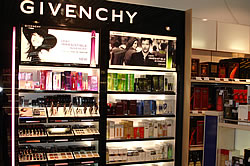
| Personalisation is the name of the game: The T2 store features a vibrant, constantly refreshed beauty offer, to which staff such as Nattia (top left) and Elena (right) bring tremendous energy and commitment | |
Fragrances and cosmetics command sizeable space in store. As with liquor there’s a strong personalisation emphasis with names such as YSL, Lauder, Clarins, Chanel, Givenchy and Guerlain drawing potential shoppers into the store from their attractive, spotlessly-clean and well-lit wall units.
“Most of our growth comes from running promotions and running them properly,” says O’Brien. “We try to have a skincare, a ladies’ fragrance and a men’s fragrance on promotion every month.” Adds Flood: “The other big thing is to keep changing the units – Dior was just replaced two weeks ago. And we have recently replaced all the gondolas.”
Kosovsky says the relative share within beauty-related items has changed considerably in recent years. “15 years ago it was mainly fragrances, these days it’s much more cosmetics,” he says.
The top three houses are Chanel, YSL and Dior – the order fluctuating according to promotions with Givenchy, Guerlain and Lancôme also prominent. YSL’s unusually powerful position – it is number one in both make-up and skincare – has a particular human dimension. “Our top beauty consultant Vika Kurapova works for YSL,” says Flood. “She won YSL beauty consultant of the year in 2002.
“She’s a phenomenal consultant who pushed them into number one position. I’m afraid to come into the shop in case she sells me something!”
But even good sellers need good buyers and Russian women are exactly that. And knowledgeable too. Notes Flood: “Russian women make straight for the latest skin care product or fragrance or fashion and they know what it is. For example, Guerlain’s new beauty elixir Orchidée Impériale (retailing at €240) is flying – they hear about it and they buy it.”
Beauty consultants are key to driving the category. “We’ve gone from 17 beauty consultants to 45 over the last four years and it’s paid off,” Flood notes. “In addition, a lot of the houses also employ spray girls.”
Departmental changes due to take place just after The Moodie Report’s visit in early June included the introduction of a La Prairie corner, the launch of Smashbox and the removal of the men’s bar cosmetics section.
“The men’s bar was simply too far away from the liquor so we’re converting a whole gondola of men’s skincare and some top-selling men’s fragrances just at the front of the beauty area [and at the end of the liquor area],” explains O’Brien. “It’s very important that men are comfortable entering the area.
“La Prairie agreed to come in to the airport just on the reputation which is amazing,” he adds, “and Smashbox is coming in soon which we’re very happy about.”
There are lots of nice touches instore. O’Brien hands me a jar of coffee beans from a fragrance gondola. Customers smelling multiple scents are encouraged to “˜nose the coffee’ in between in order to cleanse the senses. “We’re going to put 24 jars of coffee in here,” he says. It’s a nice touch, reflective of a retailer that understands its products and its consumers.
 |  |
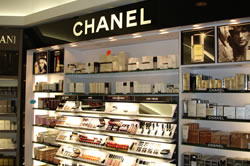 | 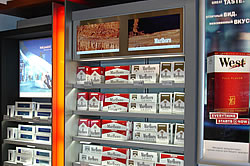 |
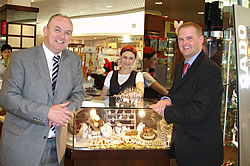
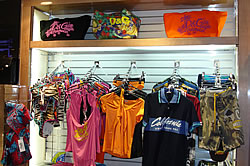
| (Clockwise from top left): Liam Flood and Laurence O’Brien at the increasingly successful jewellery counter as sales assistant Maria Doubrovsky looks on; D&G beachwear and lingerie is “flying off the shelves”; Reemtsma (now Imperial) started the personalisation trend in cigarettes which has now spread to all major brands, as with the beauty category epitomised by number one brand overall, Chanel | |
Adjacent to the fragrances and cosmetics area is fashion, as always a complex category but one that has prospered recently for Lenrianta. “We’ve had a new buyer for the past two years called Natalya Karpova,” says Flood, “and sales in that time have grown by +50%.
“It’s a very difficult category to buy – it changes so fast and there are long lead times. So if you don’t get it right the opportunity is gone.” With D&G underwear and beachwear Lenrianta has certainly got it right – “it’s flying off the shelves” enthuses Flood.
 | Liam Flood: One Irish rover |
 |
Watches is another important category that shows some distinct, though ever-changing, Russian buying patterns. “There were periods when a lot of Russians were buying,” Kosovsky recalls. “At one point every second businessman had to buy a Rado watch, for example.”
Rado remains the top seller by value ahead of volume leader Guess and Rado’s Swatch Group compatriot Tissot. A third Swatch Group stable member, Longines, also does well and Raymond Weil has grown impressively recently. Tag Heuer is an impending and important addition while Zenith does well, helped considerably by the fact that the leading St Petersburg football team (and recent semi-finalist in the UEFA Cup) shares the same name.
Flood comments: “Russian people know about watches and accessories in general. Women here have an amazing affinity with handbags and when you’re walking around Russia keep your eyes down and “˜watch the feet’ because women here are mad about their shoes – men are the same about watches.”
In jewellery Austrian crystal brand Swarovski is the clear leader, dominating a category in which sales have increased by over +40% in the last two years. Frey Wille also sells well, as does Kenzo (“nice, young and trendy” says O’Brien) and the new Montblanc jewellery line.
“Swarovski is phenomenal,” says Flood. “We gave them the back wall a year and a half ago and we believe the sales would be even higher if they would put in a dedicated sales person – salaries here are not expensive compared with western European airports. We tried it with ST Dupont last year and we saw a fantastic increase in sales.”
The store closes out with a small consumer technology section, some toys and a varied destination merchandise selection which is supported by a more upscale specialist store one storey up.
The latter is one of four specialist stores, all renovated a year ago. Russian House is a lovely little shop, packed during The Moodie Report’s visit with Korean shoppers excitedly gathered around the impressive selection of amber (a Russian speciality), gifts, books and confectionery. The portfolio ranges from magnets (“we sell 4,000 a month at the height of summer,” says O’Brien) to beautiful, upscale Lomonosov hand-painted porcelain.
“˜The detail is beautiful – we do extraordinarily well with it,” he says, suggesting like a salesman born to the role that I might want to take a closer look “when you’re shopping on the way out”. [And indeed I did, ensuring The Moodie Report far exceeded the average per customer spend – Ed].
 | 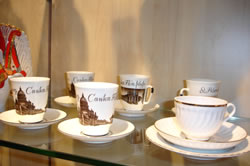 |
| Upstairs in the gallery of specialist shops Korean travellers admire a quality destination merchandise offer in Russian House, typified by this beautiful Lomonosov hand-painted porcelain coffee set | |
The amber sells strongly, again across a wide variety of price-points depending on the piece, while Faberge eggs add a classically Russian touch. High quality books are sold in six languages, up to €390 at the top end, while exquisite hand-painted lacquer boxes are one of the best sellers, peaking at around €540.
No Russian souvenir shop would be worthy of the name without a wide selection of Matrioshka dolls and the Lenrianta store comes through with colours flying. The dolls start in units of five pieces (i.e. “˜nesting’ within one another) right up to 25 for the more intricate works of art and craft. “You can pay from €5 up to whatever you want to pay,” as O’Brien puts it, no doubt making a mental note to encourage me to do exactly that on my departure.
The shop is open sell, nothing unusual to western retailers but with so many high ticket items it’s a major shift by Russian standards. Historically Russian retailers, worried about losses, have argued that such items should be counter service only and O’Brien admits there has been some healthy internal debate within the partnership over the issue. “The shop is a massive breakthrough in terms of locking versus unlocking,” he says. “But a crucial part of the sell is putting the product in peoples’ hands.”
The other shops upstairs offer music and dvds, gifts (mainly special offers) and fashion – where Givenchy is the biggest-seller and fur hats do “incredible business”. Notes O’Brien: “We also sell a lot of ties with nice ranges and a huge amount of scarves from Kenzo and other designers.”
BOOSTING THE TERMINAL ONE OFFER
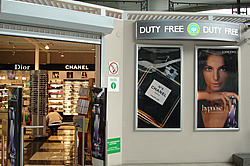 |  |
| The main terminal one store enjoys a huge fragrances and cosmetics spend – note the great central position of Chanel which can be seen from a considerable distance away; no Aer Rianta International location in Russia would be complete without an Irish bar and Pulkovo doesn’t disappoint. Don’t ask for a light beer though – the Russian beer is all at least 7% in strength | |
Pulkovo Terminal One is a very different proposition from its more modern counterpart at T2. T1 is a giant, sprawling and soulless facility which owes its origins, configuration and architectural design to the Soviet era.
It’s also a much bigger terminal due to the huge amount of internal domestic travel that was done in the days of the USSR. Today those once domestic flights to what are now fellow CIS countries are international and help drive a useful spend at the terminal.
When domestic traffic declined in the early 1990S, the terminal was used to accommodate a lot of non-essential offices and back-up facilities. This led to retail space being restricted and the lay-out becoming confusing. “However the terminal is still a fine building and were it to be re-configured it has the potential to handle the inevitable growth in passenger traffic, which this city will surely see in the years to come,” says Flood.
T1 also services intra-Russia domestic flights as well as international charter routes. A small duty paid domestic shop does nearly US$3 million in sales each year, mainly to Russian businessmen and diplomats bound for Moscow.
The current T1 showpiece store (pictured) is effectively a mini-version of the T2 offer, dominated by fragrances and cosmetics and bolstered by a Swarovski unit and some liquor and confectionery.
The store may be small at 80sq m but the sales are anything but, says Liam Flood. “The volume of perfumes and cosmetics is phenomenal,” he says. “This shop used to account for 15-16% of the spend and now it is 24-25%. In good weeks that can be even higher and that is purely because of the personalised units we have put in.”
Since The Moodie Report’s visit Lenrianta has opened an additional 149.5sq m store in T1, located in the international section. It serves CIS passengers and a number of charter flight travellers bound for destinations such as Turkey, Greece, Israel, Cyprus and Dubai.
The new outlet, located upstairs, sells all items except fragrances & cosmetics. “This terminal has real potential to grow,” Flood notes. “The charter business is increasing and so is the CIS business.”
A POSITIVE BUT UNPREDICTABLE OUTLOOK
With spending levels buoyant and Russia’s economic situation continuing to develop positively, the outlook seems equally rosy for Lenrianta.
Anatoly Shashin is keen to give credit where credit is due: “Our company has grown over the years and we have always gotten great support from our Board. We have an excellent team in Lenrianta and I would like to pay tribute to all of our staff whose efforts have made the company so successful. We work extremely well with Pulkovo Airport Authority and with all the various airport agencies and I would also like to thank them for their help and co-operation. I am proud to have been their Director General of Lenrianta for the past 16 years.”
But doing business in Russia is never straightforward and Lenrianta has grown used to having to combat unexpected legislative and bureaucratic difficulties.
Last year the authorities stipulated with little warning that every single sku in the shop had to have a health certificate from the authorities in the country of origin as well as Russian health authorization saying they were safe for consumption. “It wasn’t just a certificate for Chanel, for example, but for every single Chanel product,” Flood recalls with a shake of his head.
At the beginning of 2006 the regulators struck again. From 1 January companies wishing to import liquor into the country needed a single five-year license (as opposed to a series of individual licenses for different shipments as previously). At the same time a share capital threshold was introduced, meaning that some firms had to raise their share capital in order to comply. Lenrianta, for example, had to change its charter to reflect the new requirements, eventually gaining its new license at the end of May.
But dealing with that issue was relative child’s play compared with to the latest requirement to put back labels on all products containing alcohol, including fragrances. From the summer of 2005 an exemption for duty free products from stringent domestic market labelling requirements for items containing alcohol was removed.
The back label should now carry a range of consumer safeguard information in Russian script, including country of origin, ingredients, health-related details, and date of manufacture and sell-by date.
Duty free retailers across Russia are formulating different responses to the challenge. Aer Rianta International’s various joint ventures, for example, are asking suppliers to apply labels to all bottles or packaging as appropriate in advance. While it would like to see a 1 July implementation it acknowledges there cannot be a hard and fast date for such complex changes.
Flood comments: “Long term we would see it as the suppliers’ responsibility to produce the labels for duty free. Many suppliers are already doing this for the domestic Russian market and the information provided on these labels is essentially the same.
“However, it devolves on us to tell all our suppliers the precise labelling requirements to comply with the legislation. While we are working to a date of 1 July, it is doubtful as to whether all suppliers will be ready by that date. We’ll possibly have to rely on the authorities to give us some leeway.”
Hopefully that will be forthcoming. It seems a shame that a vibrant business that projects such a positive image for Russia should be shackled by red tape. St Petersburg is one of the world’s great cities – a historic treasure trove of architecture, culture and tradition.
It’s a beautiful tourist destination, restricted in popularity only by the Russian government’s insistence firstly on formal invitations and latterly visas for most foreign nationalities. And it has a highly impressive airport retail offer, rich in variety, local and international flavour and product diversity. Lenrianta is rightly proud of the reputation it has carved out in recent years. Even the biggest legislative barriers seem unlikely to hold it back.
FOOTNOTE: Liam Flood can be contacted at LFlood@lenrianta.com