

INTERNATIONAL. The Duty Free World Council (DFWC) has reported a predictable slowdown in international passenger growth during the second quarter of 2026, with the ongoing conflict in the Middle East weighing heavily on global air traffic.
According to the latest DFWC KPI Monitor, produced by Swiss research agency m1nd-set, international departures totalled 580 million in Q2 2026, representing 99% of the level recorded in the same period a year earlier.
The report attributes the slightly weaker performance primarily to the impact of the US and Israeli military action against Iran.
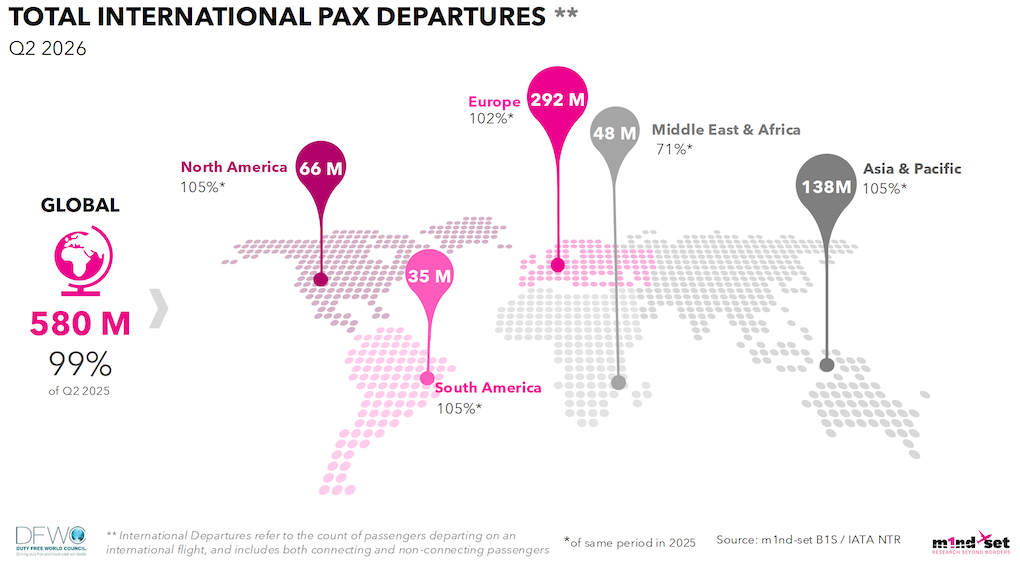
The sharpest decline came in the Middle East and Africa, where international traffic fell to 48 million departures, equivalent to just 71% of Q2 2025 levels.
Elsewhere, the market proved more resilient. Asia Pacific recorded 138 million international departures, up +5% year-on-year, while North America reached 66 million and South America 35 million, each growing by +5%.
Europe posted more modest growth of +2% to 292 million international departures.
London Heathrow retained its position as the world’s leading airport for international departures in Q2 with 12.7 million passengers.
Amsterdam Schiphol and Singapore Changi shared second place on 10.9 million, followed by Incheon with 10.8 million and Paris Charles de Gaulle with 10.4 million.
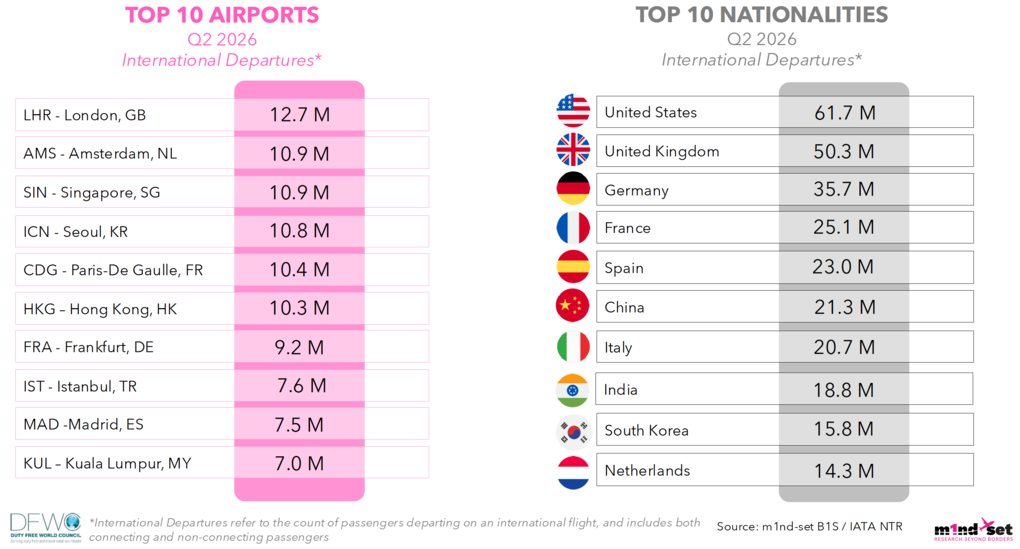
Notably, Dubai International dropped out of the global top ten as regional conflict hit traffic, with Kuala Lumpur International entering the rankings in tenth place on seven million international departures.
Hong Kong, Frankfurt, Istanbul and Madrid-Barajas also featured in the top ten.
By nationality, US travellers remained the largest international passenger group with just under 62 million departures, ahead of the UK (50 million), Germany (36 million), France (25 million) and Spain (23 million).
China, Italy, India, South Korea and The Netherlands completed the top ten.
DFWC President Sarah Branquinho commented: “With geopolitical tensions in the Middle East creating an increasingly uneven global landscape, the DFWC KPI monitor traffic data clearly illustrates the vulnerability of international travel to external influences and shocks.
“While the sharp decline in traffic across the Middle East is significant, the resilience shown by Asia Pacific, Europe and the Americas underlines a fundamentally strong appetite for travel.”
Travel retail shopper trends analysis
Beyond traffic statistics, the DFWC KPI Monitor highlights evolving shopper behaviour and continued opportunities for travel retailers.
Value remains the strongest purchase driver, cited by 29% of shoppers, ahead of convenience (22%) and brand loyalty (19%).
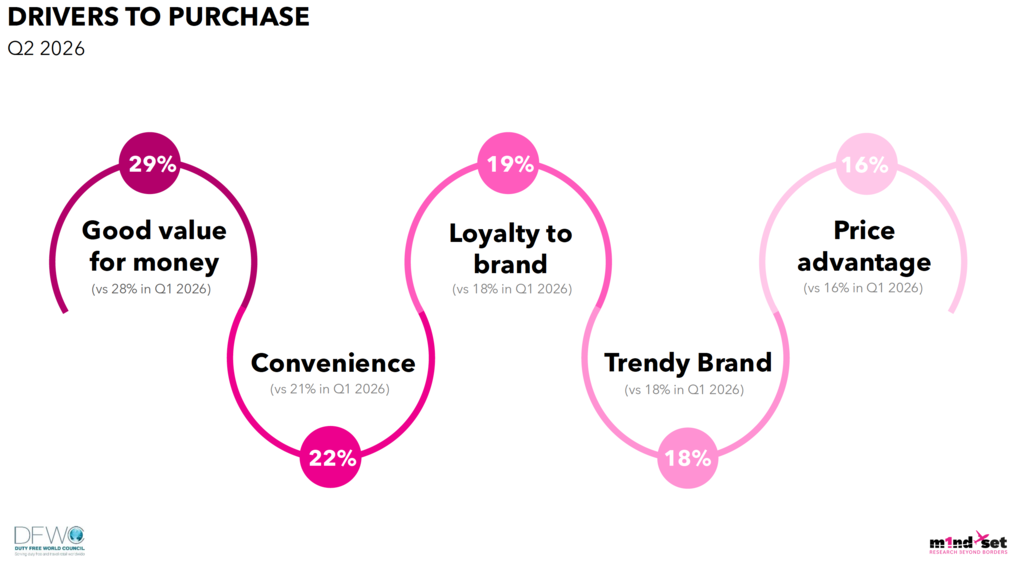
Trend-led brands and the perceived price advantage of duty free also continue to encourage purchasing.
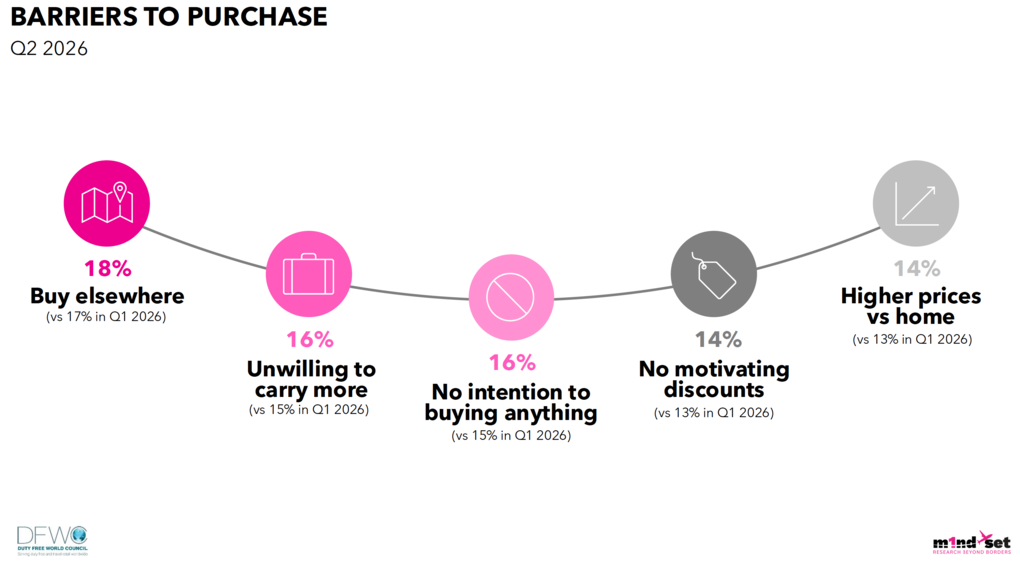
The principal barrier to shopping is travellers choosing to buy elsewhere, cited by 18% of respondents.
This is followed by reluctance to carry additional items and having no intention to purchase, both at 16%.
A perceived lack of compelling discounts and higher prices than at home were each identified by 14% of non-shoppers.
The findings reinforce the importance of the in-store experience. Some 68% of shoppers enter duty-free stores without a fixed purchase decision, with 46% undecided on what they intend to buy and a further 22% making impulse purchases.

Self-purchasing continues to dominate, accounting for 60% of purchases, while one in five shoppers buy gifts. Some 15% purchase items to share with travelling companions and 6% buy on behalf of others.
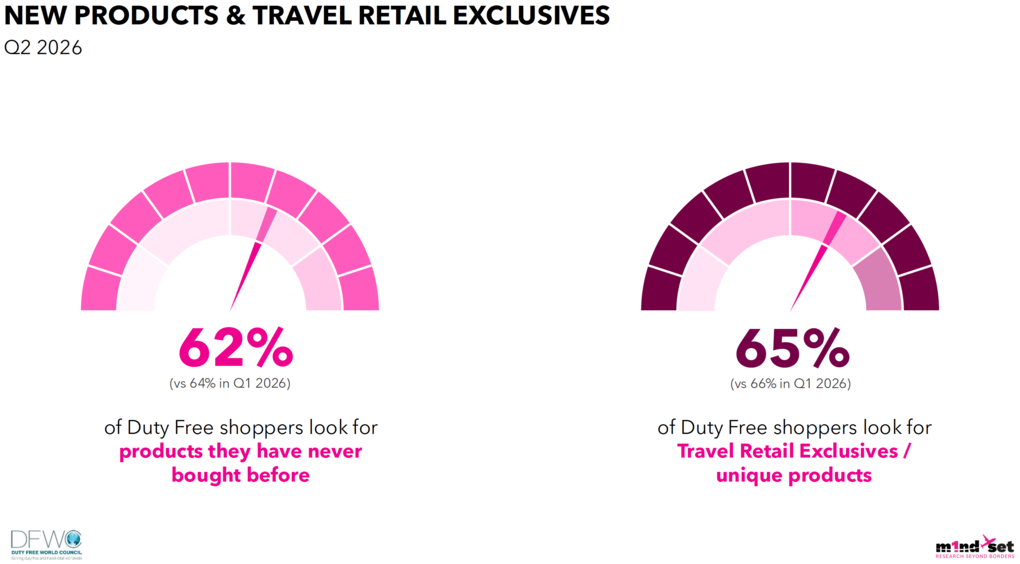
Demand for exclusivity also remains strong. The report found that 62% of shoppers are keen to discover brands or products they have not previously tried, while 65% actively seek exclusive products available only in duty free.
Pre-trip engagement is also edging higher. Around 32% of shoppers research purchases before entering stores, up one percentage point from the previous quarter.
General internet searches account for 21% of pre-store information sources, followed by social media, duty-free retailer websites and travel websites, each on 16%. Billboards account for 15%.
The monitor also points to the growing importance of face-to-face engagement. More than half of shoppers (56%) interacted with sales staff during their latest duty-free visit, up from 51% in Q1 2026.

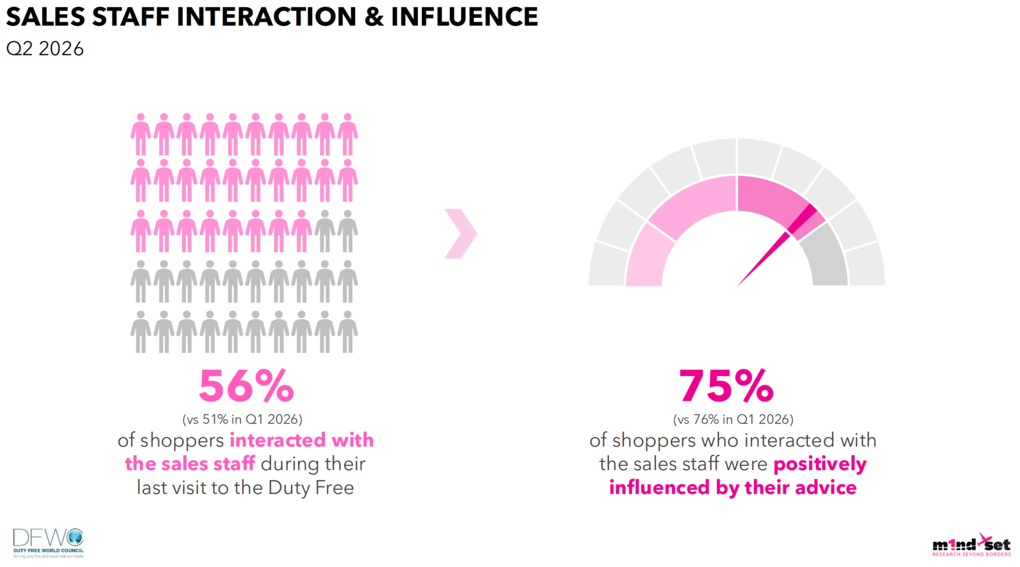
Three-quarters of those shoppers said the interaction had a positive impact on their shopping experience. ✈