SINGAPORE. DFS Asia South Managing Director Craig McKenna is calling attention to the outstanding work of Kuma Cambodia School, one of the beneficiaries of the proceeds raised by DFS Venture Singapore in the recent Great Travel Retail Educathlon.
As reported, the retailer raised over S$125,000 (US$99,000) to be split between Kuma Cambodia and Hand In Hand for Haiti.
Created by registered NGO Norwegian Association for Private Initiative in Cambodia (NAPIC) and supported by the United World College South East Asia (UWCSEA), the Kuma Cambodia project aims to provide education for poor and marginalised children in the capital and largest city of Cambodia, Phnom Penh.
Under the initiative, a new school called Kuma – the Khmer word for “˜children’ – has been constructed with a dining hall, kitchen, library, showers and toilet facilities. Students are provided with two meals a day, showers when they arrive at school and a well-rounded education which will include sport, art and IT lessons. As well as education the children receive medical checks every three months, dental education and checks, and vaccinations.
The Kuma school is one of four projects initiated by the NAPIC in the Ta Khmau province, 20 minutes outside of Phnom Penh. The others include The Maternity Clinic, Mobile Health Team and Keo San-NAPIC Free Education Center (KNFEC), all of which provide care for women and children from 20 villages within this area. These same villages are the feeder communities for the Kuma School.
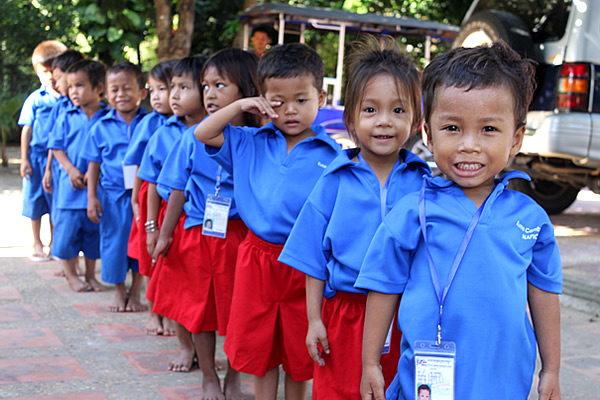 |
The DFS-supported Kuma Cambodia project aims to provide education for poor and marginalised children in the capital and largest city of Cambodia, Phnom Penh |
The Maternity Clinic
Founded by Irene and Dag Rømmen in partnership with their Cambodian friend Dr. Keo San, The Maternity Clinic aims to reduce the maternal mortality rate and therefore the number of orphans in the community.
As adoptive parents, the Rømmens were supporting a state orphanage when they realised that many of the children were orphaned as a result of their mother losing her life while giving birth to another sibling.
Complications related to childbirth are the highest cause of death for women aged 15 to 49 in Cambodia. These women leave behind a number of children who tend to end up on the streets, in crowded orphanages, or are taken advantage of in the worst ways imaginable. In 2005 89% of women gave birth at home (in comparison the percentage of home deliveries in Vietnam was 6%); 66% of them had no professional help.
In response to this, Dr. Keo San’s free maternity clinic opened its doors in Ta Khmau on 18 June 2005. Since then, over 13,000 women have delivered their babies in a clean and safe environment and with professional care. Now, the clinic sees more than 2,500 deliveries per year. Dr. Keo San has had the overall responsibility of running the clinic, and NAPIC has funded 100% of the operations with help from a handful of private donors. Many lives are saved, and it is estimated that every month 30 children keep their mothers because of this clinic alone.
To make a contribution to The Maternity Clinic, please e-mail Irene Solberg Rømmen at Irene@rommen.com or send your contribution to: Norwegian Association for Private Initiative in Cambodia, ANZ Royal Bank of Cambodia Ltd, P.O Box 624, Phnom Penh, Kingdom of Cambodia, Swift Code: ANZBKHPP, Account Number: 856970
 | 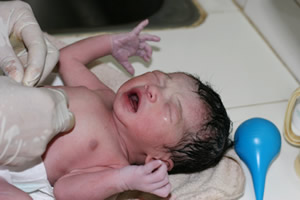 |
The Maternity Clinic opened on 18 June 2005 with an aim to reduce the maternal mortality rate and therefore the number of orphans in the community | |
Mobile health clinic
In 2007 NAPIC extended their services to include a mobile health clinic that operates in 24 villages in and near Ta Khmau. The team examines all pregnant women regularly, providing vitamins and tetanus vaccinations. Great emphasis is put upon education and training in pregnancy, nutrition, the care and nursing of infants, hygiene, HIV and other health issues
Kuma Cambodia School
Most recently, through the dedication of Andrea Naylor and a group of supporters in Singapore (including DFS) the Kuma Cambodia School opened on 5 June 2012 to its first students. At the official opening ceremony four months later, proud parents watched their children sing, dance and act as little ambassadors. Twelve months on, the 40 children are thriving under the watchful eye of a staff dedicated to carrying out the vision of the project.
The vision for the Kuma Cambodia children is for them to enter the school and complete Grade 1, Grade 2 and Grade 3 with a full day of holistic education. As they enter Grade 4 through the end of Grade 5, they will start their transition into the local schools – which only run for half a day – and then come to Kuma for the rest of their day.
This way the children can continue with their English, arts and physical education. They can have a shower and a meal and the school can continue monitoring their health. The local schools are aware of this plan and Kuma is working to develop a positive relationship with them in preparation for this. For Grade 6 the children will transition to being in the local system only. A social worker will be employed as a liaison between the Kuma School, the local schools and the village communities.
The guardians of the Kuma children attend a monthly meeting in which they hear about their child’s progress, learn how to support their child and their learning at home and learn life skills that many were not taught as children themselves. Topics range from hygiene (teeth brushing, how to wash children properly, very basic first aid for scratches etc.) to education in reducing domestic violence and gambling.
 |  |
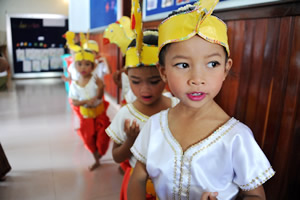 | 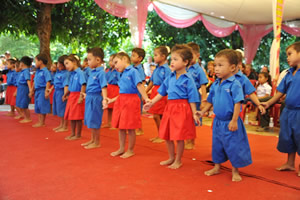 |
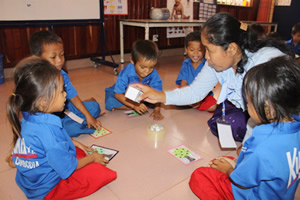
Kuma Cambodia provides a holistic education comprising the regular National Khmer curriculum, as well as additional lessons in English, P.E. and traditional Khmer arts | |
“In the future we would like to develop a vocational training programme for the parents, which they would sign up for as their children enter Kuma,” NAPIC stated. “They would choose from a few forms of vocational training, e.g. sewing and handicrafts, agriculture. They would learn new skills but also use these skills to create items or food that can be sold and the money brought back to help support the project. We would hope that by the time their child is finishing school they would be able to support their family.”
The Kuma School is run by a Cambodian staff which include the country representative for NAPIC and General Manager of the Kuma Project, Principal of both of NAPIC’s education projects, two part-time English teachers, a full-time Khmer teacher, two part-time Khmer teachers, two full-time classroom assistants, one guard, a tuk-tuk driver, two cooks and a cleaner.
A parent’s testimonial
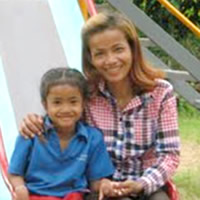 |
Mrs Sreng Savoeun and her daughter, Panha |
Mrs Sreng Savoeun (pictured right) is one of many parents whose lives have been changed by the Kuma School. Born in Prey Veng province, the 38-year-old is married with three children and is now working in the school as a cleaner.
Savoeun got married in 1989 and worked with her husband as a farmer. They were forced to move several times within a short period of time as their financial situation worsened. In 2009, having lost all of their money and forced by the government from their land, they ended up in Ta Khmau. They worked very hard to provide for their three children, but as they became increasingly desperate and domestic violence in their home worsened due to the stress of their situation, they were forced to send their two older children into an orphanage, where they knew that they would be cared for and given an education.
In September 2012, Savoeun’s youngest daughter Panha was selected to attend Kuma Cambodia. With more free time on her hands while Panha was at school, Savoeun started looking for a job to help supplement her husband’s income, taking on work in construction and at a factory. Things calmed down domestically, and the couple grew happier seeing the change in their daughter after she started attending the Kuma School. They continued to work hard and were saving to get a motorbike for their family.
In early 2013, Savoeun was hired as a cleaner at the Kuma School. Ever since she started working there, the people surrounding her have commented on how much her life has improved: she is happier and she can now afford better clothing. The manager and staff of Kuma are also full of praise for her hard work.
Savoeun said: “The Kuma project [has made] my family’s life better. Because of the Kuma project, I can now support my parents at my birth province when they need help or are sick. The Kuma project teaches all the parents how to reduce violence in their family and how to sustain their livelihood and make the family home a good place.
“My daughter has changed a lot since she started studying at the Kuma School. She speaks nicely and does not use bad words or show bad character to her elders. The Kuma project is a great project that will bring a good future for the poor kids who have no chance to study at the public school. My daughter hopes that she will became a nurse or a doctor in the future. Lots and lots of thanks to the Kuma Cambodia School!”
Kuma Cambodia: “˜Changing Tomorrows Today’
A regular day for the Kuma Cambodia children begins with the school tuk-tuk picking the children up from the villages. Once at school, the children change into their uniforms and have the first of three meals for the day. They then brush their teeth, raise the flag and have movement time. The rest of the morning consists of lessons following the regular National Khmer curriculum, following which they have playtime, then lunch and a compulsory rest period.
During the afternoon sessions the children have another session of playtime and additional lessons in English, P.E. and traditional Khmer arts such as music, dance or art. They then have their third meal of the day, brush their teeth again and change back into their own clothes. The tuk-tuk takes the children home, where they are handed over to a pre-appointed guardian.
The children have long school hours so that their parents can work in construction or at the textile factories; it also ensures that the school can provide a holistic education with the extra elements of hygiene, nourishment and healthcare.
The children receive a health check every three months. They are also provided with dental care and are now up to date with all childhood vaccinations. If they come to school and are unwell, they are taken to the local clinic where they receive medical attention. Sight and hearing tests have also been conducted, on top of tests for HIV and other diseases.
 |
 |
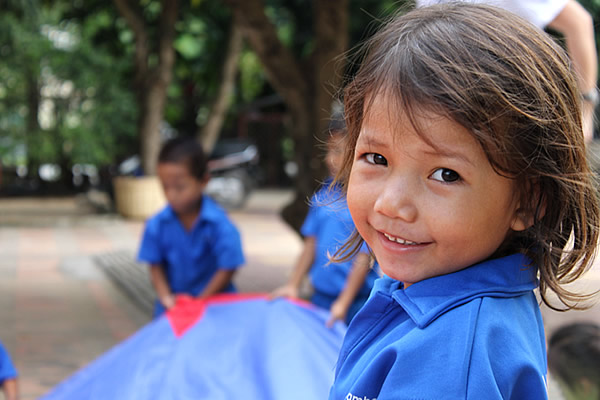
Happy, smiling faces: Since coming to Kuma Cambodia, the children have flourished into “energetic, healthy and enthusiastic little sponges” |
Commenting on the positive change in the children, the school said: “Since coming to the Kuma Cambodia School, the children have flourished. The shy, unsure and hesitant children have become energetic, healthy and enthusiastic little sponges – soaking up new experiences, learning and fun. They are progressing through the Khmer academic curriculum quickly and studying English and the arts with enthusiasm, proudly practising their new vocabulary with visitors to Kuma.
“They are learning not just socially and academically, but also in their perception of the world and the opportunities available to them. For many of them Kuma has introduced them to a world beyond their villages and they are now dreaming of the future – of becoming doctors, teachers and other professions that they did not know existed a year ago.”
To prepare the Kuma Cambodia project for future growth and sustainability, an advisory committee has been established to guide decision-making and bring a variety of perspectives to help make it sustainable and transparent. The committee is made up of parents and professionals from a variety of backgrounds who are working to apply business and financial planning and reporting practices to ensure that the Kuma School does not grow too quickly and that it will be able to honour its commitments to the community. The committee is also working with other NGOs to learn lessons from their experience and to create partnerships for Kuma within the Phnom Penh area.
The sustainability of Kuma Cambodia has been made possible with the help of corporate sponsors DFS and Agility Logistics, both of which have committed to long term support of the project. These companies have made sizable donations to the project and are keen to make a hands-on contribution, such as having their staff volunteer at the school in the future.
Kerena, the Project Manager of Kuma Cambodia, said: “The Kuma staff are all very proud to be involved in the Kuma Cambodia Project, which we feel is one of the best projects in the world to help the poorest Cambodian kids and their families to have a new life, new hope and a new future.
“The humanitarian aid and kindness from NAPIC, UWCSEA, DFS, Agility Logistics, RS Platou and other donors, encourages the Kuma staff to try their very best in helping their own Cambodian people. Our generous donors put their hearts down to support this project and continue to make the dreams of the kids come true and their support will never be forgotten by the Kuma staff, children and community.
“As we work with the children in the Ta Khmau area, it is clear to see that the work is having an impact further afield than just with the children attending school. The monthly meetings with the Kuma children’s guardians are going very well. The parents report the changes in their children with excitement and are proud of their progress. Kuma really is “˜Changing Tomorrows Today.'”
To find out more about the Kuma Cambodia Project and how you can help, please visit kumacambodia.org or contact NAPIC Managing Director Irene Solberg Rømmen at Irene@rommen.com or Kuma Cambodia Project Co-ordinator, Singapore Andrea Naylor at andreanaylor@gmail.com.
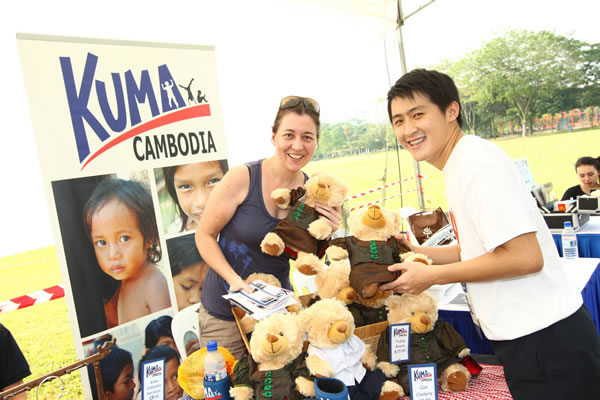 |
The sustainability of Kuma Cambodia has been made possible with the help of corporate sponsors such as DFS, which has contributed not just financially but also by having their staff volunteer at the school |