

Welcome to the Discovery Channel. No, not the Warner Bros-owned factual entertainment media programme. We’re talking travel retail, Sue Y. Nabi style.
Asked on an earnings call after the announcement of Coty’s full-year results yesterday how she saw travel retail evolving, CEO Nabi said, “We are reinforcing the ability of this channel to become a destination to discover newness.
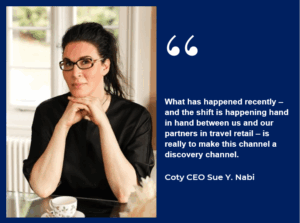
“I think what has happened recently – and the shift is happening hand-in-hand between us and our partners in travel retail – is really to make this channel a discovery channel.
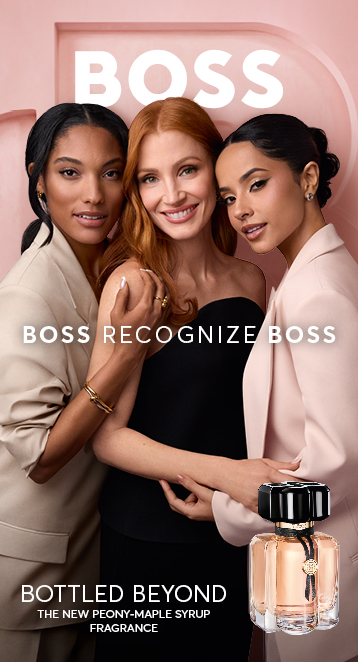
“Hence, our decision to make the key innovations of this new fiscal year travel retail-exclusives for 1.5 months. [For example], you could see the BOSS Bottled Beyond in travel retail [before the 1 September global roll-out; click here for our story].
“That’s also a great warm-up, if I may say, before the products hit the global distribution outside of travel retail. So this is a way to make sure that the consumers who are travelling… are more attracted towards these kinds of exclusivities that make the channel look almost like a niche boutique – with the newness and the things they do not yet find anywhere else. And, of course, with the price incentive.”
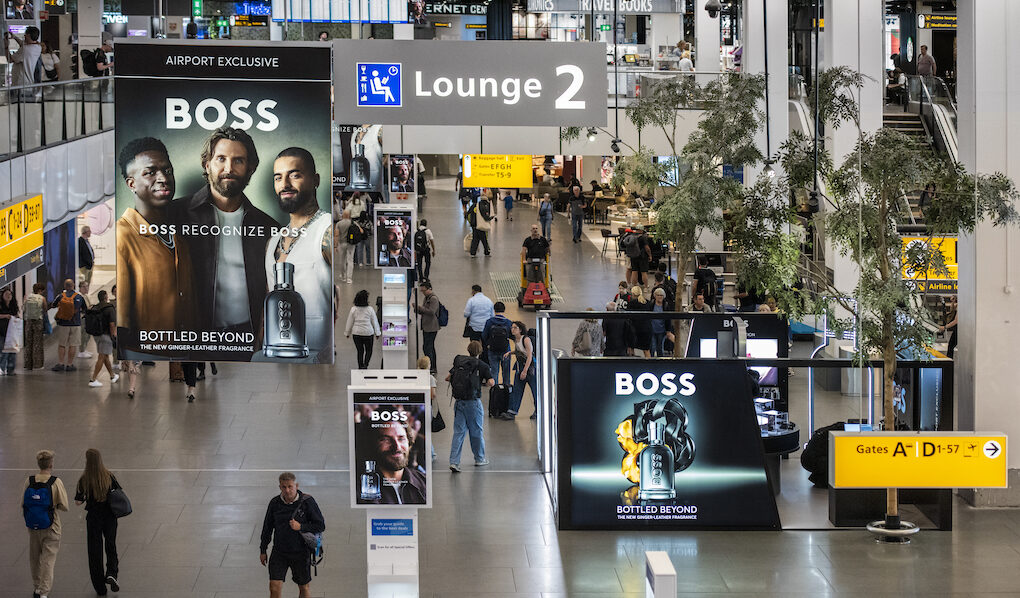
Nabi said Coty’s travel retail sales in the Americas and EMEA regions are “growing nicely”, noting (as with the company’s peers) that the only region still negatively affected is Asian travel retail, principally due to its links with subdued Chinese consumption.
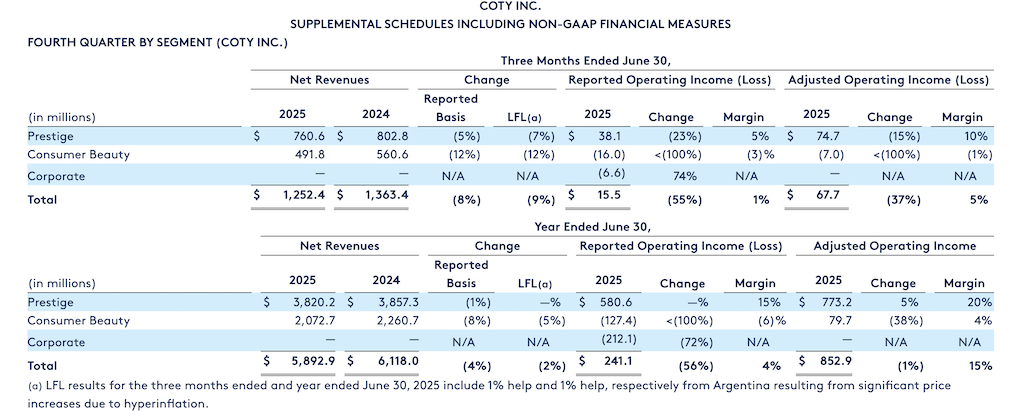
Even then, there is better news, she added. “The good news is that in China we are seeing the beauty market gradually improving with prestige beauty specifically in the June quarter positive for the first time in many… +3%, and outperformance from the fragrance category at +7%.
“So these are elements which give us confidence that the missing part when it comes to the full travel retail picture – which is the Asian Chinese travel retail region – is hopefully going to come back to a little bit more dynamism.”
Fragrances and the ‘treatonomics’ phenomenon
Nabi was even more upbeat on the fragrance category, Coty’s traditional stronghold, pointing out the strong performance of mass and prestige fragrances.
“The mass fragrance category is more or less 7% of the net revenues of the company. Its been growing nicely. The market is growing everywhere around the world. And this is part of what we used to call the fragrance index. But I think today we are more into what we call the ‘treatonomics’ phenomenon, which is the economy of treats.
“We see that as fragrances from US$5 to US$500 are becoming really the go-to destination in the beauty industry… this explains why a lot of consumers today are continuing to buy fragrances at every price level, including in mass fragrances.
Play misty for me
“They are also diversifying the way they wear fragrances, hence our perfume mist attack. And this category… is as profitable as a fragrance launch. So there is absolutely no dilution play in this game.
“It’s a game of layering… purely additional. It’s an US$8 billion market, doubling year-on-year. And this is an area where Coty, which is the leader in scenting and fragrance at large should play in. So we are playing big. And we believe this is going also to help us in the second half of the year.”
Turning to prestige, Nabi described high-end, niche fragrances as the fastest-growing category. “Niche, which is above US$150, is growing by +14% and everything under US$50 is growing by 11%. These two parts of the market are the fastest-growing.”
Instead of getting into mass discounting of established brands, as some competitors have, Coty has opted for a “perfume mist attack” implemented a year ago, she explained.
“That’s because we understood that for those who are looking for value, you cannot just sell the same brand with a -50% discount. You need to propose, specifically for the younger consumer, other ways to increase the basket or to replace the basket with the same profitability.”
Nabi cited the CK Mist launched this summer and observed: “The only places you could see a teenager queuing at airports were in front of the displays of CK Mist and it also boosted the sales of pen sprays and of 30ml fragrances.”
Still on prestige – in Coty’s case dominated by fragrances and bolstered by skincare and colour cosmetics – Nabi noted the impact of a recent restructuring of the North Asian beauty sector. Both sell-in and sell-out, she noted had been due to the “resellers’ phenomenon that is shrinking, if not totally drying, in Asia between the Hainan, [Mainland] China and Korea ecosystem”.
She added, “This is really one of the key explanations of the figures and counter-performance of the division while fragrances continue to grow.”
However, Nabi was bullish on prospects for skincare where Coty’s two key brands are Philosophy in the US and Lancaster (described as a “European/Chinese brand”).
“The great news is that Lancaster is now growing super strongly in China,” she explained. “It’s among the top five fastest-growing brands. It’s growing 3x or 4x faster than the skincare market. And it explains also our absolutely outstanding performance… where the skin are category outperformed the market by 11% for Coty.” ✈