


INTERNATIONAL. Airport hospitality specialist TAV Operation Services says it is extending its reach in the aviation ecosystem by creating experiences that are “distinctive, operationally efficient, socially responsible and emotionally engaging”.
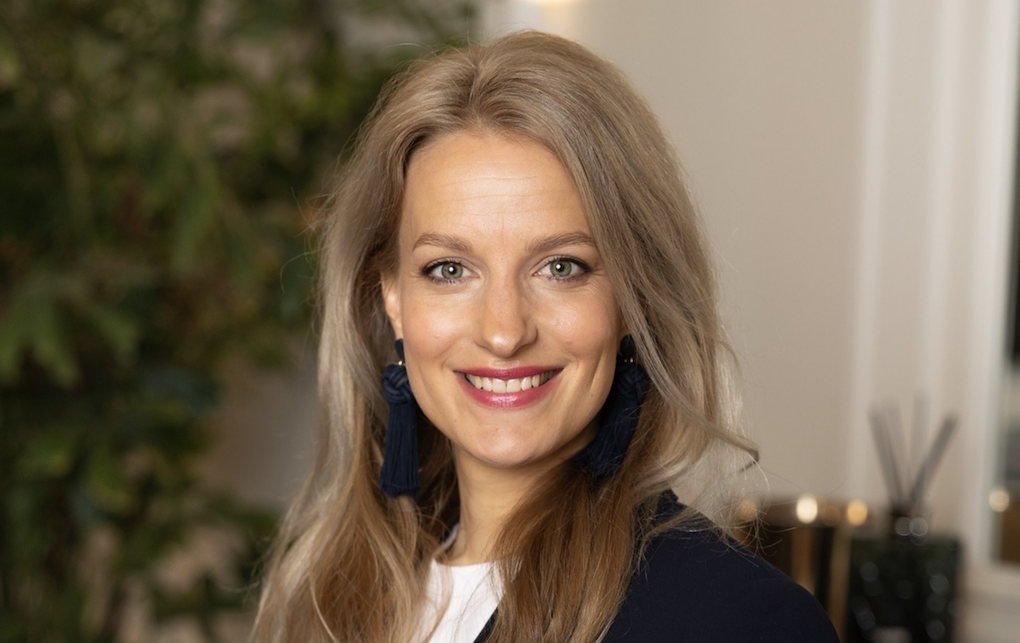
In this Q&A, TAV Airports Holding Chief Commercial Officer and TAV Operation Services Chief Executive Officer Aude Ferrand talks about a new vision for the Primeclass hospitality concept, the future for Extime Lounges, the development potential of its latest partnerships and taking leadership in designing for “flow rather than fragmentation and for collaboration rather than isolation”.
The Moodie Davitt Report: To begin with, can you outline the updated strategy and vision for TAV OS today? What are the key principles?
Aude Ferrand: At TAV Operation Services, our strategy is built on a clear conviction: airport hospitality has evolved from an ancillary service into a central element of the travel experience. We therefore approach our role not as a collection of individual services, but as an integrated hospitality platform positioned at the intersection of travellers, operators, airlines and airports. We are focused on being a trustworthy partner to all airport stakeholders, helping each reach their ambitions.
Therefore, as a growing company, we are building our platform on three connected principles: hospitality, digitalisation and ESG.
Hospitality is our foundation. We design and operate lounges and premium services around how people feel when they travel today: different rhythms, different needs, different emotional states. Our ambition is to turn airport time into meaningful time through human-centred service, thoughtful design, operational excellence and consistent quality across markets.
Digitalisation enables scale and relevance. We use data, CRM and digital tools to help us understand guest behaviour in real time, personalise experiences and support teams on the ground. Digital is not an add-on; it is the infrastructure that allows us to deliver consistent hospitality globally while remaining agile and partner focused.
Environmental, Social and Governance (ESG) principles guide how we grow. As a service company active across multiple countries, this means responsible sourcing, local employment, efficient operations and long-term value creation for all stakeholders. ESG is a pillar in all our decisions, from designing spaces to working with suppliers and co-building hospitality offers with airports and communities.
Together, these principles position TAV Operation Services as a global hospitality platform: scalable, partner-centric and deeply focused on the guest experience – while translating our global know-how into locally rooted experiences.
How does the new Primeclass branding and identity fit with this strategy? What are the guiding values for this new brand?
The evolution of Primeclass is a direct reflection of our strategic evolution at TAV Operation Services: from operating lounges as individual assets to shaping airport hospitality as a differentiated experience platform.
As global air travel has rebounded globally, traveller expectations have fundamentally changed. Premium hospitality is no longer defined solely by comfort or efficiency, but by the emotional quality of the experience. How travellers feel in an airport environment – whether they feel calm, connected and recognised – has become a key differentiator.
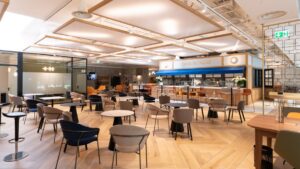
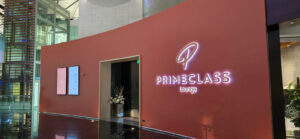
We revisited the Primeclass brand with this in mind. Today’s travellers seek not only speed and convenience, but emotional connection. The new positioning elevates Primeclass from a traditional lounge concept to a lifestyle-driven hospitality experience.
It is flexible by design, adapting to different traveller profiles, travel purposes and dwell times, while maintaining a consistent standard of quality and service. Travellers can find their rhythm and reconnect, even during intense travel moments.
Guided by The Primeclass Promise – ‘Staying Tuned, Collective Experience, Human Touch and Better Future’ – the brand delivers a consistent yet personal experience across markets. In doing so, Primeclass becomes a clear expression of our strategy: hospitality that is human, adaptable and emotionally resonant, delivered at scale within a global airport ecosystem.
What does the new Primeclass say about TAV OS’s vision for airport hospitality? How does it respond to what travellers are seeking in today’s (and tomorrow’s) world?
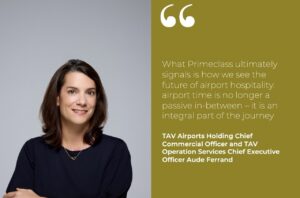
What Primeclass ultimately signals is how we see the future of airport hospitality: airport time is no longer a passive in-between – it is an integral part of the journey itself. One that increasingly shapes how people experience and remember travel itself. Travellers today are looking for more than efficiency. They expect environments that support their well-being, their productivity and their emotional balance while remaining flexible. The airport is evolving from a transit infrastructure into a lived environment.
Our vision for airport hospitality is to respond to this shift by moving beyond isolated lounges and towards hospitality ecosystems within the airport – spaces that adapt to different human needs, mindsets and rhythms over time. Primeclass is an expression of this vision. By combining spatial design, service culture, local identity and digital enablement, we create environments where travellers feel supported, recognised and at ease.
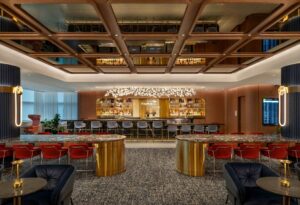
Ultimately, this signals a wider transformation: airport hospitality is becoming a central part of the travel experience itself, shaping environments where people don’t simply pass through but genuinely connect.
How does this new branding and lifestyle concept help TAV OS stand out in the increasingly competitive airport hospitality market?
As airport hospitality becomes more competitive, differentiation is no longer achieved by adding more amenities – it comes from how experiences are designed, connected and operated on a scale.
Primeclass represents a shift from lounges as physical facilities to lounges as lifestyle-led environments. We design around human behaviour, emotional states and travel rhythms, so that architecture, service tone, food, lighting and flow all work together to create environments that travellers remember, not just use. But the real distinction lies beyond brand expression – it sits in how TAV Operation Services operates as a global hospitality platform and a long-term partner.
We combine several structural strengths. As explained, we apply experience architecture with a strong sense of place, embedding local culture, materials and gastronomy while maintaining global consistency that remains locally meaningful.
We embed sustainability into how we design, source and grow, ensuring long-term value creation for airports and communities while also investing deeply in service culture and building diverse, locally rooted teams that reflect the global traveller. Hospitality remains human at its core.
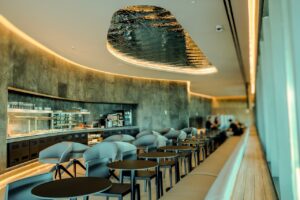
This operating model is reinforced by digital intelligence. To support our operations, we leverage CRM and dedicated data platforms to manage capacity, continuously improve quality, personalise touchpoints and support teams with real-time insights.
Importantly, TAV Operation Services is part of TAV Airports, itself a subsidiary of Groupe ADP. This gives us a unique, internal understanding of airport constraints, priorities and operational realities. As a result, co-building projects with airports comes naturally.
Another advantage is that we operate within a broader commercial ecosystem. This includes BTA in food and beverage, ATÜ through our duty-free joint venture with Heinemann, and the Extime ecosystem — including Extime F&B, Extime Duty Free and Extime Media — as well as TREVA as our digital platform. Together, these capabilities allow us to create connected experiences across the terminal, rather than isolated touchpoints.
This integrated model allows us to move beyond the traditional lounge operator role and act as a hospitality platform partner for airports – delivering experiences that are distinctive, operationally efficient, socially responsible and emotionally engaging.
Where will we see the new Primeclass branding take early shape, and how will it be executed?
The new Primeclass concept will be gradually implemented across our global lounge network by the end of 2027. But first, it will be open three key airport locations: Sofia, Ankara Esenboğa and Paris Orly, which are important reference points, as they represent different traveller profiles, operational contexts and cultural environments. This allows us to demonstrate how the Primeclass platform adapts across diverse environments while maintaining a consistent experience framework.

However, execution is not limited to a design refresh. It is a holistic transformation across several dimensions: integrating new sustainable materials, integrating digitalisation into the lounge and more. It is also a great opportunity to improve the service culture. This is the reason why we are launching a new collaboration with Atelier X by Forbes Travel Guide. Teams are trained to embody the Primeclass Promise, with emphasis on emotional awareness, attentiveness and personalisation.
Our objective is to deliver a model that is scalable yet locally expressive – ensuring consistency in quality and operational standards, while allowing each airport to offer a distinctive hospitality experience that complements its own positioning.
Beyond this, how are you aiming to adapt your suite of brands and experiences for each partner and market?
These brands reflect our broader ambition to support airports with differentiated hospitality concepts that enhance their commercial appeal.
Our main aim is to support airports in achieving their customer ambitions. Our approach is based on understanding the airport customer strategy to propose the most relevant concept. It means considering the number and typologies of lounges, their sizes and the existing offer within the terminal.
Success cannot come from replicating one fixed concept everywhere. Instead, we build scalable experience frameworks at a global level – covering design standards, service culture, digital infrastructure and operational processes – and then adapt these in close collaboration with each airport partner.
For airport partners, this approach offers more than a lounge solution. It allows hospitality to become a strategic tool that supports the airport’s identity, commercial positioning and guest engagement strategy.
By balancing structure with flexibility, we remain adaptable across markets while delivering a reliable, high-quality hospitality experience that travellers recognise – yet always experience as locally meaningful.
Building on the key strategic pillars, tell us more please about your ESG ambitions and how these translate into day-to-day activities at TAV OS?
At TAV Operation Services, we do not treat ESG as an add-on or a communication exercise. It is a core part of how we govern the company, make decisions and operate across 61 countries, covering more than 200 airports and nearly 400 service points.
This starts at the governance level. ESG is embedded in our Executive leadership structure and supported by dedicated internal committees that actively generate initiatives across environmental, social and governance priorities. By integrating ESG KPIs into corporate and functional performance targets, we ensure that sustainability is part of business accountability – not a parallel agenda.

We also align our approach with internationally recognised frameworks. Our B-Corp journey reflects a clear ambition: to embed responsible business practices across governance, people, environment and community engagement, while aligning with evolving global standards.
Most importantly, we focus on making ESG operational and tangible.
In day-to-day activities, this translates into concrete choices: sustainable materials in lounge design and uniforms to reduce single-use plastics; responsible procurement; and close collaboration with local producers, artists and communities. We pay particular attention to ‘micro-impacts’ – small operational decisions that, when replicated across our global network, create meaningful environmental and social outcomes.
Ultimately, our ambition is to make ESG practical, visible and human beings, something our people can act on daily, our guests can experience directly, and our airport partners can recognise as part of the long-term value we create together.
How do you maximise physical and digital touchpoints with the consumer in ways that best meet their needs? And how do you see the role of people in delivering the future guest experience within TAV OS?
We do not treat physical and digital touchpoints as separate channels. Our view is that they form a single, continuous guest journey that must feel intuitive and coherent from the first interaction to the last.
As travel becomes more complex, guests increasingly expect simplicity.
Our role is to orchestrate touchpoints – access, service, space and follow-up – so that the experience feels seamless rather than fragmented. Digital capability is critical in enabling this. It allows us to anticipate flows, understand preferences and reduce friction. But the purpose of technology is not visibility – it is invisibility. The best digital experience is the one that makes the journey feel effortless.
This is where our people make the difference. As digital tools remove complexity, our teams are empowered to focus on what only humans can deliver: emotional awareness, judgement and genuine connection. Digital systems and human services do not compete; they complement each other. Technology increases efficiency and consistency, while people bring empathy, intuition and personal connection.
Our long-term advantage lies in combining system intelligence with human capability. We are building an organisation where teams feel equipped, trusted and connected to a shared purpose, because empowered people are essential to delivering memorable guest experiences.
Ultimately, it is this balance – seamless systems and empowered teams – that allows us to turn multiple touchpoints into one meaningful experience. (Story continues after panel below)
Elevating airport hospitality through ExtimeTAV Operation Services has a key part to play in the management and roll-out of the Groupe ADP hospitality concept Extime Lounges, which began life in Paris. Elaborating on what Extime should represent, Aude Ferrand says the experience should be one where every visit it memorable, “away from the crowd and the usual path. And it makes moments that were once indifferent delightful through expanded services and a wider range of amenities, together with inspired, experiential touches.”
Reinforcing the view that hospitality today goes beyond operating lounges, Ferrand adds: “We work to bring depth and consistency to the guest journey through a dedicated service culture, supported by Extime Campus, created by Groupe ADP, and specific experiential attentions and unique operational excellence for each traveller to experience a moment of quality, but always a unique and personalised one.” While there are consistencies in the approach, each Extime Lounge around the world should also be slightly different, adapted to each location to give it its own ambience and sense of place. “From a growth perspective, Extime Lounge demonstrates how strong brand platforms can travel beyond their original network. Projects such as the Zurich pipeline and the recent opening of the Extime lounges in Almaty illustrate how the concept can scale internationally while adapting to local traveller profiles and airport strategies,” says Ferrand. |

How do you see the future of partnerships across the travel ecosystem developing? How can the various partners be brought together to act in concert more effectively to benefit the end consumer?
The future of travel will be shaped less by individual players and more by how effectively ecosystems function together. From the guest’s perspective, the journey is not a sequence of separate services, it is one continuous experience. For that reason, partnerships must evolve beyond transactional arrangements and into platforms for shared value creation.
At TAV Operation Services, we are looking for partnerships where the outcome is clearly greater than the sum of the parts. This requires alignment that goes well beyond commercial terms. True value is created when partners share a common framework for data, service standards, operational integration, and, increasingly, sustainability.
When objectives and principles are aligned, collaboration becomes faster, innovation becomes scalable, and results are structurally stronger than what any one organisation could achieve alone.
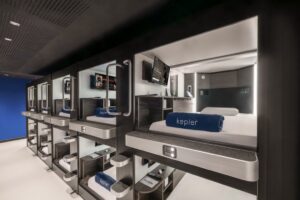
We see this ecosystem logic developing both horizontally and vertically. Horizontally, collaboration across airports, hospitality operators, technology providers and brands allows us to create more connected and intuitive guest journeys. Our collaboration with Kepler Club, a pioneer in airport-based short-stay accommodations, is a good example of how complementary capabilities can unlock new forms of experience and efficiency.
Vertically, we value partnerships that deepen expertise and raise standards in critical domains. For example, our collaboration with Forbes Travel Guide supports elevating service culture and training standards across our network. Digital infrastructure is another key enabler. When data flows responsibly and systems are interoperable, services become more coordinated and the traveller experiences the journey as seamless and intuitive.
The strongest travel ecosystems will deliver not only operational efficiency but a more coherent, human and memorable travel experience.
If you look five years ahead, what does the world of travel hospitality look like to you, and how can TAV OS play its full part in delivering on evolving traveller demand?
Five years from now, travel hospitality will be defined by one word: connectivity. Not connectivity in a technical sense, but in how seamlessly experiences link airports, lounges, mobility, retail, food & beverage or digital services as separate layers – they will experience them as one continuous flow.
In this context, value will lie in connectivity: connecting locations, connecting brands, connecting local ecosystems, and ultimately connecting people to experiences that feel coherent, personalised and meaningful. Each airport, each city will retain its own identity and sense of place – but will also form part of a broader experience layer that travels with the guests. (Story continues after panel below)
Putting vision into practiceWe summarise three initiatives that are emblematic of the updated approach to hospitality at TAV Operation Services (TAV OS). In November 2025 the company unveiled its reimagined lifestyle-led Primeclass concept. This is guided by a new ‘The Place To Be You’ mantra and philosophy, through which the TAV Airports-owned company said it aims to “transform airport lounges into vibrant lifestyle destinations – blending design, culinary excellence and authentic human connection”. Full story here. In January, TAV OS advanced its global learning and development strategy through a strategic collaboration with Atelier CX, the consulting division of Forbes Travel Guide. The new partnership aims to reinforce its focus on service excellence across its operations worldwide.
In February, TAV OS announced a strategic collaboration with technology-led rest solutions provider Kepler Club. Through this, the pair will explore opportunities to develop new airport hospitality concepts aimed at enhancing passenger comfort, flexibility and wellbeing. |
This is where TAV Operation Services plays a defining role. Our ambition is to act as a connector. With our deep operational expertise, global footprint and strong partnerships across the airport hospitality ecosystem, we act as a connector – bringing together diverse players to design experiences that flow across borders while remaining locally grounded.
A key part of this evolution will be the development of digital solutions that create stronger links between physical environments and service ecosystems. At TAV Airports, by building TREVA that connects partners, data and guest journeys, we aim to enable more coordinated services, smoother interactions and more personalised experiences across the travel journey.
Looking ahead, the leaders in travel hospitality will be those who design for flow rather than fragmentation, and for collaboration rather than isolation. Our role is to help the industry move in that direction – building the frameworks, digital capabilities and partnerships that allow airport hospitality to evolve into a truly connected, human-centred experience. ✈
 The Moodie Davitt Report is delighted to announce Airport Hospitality World, the latest edition to its wide-ranging, market-leading travel retail and airport non-aeronautical revenues publishing and event portfolio. Airport Hospitality World covers all forms of airport lounges across international and domestic terminals, including various definitions as follows:
Plus other hospitality-related platforms:
Excitingly, the long-established Airport Food & Beverage (FAB) + Hospitality Conference & Awards will embrace Airport Hospitality World from the 2026 edition – the event’s 15th anniversary. The event will take on an extended form, featuring an exhibition and the ultimate one-stop airport hospitality and food & beverage conference and awards platform. |