


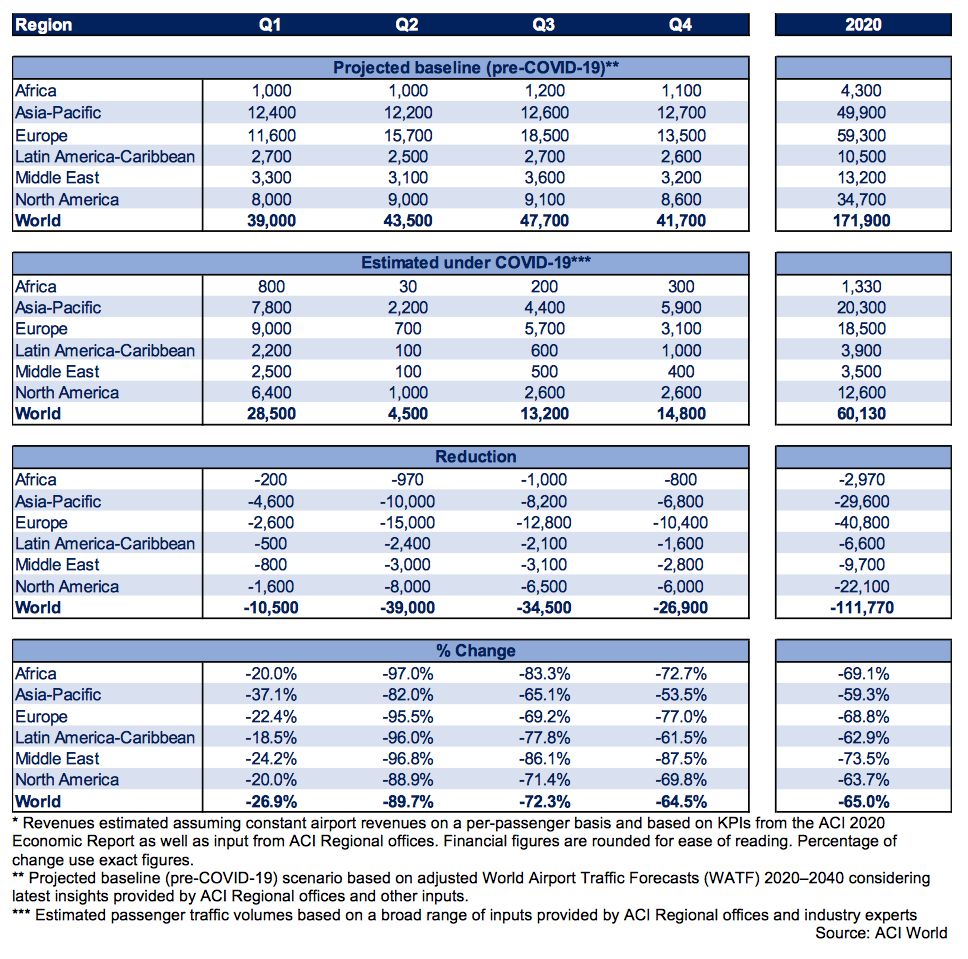
INTERNATIONAL. Airports Council International (ACI) World predicts that the airport industry will end this year with overall revenues down -65% on pre-COVID-19 forecasts to about US$60.2 billion. The trade body repeated its call for government assistance and policy support now to lay a solid foundation for recovery.
The figures were announced as ACI World published its fifth COVID-19 economic impact analysis, which also reveals wide-ranging data on air traffic and airport revenue recovery.
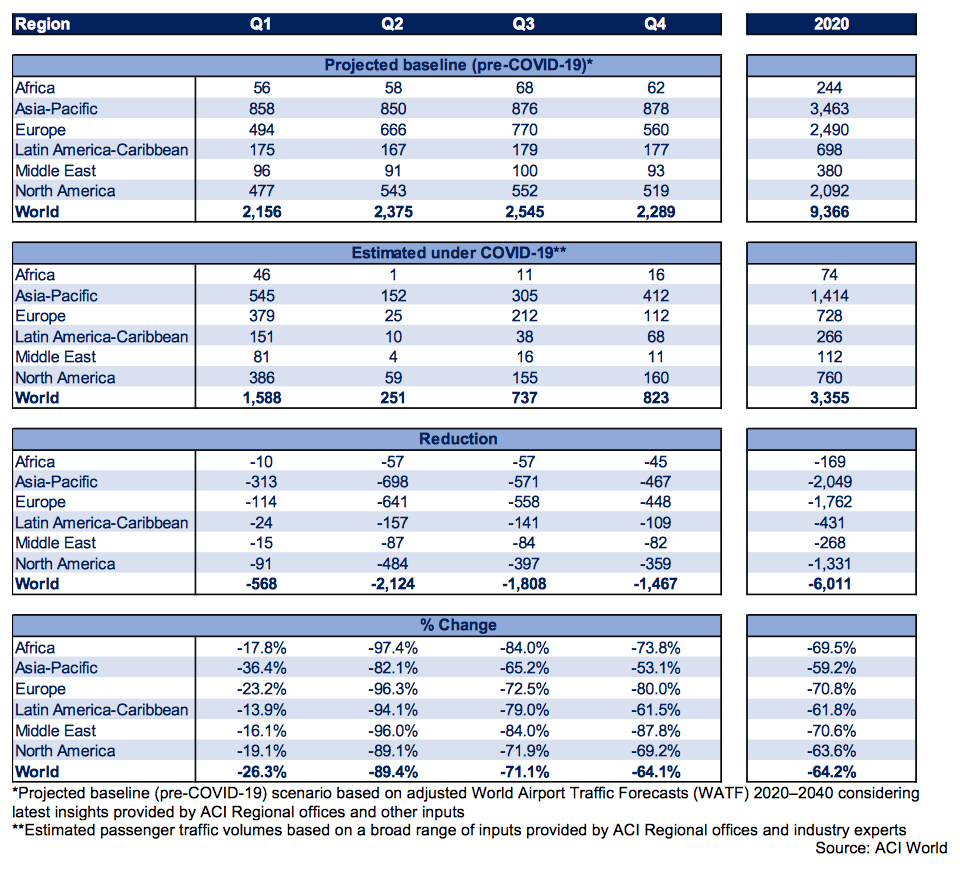
The Advisory Bulletin, The impact of COVID-19 on the airport business, reveals that the global airport sector will register a reduction of over 6 billion passengers by the end of 2020 compared to the pre-COVID-19 forecast, a -64.2% slump.
Europe and the Middle East are predicted to be the hardest-hit regions, with projected declines above -70% compared to the projected baseline. Asia Pacific, meanwhile, is forecasted to close this year with a decline of -59.2%, reflecting its earlier and faster recovery in comparison to other regions. ACI World noted that this was driven by large domestic markets such as China.
The airport industry was expected to generate about US$172 billion this year according to ACI World’s previous forecast, but the COVID-19 crisis impact on airport revenues will result in a huge reduction of a predicted US$111.8 billion (-65% compared to the pre-pandemic forecast).

Europe is the most-affected region in absolute terms with an estimated revenue shortfall of US$40.8 billion income for 2020. In relative terms, the sharpest fall was recorded by the Middle East with a predicted collapse of -73.5% of revenues for 2020 compared to the projected baseline.
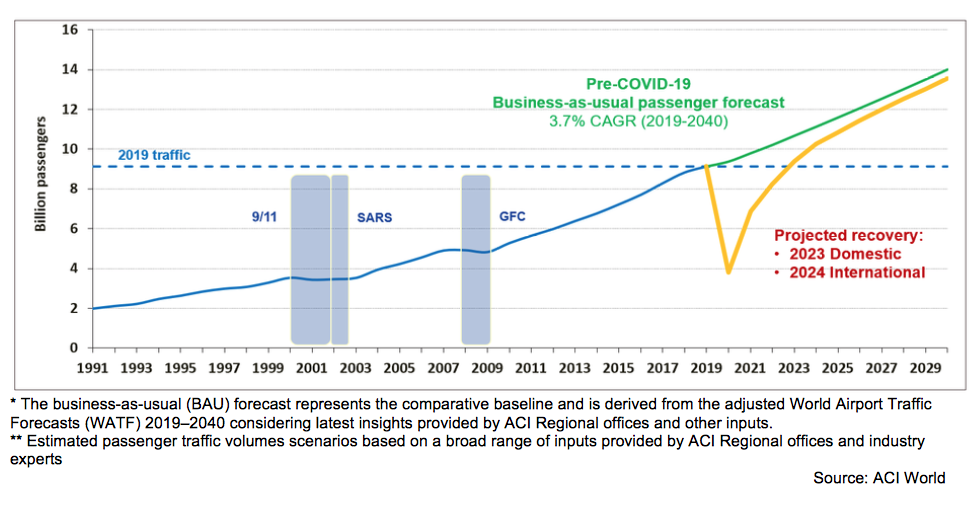
ACI World has developed scenarios exploring the potential recovery trajectory of air passenger taffic. Under its baseline scenario, domestic passenger traffic is expected to recover to 2019 levels by 2023 with the recovery of international passenger traffic following in 2024.

Global passenger traffic volume for the first half of 2021 is forecasted to reach 2.2 billion according to ACI World, a +20% increase compared to the corresponding period in 2020. The second half of 2021 will see a much stronger uptick, the trade body said, reaching more than 3.5 billion passengers. This figure is more than double the passenger volume for the same period in 2020.
ACI World asserts that international passenger volume will remain weak in the first half of 2021 but will pick up in the second half of the year as an increasing number of people get vaccinated, and travel restriction are gradually lifted.
Domestic traffic, meanwhile, is predicted to increase in 2021 to reach 2.35 billion passengers in the second half of the year, corresponding to 86.5% of the 2019 level for the same period.
Taking a longer-term view, ACI World predicts that the global traffic may take up to two decades to return to previously projected levels (pre-COVID-19 forecast).

More than 65 experts in the aviation industry were polled regarding their thoughts on the upcoming air transport recovery and their answers were used for the construction of a Delphi-method forecast, which aligns with these results.
ACI World Director General Luis Felipe de Oliveira said: “The pandemic has resulted in a full-scale transportation crisis with the aviation industry brought to a virtual halt in April following lockdowns imposed in many countries in the second half of March.
“We are now seeing some positive signs and prospects are slightly better for recovery but there is still a long way to go. One thing is certain, the world will be different after this pandemic. Recent announcements of successful vaccine trials are offering hope for a sustained recovery, but vaccination campaigns will take time and the industry needs government assistance and policy support now to lay a solid foundation for recovery.
“A consistent approach to testing should be implemented now to promote travel and do away with restrictive quarantine measures with a coordinated and risk-based approach to combining testing and vaccination introduced going forward. Tests and vaccines together will play a key role on the industry recovery, providing passengers with a safe travel environment and foster confidence in air travel.”