
 |
Angela Gittens: The world’s airports handled over 5 billion passengers for the first time ever |
INTERNATIONAL. Asia Pacific and the Middle East outperformed other world regions for international passenger traffic growth in 2010, according to preliminary full-year results just released by Airports Council International (ACI).
The results, based on reports from over 900 airports worldwide, indicate that global passenger traffic grew at a better than expected rate of +6.3%, while aircraft movements grew by just under +1%.
 |
International passenger volumes climbed by +7.5% year-on-year, a figure that was outstripped by strong performances in the key Asia Pacific (+14.2%) and Middle East (+12.1%) regions. Europe, the largest market for international travel, posted +4.5% growth while in North America the figure was +5.7%.
ACI World Director General Angela Gittens said: “2010 underscored the resilience of the air transport business and resulted in over 5 billion annual passengers for the first time ever. 2010 also pronounced the shift and divergence in growth across the regions. While North America and Europe have struggled to reach pre-crisis passenger volumes, Asia Pacific, Latin America-Caribbean and Middle East sustained a strong momentum and gained market share through double-digit growth.”
Monthly passenger growth worldwide in 2010 was consistently high at between +5% and +10% with the exception of a significant setback in April due to the volcanic ash cloud that hit Europe particularly hard. Another anomaly impacting traffic mainly in Europe was the unusually harsh winter weather in December.
A slow economic recovery and restraint among air carriers in adding domestic capacity led to modest growth in North America of +2.4% (in total volumes) keeping passenger numbers below pre-crisis levels in that region.
Latin America-Caribbean enjoyed strong domestic traffic growth, particularly in Brazil and other Latin American countries as national economies and low cost carriers expanded quickly.
International traffic was also important in Africa which registered +8.8% more passengers in total and +10.4% in international terms.
 |
Aircraft movements increased the most in Latin America-Caribbean (+6.2%), Middle East (+6.1%) and Asia Pacific (+5%) while movements continued to decline in Europe (-0.4%) and North America (-1.2%).
Gittens added: “Passenger and freight growth clearly surpassed global GDP growth in 2010. GDP growth projections for this and the coming years are high, creating a positive outlook for demand for air transport. This underpins the need to continue to expand and modernise airport infrastructure to maintain high standards of efficiency and customer service. More than ever, airports will be asked to finance these projects autonomously without public funds requiring private and public airports to be empowered to generate necessary returns on their investment.”
Airport rankings
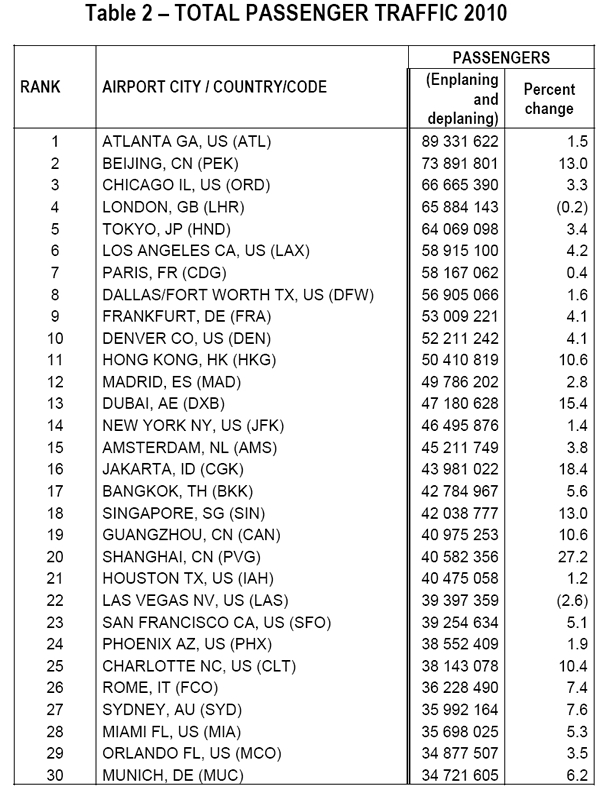
Among the largest airports in the world Beijing (with +13% growth in total passenger numbers) leaped into second place after Atlanta (+1.5%) which continues to be the world’s largest airport. London Heathrow dropped to the fourth rank, and was overtaken by Beijing and Chicago O’Hare (+3.3%).
Only two airports in the top 30 did not grow in 2010, Las Vegas (-2.6%) and London Heathrow (-0.2%). Charlotte (+10.4%) was the only large airport outside Asia Pacific and Middle East growing by more than +10%.
 |