
ASIA PACIFIC. Asia Pacific locations are playing a crucial role in the movement of the world’s tourism economy, according to the MasterCard Index of Global Destination Cities released this week [Read on for the Asia Pacific results; we’ll follow up with the full international results soon.]
The latest Index is a new approach to understanding the global economy and the dynamic flow of commerce across the world. It ranks cities by their total international visitor arrivals and the cross-border spending by these same visitors in the destination cities, and gives visitor and passenger growth forecasts for 2011.
The Index results show that many emerging market cities are showing robust growth with increases in both visitor arrivals and cross-border expenditures, with many showing growth rates exceeding +20%.
Cities in Asia Pacific led the charge globally, having eight of the top cities by international arrivals. Bangkok is ranked third, projected to have 11.5 million visitors this year, followed by Singapore in fourth place with 11.4 million visitors and Hong Kong fifth with 10.9 million.
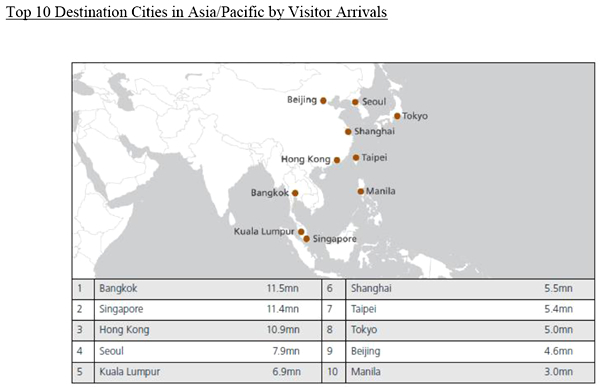 |
Asia also displayed strong visitor growth for 2011 with Kuala Lumpur ranked second in the world with a +21.8% growth forecast, only behind Barcelona which led with an impressive +24.3%. Istanbul ranked third with +20.4%, followed by Shanghai (+18.6%) and Hong Kong (+17.4%). Note that all figures for Tokyo estimated in this Index will be subject to change as the impacts of the recent earthquake and tsunami evolve.
The region also ranked highly on visitor spending with Bangkok ranked fourth globally with US$14.4 billion expected to be spent by inbound passengers in 2011; Sydney ranked sixth with US$13.8 billion, Singapore ranked ninth (US$10.8 billion) and Hong Kong tenth (US$10.4 billion).
Asian cities dominate in terms of expenditure growth rates too, with seven of the top 27 high-growth cities in the world heralding from the region, including Singapore (+23.9%), Hong Kong (+23.6%), Tokyo (+20.8%) and Taipei (+20.3%).
“This kind of growth pattern strongly suggests that destination cities in emerging markets in Asia will continue to grow in importance,” observed Dr Yuwa Hedrick-Wong, Global Economic Advisor, MasterCard Worldwide.
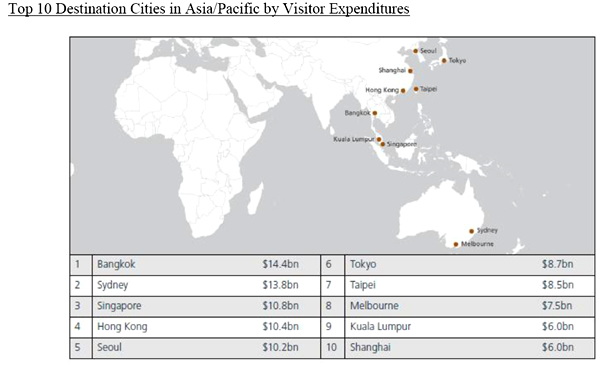 |
Overall London topped the world’s cities by visitor numbers with 20.1 million inbound passengers expected in 2011, ahead of Paris in second with 18.1 million. Only one city in North America is in the top 20, New York, which is ranked twelfth with 7.6 million inbound passengers expected.
METHODOLOGY
The MasterCard Worldwide Index of Global Destination Cities is compiled using international flight and flight capacity information purchased from OAG Global, a provider of international aviation data.
 |
“This kind of growth pattern strongly suggests that destination cities in emerging markets in Asia will continue to grow in importance“ |
Dr Yuwa Hedrick-Wong Global Economic Advisor MasterCard Worldwide [Picture: TFWA] |
Flight schedules are also used for calculating flight frequency between pairs of cities. Airlines also publish on a regular basis their historical load factor, and advance flight schedules, which are then used to estimate the actual outbound passenger departures, and for forecasting outbound passenger departures in the coming year.
On any given flight there are visitors from the departure country, returning residents of the destination city after visiting the departure country, and a third group: non-residents connecting through the departure country to the destination city on their way to a second destination city. This group can be a low proportion of the passengers for typically non-hub cities, but very high for destination cities that are hubs such as Singapore, Amsterdam, and Frankfurt.
On a country level, the UN Database of “˜Trade in Service’ in the “˜Travel Component’ provides estimates of how much each year residents spend abroad (air fare paid in home country not included). An algorithm is applied to this total outbound expenditure and estimated total number of outbound passengers to derive an estimate of average per outbound passenger’s expenditure overseas.
A margin of error is also unavoidable in such estimates, as not all outbound trips are of equal length, and the cost of living varies a great between arrival cities such that even if each trip was of equal length, expenditure per passenger between different arrival cities would still be very different.
This margin of error is reduced significantly by imposing a minimum of expenditures in the algorithm, after a number of iterative testing (US$500 per trip for bordering arrival country and US$700 per trip for non-bordering arrival country).
ABOUT MASTERCARD WORLDWIDE
MasterCard serves as a franchisor, processor and advisor to the payments industry, and assists commerce by providing a powerful economic link among financial institutions, governments, businesses, merchants, and cardholders worldwide.
In 2010, US$2.7 trillion in gross dollar volume was generated on its products by consumers around the world. MasterCard processes over 23 billion transactions each year and has the capacity to handle 160 million transactions per hour.
Download free from the iTunes App Store | |