


INTERNATIONAL. Asian stock markets led by China pared back heavy losses suffered on Monday in today’s trading session, and global stock markets are now expected to follow. Contracts on the S&P 500 advanced 3.5% as of 12 p.m. in London.
The US stock market suffered the worst one-day fall since December 2008 yesterday (9 March) and global markets reeled at the risk of a full-blown crude price war between the world’s largest oil producers.
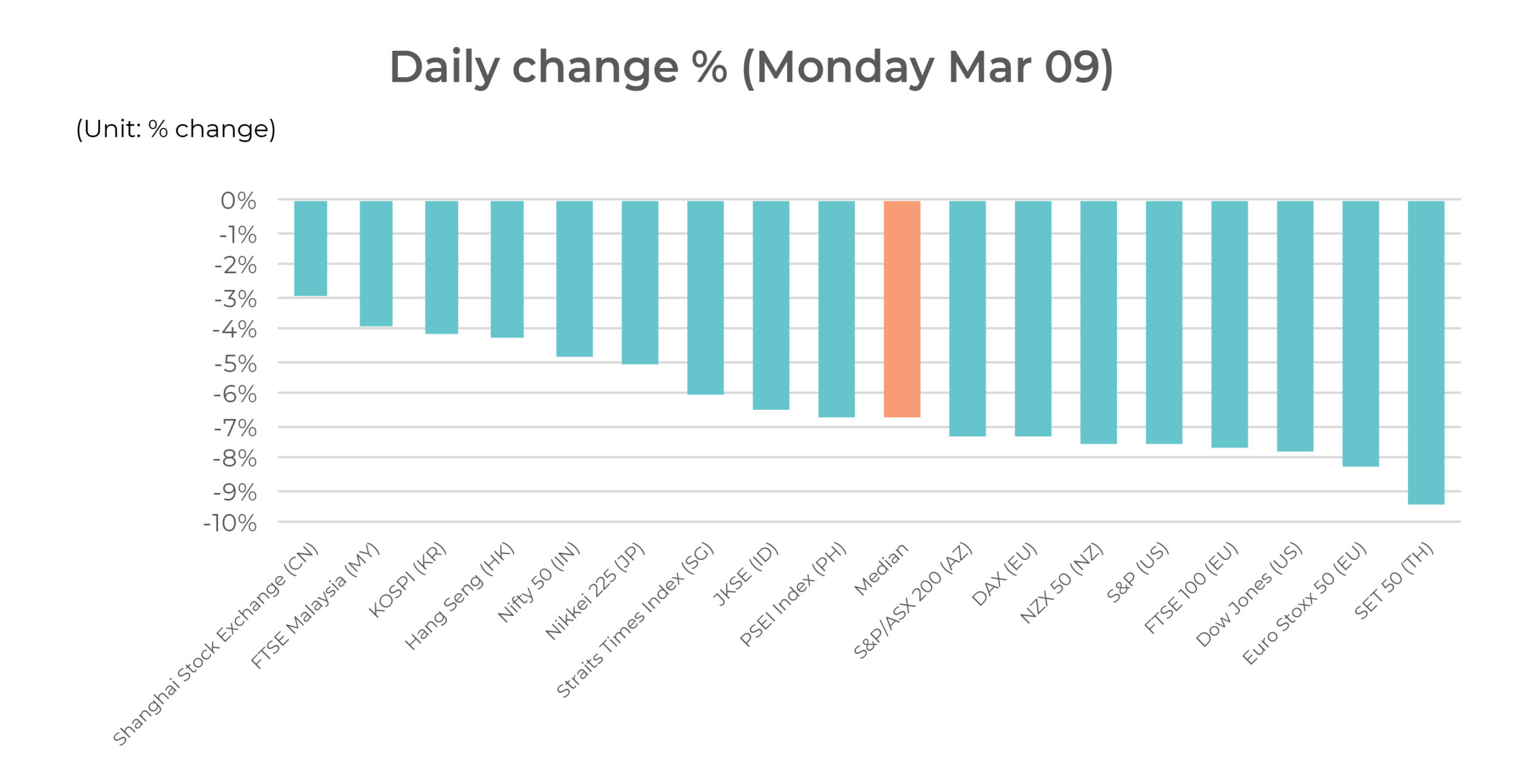
The S&P fell by -7.6% and is now -17.5% lower than 20 January when COVID-19 began to take a toll on the stock market. The Thai benchmark index SET 50 closed to its lowest level since January 2016 and was the worst performer among benchmark indexes tracked by The Moodie Davitt Report.
The median of global benchmark indexes show that stocks are -16.1% lower than on 20 January as COVID-19 spreads into new countries – nearly reaching pandemic proportions, according to officials from the World Health Organization (WHO). “Now that the coronavirus has a foothold in so many countries, the threat of a pandemic has become very real,” said WHO Director-General Tedros Adhanom Ghebreyesus in a press briefing yesterday.
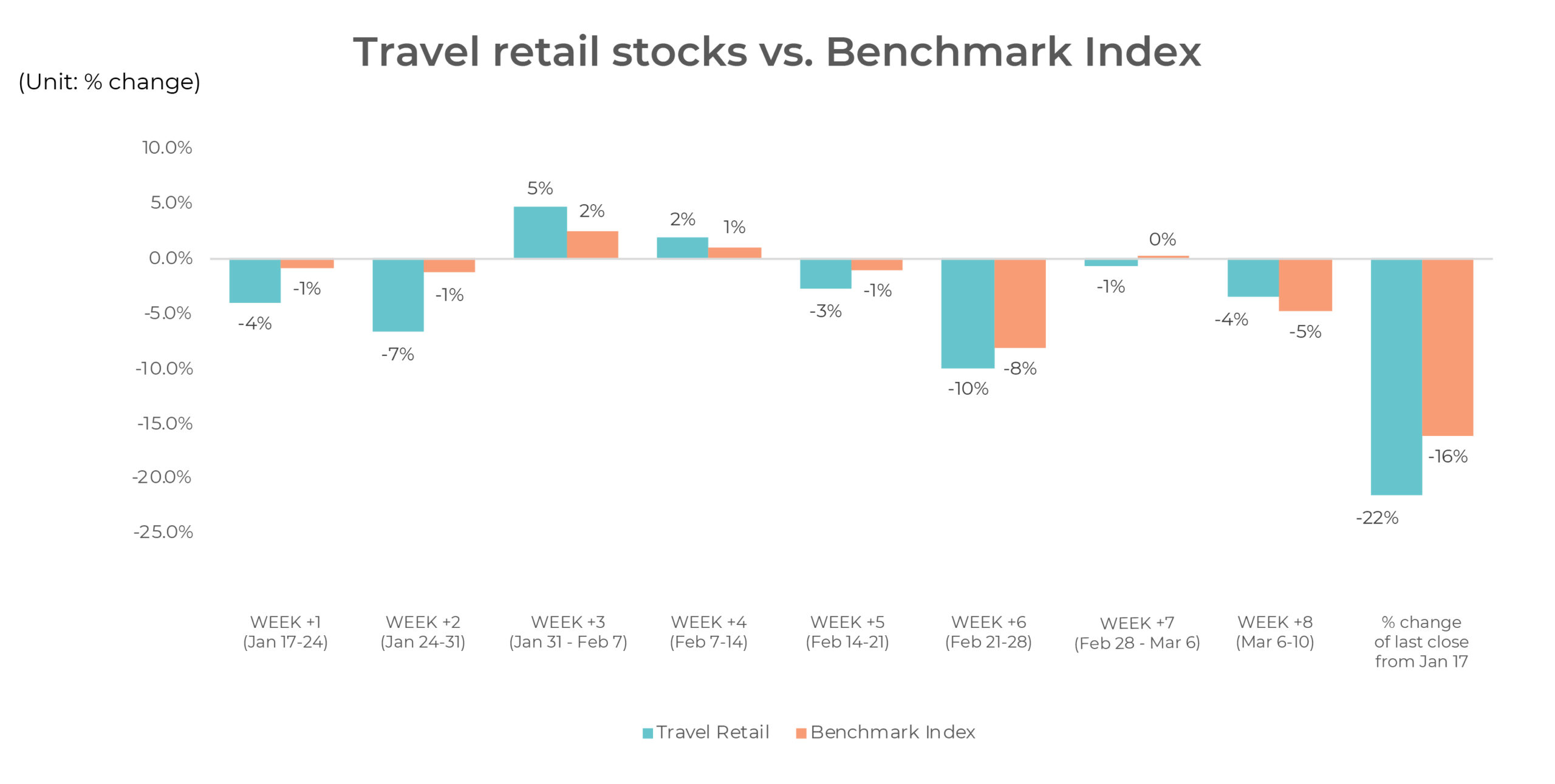
Travel retail stocks monitored by The Moodie Davitt Report show share prices in the sector outperformed the median of benchmark indexes for the first time since the outbreak this week.
However, that does not necessarily equate to good news. The sector’s largest player by sales, Dufry, closed at CHF49.80 on 9 March, setting a 52-week low of CHF48.51 during the trading session. Concerns on the economic impact of COVID-19 outside China has risen sharply since the beginning of March.
Gary Kelly, Chief Executive of Southwest Airlines, the largest US domestic carrier, warned on 5 March that the US airline was noticing a sharp decline in air traffic similar to 9/11. “9/11 wasn’t an economically driven issue for travel – it was more fear, quite frankly. And I think that’s really what’s manifested this time… it has a 9/11-like feel. Hopefully we’ll get this behind us very quickly.’’
The Swiss benchmark index SMI declined by -5.55% in Monday’s session. The government reported the unemployment numbers decreased by 3,196 in February but the sentiment driver is COVID-19. Some 21 of 26 of Switzerland’s cantons [administrative divisions] have reported confirmed cases, with the latest nationwide tally standing at 374.
Dufry, seen as vulnerable due to its extensive retail footprint across the world (including in hard-hit Italy and Spain), is one Swiss stock being adversely affected by COVID-19. Dufry stock now stands -45% below its pre-crisis level.
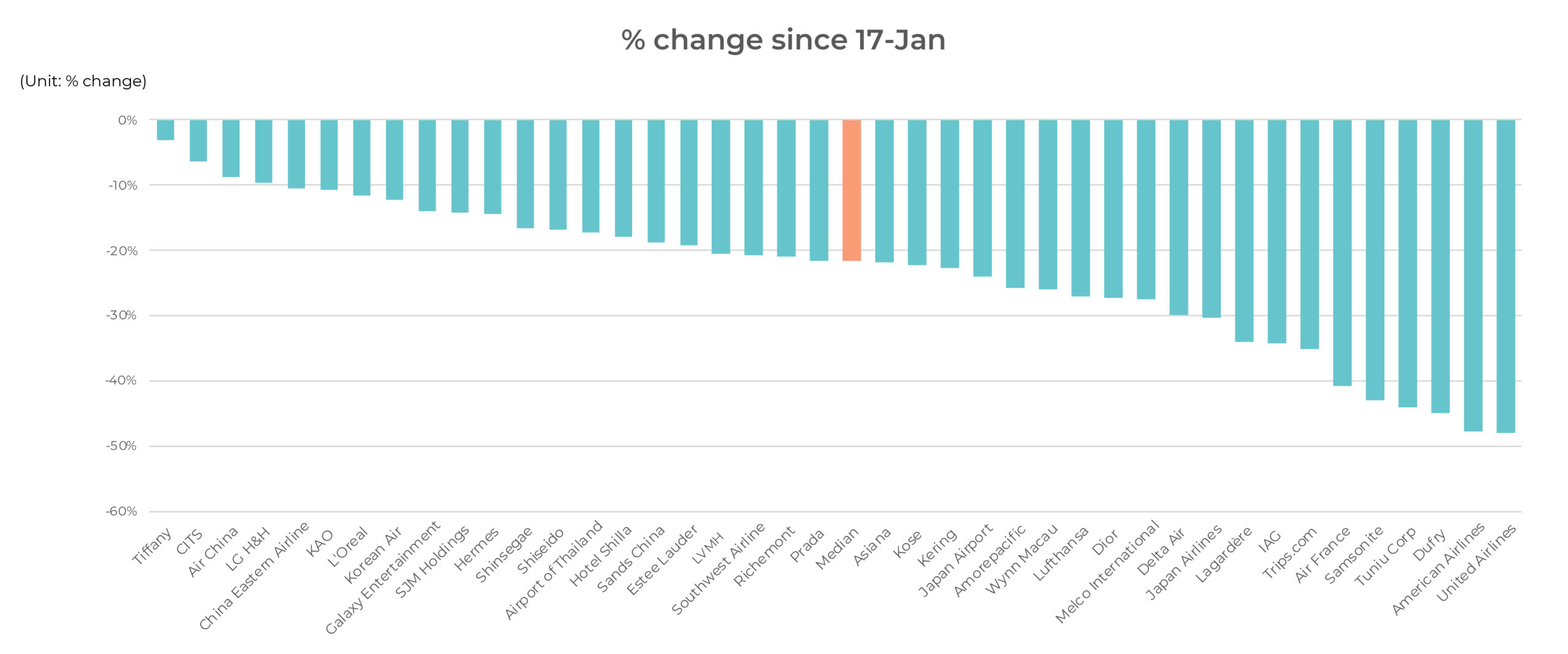
Shares in Lagardère Travel Retail, which similarly operates globally and also has a substantial food & beverage business, closed at €12.58 on 9 March, having also dropped to a 52-week low (€12.57). A closing price of €19.52 was recorded on 17 January, representing a drop of -35.6%.
Shares in The Shilla Duty Free parent Hotel Shilla have fallen from KW108,500 on 17 January to KW81,000 on 9 March, or -25.3%, but that is still above the 52-week low of KW73,300 recorded in August 2019.
It is a similar story at LVMH Moët Hennessy Louis Vuitton, the world’s leading luxury products group. Shares have dropped from €439.05 on 17 January to €338 on 9 March, or -23%. Shares in the company had been rising on a relatively consistent basis since January 2019 – the company opened that month with a share price of €258.30.
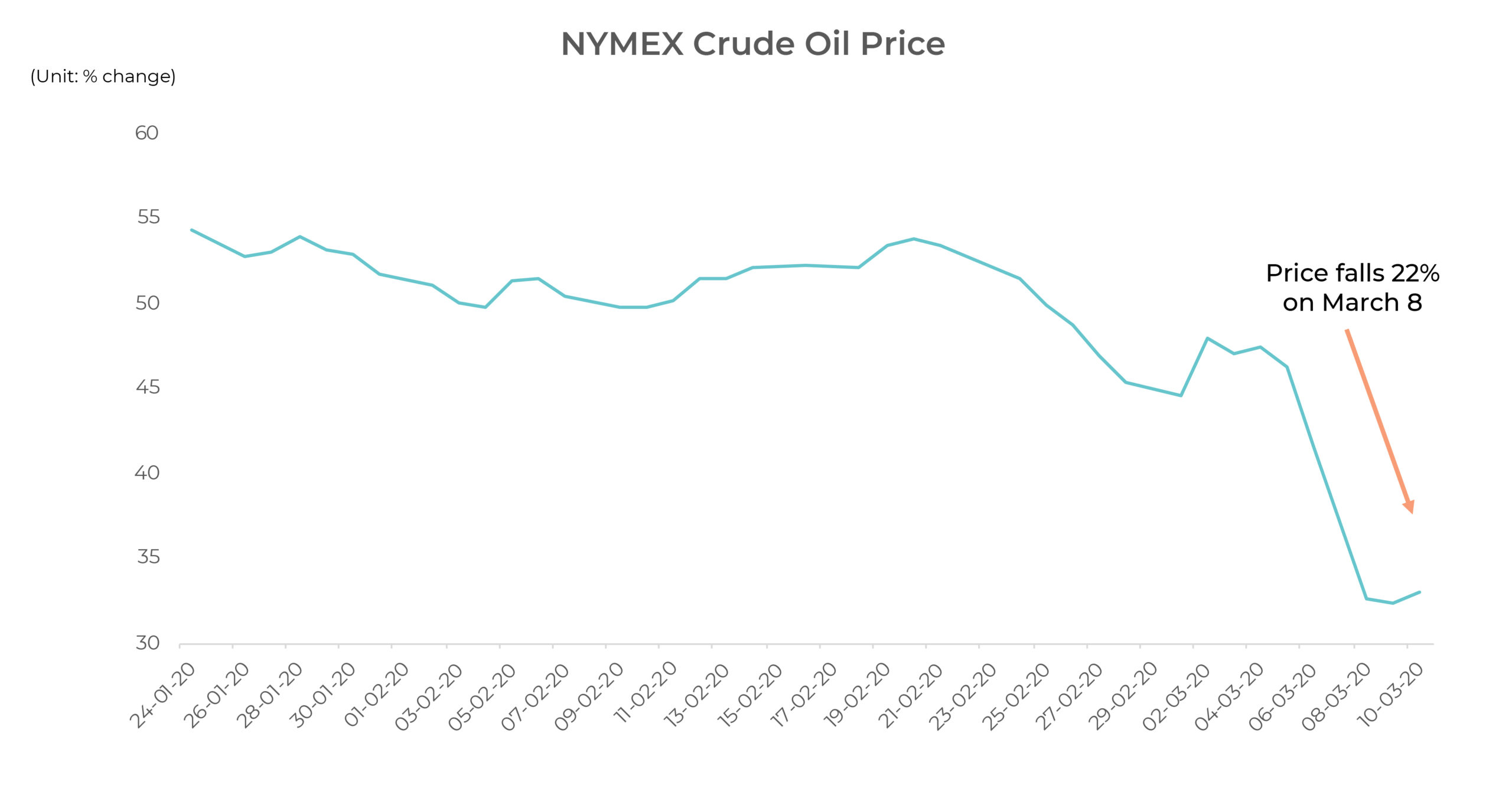
Oil prices crashed by as much as -30% on 9 March – the biggest one-day drop since the Gulf War in 1991 – before pulling back to a -22% decline. The sudden slump in prices has added to the woes in a stock market already weighed down by COVID-19. Oil prices plunged with Russia refusing Saudi Arabia’s request to reduce production in the face of the outbreak which has disrupted global economic activity.
China announced on 7 March that export growth declined by -17.2% year-on-year in January and February combined. This is a big turnaround from the +7.9% growth seen in December 2019. Future data points will continue to deteriorate as the coronavirus’s impact only really kicked in from February. Saudi Arabia responded by discounting its export prices and has threatened to increase production further, resulting in the plunge in the oil prices.
As noted, Asian stock markets pared back some losses in Tuesday’s trading session. They were buoyed by US President Donald Trump’s announcement that he would ask Congress for “very substantial” payroll tax cuts for hourly wage earners impacted by COVID-19. Another filip came with the New York Federal Reserve’s announcement that it will increase the amount of money offered to banks for short-term funding.
Encouraging signs to suggest containment measures were working in China and South Korea also worked in favour of the bulls in Tuesday’s trading sessions. In a national morale booster, Chinese leader Xi Jinping visited Wuhan today to inspect facillities, underining China’s growing confidence that containment measures have been successful.

Gains in Asian stock markets on Monday see Shanghai Stock Exchange as the best performer so far this week, with the Hang Seng just behind. The global stock market is expected to follow with European markets trading in the green and the US futures showing gains ahead of Tuesday’s trading session.