

INTERNATIONAL. Airport Dimensions has shared further compelling insights from its recently launched Airport Experience (AX26) study. The travel experience company has highlighted a growing generational divide in airport engagement, with baby boomers (aged between 62 and 80) significantly less likely than younger travellers to spend time – and money – across the airport ecosystem.
The study, based on insights from more than 11,000 regular travellers globally, found that 26% of boomers prefer to head straight to the gate rather than visit shops, restaurants or bars.
The findings raise fresh questions for airports and travel retailers about how effectively older travellers are being engaged, particularly as younger generations increasingly drive commercial revenues, Airport Dimensions observed.
According to its research, only 36% of boomers believe airports offer value for money, compared with 64% of Gen Y and Gen Z travellers.
Airport Dimensions said this perception gap is contributing to weaker engagement and lower satisfaction levels among older passengers.
While satisfaction among younger travellers has risen to 84%, boomer satisfaction has remained static at 72% over the past three years according to the research data.
The study linked this to ‘gate hugging’ behaviour, with many older travellers opting to wait at the gate or remain in public seating areas rather than participate in the wider airport experience.
Digital engagement also remains a significant challenge. Only 40% of boomers are likely to use online airport services compared with 62% of younger travellers, while 25% avoid digital purchasing channels entirely.
Just 22% access airport services before arriving at the airport, versus 34% of younger passengers.
However, the research suggests airports still have opportunities to better connect with older travellers by focusing on functionality and simplicity rather than experiential or heavily digitised propositions.
Boomers recorded strong satisfaction scores for core operational elements, including ease of navigation (84%), cleanliness (88%) and wifi provision (71%).
Notably, 62% said better access to flight and gate information would improve their journey, ahead of younger travellers at 53%.
Airport Dimensions also found boomers to be equally receptive as younger generations to the idea of a single airport app providing access to all services, suggesting demand for streamlined and intuitive digital solutions rather than multiple fragmented platforms.
The company said integrated digital tools could help airports improve perceptions of value while encouraging greater engagement and spend through tailored promotions, navigation support and bundled offers.
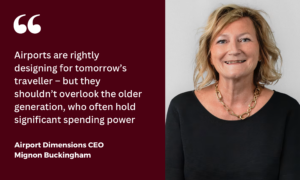
Airport Dimensions CEO Mignon Buckingham said: “Airports are rightly designing for tomorrow’s traveller – but they shouldn’t overlook the older generation, who often hold significant spending power. Their expectations are simple: a smooth, uninterrupted journey to the gate.
“That clarity represents a major, untapped revenue opportunity. The key is designing for different demographics in distinct ways, while keeping every touchpoint part of one seamless, unified travel experience.
“Engage them on their terms, and airports can boost both satisfaction and spend – it just may look different from what younger travellers want.”
Read our recent interview with Mignon Buckingham, as she reflects on the key findings of AX26, here. Download the full AX26 research here. ✈
 The Moodie Davitt Report also publishes Airport Hospitality World, the latest edition to our wide-ranging, market-leading travel retail and airport non-aeronautical revenues publishing and event portfolio. Airport Hospitality World covers all forms of airport lounges across international and domestic terminals, including various definitions as follows:
Plus other hospitality-related platforms:
Excitingly, the long-established Airport Food & Beverage (FAB) + Hospitality Conference & Awards will embrace Airport Hospitality World from the 2026 edition – the event’s 15th anniversary. |