SOUTH KOREA. Chinese visitor arrivals soared by +53.4% in the first 11 months of 2013 to 4,050,635, according to Korea Tourism Organization (KTO).
In contrast, the country’s other great inbound tourism nationality, the Japanese, plummeted by -23.1% to 2,532,700 in the period.
In November, Chinese arrivals rose by +35.2% to 276,428, a strong bounce-back from the more modest (yet still strong) +22.8% in October that was widely attributed to the new Chinese group travel regulations introduced on 1 October. These prohibit outbound group tour packages to any country at what the government considers unreasonably low prices.
The latest numbers confirm a dramatic transformation of Korea’s inbound tourism market over recent years, one that has seen the Chinese surge in importance at the expense of the Japanese. Both groups, along with Korean nationals, form the core traveller base that makes South Korea’s travel retail market so valuable (Americans with 6% and not a force in travel retail terms and Taiwanese with 4.5% come next).
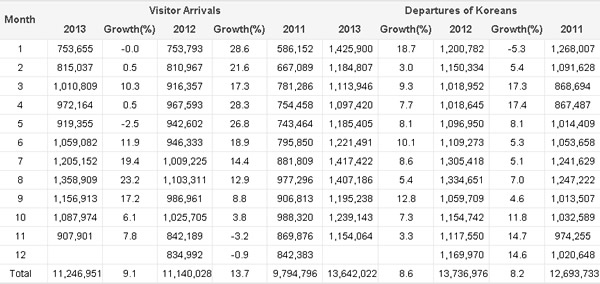 |
This Korea Tourism Organization snapshot of visitor arrivals and Korean national departures shows healthy growth through 2013 but the real story lies with the boom in Chinese tourism |
The Chinese share of the inbound market in the first 11 months of 2013 surged to 36% compared with 22.5% for the once dominant Japanese. In contrast, the 2012 year-end figures had the Japanese as the leading force with 31.9% and the Chinese 25.6%.
Go back to 2008 and the extent of the change is even more apparent. Then, the Japanese enjoyed a 34.5% share and the Chinese just 16.9%. That represents a near 20 percentage point market share gain in five years for the Chinese and a +247% increase in absolute numbers (and that’s comparing 11 months of 2013 with a full year for 2008).
Japanese arrivals for the same period rose just +6.5%.
Departures of Koreans rose +8.6% in the first 11 months of 2013 to 1,154,064, including a +3.3% increase in November.