
SOUTH KOREA. Jeju Tourism Organization (JTO), the powerful Jeju Island tourism-to-retail body, and international travel retailer DFS Group today unveiled a key strategic partnership. The agreement is designed to raise awareness and attract international tourism to Jeju Island, as well as providing an elevated retail experience for international tourists.
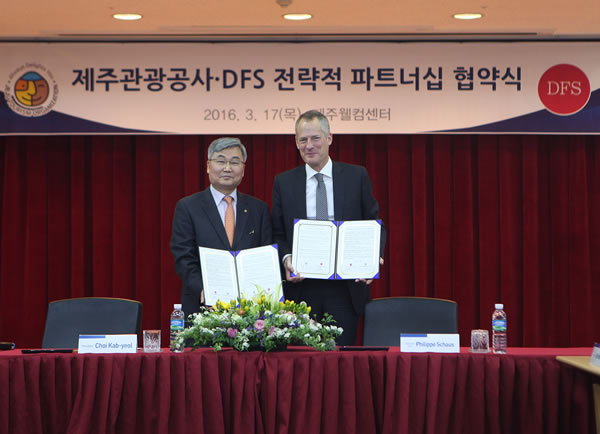
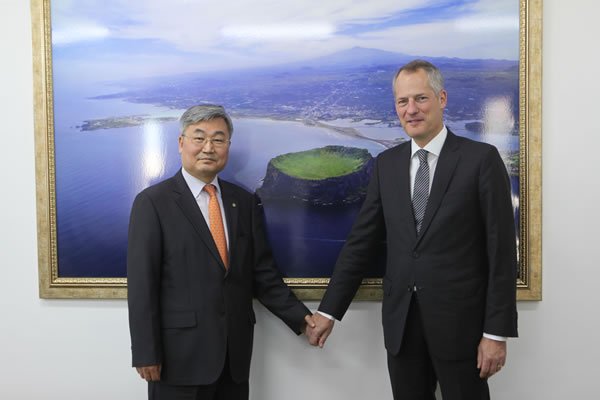
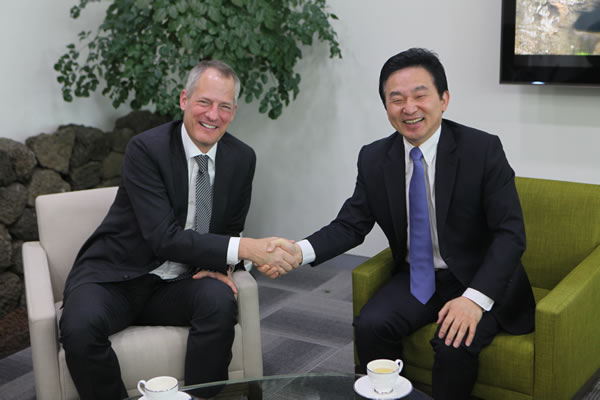
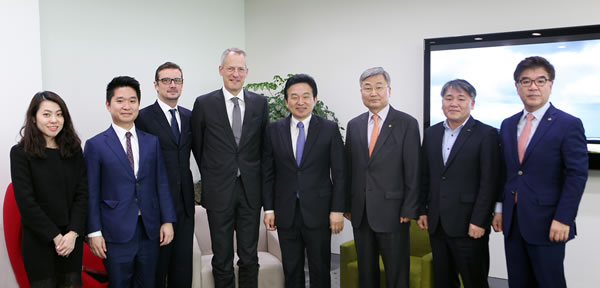
Underlining the importance of the deal, a high-level signing ceremony was held in Jeju this morning featuring the top executives from both retailers (see pictures below) and Governor of Jeju Special Self-governing Province Hee-ryong Won.
Under the agreement, DFS will integrate its global worldwide network and marketing capabilities to encourage tourism to Jeju.
The Hong Kong-based retailer will also supply international luxury merchandise under its long-established retail operational model (see panel for comment) to JTO to establish a new duty free store (on the site of the former Lotte Duty Free store) in Jungmun, southern Jeju, later this year.
As first revealed by The Moodie Report, JTO was awarded a new downtown duty free licence for Jeju Island last July after a competitive tender.
The store, called The Jeju Duty Free, will be located in one of the largest 5-star beachfront and gaming resorts in Jungmun and will feature global brands as well as local offerings for international visitors. Jeju is hugely popular with Chinese visitors, for whom (critically) it offers visa-free status. In 2014 Chinese visitor numbers rose by an extraordinary +57.8%, with the island generating an emphatic 46.66% of total Chinese arrivals to South Korea. 2015 was affected badly by the MERS crisis but Chinese tourism is surging again this year.
There is scope for the partnership to extend to other channels in future, the partners noted.
The Jeju Duty Free will open in its second phase by May this year, with all brands and product offerings in place by the fourth quarter.
JTO and DFS aim for direct, customer-friendly approach Shoppers at The Jeju Duty Free are set to benefit from DFS Group’s traditional operating model – which is very different from that typically used by Korean travel retailers (also see Moodie Analysis below). Rather than mirror (and compete head on with) the vast operations of the Korean travel retailers on Jeju, DFS plans a high-quality approach – more akin to a small luxury department store. DFS is likely to bring to its new Korean partner a niche, qualitative mind-set, one underpinned by its way of doing business. By contrast, under the long-established Korean duty free system, store staff are largely employed by the agents (and charged back to the brands) – not the retailers themselves. That means that if a consumer buys three different cosmetics SKUs (from, say, Lauder, Lancôme and LVMH), they have to make three separate transactions, a time-consuming process hardly conducive to incremental business in a time-constrained environment. In most cases (and certainly with the core beauty category) the retailers buy the brands through the local duty free agent. As an international player, DFS does things differently – just as it did at Incheon International Airport when it ran a key multi-store concession from 2001 to 2008. DFS will supply the international products to JTO, sourcing directly and not through agents. Importantly, that spells no need for multiple transactions, something that both JTO and DFS believe will improve the quality of the offer and of service. One informed observer notes: “If one looks at the retail experience of duty free in Korea – whether you’re Lotte or Shilla, or one of the new SMEs – there is this brand and agent issue, which means that a customer is forced to make different transactions. It’s inefficient and it’s not customer friendly.” If JTO, through partnering with DFS, can successfully implement the latter’s international operating model, it could be transformative from an industry – and, more importantly, from a customer – perspective.
|
JUNGMUN DEVELOPMENT KEY TO JEJU’S TOURISM GROWTH
Jeju Island is a self-governed province and South Korea’s largest island, located south-west of the Korean Peninsula. A leading tourism destination in North Asia (particularly to Chinese travellers), it has been referred to as “The Hawaii of South Korea”, renowned for its dramatic natural beauty and boasting three UNESCO World Heritage Sites as well as offering a wide range of leisure and cultural pursuits.
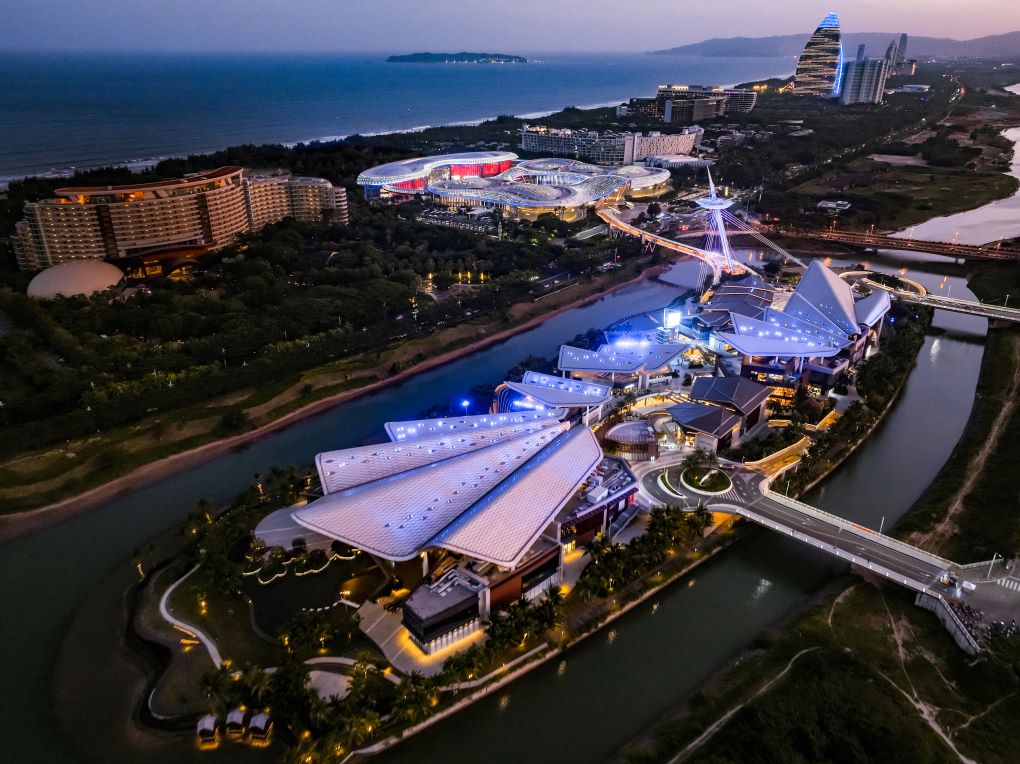
Jungmun, in the south of the island, is a hugely popular holiday destination due to its combination with its beaches, golf courses, high-end resorts and casinos, and an international convention centre.
Jeju Island is forecast to attract four million visitors in 2016 and has recorded an average +44% growth in foreign travellers per year since 2010.
To further support the growth of international tourism, the Jeju Provincial Government, through the efforts of JTO, has begun a programme of strategic development in Jungmun to further attract discerning overseas travellers who are seeking a combination of adventure and excitement but who also value luxury and convenience.
In addition to several new large-scale integrated resorts and casinos, a cruise port is planned for completion in 2017 with an estimated annual handling capacity of one million passengers. This will enable large cruise liners to dock near Jungmun and alleviate the limited capacity at the current port in Jeju City.
Buoyed by a long history of assisting tourism development in destinations such as Okinawa, Bali and Hainan, DFS said it is well-suited for this shared vision.
“As a provincial government entity of Jeju Special Self-Governing Province, we must elevate Jeju’s value as a tourism destination by bringing high-quality duty free shopping services,” said Jeju Governor Hee-ryong Won. “We look forward to positively contributing to the development of Korea’s duty free industry.”
“We highly respect DFS’ dedication to JTO’s vision in developing Jeju as a preferred destination for tourism,” said Kab-Yeol Choi, President of JTO.
“The strategic partnership between JTO and DFS will allow Jungmun to offer the best duty free shopping experience and be of great assistance in attracting more international tourists to Jeju.”
“DFS is honoured to join this project with JTO to bring an elevated retail experience to southern Jeju,” said DFS Group Chairman and CEO Philippe Schaus.
“We greatly admire JTO’s creativity and foresight in developing Jungmun and the surrounding area as an international tourist destination, and we are pleased to be able to contribute to these efforts by providing travellers with a tailored selection of high quality, luxury products from our partner brands around the world.”
MOODIE ANALYSIS So what makes the DFS operating model so different to that embraced by Korean travel retailers? There are several differences but critically DFS deals directly with brand suppliers rather than sourcing through local agents – the traditional Korean way. Essentially Korean retailers act more in a landlord capacity, with sales staff largely employed by the agents (and charged back to the brands). DFS is a retailer through and through and will offer that expertise in Jeju, albeit JTO will be the retailer. So if the staff are employed by agents, what does that mean for shoppers? Probably the key repercussion if that if a consumer buys multiple items, they have to make multiple transactions. It’s a quirky system that is not optimum given the severe time constraints of buying and selling in an airport or downtown duty free environment. That doesn’t sound very customer-friendly. It’s not and there are influential Korean duty free retailers who would like to change it. But it is a long-established modus operandi first introduced (and embraced by the brands) because of some particular traits of the Korean duty free market. How did DFS operate when it ran one of the Incheon concessions for many years? With its traditional, direct operational model – just as it does around the world. That’s what will happen in Jeju. The model is designed to be customer focused and customer friendly. It’s the T Galleria by DFS model. The agents won’t like this much will they? No, that’s probably an understatement, but DFS and JTO are likely to insist on direct supply. What if brands resist and say supply must come through the agents? That could happen. Neither DFS nor JTO will want a running dispute with the agents but it could mean some brand absences from the shelf. So this is a JTO operation buoyed by DFS expertise and buying power? Yes, JTO is the retailer, DFS the operating partner and supplier only. The licence precludes a foreign company’s joint venture investment as such. Since DFS exited Incheon, Korean duty free has been widely perceived as a closed shop to foreign players. Could this augur change? Well you’ve got Dufry at Gimhae International Airport in Busan, albeit through being part of a locally registered small & medium enterprise (SME) but that is a one-off. Remarkably, the last Incheon International Airport duty free bid – and remember it was the world’s biggest airport tender – only attracted one offshore player, King Power International Group of Thailand. Pertinently, given the size of its financial offer and the quality of its bid, the Thai company was bitterly disappointed with the tender results. So, yes, there’s definite scepticism. Notably too, the new SME concessions at Incheon last time around were open to Korean companies only. What about the forthcoming Incheon Airport Terminal 2 duty free tender, which takes place later this year? Refreshingly, Incheon International Airport Corporation (IIAC) has insisted it is encouraging and welcoming international retailers to bid. IIAC Deputy Executive Director, Commercial Marketing Group, Bum-Ho Kim told The Moodie Report last month, “We have had a lot of interest from all of the major operators. We will also be open to international players. They may have been deterred in the past but we welcome them to take part.” That’s commendable and encouraging to hear. But will international players actually bid or do they view Korean duty free as an impossible nut to crack? Good question. Korea’s duty free market is the biggest in the world and features a number of very strong players fiercely defensive of their home turf. Many international retailers see the Korean situation as protectionism and believe international players should not only have a feasible chance of winning tenders (and downtown duty free licences) but also be allowed to invest in local businesses. Incheon needs foreign bidders but they’ll only come if they feel there is a realistic chance of winning. Back to Jeju. Why would JTO have struck such a potentially controversial partnership in Jungmun? They’re a local government organisation whose core mission is to promote the wonders and charms of Jeju. Duty free shopping revenues are key to those efforts. JTO wants the new store to be as successful as possible and believes that by partnering with DFS it can bring an elevated retail experience. Remember, JTO has done a superb job in building tourism to Jeju by putting the consumer first and offering visa-free travel for Chinese – an inspired move that has spurred phenomenal growth in Chinese tourism over recent years. The organisation is deeply mindful of the island’s virtues and culture and will want everything it does commercially to be in line with that philosophy. |