


INTERNATIONAL. The International Air Transport Association (IATA) has reported passenger traffic grew across every region in May 2019 compared to May 2018, contributing to global year-on-year growth of 4.5%.
The latest figures from the association, which measures demand by the number of revenue passenger kilometres (RPK), found that demand grew in line with the revised April traffic growth of 4.4%. This is also above the trough of 3.1% year-on-year growth seen in March, but below the 20-year average growth rate of 5.5%.
Capacity, measured by available seat kilometres (ASK), grew by 2.7%; the result is load factor (PLF) increasing by 1.4 percentage points to 81.5%.
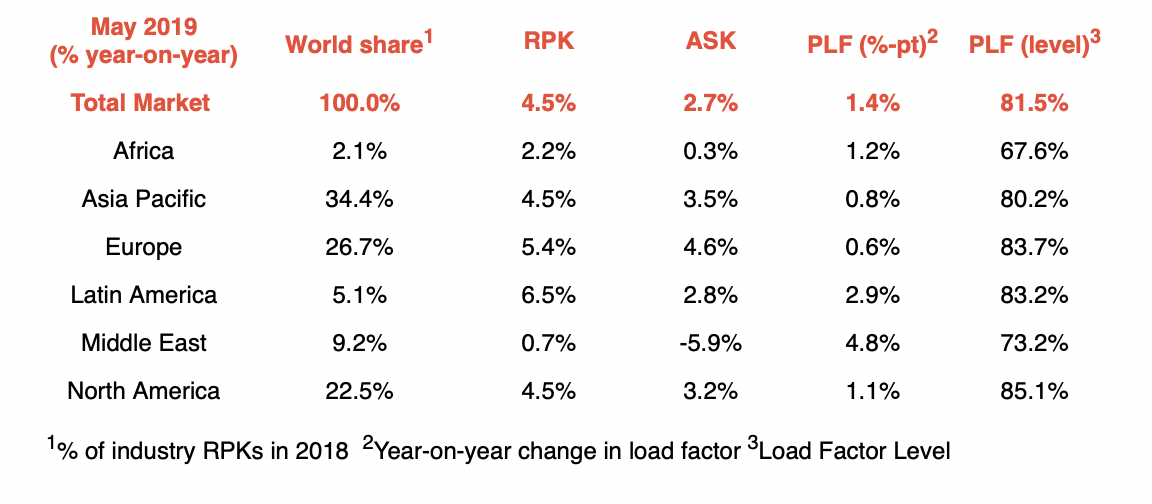
IATA Director General & CEO Alexandre de Juniac said: “Passenger demand growth has slowed compared to the past two years. This is in line with slumping global trade, rising trade tensions and weakening business confidence. In this challenging environment, airlines are managing capacity carefully in order to optimise efficiency.”
European carriers saw a 5.4% increase in demand for the first five months of 2019 compared to the first five months of 2018, Asia Pacific airlines saw growth of 4% for the five-month period, while growth with Middle East carriers slowed to 0.8%, North American airline traffic rose 4.8%, Latin American airline traffic increased 6.7% and African airlines posted a 2.1% increase in traffic for the first five months of 2019 compared to a year earlier.
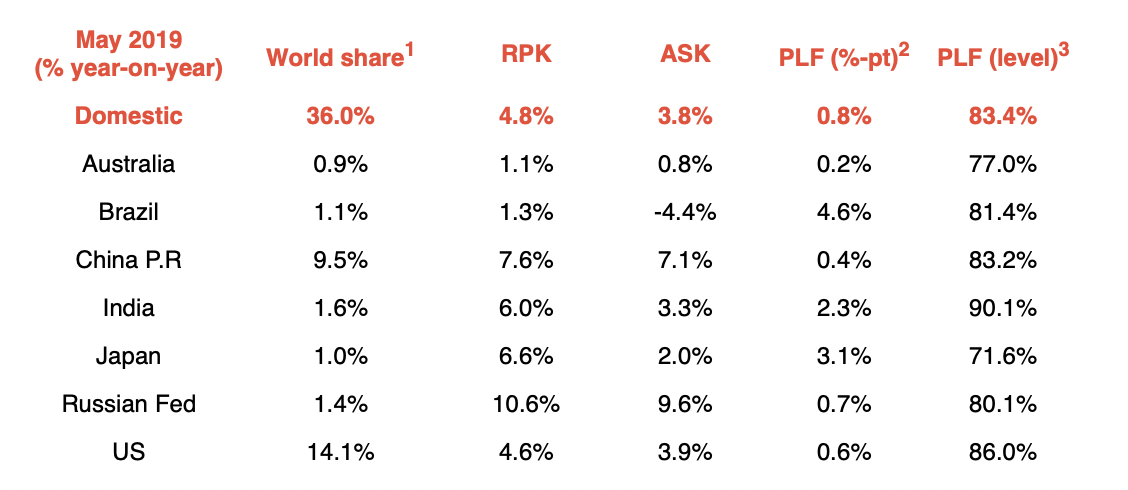
Meanwhile, domestic traffic for May 2019 grew 4.8% compared to May 2018, which is well above the 3% year-on-year rise reported in April. Russian airlines reported a double-digit percentage increase for domestic RPK compared to May 2018.
De Juniac added: “Aviation is the business of freedom, connecting people and trade and creating new opportunities for growth and development. But to be effective, the business of freedom relies on borders that are open to the movement of people and goods—and aircraft.
“In recent weeks, we have seen extensive airspace closures owing to political tensions. These closures have contributed to longer and less efficient routings, higher operating costs and increased carbon emissions. Without any compromise on safety, it is vital that governments work to minimise airspace closures so that the business of freedom can continue to deliver its benefits as efficiently as possible.”