
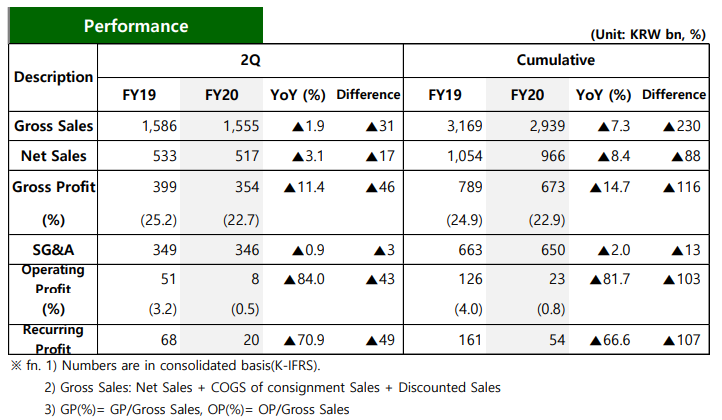
SOUTH KOREA. Hyundai Department Store posted an -84% slump in operating profit for the second quarter to KRW8 billion (US$7 million). Gross sales declined by -1.9% to KRW1,555 billion (US$1.3 billion), writes Min Yong Jung*.
The result underperformed market expectations – consensus OP was KRW28.6 billion (US$24.1 million).
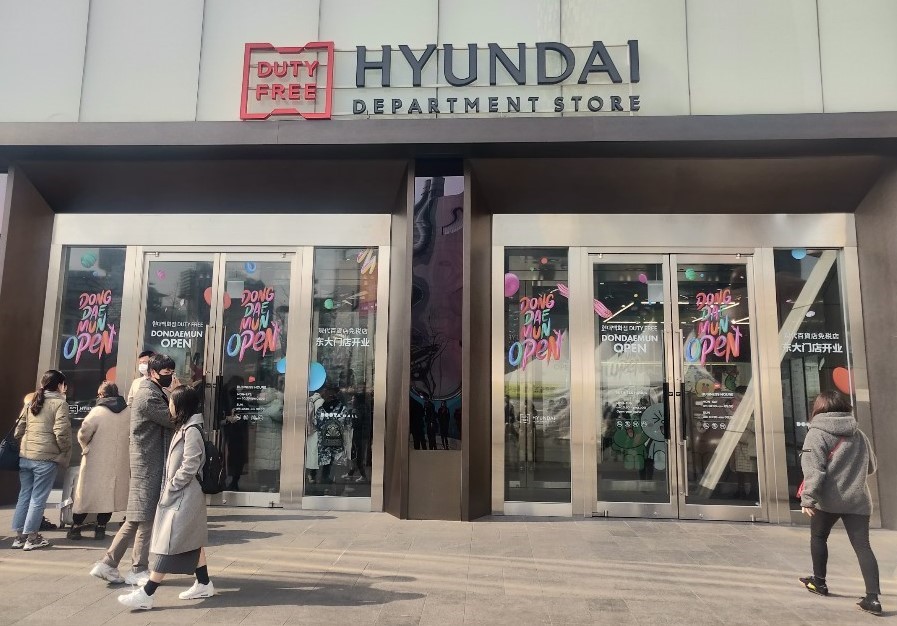
Hyundai Department Store Duty Free posted a +37% increase in sales to KRW117 billion (US$98.7 million) and a slight improvement to OP from KRW -19 billion (-US$ 16 million) in Q2 2019 to -KRW18 billion (-US$15.1 million). Revenues were enhanced by the opening of a second downtown duty free store in Dongdaemun, Seoul and losses eased by heavy cost-cutting measures.
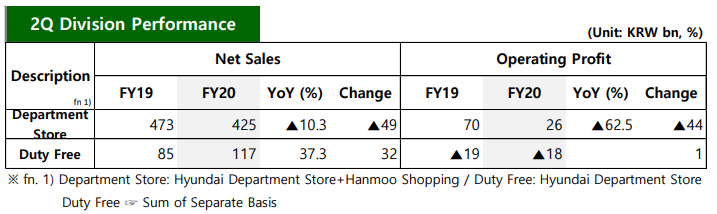
The department store business sales growth and same-store-sales growth deteriorated by -10% and -3% – weaker than peer Shinsegae Department Store whose gross sales and same-store-sales growth dropped by -3% and -2%.
Airport retail laced with uncertainty
What of Hyundai’s much-anticipated debut in the airport retail business? While Incheon International Airport Corporation (IIAC) has outlined its lowered expectations for the new Terminal 1 concession tender – a MAG lowered by -30% compared to the initial tender; a previous 9% maximum MAG discount for passenger traffic decline abolished; and rent payments tied to sales until traffic recovers to 60% of normal – the duty free industry’s response so far has been that the new measures announced by IIAC are not enough.
The fact that the concession payment structure is due to return to a MAG basis after any traffic recovery is a key concern for Korean duty free retailers. The sector has incurred heavy losses as a result of COVID-19, a crisis that resulted in four of the six preferred bidders for the Incheon T1 concession subsequently withdrawing their bids.
For Hyundai Department Store Duty Free the Incheon situation is precarious. While discussions are ongoing with IIAC to change the payment terms of the company’s new DF7 concession (fashion and miscellaneous goods), the retailer’s bargaining power at the table is much lower than rivals Lotte, Shilla and Shinsegae. Unlike its competitors who withdrew their winning bids, Hyundai proceeded with contracting the DF7 concession and is due to take over from existing concessionaire Shinsegae Duty Free in September.
Much may yet happen with the tender landscape at Incheon, however. IIAC says that it has already eased the terms (and risk) of entry and will await the level of participation by duty free retailers. Whatever the final terms, with traffic levels still a fraction of those in 2019 and any recovery hindered by the recent resurgence of the coronavirus, airport retailing promises to be deeply problematic for Hyundai Department Store Duty Free, as it will be for all the company’s rivals.
 *Note: Korean national Min Yong Jung, formerly based in London and now in Seoul, is Senior Retail and Commercial Analyst at The Moodie Davitt Report. His appointment in June 2019 was the first of its kind in travel retail media. It marked the creation of the Moodie Davitt Business Intelligence Unit, a new division designed to provide a previously unseen level of research and analysis for the travel retail channel.
Do you have research needs related to the Korean and Asia Pacific travel retail and luxury markets? Min Yong Jung can be contacted at minyong@moodiedavittreport.com