Incheon International Airport Terminal 2 will record the largest increase in female Chinese Gen Z passenger traffic, according to new analysis from Air4casts, highlighting growing opportunities for airport beauty retailers across Asia.
Air4casts estimates that 17.99 million female Chinese passengers aged 18-29 will depart from airports covered by its comparable terminal data in 2026, up 837,000, or +4.9%, year on year.
Incheon Airport Terminal 2 leads the growth rankings, with an additional 166,000 passengers in the target demographic, taking its total to 355,000.
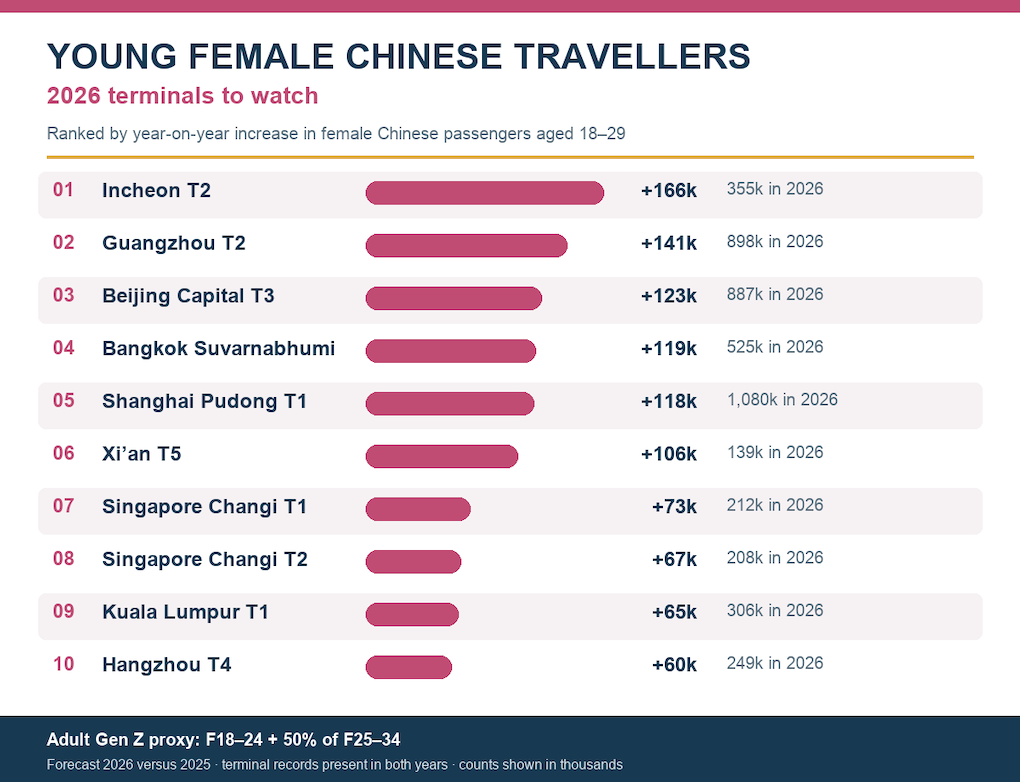
Guangzhou Terminal 2 follows with an increase of 141,000 to 898,000, while Beijing Capital Terminal 3 is expected to serve 887,000, up 123,000.
Bangkok Suvarnabhumi ranks fourth, adding 119,000 passengers to reach 525,000, followed by Shanghai Pudong Terminal 1, where traffic is forecast to increase by 118,000 to 1.08 million.
Other terminals recording significant growth include Xi’an Terminal 5, Singapore Changi terminals 1 and 2, Kuala Lumpur Terminal 1 and Hangzhou Terminal 4.
Duty-free operators positioned for growth
The findings highlight opportunities for duty-free operators and beauty brands seeking to capitalise on increasing Chinese outbound passenger traffic.
China Duty Free Group has the broadest exposure through its mainland Chinese airport network, while Shilla is positioned across Singapore, Macau and selected South Korean terminals, Air4casts noted.
Avolta has a presence in Shanghai Pudong Terminal 1, while King Power Thailand benefits from its operations at Bangkok and Thailand’s resort airports.
Lotte Group and Hyundai are particularly well positioned to capture growth in Incheon Terminal 2, according to the research company.
Air4casts said passenger growth alone would not necessarily translate into increased retail sales, with younger Chinese consumers increasingly focused on pricing, product availability and value.
“Beauty remains one of the strongest reasons for Chinese passengers to enter an airport store, but traffic alone no longer guarantees conversion,” the research company commented. “Younger shoppers arrive with extensive product knowledge, compare airport prices with ecommerce and expect the brands and products they have already researched to be available.
“The opportunity therefore sits at the intersection of passenger growth, the right assortment and a credible value proposition. Our terminal analysis shows where those passenger numbers are increasing and which retailers have the airside access to act on that growth.”
Supporting research
Air4casts cited separate research from China Trading Desk which found that 62.1% of Chinese outbound travellers were likely to buy beauty products in the second quarter of 2026, while 66.5% expected to shop at airports before departure.
The survey also found that 68.3% were likely to make an airport purchase after seeing a product promoted on social media.
McKinsey’s 2025 China beauty research found 60% of consumers had increased skincare spending over the previous year, while 50% had spent more on colour cosmetics.
Air4casts said its analysis could help retailers and brands target inventory, product ranges, marketing and promotional investment at terminals experiencing the strongest demographic growth.
The rankings combine passenger nationality, age and gender estimates with Air4casts’ airport concession database to identify terminals with both growing passenger numbers and established airside beauty retail operations.
The analysis covers terminals with comparable 2025 and 2026 data, at least 10,000 passengers in the target demographic and a mapped airside beauty concession.
Air4casts stressed that the figures represent potential retail exposure rather than actual beauty purchases, conversion rates or sales forecasts. ✈