

“Post-COVID-19, a new travel retail world will be drawn,” says L’Occitane Group Managing Director Travel Retail, Export, B2B & Spa Worldwide Aline Valantin as she outlines the French wellness brand’s CSR-driven approach to navigating the COVID-19 crisis.
“Buying behaviours have not changed permanently but the crisis has acted like a catalyst to consolidate the online shopping navigation at least before purchase.”
As the landscape continues to shift, Valantin spent the last few crucial months planning for how L’Occitane can adapt and do more not just a business but as a force for good in the world.
L’Occitane Group remarkably donated 1,000,000 products to support worldwide COVID-19 relief efforts at the peak of the crisis. It also supported its producers with pre-financing programmes and donated hand care products to frontline workers.
In addition, the company is transitioning to sustainable packaging and also sponsored an epic ocean odyssey to end plastic waste. “It definitely made all L’Occitane employees proud to work in a company that is living up to its values and standing up for the community.”
In this interview, Valantin expounds on the group’s CSR-driven COVID-19 recovery strategy and urges the travel retail industry to foster meaningful, mutually-supportive partnerships. She also discusses the opportunities offered by digital, omnichannel and social-selling particularly in Asia Pacific.
Finally, she previews what industry partners can expect at L’Occitane Group’s #Virtual Stand BT-G7 at the upcoming Moodie Davitt Virtual Expo, where it is a Gold Partner. Commenting on the Expo, she says: “Inspire and get inspired that’s what it’s all about. This is also time for our industry to come together and stand shoulder to shoulder to face this crisis.”

What is the major focus for L’Occitane at the Virtual Travel Retail Expo?
The Virtual Travel Retail Expo offers an innovative format, which will allow creating a get together event despite the COVID-19 constraints. Inspire and get inspired that’s what it’s all about. This is also time for our industry to come together and stand shoulder to shoulder to face this crisis.
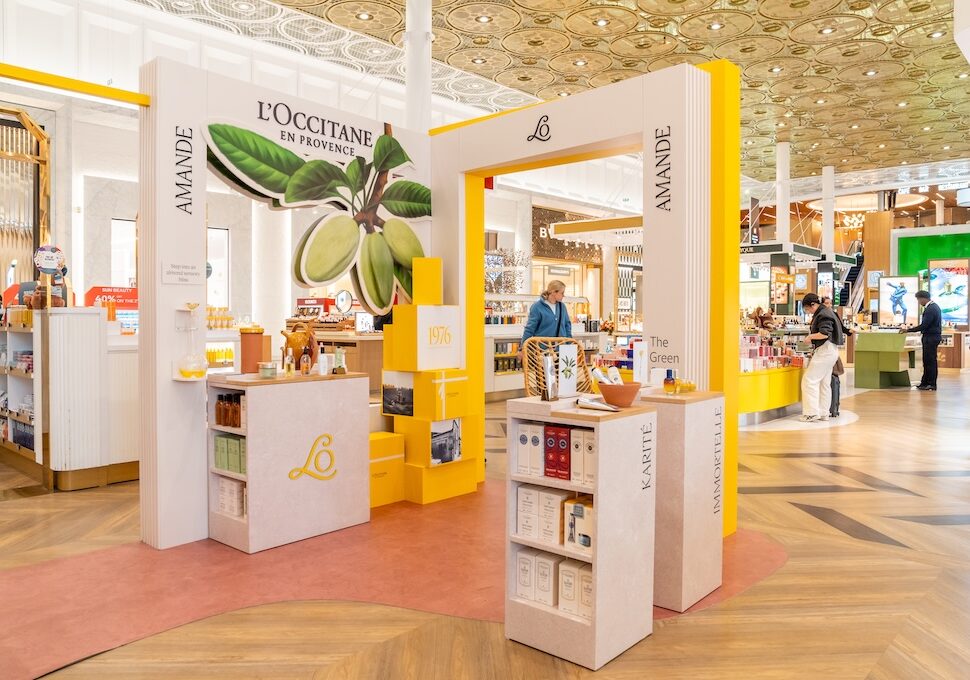
The event will allow us to highlight our brands strategy & key innovations through an immersive 3D installation. We will share L’Occitane Reset & Fly strategy to be implemented in the post-Covid travel retail environment. It comprises of a full 360° approach including an architectural concept, offer and experience.
For each of our brands, it’s all about our USP to travellers, best sellers, sense of place and gifting offer. We will be presenting our core segments and relaunching the Immortelle range to accelerate our Face Care Business & highlight our best-sellers from our healthy hands programme.
We are thrilled to also present our natural beauty brands, which are expanding worldwide with spectacular growth despite the crisis:
- Elemis: UK award-winning luxury skincare brand sourced from nature and led by science
- Erborian: effortless & powerful beauty game-changers drawn from Korean beauty expertise
- Melvita: best-in-class clean beauty & organic brand born from floral waters and vegetal oils

What are your major targets by geography, channel or retailer type as you seek to tap into a recovering market?
Geographically, L’Occitane is a very well balanced international skincare brand. Would you have asked me the same question before COVID-19, the objective would have been to reflect our domestic market shares.
Post-COVID-19, a new travel retail world will be drawn; buying behaviours have not changed permanently but the crisis has acted like a catalyst to consolidate the online shopping navigation at least before purchase.
To manage social distancing, consumers are using digital to connect, entertain and shop. We saw a surge in livestreaming by retailers and social e-commerce. These innovative ways to shop have helped bolster sales for both international brands and local businesses.
Thus, we need to step-up our game. How are we going to create value in travel retail in the next three years? How can we include the travel experience within our domestic omnichannel strategy?
Our goal at L’Occitane is to be present in 90 countries with more than 3,400 retail stores with a direct access to our clients. We are obsessed with offering them the best possible customer experience wherever they are.
So, to answer your question: We are shifting from strict opportunistic in-store selling to an omnichannel and CRM approach. The omnichannel transition is a perfect opportunity for the trinity to better share information & data to constantly adapt and stay relevant to travellers at any circumstance (on top of creating additional business opportunities).


In the early months of the pandemic crisis, L’Occitane stepped up and donated 1,000,000 products around the world. What it was like reaching this CSR milestone?
As a pioneer in corporate sustainability, L’Occitane naturally stood with the global community from day one to help limit the spread of the virus and support healthcare workers.
We started this initiative as early as February in China. Our international subsidiaries have made numerous donations across more than 30 countries around the world:
- 300,000 bottles containing 77,0000 litres of hand-sanitisers for health authorities facing shortages in Europe
- 765,000 soaps and moisturising products for healthcare workers suffering from skin lesions due to prolonged use of protective clothing.
- Our Spa, travel retail and B2B business donated more than 200,000 moisturising products to hospitals and care homes ‘EHPAD’ in France, 3,000 Shea Butter Hand Creams to a medical centre in Seoul and more than 10 000 spa treatment products to staff of the Paris University Hospital Trust (Assistance Publique – Hôpitaux de Paris, AP–HP).
It definitely made all L’Occitane employees proud to work in a company living up to its values and standing up for the community.

What were the biggest challenges you had to overcome to achieve it?
The main challenges were the shortages of raw materials, distribution difficulties due to COVID-19 related restrictions and the emergency approval of sanitiser formula
The manufacturing of large quantities of hand sanitiser and donating 1,000,000 care products was only possible thanks to the collaboration within local ecosystems. Local distilleries provided tens of thousands of litres of alcohol. Our partners/suppliers made warehouse space available, provided delivery services and empty anti-static containers in record-time. There is a massive number of companies involved in this initiative.
During this time, L’Occitane also implemented various financial cushions to support partners and suppliers across the value chain. Could you tell us more about your ongoing commitment to supporting your stakeholders through the crisis?
During this crisis, L’Occitane stood by its suppliers and partners, building on our resilient business model. We donated hand hygiene products to those facing shortages, especially to those who had helped the Group produce hand sanitisers.
We are also in direct contact with our raw materials producers. In the face of the crisis, our multiyear, quantity contracts and pre-financing, from 50% to 80% of cost before harvest, were more valuable to our producers than ever. This gave them the security to sell their stocks and secure their revenues.
For example, Burkina Faso put strict measures in place, which disrupted the end of the shea harvest. The Group pushed some of its delivery to autumn, while making 80% advanced payments to maintain producers’ cash flow. Furthermore, one of our financial partners in the RESIST programme offered €50,000 to help protect these workers from COVID-19.
In the South of France, our employees volunteered to help producers with the orange blossom harvest, as producers had a hard time finding pickers due to COVID-19.


L’Occitane recently launched an online consultation service via Zoom. Do you see this service translating into your travel retail division as well? In what other ways are you embracing digital mediums in your communications?
We combined digital with retail expertise to engage more with our loyal customers and to recruit new L’Occitane fans, especially in the era of COVID-19. This brilliant online project went live at the beginning of August with our UK affiliate. They had great results with only six beauty advisors, and we integrated in the project moving forward.
With consumers spending less time shopping in airports following COVID-19, digital can help us to explore untapped opportunities.
Initiatives are already in-place within this evolving digital environment and L’Occitane is already part of this journey in travel retail. We’ve launched more than ten social-selling projects so far (mainly live streaming in APAC) and more than ten upcoming, including test and learn projects in EMEA & Americas.
We are also working in close partnership with retailers to increase our presence on online and on social media. We are ready to listen to opportunities on innovative digital projects.
L’Occitane recently launched a Lavender Hand Sanitiser made with 69% alcohol. Do you see your product assortment shifting to include more hygiene products given the current climate?
The Clean Hands Gel met a pressing need because of the COVID-19 pandemic and was therefore a great success with our customers. It is effective as it contains 69% alcohol. It is also made with 96% naturally sourced, composed of 100% vegan ingredients and is subtly fragranced.
COVID-19 has shed new light on the importance of hygiene and self-care, and so our body and hand care segments saw increase in sales mix.
In early May, we launched an agile 360° Healthy Hands collection which we presented to worldwide travel retail in anticipation of the re-opening of our stores. It included our hydroalcoholic gels, our Art of Soap set and a travel retail-exclusive set.
We also designed new merchandising for post-Covid consumers who would like to discover L’Occitane iconic products with reduced contact and without testers. All of these developments will be presented during the Virtual Expo.

Since 2008, L’Occitane has protected 150 different varieties of plants with the aim of contributing to the protection of 1,000 plant species by 2025. How close are you to achieving this goal?
The Food and Agriculture Organisation of the United Nations (FAO) has estimated that 75% of crop diversity was already lost between 1900 and 2000.
We set out specific actions to develop regenerative and organic agricultural practices through long-lasting partnerships with our producers and via our engagement in the One Planet Business for Biodiversity coalition.
Our concrete achievements include protecting 950 plant varieties, planting 24,000 trees, planting 6,000 almond trees, and setting up 1,000 beehives through the Melvita brand.
As you can see, we are already very close of this goal with 950 varieties protected today, and we are now thinking about a new, more ambitious objective for 2025.

It has been almost one year since your appointment. While it has been a challenging trading period, what have been your most significant achievements in this role so far?
A challenging trading period it was… in just a year, I’ve entered a completely new environment.
Luckily, I am supported by a great team of positive, smart and pragmatic people who are eager to integrate new and agile ways of working and a supportive Board eager to experiment even in times of crisis.
Over the last year, we had a complete reorganisation from a purely hierarchical company to autonomous and multidisciplinary teams – we call them squad – with one single obsession: to create value for our customer’s with an omnichannel approach across our domestic retail stores, ecommerce, hotels, spas and of course travel retail.
We are also reviewing our product offer to adapt to the green transformation of our hotel partners and end consumers. In the last year, the L’Occitane Spa team has worked to fully integrate our wellness offering. The export market team also updated our local websites in 40 countries and is preparing a social-selling strategy to help us navigate through the COVID-19 crisis.
In terms of HR, I helped introduce an inclusive global parental leave policy to support families of all shapes and sizes. This new policy gives primary caregivers a minimum of 20 weeks’ fully paid leave and secondary caregivers a minimum of 12 weeks’ fully paid leave.
This new policy seeks to empower all employees and their families. It directly promotes health and well-being through equal opportunities in the workplace and fairer gender relations within the family.
While travel retail has slowed down, we are rethinking our approach to deliver a strong sense of place and a dedicated traveller offer.

How would you like to see industry partnerships evolve as we enter a new era for travel and travel retail?
This context offers a chance to reset and emerge with business models that are mutually supportive, collaborative and financially viable.
The crisis showed us the necessity of having flexible commercial agreements, which rewards performance when business is up and permits to share the risks when business collapses like today.
I believe that post-Covid partnerships should better reflect the reality of the market and the traffic.
Why not focus on clear retail KPIs such as conversion rate, ATV to build future partnerships?