


TÜRKİYE. In March this year, TAV Airports division TAV Operation Services (TAV OS) formally launched Treva, a next-generation digital platform that brings multiple airport services together.
What sets the solution apart, TAV OS said upon launch, is that it creates a single ecosystem spanning lounge access, fast-track security, food & beverage, duty-free shopping, private transfers, car rental and parking, alongside real-time flight information, terminal navigation and wifi.
This is supported by the group-wide expertise in both airport operations and and commercial activities, which gives TAV OS a comprehensive understanding of the entire airport ecosystem. It also supports a strong ambition for TAV OS to become known as the leading airport hospitality partner, on that can support airports in developing and implementing their own hospitality strategies.
By enabling travellers to complete their shopping and orders pre-trip, Treva marks a major advance towards creating the seamless airport journey. It also allows for collaborations across mobility, retail, financial services and digital solutions.
Importantly too, the platform extends beyond individual airport ecosystems, offering access to lounges at more than 300 travel hubs worldwide and car rental services across 160 countries.

Treva was initially rolled out at TAV Airports locations such as İzmir Adnan Menderes, Milas-Bodrum and Ankara Esenboğa airports, with expansion later to Almaty and Tbilisi airports.
The approach aims to reposition the airport journey as a connected, experience-led ecosystem rather than a series of fragmented touchpoints.
In this interview, TAV OS Chief Marketing & Digital Officer & TAV Airports Marketing and E-commerce Director Aylin Alpay explains the thinking behind the platform’s creation and how it can become much more than a marketplace but a tool to manage the end-to-end airport experience.
The Moodie Davitt Report: Tell us about the thinking that led to the creation of Treva at TAV OS? What needs does it solve?
Aylin Alpay: The idea behind Treva started with a very simple observation: the traveller sees one journey, while the industry still often operates through separate services and touchpoints.
Think about the airport experience today. A passenger may use one channel for flight information, another for parking, another for Fast Track or lounge access, and different platforms again for shopping, dining or ground transportation. From the passenger’s perspective, however, these are not separate categories. They are all part of the same journey.
This fragmentation creates uncertainty and decision fatigue in an already time-sensitive environment. It also makes services harder to discover and can result in missed commercial opportunities for airports and their partners.
Treva was created to close that gap. It brings together a broad range of airport and travel services-from lounge access, Fast Track, Meet & Greet to parking, transfers, duty free, food & beverage pre-order and car rental – alongside free utilities such as live flight tracking, terminal navigation, wifi access and practical airport information.
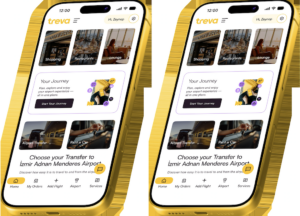
For passengers, this means greater control: they can plan ahead, book and pay for services, and navigate the airport more confidently. For airports and partners, Treva provides a measurable digital distribution channel that improves service visibility and captures demand earlier.
Ultimately, Treva is about connecting what the passenger already experiences as one journey – bringing physical and digital touchpoints together in a way that is simpler for travellers and creates more value across the airport ecosystem.
How does Treva function as a digital travel assistant, and how does it respond to the way modern consumers travel and engage with services?
Airports are one of the most context-sensitive environments in travel. What a passenger needs can change completely depending on their flight, terminal, journey stage or simply how much time they have.
That is how we think about Treva as a digital travel assistant. Rather than presenting passengers with a static catalogue of services, the aim is to help them discover what is relevant at the right moment – whether that means checking a flight, navigating the terminal, booking Fast Track, reserving a lounge or arranging transportation.
Treva brings these different needs into one passenger-facing environment. Its role is not to own every service, but to connect the capabilities of airports and their partners in a more coherent way.

Its API-first architecture allows existing service information, availability, booking and payment capabilities to connect without requiring airports or partners to replace their existing technology. This means the ecosystem can grow progressively as new partners, services and locations are added.
For me, this is what makes Treva more than just another airport app: commercial engagement follows a genuine travel need, rather than starting with a sales message.
How do you encourage Treva’s use among consumers? In what ways is it more than a loyalty app?
The real question for any travel platform today is very simple: why would a traveller download another app? It has to earn its place by being genuinely useful from the very first interaction.
That is why Treva combines practical, frequently used functions such as flight information, terminal navigation and wifi access with services that can directly improve the journey. We then support adoption through pre-travel communications, airport touchpoints, partner channels and targeted campaigns that give passengers a clear reason to engage.


But we do not see Treva primarily as a loyalty app. Traditional loyalty programmes often begin with the transaction – earn, redeem, repeat. Treva begins earlier, with the journey itself: helping travellers discover what they need, make decisions, complete a purchase and manage practical travel needs in real time.
For us, loyalty is an outcome of relevance and usefulness, not the starting point. The more value we can create throughout the journey, the stronger the reason for travellers to return to the platform.
How do you encourage its adoption across your partner airport network? Are there any obstacles to this?
In aviation, the biggest barrier to digital transformation is rarely the technology itself. The real challenge is bringing different stakeholders, systems and commercial interests around the same passenger journey.
That is why our approach with Treva starts with shared value. We do not go into an airport saying, ‘replace what you already have’. We start by identifying where the passenger journey is fragmented, which services would benefit most from better visibility or easier access, and how Treva can connect into the existing ecosystem.
Every airport is different. Passenger profiles, service portfolios, concession structures and levels of digital maturity vary significantly, so the model has to be flexible. We work with local teams and service partners to prioritise the right use cases, connect the necessary services and make sure the operational model works on the ground.

Of course, there are obstacles: legacy technology, fragmented data ownership, different commercial agreements and, sometimes, understandable concerns about introducing another customer-facing channel into an already complex environment.
This is where Treva’s modular, API-first architecture becomes important. It allows partners to retain their existing systems and connect progressively, reducing both disruption and implementation risk.
But ultimately, successful adoption is not just about integration. It is about alignment – making sure every participant can clearly see the value of being part of the ecosystem.
How does Treva cross into areas such as retail, F&B, mobility and more without disrupting existing commercial agreements in these areas?
 Our goal is not to replace the existing airport ecosystem; it is to make it work better together. Retailers, food & beverage operators, mobility companies and hospitality providers all have their own expertise, operating models and commercial relationships.
Treva respects that. What it adds is a digital layer that makes those services easier for travellers to discover, access and use as part of one journey.
The integration can therefore be different in each category. In some cases, Treva may support discovery only; in others, it can enable booking, pre-ordering, payment or fulfilment. The model adapts to the airport and the partner rather than forcing every service into the same structure.
Our F&B implementation with BTA our established partners (also part of TAV Airports) is a good example.
Restaurants continue to manage their own operations, menus and pricing, while Treva provides an additional digital channel that makes their offers easier to discover and access, including through browsing, pre-ordering and outlet discovery.
The most important point is that we see much of this opportunity as incremental. If a traveller does not know a service exists, cannot find it easily, has limited time or wants to avoid a queue, that transaction may never happen.
So the objective is not simply to move demand from one channel to another. It is to unlock demand that might otherwise be lost.
For TAV OS, that is how we start to break down silos in the airport environment: not by removing existing structures, but by connecting them in a way that creates more value for the traveller and for every partner involved.
How does Treva help the wider industry ecosystem make progress in engaging and satisfying the needs of today’s traveller audience?
For years, our industry has focused on digitising individual touchpoints. The next opportunity is to connect and orchestrate the journey between them. Treva creates a digital connective layer that enables the industry to orchestrate seamless, personalised journeys rather than manage isolated service categories.
The traveller sees one journey, not a series of separate operators. So the real challenge for the industry is to make those different parts work together in a more intuitive way.
A connected platform supports three priorities. The first is access: services need to be easy to discover and use. The second is relevance: passengers should see options that reflect their flight, terminal, and journey stage and available time. The third is continuity: the experience should not feel as though it starts again every time the passenger moves from one provider to another.
There is also an important intelligence dimension. A connected platform can help us understand how passengers discover services, which combinations they use, where demand peaks and where friction exists in the journey.
Used responsibly and within strong data-governance principles, these insights can support more relevant communication, better capacity planning and stronger commercial decisions across the ecosystem.
Over time, this allows us to move from simply understanding what a passenger has already done to anticipating what may be useful next. That is where the real opportunity lies: not just digitising services but making the entire journey work more intelligently.

What are the long-term ambitions for Treva and what can become within the industry landscape?
Our long-term ambition is for Treva to become a trusted digital companion across the airport journey and, progressively, beyond it.
For us, the super-app ambition is not about placing as many services as possible into one interface. It is about creating one consistent relationship with the traveller, while allowing the experience to adapt to each airport, each journey and each moment.
A passenger should be able to use a familiar digital environment across different airports, while the services, content and recommendations remain locally relevant. Global familiarity with local relevance is an important part of that vision.
Over time, Treva can connect more deeply with airports, merchants, mobility providers, payment partners and loyalty programmes, enabling a more intelligent and personalised journey from before arrival at the airport through to the destination.
And ultimately, the biggest opportunity is this: passengers should not need to understand how complex the airport ecosystem is behind the scenes. They should simply feel that the journey works. ✈