

In this column, we bring you regular passenger traffic news bulletins from airports around the world, as the travel industry’s recovery continues apace. Check back on this page for all the latest updates.
27 July
EUROPE. First-half passenger traffic figures from ACI Europe underline the strong recovery at regional airports. Passenger numbers across the European airport network leapt by +247% year-on-year from January to June, or an additional 660 million.
The increase was predominantly driven by international traffic (+381.2%) rather than domestic traffic (+88.5%). It was also concentrated in the second quarter (+245.9%) – following the easing in March of the Omicron-related restrictions for travel within Europe as well as for an increasing number of external markets.
Airports in the EU+ market saw by far the biggest jump in passenger traffic in H1 at +348.9%, resulting in their passenger volumes increasing to 635 million from 140 million compared to last year. Within the bloc, airports in Ireland (+1125%), the UK (+833%), Slovakia (+842.2%), Hungary (+784.8%) and Denmark (+611.8%) all experienced extraordinary increases.

Meanwhile, there was more moderate growth in passenger traffic at airports across the rest of Europe (+58.3%).
ACI Europe said: “This reflected the fact that those markets had generally been subjected to less stringent restrictions both locally and for travel throughout the pandemic and had started recovering earlier compared to the EU+ market. This was notably the case for airports in Turkey (+96.3%) but also in smaller markets such as Armenia (+75.6%) and Kazakhstan (+11.5%) – with airports in Israel (+328.9%) being the exception and following a dynamic similar to the EU+ airports.”
The performance of the non-EU+ market also reflects the impact of the war on Ukrainian airports – with international sanctions weighing on airports in Russia (-3.6%) and Belarus (-16.7%).
ACI Europe Director General Olivier Jankovec said: “These numbers speak for themselves. If COVID-19 caused an unprecedented collapse in passenger traffic for Europe’s airports, the rebound we have experienced this Spring – especially in the EU+ market – is equally extraordinary. The fact that volumes across the continent still remained -28.3% below pre-pandemic levels for the first half of the year should not eclipse the sheer and unprecedented unleashing of pent-up demand that has occurred since March.”
Encouragingly, June traffic closed -17.4% against June 2019 levels. This was the strongest monthly performance since February 2020.
In a reversal of the situation that prevailed throughout the pandemic the EU+ market (-16.6%) outperformed the rest of Europe (-21.7%) in June when compared to pre-pandemic (2019) levels.
The recovery continues to be driven by leisure & VFR (visiting friends & relatives) demand, as evidenced from the results achieved by airports in countries heavily relying on tourism.
Airports in Greece (+1.8%) and Luxembourg (flat) were the only ones having fully recovered their pre-pandemic (2019) passenger traffic volumes in June. Airports in Portugal (-2.9%) came close to a full recovery, followed by those in Lithuania (-7.5%) and Norway (-9.9%).
Against this, airports in Slovenia (-45.7%), Finland (-36.8%), Bulgaria (-34.1%), Czechia (-33.3%) and Latvia (-28%) struggled to recover, notably due to the impact of the war in Ukraine and related international sanctions on Russia.
Among the largest EU+ markets, airports in Spain (-10.8%) and Italy (-12.7%) posted the best results, followed by airports in France (-17.6%), the UK (-19.2%) and Germany (-27%).
In the rest of Europe, the best results in June came from airports in the smaller markets of Albania (+59.3%), Bosnia-Herzegovina (+29.9%), Kosovo (+24.8%), Armenia (+16.7%) and Kazakhstan (+13.1%), which far exceeded their pre-pandemic (2019) levels.
Airports in North Macedonia (-5%) and Serbia (-8.7%) came close to full recovery, followed by those in Turkey (-12.4%). Airports in Ukraine have lost all passenger traffic (-100%), with international sanctions impacting the performance of airports in Russia (-27%) and Belarus (-62.1%), as well as those in Montenegro (-60.9%), Georgia (-32.5%) and Moldova (-28.6%).
The Top 5 European airports posted June traffic down by -17% on June 2019. This reflected continued travel restrictions in selected Asian markets – in particular in China, said ACI Europe.
Istanbul traffic was down by just -1.7% versus 2019, with London Heathrow second in absolute terms and -17.3% on 2019. Then came Paris-CDG (-21.2% vs. 2019) and Amsterdam-Schiphol (-19.5% vs. 2019).
There was a mixed picture among other large and hub airports. Palma de Mallorca (-3.6%), Lisbon (-6.6%) and Athens (-6.8%) were close to fully recovering their pre-pandemic (2019) traffic levels.
Paris Orly (-10.4%) benefited from its domestic and intra-European focus, while the reliance of Dublin (-11.7%) on the transatlantic market also boosted its results.
Conversely, Brussels (-28.2%) was hit by industrial action, and in Helsinki (-36.8%) the exposure to the Asian market with routings that used to involve overflying Russia limited its recovery.
26 July
ASIA PACIFIC. The Association of Asia Pacific Airlines (AAPA) has released its preliminary June traffic figures. They show robust growth in international air passenger demand, as the increasing willingness to fly in the Asia Pacific region continues to drive a recovery in both leisure and corporate travel.
The number of international passengers served increased more than sixfold year-on-year to a combined 9 million in June, against a very low base from 2021. It brought demand to 28.3% of the corresponding pre-pandemic month in 2019.

As measured in revenue passenger kilometres (RPK), demand rose by a robust +509.3%, significantly outpacing the +139.5% expansion in available seat capacity. As a result, the average international passenger load factor jumped by +46.7 percentage points to reach a new pandemic era high of 76.9%.
AAPA Director General Subhas Menon, said: “The region’s airlines are resuming flights to more destinations, as economies reopen for business and international travel. This is a welcome change that was a long time coming.”
23 July
JORDAN. Queen Alia International Airport operator AIG has reported that Jordan’s largest travel hub served 3,248,467 passengers during the first half of 2022. The figure is -21.7% lower than the same period in pre-pandemic 2019.
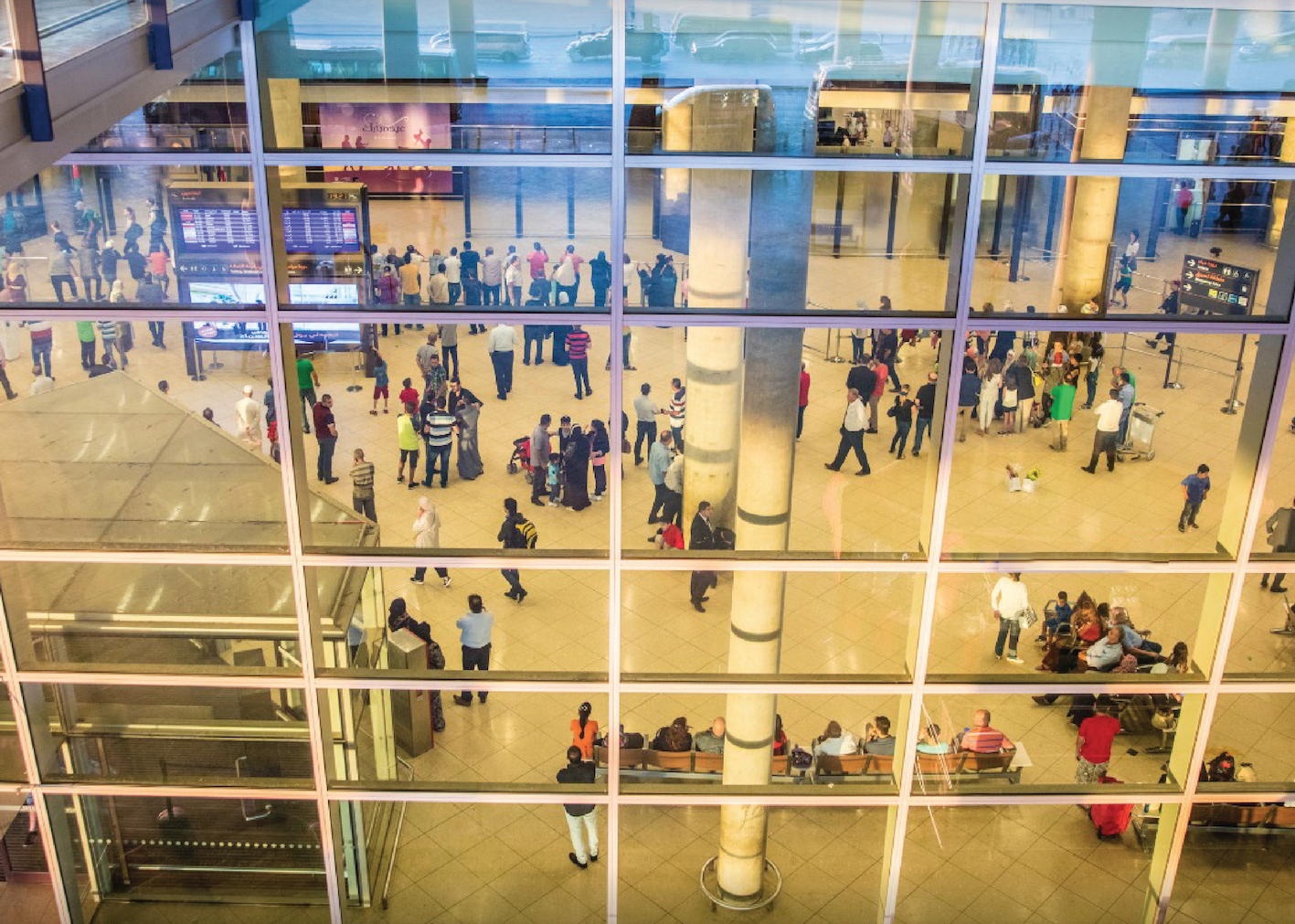
The number of passengers welcomed in June totalled 711,983. This represented a smaller decrease of -14.9% against the same month of 2019, as recovery momentum gathered pace at the Middle East airport.
21 July
SWEDEN. Swedavia, the operator of ten Swedish airports, has reported that it served 7.7 million passengers in the April-June period. The number represents nearly five times as many as that recorded during Q2 last year.
The Q2 result is 70% of the passenger volume processed during the second quarter of pre-pandemic 2019.
Swedavia’s portfolio includes Stockholm Arlanda, Malmö and Gothenburg Landvetter airports.
15 July
AUSTRIA. Flughafen Wien Group served 3,067,003 passengers in June across its three airports – Vienna, Malta and Kosice. Vienna Airport accounted for 2,400,515 of that number, about three times higher than in the prior-year month of June 2021.
Total Group passenger volume in June 2022 stood at 81.4% of the pre-crisis level, whereas Vienna Airport handled 80.4% of the passengers recorded in June 2019.
Malta Airport reported a rise in passenger volume in June 2022 to 603,532 travellers (+216.8% against June 2021), amounting to 83.6% of the pre-crisis level of June 2019.
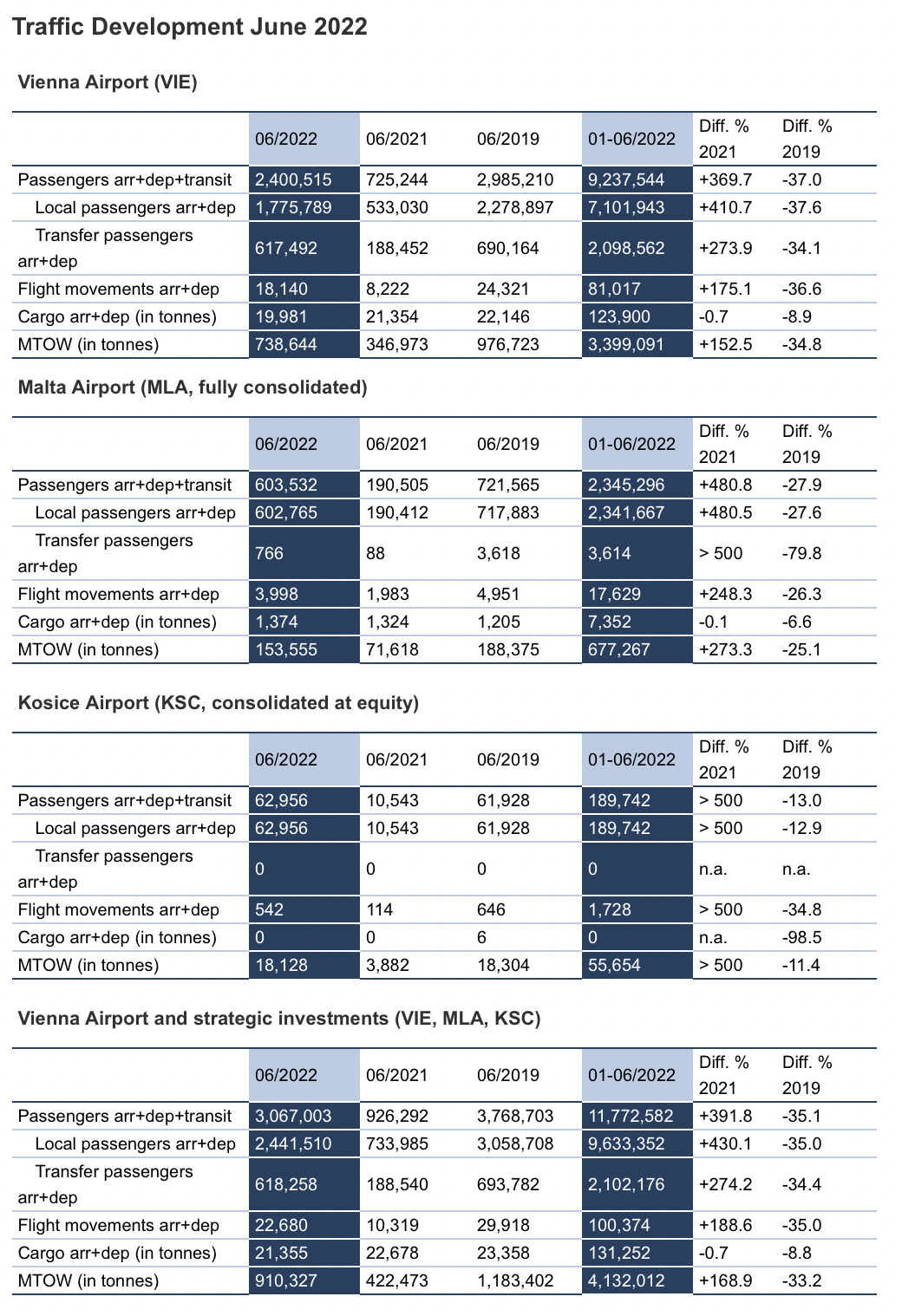
Kosice Airport recorded handling 62,956 passengers during the month (+497.1% vs. June 2021).
CHINA (HONG KONG). Airport Authority Hong Kong has reported that Hong Kong International Airport (HKIA) served 295,000 passengers in June. This represents a surge of +254.1% over June 2021, albeit against a very low base and still at a fraction of pre-pandemic levels.

Following the relaxation of inbound travel and transfer/transit measures, all passenger segments – including Hong Kong residents, visitors and transfer/transit passengers – experienced significant year-on-year growth in June compared to the same month last year. Passenger traffic to and from Southeast Asia saw the largest increase.
Over the first six months of the year, HKIA handled 842,000 passengers, an increase of +121.7% compared to the same period last year.
On a 12-month rolling basis, the airport handled 1.81 million passengers, marking +99.1% year-on-year growth.
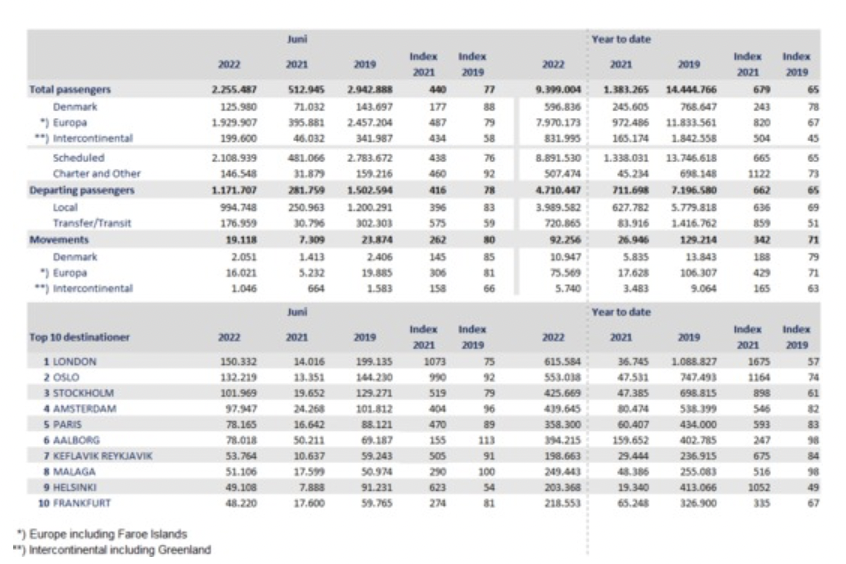
DENMARK. Copenhagen Airport saw 2.2 million passengers pass through its terminals in June. The 2,255,487 passengers served during the month is the highest monthly figure since the COVID-19 pandemic hit. Sunday 19 June was the busiest day of the year so far at the airport with 86,922 passengers.
Greece was the leading charter destination in June, with 41,070 passengers. This represents an increase of +16.6% compared to 2019 when the corresponding figure was 35,224 travellers.